Some Notes Made on Evacuation Day 2011
by Jen Paton
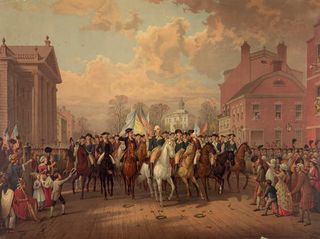
One hundred years from this moment, crowds in this same city would stand on the streets, in the rain, under “stars and stripes from every Flag-pole,” to commemorate this day, and to commemorate it for the last time on such a scale: “every tower, every steeple, every rooftop which commanded” river views would be “peopled with human beings,” and thousands would brave torrential rain to catch a glimpse of the festivities. Two hundred and twenty five years later, this would be the subject of a snarky Gawker Post. Two hundred and twenty eight years later, a humorous conversation in The Daily Show. But for now, in 1783, it’s just eight hundred guys waiting at Bowery, waiting for the signal.
Once this road was a footpath for the people who lived here first, a bit later it was a road that led to the Dutch Governor General's farm. At one o'clock, in the distance, they heard the cannon fire, fired from the departing enemy ship, and this meant it was safe to enter New York City. They marched in, a newspaper would say a few weeks later, with “an inviolable regard to order and discipline, as Tyranny could never be enforced.” (qtd in Hood, 2004). Quite.
The occupying British commander, Sir Guy Carleton, now on a ship living the island, had received the orders to evacuate months before. It was a delicate operation: the Americans wanted military control of the city as soon as possible, the better to quell any lingering dissent there, but they also hoped to keep the British army and their own from exchanging fire in the process. Carleton had to pull out not only his troops, but the thousands of refugees loyal to him, who had been streaming into this city since rebel victory became assured, as well as the slaves liberated from the enemy who had sought refuge within its walls. He would leave with thousands of refugees, including 3000 freedmen, whom the British promised to “pay” the Americans for at Washington’s insistence and, apparently, never did. Some would settle in Nova Scotia, of which some would end up in Freetown, Sierra Leone.