by Eric Byrd
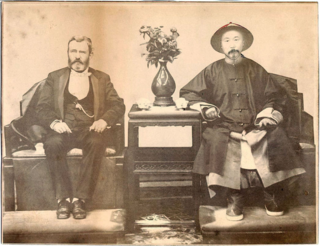 In an ideal library Mark Twain is the author of Around the World with General Grant (1879; handily abridged in 2002). On earth, however, Ulysses Grant commenced his travels before he and Twain were well acquainted, and even if they had been Twain was a famous writer with a schedule of lucrative lectures, not at all what Grant needed and found in the New York Herald's John Russell Young – a pure correspondent, an instrumental journalist whose lively dispatches from the epic world tour (Liverpool to Nagasaki, May 1877 to September 1879) would keep Grant in the domestic eye and impress the American voter (who might be asked to consider an unprecedented third term) with report of the honors European royalty and the picturesque potentates of faraway Asia were showering on the homely ex-president. Young notes that while cruising the Mediterranean aboard an American warship, Grant read and enjoyed Twain's Innocents Abroad.
The Wanderings of Ulysses
 In 1877: Philadelphia, Liverpool, London; a detour around Paris, where the Third Republic was in its volatile infancy, and where Victor Hugo had issued a poem denouncing Grant as pro-German and crypto-royalist; Brussels, Cologne, Frankfurt, Geneva, Alsace-Lorraine; Edinburgh, Glasgow, Newcastle for a gigantic parade of workingmen's associations, Birmingham; Paris, which would become their European base, then Villefranche, Naples, Palermo, Malta. 1878: Alexandria, Cairo, the Nile to Assiout, Abydos, Karnak, Luxor, Thebes, Aswan, and back to Alexandria; Jaffa, Jerusalem, Bethlehem, Nazareth, Damascus, Beirut, Istanbul, Athens, Rome, Florence, Pisa, Venice, Milan, Paris, Amsterdam, Rotterdam, Berlin, Hamburg, Copenhagen, Gottenburg, Christiana, Stockholm, St. Petersburg, Moscow, Vienna, Munich, Bordeaux, Gibraltar (where a British soldier's daughter young Molly Bloom recalled “the damn guns bursting and booming all over the shop especially the Queens birthday and throwing everything down in all directions if you didn't open the windows when general Ulysses Grant whoever he was or did supposed to be some great fellow landed off the ship”), Vittoria, Madrid, Lisbon. 1879: London, Dublin, Londonderry, Belfast, Marseilles, Alexandria, Suez, Bombay, Agra, Delhi, Rangoon, Penang, Singapore, Bangkok, Saigon, Hong Kong, Guangzhou, Macao, Shanghai, Tianjin, Beijing, Nagasaki, Yokohama, Tokyo, San Francisco.
Mother Country
Dominic Lieven has written that the Anglo-American solidarity “crucial to the victory of democracy in the twentieth century” could have been impeded, perhaps prevented, by Confederate independence and British recognition thereof. Even after the destruction of the unrecognized Confederacy, however, relations remained sour. There remained the US government's claims for damages against Great Britain, called the “Alabama claims” after the rebel commerce raider built in a British shipyard and allowed to sail by Prime Minister Palmerston. Senator Charles Sumner, Chairman of the Foreign Relations committee, called for $2.5 billion, a sum he knew the British would reject, and declared that in lieu of the cash, Canada would be acceptable. International arbitrators meeting in Geneva would eventually award the US a far smaller sum – $10 million. Sumner was to be the last of the long line of American politicians to threaten invasion of Canada.
Read more »