by Fausto Ribeiro
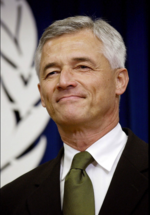
The year that marked the tenth anniversary of Sergio Vieira de Mello's death in Baghdad was also the one in which his biographer, Pulitzer Prize-winning activist Samantha Power, was nominated as the American Ambassador to the United Nations. Now, 2013 is over and the Nobel Peace Prize has been awarded to the Organization for the Prohibition of Chemical Weapons, whose efforts have been essential in the struggle against the Assad regime's chemical warfare. In light of this, one must surely wonder whether a turning point in international relations is taking place, after years in which irrational power-politics seemed to be the only available form of conflict resolution. As part of the effort to reflect upon that question, a reappraisal of Vieira de Mello's life's work may prove invaluable.
Sergio Vieira de Mello, the UN diplomat whose peculiar background included a Sorbonne degree in philosophy and a stint as a quintessentially soixante-huitard Paris rebel, never ceased to look for a theoretical foundation upon which to base his notoriously active and adventurous career. In a 2000 lecture, for instance, the Brazilian diplomat claimed to experience a “tranquilizing fascination” with the Hegelian idea that the march of history is perfectible through the power of reason – an idea which dismisses the recurrence of human tragedies as nothing but superficial upheavals that do not prevent progress towards an idealized future. However, Vieira de Mello would also declare himself suspicious about that notion, “because the real of my experience has invariably inspired in me a great skepticism towards totalizing theories, given the multiple manifestations of the irrational that always contradict them”. Hegel's World's Spirit (Weltgeist) would be, in the diplomat's perception, akin to “a religious interpretation of the course of history, in the sense that conviction derives from faith, from purely abstract reason, and not from concrete facts, from the real”. To consider the World's Spirit an irrefutable theory would only be possible for des yeux des convertis – the eyes of the proselytes.
In numerous aspects, Vieira de Mello considered that the UN, with the creative duality and mutual support existent between its Security Council and its Secretariat, “had begun to prove that it may – and, therefore, must – exert the role not of the Spirit, but of the World's Conscience”. A conscience would differ from a spirit in that it is “anti-dogmatic, receptive, and tolerant, because it is enriched and formed by the discovery and recognition of its characteristics, by its particular values, and, above all, by its capacity to extract the principles and common interests from the brute mass of events and of our history”.
Before presenting this alternative theory of history, however, Vieira de Mello asked a question whose deep significance would only become fully clear one year later, on September, 11th, 2001: aside from nihilism, what is there left? The matter-of-fact manner in which nihilism was dismissed in the question clearly indicates that Vieira de Mello found this alternative to be so abhorrent that it did not even merit further consideration. It is therefore a grim irony that precisely such nihilism was at the core of the mindset that would lead not only to the destruction of the Twin Towers, but also to the 2003 attack that put an end to Vieira de Mello's life itself.