by Brooks Riley
Nostalgia is a Muse
by Jalees Rehman
“Let others praise ancient times. I am glad that I was born in these.”
– Ovid in “Ars Amatoria”
When I struggle with scientist's block, I play 1980s music with the hope that the music will inspire me. This blast from the past often works for me. After listening to the songs, I can sometimes perceive patterns between our various pieces of cell biology and molecular biology data that had previously eluded me and design new biological experiments. But I have to admit that I have never performed the proper music control studies. Before attributing inspirational power to songs such as “99 Luftballons“, “Bruttosozialprodukt” or “Billie Jean“, I ought to spend equal time listening to music from other decades and then compare the impact of these listening sessions. I have always assumed that there is nothing intrinsically superior or inspirational about these songs, they simply evoke memories of my childhood. Eating comfort foods or seeing images of Munich and Lagos that remind me of my childhood also seem to work their muse magic.

My personal interpretation has been that indulging nostalgia somehow liberates us from everyday issues and worries – some trivial, some more burdensome – which in turn allows us to approach our world with a fresh, creative perspective. It is difficult to make such general sweeping statements based on my own anecdotal experiences and I have always felt a bit of apprehension about discussing this with others. My nostalgia makes me feel like an old fogey who is stuck in an ossified past. Nostalgia does not have a good reputation. The German expression “Früher war alles besser!” (Back then, everything used to be better!) is used in contemporary culture to mock those who always speak of the romanticized past with whimsical fondness. In fact, the expression nostalgia was coined in 1688 by the Swiss medical student Johannes Hofer. In his dissertation “Dissertatio Medica de Nostalgia oder Heimweh“, Hofer used nostalgia as an equivalent of the German word Heimweh (“home-ache”), combining the Greek words nostos(homecoming) and algos (ache or pain), to describe a medical illness characterized by a “melancholy that originates from the desire to return to one's homeland“. This view of nostalgia as an illness did not change much during the subsequent centuries where it was viewed as a neurological or psychiatric disorder.
What if Lee Child wrote “Purity” and Jonathan Franzen wrote “Make Me?”
by Andy Martin

JONATHAN FRANZEN RE-WRITTEN BY LEE CHILD
Begin with a backhoe. Obviously. Look at pp. 134-5 [of Purity]: Andreas spends far too much time digging. With a shovel. Get some decent machinery in there. Why struggle? Dig the hole deeper, shove the guy in, cover it over. Job done. Don't sweat it. And look, you postpone the murder till after page 100. Which is too long. Postponement is one thing, but you are going to lose a helluva lot of readers that way. (And then you take pages and pages just to do it! What is your problem?) You either need to kick off with the murder and then Andreas is the bad guy who must be hunted down (by the way, your solution for what happens to him… why the hell would he do that?) or… and this is more promising: what if he has a far better reason for knocking off this guy than… oh yeah, his girlfriend asks him to. ‘Hey, Andreas, would you mind if…?' Come on!
Stepfather? What about Godfather? What if you have Andreas, with all his skills, and his team of hackers, crack the mystery of this bad guy who must be channelling funds to Al-Qaeda while running drugs and girls and degraded nuclear material (probably polluting the environment too) and finally, and here we come to a climax, nailing this woman Pip, who is an ex-FBI agent (maybe abducting her, locking her up, and sadistically abusing…) And so Andreas is fully and righteously justified in offing him. No anxieties, no remorse. Maybe Pip could help bury him. A woman driving the backhoe. Which would be a breakthrough. Good revenge motive.
Monday, March 21, 2016
The “Streetlight Effect”: A Metaphor for Knowledge and Ignorance
by Yohan J. John
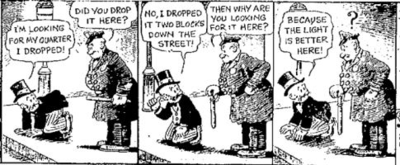
A parable featuring the Seljuk Sufi mystic Nasrudin Hodja may be the earliest form of the story: 'Someone saw Nasrudin searching for something on the ground. “What have you lost, Mulla?” he asked. “My key,” said the Mulla. So they both went down on their knees and looked for it. After a time the other man asked: “Where exactly did you drop it?” “In my own house.” “Then why are you looking here?” “There is more light here than inside my own house.”' The Indologist Wendy Doniger quotes this parable in her book The Hindus: An Alternative History, as a way to prepare the reader for the disappointing realization that the “available light” on Hinduism — the hymns, the histories, the archaeological remains — tends to illuminate the perspectives of dominant groups, relegating to the shadows the viewpoints of women, lower castes, and other marginalized groups.
Noam Chomsky has a characteristically dry and precise version of the story: “Science is a bit like the joke about the drunk who is looking under a lamppost for a key that he has lost on the other side of the street, because that’s where the light is. It has no other choice.”
So historians, mystics, scientists and drunks have something in common: they all tend to seek the truth where the process of seeking is easy, rather than where truth is. Responses to this problem vary. The mystic is most likely trying to remind the listener of how limited human knowledge is, and how often we look for solutions in precisely the wrong places. The humanities professor Doniger uses the problem as a justification for reading between the lines: using the available light to speculate about what may lie in the darkness. And the cognitive scientist Chomsky seems to be using the problem to justify why scientists answer questions that are almost, but not quite, entirely unlike the questions they originally set out to answer.
Trumpcare
by Saurabh Jha

This is relatively easy to answer when it comes to health policy. Just ask what people want. Seniors don't want Medicare rescinded. Even the most ardent free market fundamentalist group, the Tea Party, want Medicare benefits; as one of their ranks warned Obama, without a trace of irony, “Government, hands off my Medicare.”
Trump will protect Medicare. Even raising the eligibility age for Medicare is off the cards as far as he is concerned. He has promised that no one will be left dying on the streets. That people no longer die on streets, but in hospitals, because emergency rooms must treat patients regardless of their ability to pay, is irrelevant. The point is that Mr. Trump knows that the public values healthcare. And Trumpcare will show that Trump cares.
But it gets complicated. Yes, the public wants top notch healthcare for themselves. No, the public don't want to die on the streets. Yes, the public wants the government to look after them. The problem is that the public doesn't really want to pay for these services. Not much at least.
How will Trump manage these contradictory desires? Trump recently released his healthcare manifesto. Here are its Seven Pillars:
- Repeal Obamacare
- Allow purchase of insurance across state lines
- Allow people to deduct insurance from taxes
- Expand Health Savings Accounts (HSAs)
- Require price transparency for medical goods and services
- Block-grant for Medicaid to the States
- More free market for pharma
Trump's first test will be repealing Obamacare. It is clear Mr. Trump doesn't like Obamacare. He says about Obamacare that “people have had to suffer under the incredible economic burden.” What will he do about people with pre-existing conditions who insurers must cover by law thanks to Obamacare? Will we return to the days when insurers can turn down patients based on their risk, or yank the premium so high that they cannot afford insurance?
Science in the World of Islam, 1: The Syllable Al-
by Paul Braterman
As in Alcatraz; Alcove; Alfalfa; Alcohol; Alkali; Alizarin; Almanac; Alchemy; Alembic; Algol; Almagest; Algebra; Algorithm; Alhambra
The syllable Al- is Arabic for “The”, and is attached to the beginning of the word to which it applies.
Like English today, or Latin in Renaissance Europe, the dominant language of learned discourse for several centuries was Arabic. Arabic-speaking scholars translated the great works of the Greek philosophers and scientists, as well as studying them in the original, did likewise for the texts of Indian mathematics (from which we derive our modern “Arabic” numbering system), and made important discoveries of their own. Spain was where the worlds of Islam and of Western Christianity met, fought, and mingled for more than seven hundred years, and it is mainly through Spanish that Arabic words have entered the English language.


CATSPEAK
by Brooks Riley
Arab Muslim Writing in Britain
by Claire Chambers
Since 1855, both orthodox and non-practising Arab Muslim writers have produced an exciting, politicized, and high-quality body of artistic work. Among other aims, it seeks to portray the concerns of British-based members of the transnational faith group, or ummah. My research indicates that, particularly in the years following the riots in northern England in 2001, the attacks on America later that year, and the onset of the so-called War on Terror, British literature, film, and media have become increasingly preoccupied by Islam. In fiction at least, the strategies for representing Muslim communities are beginning to undergo significant alteration. Following the turning point of the Rushdie affair and accelerating since twenty-first-century wars of questionable legality, a surge in Islamophobia, the Arab Spring/Winter, and the refugee crisis, growing numbers of writers are representing specific British Muslim communities in a more nuanced way than had been attempted previously. Non-Muslim authors such as Martin Amis, John Updike, and Ian McEwan zero in on the figure of the terrorist. Arab Muslim writers tend to look at Islam in subtler ways, while often remaining highly critical of the religion's practices and accretions. Novelists such as Leila Aboulela and Robin Yassin-Kassab repudiate as distortions of the religion's pluralist history attempts to constrict Islam into an exclusive, singular identity.
The South Asian community constitute the biggest and most recognizable Muslim migrant population in Britain. However, Arabs, 
Since the discovery that the 2005 London bombers (none of them from Arab backgrounds) were 'home-grown', cultural commentators such as David Goodhart and Trevor Phillips have argued that multiculturalism is to blame for alienation, a lack of community cohesion, and even terrorism. However, I follow Tariq Modood in arguing just the reverse, that more rather than less multiculturalism is needed, if Britain is to inculcate a genuine (and necessarily diverse) sense of citizenship in its populace.
Tee for TOLET
by Maniza Naqvi
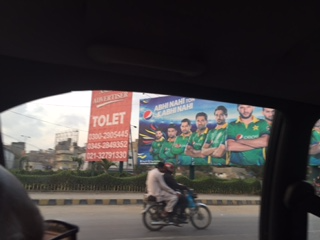
Mud, dirt, sand, land- look no further in Karachi or anywhere else for reasons for trouble. Trump cards, these, everywhere, up for grabs, for rent or lease or as it is said in Karachi: to let. Or, as the billboards scream all over Karachi: TOLET. Everything tolet. Perhaps, a Freudian nod to complicity by the scribe, as well as the reader, omitting the 'I', but managing still to point to the pervasive smell wafting all over the city the eau de toilet—or rather 'Ewwww dah toilet!!!' Something indeed is rotten.
Tee for Tolet. Karachi a city the size of a mid- sized country seems to be disappearing in to a golf hole— a vortex, a vortex of greed—into a TV screen, a swimming pool drain or down the tolet—toilet. The teeing off are teed-off if you do protest this too much. Protest the erasing of public spaces, the grabbing of public assets–and you're likely to be whacked or clubbed like a little white ball–and end up barred or down a hole. Players are quick to remind you that golf courses create green spaces and they don't use up water–only sewage water. Stinks?
The city, as a place to protest seems only to exist as pretty on the face of it—on Facebook. It appears pretty, as a dream—or as an idea of luxury—on gigantic billboards above its streets, but where on the streets themselves it more likely that idealism is shot to death and recycled as a cynical sickness: take for instance the poet's command—Bol! Speak! It was turned into a joke in this city. Here: ‘Speak!, means ‘Shut up!' Just as war means peace.
Poem
Mother Writes to Indira Gandhi
The Hon’ble Mrs. Indira Gandhi,
Prime Minister, Murti Lane, New Delhi.
7 July 1975, Dear Madam,
How are you? What’s with this
Emergency? India’s star is
fading while you’re sexing guru Brahmachari?
A pilot bucklemeups in his sexjet.
Pompous rogue has intensified
wireless: whispering, murmuring:
shanti, ashanti. Indira Ji, please heed my plea:
empty the sky. Show your ire. Command him,
at once ceasefire. A woman’s
mind is no man’s land. I hang
my vaginarags out on a string — pale buntings
fluttering Kashmir’s fragrant breeze. My
husband remarried. She burps, yawns,
farts, is fertile and thick as two
planks. Will she leave him alone at dawn to write
his diary? Her two readymade children
call me, Big Mom: Bahdi Ami.
My husband says new wife will be
my caregiver. It’s tearing me apart, Madam,
and I’m again losing my mind. Faithfully
yours, Mrs. Maryam Jan, Raj Bagh
Srinagar, Kashmir ((India).
* * *
Indira Gandhi
Teen Murti Lane
New Delhi
30 July 1975
Dear Maryam Jan,
I am delighted to pen this in my own hand. “You have to keep breaking your heart until it opens,” says Rumi, but I wish I had said it, for after my husband died, I took solace in poetry to heal my bruised heart — a very hard thing to do, perhaps the hardest thing to do as I am learning myself. Many say I am mad. They have no clue about the fine line between madam and madness. You have your pilot, his sexjet. I have my guru who drives me insane. There is an insurgency in my own emergency with Brahmachari. Indians are unruly. Elite talk only of civil rights. No one thinks of responsibilities, for there are no rights without responsibilities. A dose of self-enlightened Madam Rule should give India pause. I wish I were there inhaling the fragrant breeze, for Kashmir is my ancestral home too.
Yours, Indira
* * *
By Rafiq Kathwari, winner of the Patrick Kavanagh Award, who would like you to read more epistles from his mother to the Prime Ministers of the World, here.
Akeel Bilgrami’s Introduction to Noam Chomsky’s “What Kind of Creatures Are We?”
by Akeel Bilgrami

Lecture 1 presents with clarity and precision, his own basic ideas in theoretical linguistics and cognitive science (both fields in which he has played an absolutely central founding role) recording the progress achieved over the years but recording much more strenuously how tentatively those claims to progress must be made and how a very large amount of work remains to be done even in the most fundamental areas of study. Changes of mind over these years are also recorded, some of the most striking of which occurred only in the last decade or so.
The lecture begins by motivating the question its title announces, “What is Language?” It behooves us to ask it because without being clear about what language is, not only will we not get the right answers to other questions about various specific aspects of language (perhaps cannot even correctly frame those specific questions), but because we won’t get close to investigating or even plausibly speculating about the biological basis and evolutionary origins of language.
LEE CHILD, JONATHAN FRANZEN, AND JOUÏSSANCE ON 57TH STREET
by Andy Martin

Lee Child and Andy Martin
It was typical Lee Child.
Not long before he had been ranting on about how you really ought to ‘kill off all your relatives' (speaking aesthetically, but with a definite sense that art is murder) and how much he hated all those family trees in the classic novel. He was anti-genealogy. No begats. You can't have an XXL ex-military vigilante drifter roaming about and he has to call up his old mum every couple of weeks.
Now he was saying, ‘What if his mother comes back? Madame Reacher. You know, but young. In the Resistance. A kid. Before she became a Reacher. I love that period. The Nazis marching down the boulevard. Sartre and Camus writing in the Café de Flore. Most of the Resistance fighters achieved nothing, beyond getting themselves tortured. Useless, a lot of them. But the couriers – they were really something. They saved lives.'
We were crossing the street at Columbus Circle, weaving around cars and buses, riffing on the phrase ‘San Fairy Ann' (the Anglicization of Ça ne fait rien), deriving from our Second World War-era franglais-mangling fathers. Neon-lit darkness. Only a hazy idea where we were supposed to be going. We'd just finished the New York Times job in the Starbucks across from Lincoln Center Plaza. Lee was looking particularly disreputable for some reason. Maybe it was the stubble or the jeans-and-t-shirt look. Piratical. Like, if you were sheriff, you'd want to run him out of town before he started anything.
Sunday, March 20, 2016
Venerating the Army: A Pathology of Nationalism
by Namit Arora
A cloying veneration of army men is yet another pathology of nationalism that’s more pervasive than ever in India today. Army men are now widely seen as paragons of nobility and patriotism. Whether their deaths are due to freak accidents or border skirmishes, they’re eulogized for “making the supreme sacrifice for the nation”. Politicians routinely signal their patriotism by chanting Bhārat Mātā ki Jai, victory to mother India, and fall over each other for photo ops where they’re seen honoring soldiers, dead or alive.
Curiously, this adoration for army men seems most intense in urban middle-class families, including those who don’t desire or nudge their own kids to join their nation’s army. Instead, they want their kids to prepare for more lucrative professions, pursue office jobs in multinationals, live in gated high-rise apartments, and own nice cars. A textbook case of hypocrisy?
These folks may claim that their reverence for army men stems from their appreciation for the sacrifice the jawans (soldiers) make for others by enduring great hardship and risk, even death. And yet these same people certainly don’t glorify other risky jobs that benefit the nation no less, like unclogging the nation’s sewers, mining the nation’s coal, building the nation’s infrastructure, or toiling in the nation’s shipping graveyard—all jobs that apparently have lower pay and benefits combined with higher fatality, injury, and illness rates than Indian army jobs. Clearly, something else animates all that adoration for army men.
And who are the jawans who comprise the majority of the army? Most come from the rural poor and are hired after 10th grade. Some follow in the footsteps of other soldiers in their families, at times going back to British colonial times. As happens in all societies with volunteer armies and a severe lack of equal opportunity, most recruits join to escape poverty, get a stable job and a pension, and pursue a ticket to a higher social class, prestige, and some adventure. Indeed, in recent years, economic distress in parts of rural India has forced army recruiters to lower their physical fitness standards in some centers because the pool of candidates is too undernourished. Though the army does not release demographic data by caste or religion, it is well known that Muslims are severely underrepresented in it—as low as 2-3 percent—raising a host of awkward questions about its commitment to secularism.
Monday, March 14, 2016
Should collective action be protected by the law (as labor law would suggest), or prosecuted by it (as antitrust law would suggest)?
by Sanjukta Paul

One of the most visible manifestations of precarious work is in the so-called on-demand or gig economy, exemplified by companies such as Uber. Companies in this sector generally argue that their growth is due to technological innovation, while many labor and community advocates argue that is largely due to the avoidance of socially beneficial regulation, which in turn enables them to undercut existing businesses. These companies also take the position that people providing the services in which they deal (such as cab rides) are not employees, but independent businesspeople, and thus that labor regulation does not apply to them. One response has been to argue, in the courts and the legislatures, that such workers are legally employees, and have been misclassified by the companies engaging their services. The City of Seattle recently took a different and more direct approach, enacting an ordinance granting collective bargaining rights to drivers for taxicab, limo, and “transportation network companies” (encompassing Uber, Lyft and other companies in the on-demand sector) who are classified as independent contractors rather than employees. The approach of the policy-makers and advocates who passed the Seattle ordinance is novel in that it guarantees these rights to workers directly, rather than endeavoring to first establish their employee status, whether by legislation or by litigation. As expected, an industry group (the United States Chamber of Commerce, no less) has now filed a lawsuit challenging the ordinance on grounds that it is barred by antitrust law and by the National Labor Relations Act.
Monday Poem
Standing at the East End of a Patio
Seeing a Mountain and a Moon
I have no ears for moons
nor eyes for the snapping of limbs
against each other in the wind
these come to me piecemeal by different senses
to be assembled in a dark place
into a dream of moonlit-windy-night
where all up sides are glazed in silver
while underneath are shadows,
and shadows (forever)
have no tongues
.
by Jim Culleny
3/11/16
.
Why have we lost faith in science?
by Thomas R. Wells
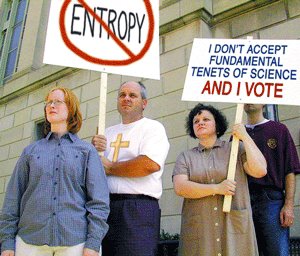
And yet despite dominating the modern world, the authority of science has declined. The general public are losing faith in its relevance to our lives, and are increasingly distrustful of its specific claims. This attitude is regrettable but not entirely unreasonable. Scientists have long claimed the status of public servants but exhibit little interest in living up to that role, for example by investigating boring but deadly diseases. Furthermore, science as an industry – Big Science – is entwined with power and money. That undermines the credibility of scientific pronouncements on politically contentious issues such as GM crops or climate change.
Choose the Axiom
by Carl Pierer
***
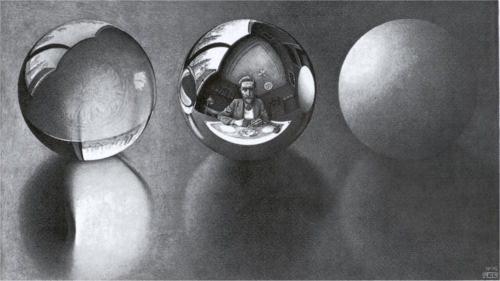
M.C. Escher: Three Spheres II.
*
If we take an infinite collection of sets, all of which contain at least one element, is there a way to choose exactly one element from each of them? This seems to be just obviously true. After all, there is something in every set, so we can just take any of those things. Certainly, it holds for finite collection of sets. Even if this number is very large, we could just go to each set and pick an element. However, if the collection becomes infinite, this becomes more worrisome. We would need a principled way of choosing one element of each set. Consider, for instance, all non-empty subsets of the natural numbers (the natural numbers being those we use to count: 1, 2, 3, …). By the nature of the natural numbers, such a set will always have a least element. Hence, we could simply pick the least element of each set in our collection. Compare this with an infinite collection of sets of pairs of gloves. As a pair of gloves always consists of a right and a left glove, we can always pick the left glove, say. But this is not so straightforward with other sets. For example, considering all non-empty subsets of the real numbers (containing the natural numbers, but also ¼, e, √π,…) it is far from obvious how we could ensure that we can pick precisely one element from each of those sets. Contrast this with an infinite collection of sets of peas. You know that each set will contain at least 1 pea, but which one are you going to pick if there are more than 1?
The axiom of choice, then, claims that this is always possible. It is, what some may call, somewhat theological, as it asserts the existence of something (a choice function) – even though we might have no idea at all how to construct it, as for instance in the real number example. Yet, it just seems very obvious that this principle should hold. After all, there is something in every set to choose from. The axiom is probably one of the most contentious of the standard axioms of set-theory[i]. On the one hand, it is very powerful and many important proofs in mathematics – explicitly or implicitly – use it. On the other, it leads to some highly counter-intuitive consequences.
Where Probability Meets Literature and Language: Markov Models for Text Analysis
by Hari Balasubramanian
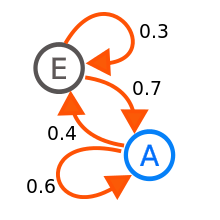
The key phrase, as we shall see, is ‘dependent quantities'. Broadly speaking, Markov models are applications of that basic rule of conditional probability, P(A|B): the probability of Event A happening, given that B occurs. The uses of Markov chains are many and varied – from the transmission of genes through generations, to the analysis of queues in telecommunication networks, to the movements of particles in physics. In 2006 – the 100th anniversary of Markov's paper – Philipp Von Hilgers and Amy Langville summarized the five greatest applications of Markov chains. This includes the one that is unknowingly used by most of us on a daily basis: every time we search on the internet, the ranking of webpages is based on the solution to massive Markov chain.
The focus of this piece, however, is the analysis of letter and word sequences as they appear in text. In what follows, I'll look at four examples where Markov models play a role.
Is unpunctuality a moral failing?

We all know people who are routinely late. We may even be one of them. These people aren't necessarily late for everything. They usually manage to catch their trains or planes, get to a concert before it begins, and make it to their job interviews on time. But if it's a matter of rendezvousing for coffee, not holding up dinner, or being packed for a trip by the prearranged departure time, they are systematically hopeless.
Surprisingly, English doesn't seem to have a noun for this kind of person akin to words like “slob” or “scruff” or “lazybones.” The term “latecomer” won't do since it denotes one who is late for a specific event, not one who regularly keeps other waiting. So for the sake of convenience, let's label these people “unpunctuals.”
On several occasions I have heard amusing little speeches given about such individuals, at birthday parties, anniversaries, and graduation celebrations. The spirit is always the same: the subject of the toast/roast is a lovely person in many, many ways but he/she has a unique (although, in truth, it obviously isn't unique) sense of time. A familiar consequence of this has been that the unpunctual's nearest and dearest have spent a goodly proportion of their earthly existence hanging around wondering when the unpunctual will show up/be ready/finish a task etc..
This charitableness toward the unpunctual is interesting. We are less ready to laugh at other little failings which inconvenience us. Imagine a similar speech about someone who regularly borrows money and doesn't pay it back. Or who routinely fails to pick up their share of the tab at a restaurant. Or who insists on inflicting loud music on us when we are trying to concentrate or are suffering from a migraine. In such cases, the humour would be more barbed, the implicit criticism more pointed.
CATSPEAK
by Brooks Riley