by Michael Liss
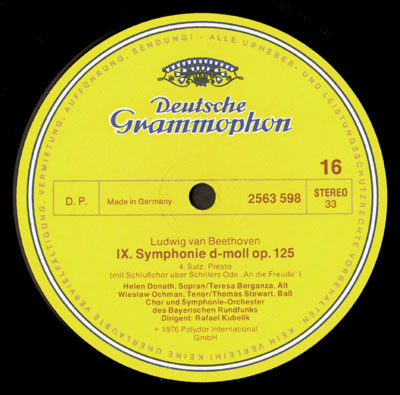 If you love classical music, there is a place in your imagination that takes you back 192 years, to May 7, 1824, and puts you at one of the most extraordinary moments in musical history—the first public performance of Beethoven's Ninth Symphony.
You want to be there. You want to see Beethoven himself raise his hands for the first downbeat, that odd woosh that then unfolds almost like an orchestra tuning up. You want to hear those crisp, slashing sounds as it moves through the second movement, and swirling cloud of notes, floating above you, that is the third. But the payoff comes in the fourth, when Beethoven surpasses himself, first trying, and then rejecting, the themes of the first three to resolve by joining instrumental beauty to vocal, fused in the pure elation of Schiller's “Ode to Joy. “
If you were there, you would do as every other person in attendance did—leap to your feet and roar your approval. And you would be witness to the most dramatic, even shattering moment in music history—when one of soloists, Caroline Unger, gently turns the ailing, unhearing Beethoven to receive their adoration.
As the historian (and musicologist) Edmund Morris recounts in “Beethoven, the Universal Composer,” if there was any silence in the house, it could have only come from the Imperial Box, which was empty. Beethoven, a man underwritten for decades by the aristocratic and wealthy, had begun to edge away from them, and they from him. The Ninth is not only revolutionary in its form, it is perhaps the first large-scale truly democratic work. With one 74-minute effort, Beethoven created an entirely new vocabulary, one that not only spoke of a stateless universal brotherhood, but in form and delivery, frees the individual to participate to the extent of his abilities.
To put Beethoven in better context, it's useful to place him, and two of the great composers before him, Bach and Mozart, in “political-musical” time, or perhaps more accurately, “political-musical-economic” time.
Read more »