by Jonathan Kujawa
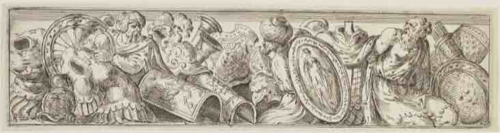
In 1971 H. S. M. Coxeter introduced a mathematical trifle he called “friezes”. At the time they didn't seem like much more than a cute game you can play. In the past decade, however, they've become a central player in a major new area of research. I recently saw an entertaining talk by Peter Jorgensen at the Mittag-Leffler Institute about his work in this area with Christine Bessenrodt and Thorsten Holm. Peter's talk reminded me that I should really tell you the story of friezes. We've all seen friezes such as this one by Caravaggio [1]:
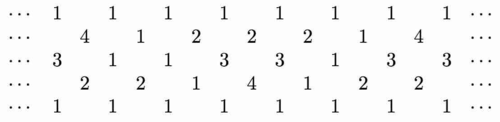
What is a frieze à la Coxeter? It's easiest to show with an example:
As you can see, a frieze is an array of the counting numbers (1,2,3,4,…) where the top and bottom rows are all ones. The dots on the left and right mean that each row continues forever in both directions. The real mystery is the numbers in the middle rows. There is some sort of pattern and symmetry but I, at least, couldn't quite put my finger on it the first time I saw a frieze. The mysterious missing rule is that each diamond of four numbers:
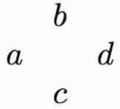
is required to satisfy the equation:
You can check the diamonds in our example frieze and see that the formula always holds true. Notice, too, we can make diamonds on each edge where we know three out of four of the numbers. Using our formula we can solve for the missing number and so fill in missing numbers on each edge. This observation along with the fact that the top and bottom rows are always one means the frieze really does continue forever in both directions and the Rule for Diamonds tells us how to calculate the missing numbers.