by Shadab Zeest Hashmi
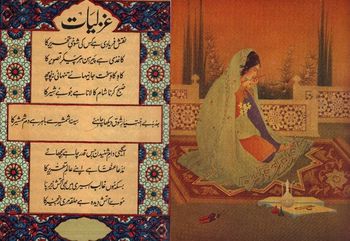

by Shadab Zeest Hashmi
by Matt McKenna

by Dwight Furrow

How times have changed! Today, celebrity chefs strut across the stage like rock stars, a whole TV network is devoted to explaining the intricacies of fermentation or how to butcher a hog, countless blogs recount last night's meal in excruciating detail, and competitions for culinary capo make the evening news. We talk endlessly about the pleasures of food, conversations that are supported by specialty food shops, artisan producers, and aisles of fresh, organic produce in the supermarket. Restaurants, even small neighborhood establishments, feature chefs who cook with creativity and panache.
Why this sudden interest in food? As I argue in American Foodie: Taste, Art and the Cultural Revolution, our current interest in food is a search for authenticity, face-to-face contact, local control, and personal creativity amidst a world that is increasingly standardized, bureaucratic, digitized, and impersonal. In contemporary life, the public world of work, with its incessant demands for efficiency and profit, has colonized our private lives. The pressures of a competitive, unstable labor market, the so-called “gig” economy, along with intrusive communications technology make it increasingly difficult to escape a work world governed by the value of efficiency. This relentless acceleration of demands compresses our sense of time so we feel like there is never enough of it. Standardization destroys the uniqueness of localities and our social lives are spread across the globe in superficial networks of “contacts” where we interact with brands instead of whole persons. The idea that something besides production and consumption should occupy our attention, such as a sense of community or self-examination, seems quaint and inefficient—a waste of time. Thus, we lose touch with ourselves while internalizing the self-as-commodity theme and hiving off all aspects of our lives that might harm our “brand”—a homogenized, marketable self. Even our vaunted and precious capacity to choose is endangered, for we no longer choose based on a sensibility shaped by our unique experiences; instead our sensibilities are constructed by corporate choice architects, informed by their surveys and datamining that shepherd our decisions.
by Jonathan Kujawa
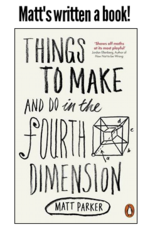
I came dangerously close to not becoming a mathematician. Like many people my experiences with math in school left me irritated and bored. I have a poor memory and I'm not a detail oriented person [1]. The arbitrary rules to be memorized and the fiddly and unforgiving nature of calculations made each homework a minefield of point-losing opportunities. And the problems! To “motivate” us with “applications” the problems were meant to be real-world, yet always seemed to involve the patently ridiculous: rectangular pastures, conical barns, spherical cows. I don't know how anyone can refer to such obviously contrived problems as “real-world” with a straight face.
Or, worse, problems were completely devoid of any motivation whatsoever. I have strong memory of having to learn how to multiply together matrices. The rules were clearly designed to maximize the number of calculations required and, hence, the chances of making a mistake. I can't imagine who thought this was a good topic for fifteen year olds. Not a word was said about why we should learn such a thing, or why anyone, anywhere should care. Oh to have known something about how matrices are used in geometry and computer graphics, or to store and manipulate data, or to compute probabilities in Markov processes. Heck, just to point out that it is an example of a “multiplication” where AB and BA are not equal would have been great start!
Of course my experience is the rule, not the exception. Paul Lockhart wrote a fantastic essay in 2002 entitled “A Mathematician's Lament” which captures the situation perfectly. It's requiring everyone to be able to read music and never letting them hear a tune, only saying it will be needed in some unspecified way as a working adult. Or teaching reading using only tax forms and TV repair manuals. Everyone with an interest in math or education should read it. You can read it here. As Lockhart writes,
…if I had to design a mechanism for the express purpose of destroying a child’s natural curiosity and love of pattern-making, I couldn’t possibly do as good a job as is currently being done— I simply wouldn’t have the imagination to come up with the kind of senseless, soul-crushing ideas that constitute contemporary mathematics education.
So how was my soul saved?
by Scott F. Aikin and Robert B. Talisse
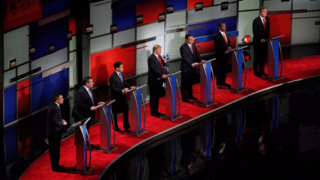
Any view important enough to stimulate disagreement is a view that will look to some reasonable others as prohibitively costly, suboptimal, incorrect, or foolhardy. Thus assessing the drawbacks of one's view is where the argument concerning its overall merit begins, not where it ends. Thoughtful people are aware that their views will strike some reasonable others as manifestly rejectable, and consequently, thoughtful people take reasonable criticism not always as an attack on their proposals, but rather as an occasion for thinking and saying more about them. In some instances, the case can be made that the drawbacks of one's view must be borne (because, perhaps, the viable alternatives are yet even worse); in other cases, it might be arguable that the costs of adopting one's view are merely apparent or on the whole insignificant. The point is that it's plainly insipid to proceed as if the fact that an opponent's view is imperfect were a decisive reason to reject it. Showing that an interlocutor's proposal is thoroughly criticizable is never the end of the matter. What must also be shown is that the interlocutor's criticizable proposal is inferior to the other (criticizable) proposals worth considering. And that comparative task requires us to allow our interlocutors to respond to our criticisms.
The trouble is that so much popular political debate seems to presuppose that the only political view worth accepting would be one that could not be reasonably criticized.
by Jalees Rehman
Nearly half a million applications for asylum submitted by refugees were processed by German authorities in 2015, according to the German Federal Office for Refugees and Migration. The number of people who were officially registered in Germany as potential asylum seekers was even far higher-roughly one million in 2015 – which suggests that Germany anticipates an even higher number of official asylum applications for 2016. Chancellor Angela Merkel has defied many critics even in her own party and cabinet by emphasizing that Germany can and will take on more refugees, most of whom are coming from war-torn countries such as Syria, Iraq and Afghanistan. “We can do it!” (“Wir schaffen das!”) was the phrase she used in September of 2015 to convey her optimism and determination in the face of ever-growing numbers of refugees and the gradual rise of support for far right extremist demonstrations and violent attacks by far right extremists on refugees centers in Germany.
The German media and right wing populists are currently obsessing about statistics such as the fact that the far right and libertarian party AfD (Alternative für Deutschland – Alternative for Germany) will garner 10% of the popular vote or that the vast majority of the refugees are male and could lead to a demographic gender shift if they remain in Germany. While such statistics serve as an important barometer of the political climate in the German electorate or to prepare for the challenges faced by the refugees and German society in the next years, they do not address the fundamental philosophical questions raised by this refugee crisis. In the latest issue of the popular German philosophy periodical “Philosophie Magazin“, the editors asked philosophers and other academic scholars to weigh in on some of the key issues and challenges in the face of this crisis.
Should we be motivated by a sense of global responsibility when we are confronted with the terrible suffering experienced by refugees whose homes have been destroyed? The sociologist Hartmut Rosa at the University of Jena responds to this question by suggesting that we should focus on Verbundenheit (“connectedness”) instead of Verantwortung (“responsibility”). Demanding that those of us who lead privileged lives of safety and reasonable material comfort should feel individually responsible for the suffering of others can lead to a sense of moral exhaustion. Are we responsible for the suffering of millions of people in Syria and East Africa? Are we responsible for the extinction of species as a consequence of climate change? Instead of atomizing – and thus perhaps even rendering irrelevant – the abstract concept of individual responsibility, we should become aware of how we are all connected.
by Brooks Riley
by Tamuira Reid
I.
I stopped caring about him sometime between January and May, when the weather changed and the leaves came back. He went on that big white pill and couldn't have aged cheese or avocado and I sat at the table in the kitchen, watching him watch me.
The yelling wouldn't stop until he'd had enough, when his eyes no longer felt right in his head and he'd rather lay down than stand there, fist in mouth, cat rubbing against both legs.
He once told me that depression comes in waves but that makes it sound too beautiful. There was nothing good about the bad.
Sometimes we'd try to fight it before it hit. I'd take a shower. He'd shave his face. Vacuum the hallway rug. But it never worked and the top would blow off and it would be hands to throats again, just like that.
Teacups shook in their skin, books fell over on themselves and I wanted to see how it would all play out. Does he get the girl in the end? Or does she leave during a quiet moment, smiling as she turns away. His hand pressed against her like an ear.
“No sooner does man discover intelligence
than he tries to involve it in his own stupidity.”
~ Jacques Yves Cousteau

It's actually kind of difficult to envision this as even being a problem in the first place. It's true that, up until in the first years of this century, there was some discussion of the so-called ‘digital divide', where certain segments of the population would not be able to get onto the ‘Internet superhighway' (another term that has fallen into disuse, perhaps because it feels like we never get out of our cars anymore). These were the segments of society that were already disadvantaged in some respect, where circumstances of poverty and/or geography prevented the delivery of physical and therefore digital services. Less so, those on the wrong side of the divide may have also landed there because of language proficiency or age.
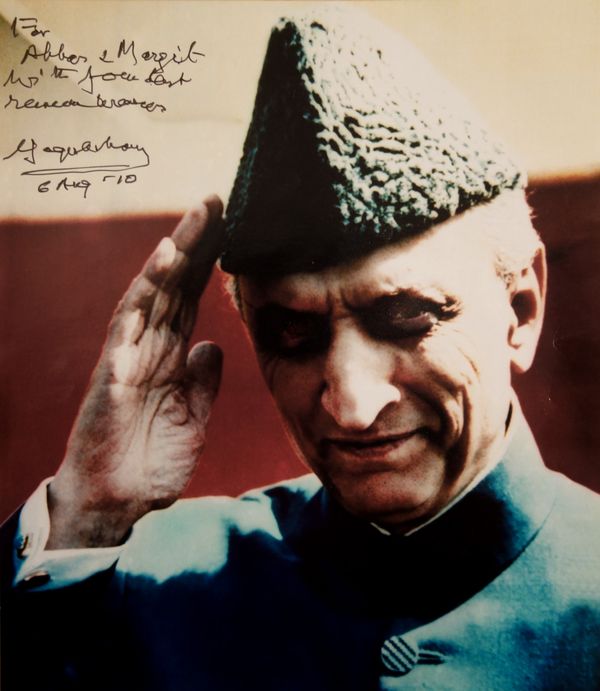
A great man and one of the most significant figures in the history of Pakistan has just died. I consider it my great fortune that I came to know him and the idea of a world without him in it is quite unbearable. Here is what I wrote about him more than 10 years ago on 3QD:
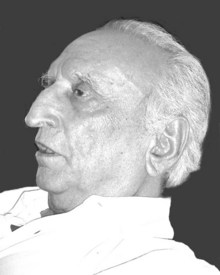
The first time that I met Sahabzada Yaqub Khan about six years ago, he was in Washington and New York as part of a tour of four or five countries (America, Russia, China, Japan, etc.) relations with which are especially important to Pakistan. He had come as President Musharraf's special envoy to reassure these governments in the wake of the fall of the kleptocratic shambles that was Prime Minister Nawaz Sharif's so-called democratic government. Samad Khan, or Sammy K as he is affectionately known to friends, invited me over to his apartment to meet his Dad. I had heard and read much about Sahabzada Yaqub and knew his reputation for fierce intellect and even more intimidating, had heard reports of his impatience with and inability to suffer fools, so I was nervous when I walked in. Over the next couple of hours I was blown away: Sahabzada Yaqub was not much interested in talking about politics, and instead, asked about my doctoral studies in philosophy. It was soon apparent that he had read widely and deeply in the subject, and knew quite a bit about the Anglo-American analytic philosophy I had spent the previous five years reading. He even asked some pointed questions about aspects of philosophy which even some graduate students in the field might not know about, much less laymen. Though we were interrupted by a series of phone calls from the likes of Henry Kissinger wanting to pay their respects while Sahabzada Yaqub was in town, we managed to talk not just about philosophy, but also physics (he wanted to know more about string theory), Goethe (SYK explained some of his little-known scientific work, in addition to quoting and then explicating some difficult passages from Faust), the implications of Gödel's incompleteness theorem, and Urdu literature, of which Sahabzada Yaqub has been a lifelong devotee.
More here.
by Brooks Riley
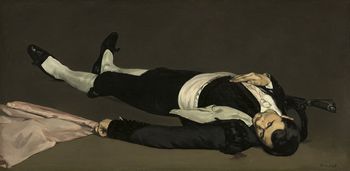
It may seem insulting to my living friends that I find myself revisiting the inanimate ones to try to understand their place in my personal pantheon. Friendship may even be the wrong word for the acquaintance one makes with a work of art. But the attraction is there, just as we are attracted to the singular mix of attributes of a person whom one knows will become a friend. The first time I saw my best friend, it was not in person, but in a thumbnail photograph of her among hundreds, of incoming freshmen at college. There was nothing unusual about that face, but there was a quality I noticed, something ineffable. When I later met that freshman, I recognized her immediately.
I was probably 14 or 15 years old when I first saw the Manet painting. Walking into the gallery where it hung, I was immediately drawn to it. From a distance, it was the dynamism within the frame, the chiaroscuro 20-degree angle slashed across the wide canvas from upper left to lower right, that made me want to move closer. It was also the proto-cinematic framing, heralding the 1.85:1 aspect ratio of modern cinema. The angle was formed by the body of a dead bullfighter, the only event in an otherwise nearly blank, dark canvas with little context. His head, upside down, is closest to us. His feet lie at the other end of the perspective.
.
.
.
Solar Filaments
the sun's intense but placid
teasing this morning’s fog from the river,
at least from this vantage, sitting as we are
at a perfect distance from its orange firebox
safe from its arcing solar filaments,
the eruptions which suddenly uncoil like snakes
and would reduce me to cinders
with their dragon breath if not for
certain equations like those that render orbits
and the change of state that gives
this river its gray vapor coat
in which it rides its way to the sea
under the cool red blast furnace blaze
of clouds caught in the cup of two slopes
behind the phone pole’s tangle of wires
to the sound of water over the dam
speaking familiar alien tongues,
and footsteps curiously synced to my pace,
and the rhythmic exhalation
of my fog-spilling lungs
.
by Jim Culleny
1/19/15
by Claire Chambers
I recently wrote an essay for Dawn on general postcolonial rewritings of Shakespeare's Othello. For the present column, I turn to 
In her essay '”Filmi” Shakespeare', Poonam Trivedi defies accusations of 'bardolatry' and colonial cultural cringe to trace the history of Shakespeare on the Indian big screen. She shows that this history goes back to 1935 and Sohrab Modi's Khoon-ka Khoon, a cinematic rendering of an Indian stage version of Hamlet. Because the British colonizers laid emphasis on an English literary education for the Indians over whom they ruled, there were many filmic adaptations of Shakespeare's plays. Hamlet's blend of politics and metaphysical mystery seems to have proven the most popular of the Bard's plays for Indian auteurs. These directors, according to Trivedi, in the early days of Indian cinema found themselves between the rock of leaving Shakespeare 'pure and pristine' or the hard place of making him entirely 'bowdlerized and indigenized'. By the mid-twentieth century, the most successful adaptations relocated the plays to India in their entirety. Directors 'used' rather than 'abused' the Shakespearean originals, taking ideas from their plots and themes rather than critically writing back to the plays.
The Bengali film Saptapadhi was in 1961 probably the first to namecheck Othello. In it, a pair of starcrossed lovers − a Brahmin boy 
by Yohan J. John
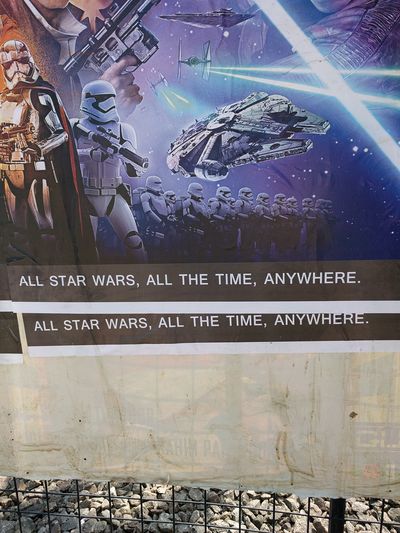
I had two reasons to watch the latest Star Wars movie, The Force Awakens, as soon as I was able. Firstly, I knew that despite all the talk of spoiler warnings and respect for “the fans”, I would have to basically avoid the internet until I managed to see it. (There's always some kill-joy on your facebook feed who gets a kick out of giving it all away, or an oaf who does not know what a spoiler is.) Secondly, and perhaps most importantly, I wanted to join in the conversation. One of the great things about a pop cultural juggernaut (such as Star Wars, Pope Francis, or the FIFA World Cup) is that a lot of people —friends, family, strangers in bars, members of the chatterati — will be talking about it. Pop cultural mega-events are like Rorschach tests: whether we enjoy them or not, we feel the urge to project onto them our emotions, our theories, our politics, our ideals. By virtue of their popularity, these events bring us together and draw our attention to a common focal point, at which point we can share our projections with each other.
In his book Finite and Infinite Games, James P Carse defines finite games as those that are played for the purpose of bringing play to an end. Infinite games, by contrast, are played “for the purpose of continuing the play”. When we think about games we typically think about the finite sort: their end goal is some victory or end state, at which point the game is over. Wars take the form of a finite game — they aim to bring an end to the adversary's 'play'. Debates takes this form too; their goal is to silence the opponent. A scathing critical review is meant to remove a work of art from the field of aesthetic play. But real conversations, by contrast, are infinite games. Their goal is to enlighten and entertain all the participants. A conversation is an occasion not only to look at a topic, but also to look through a topic, treating it as a prism that can be pointed at self, other, and world. A good conversation never comes to a definitive end; it is simply held in abeyance for a time, to be revisited later or carried on by new participants. The road goes ever on.
What follows are some impressions gleaned from the Star Wars Conversation, and some ideas for how we might carry on the infinite play and entice more people to join in. I'm not sure this will add up to a coherent essay, so feel free to skim, as you would a listicle or an annotated reading list. And by all means, contribute to the conversation in the comments section.
by Brooks Riley
Childhood
A Version after Iqbal
Earth & sky were new realms for me
My mother’s embrace the world
If anyone made me weep, I found
Comfort in rattling the door chain
O to gaze for hours at the moon
Journeying silently amidst clouds
Above mountains & deserts
Astonished at the blend of truth & lies
I trained my eyes to see, lips to move
My heart yearned
Translated from the original Urdu by Rafiq Kathwari whose collection ‘In Another Country’ is available here.
by Gail Pellett

The books published by Mighty Current had survived in the lively Hong Kong book market for two decades while being banned in China. They were particularly popular with mainland day tourists visiting Hong Kong. Now their popular bookstore is closed and the press is shut. Like any troubling story there are complexities and mysteries.
On Dec. 30, Lee Bo, one of Gui's business partners in the publishing company, suddenly disappeared as well. Lee and his wife owned the bookstore that sold their publications. Soon after disappearing Lee made a strange communication to his wife from Shenzhen that he was “working on an investigation.” His wife noted that he had left his passport at home. A passport he would need to enter Mainland China from Hong Kong. Lee Bo is a British citizen.
Last weekend, Sunday, Jan. 17, Gui, who is a naturalized Swedish citizen, suddenly showed up on CCTV —China's official TV network—confessing tearfully that he had violated his probation back in China for a drunken driving accident in 2003 that had ended in a fatality. Hong Kong based China watchers were quick to point out the edits in the video as revealed by the fact that Gui‘s t-shirt changed color mid-way.
by Evert Cilliers aka Adam Ash
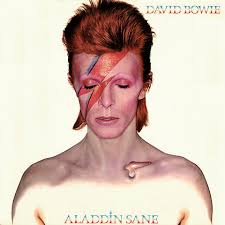
I once met David Bowie in London in 1972. He was wearing a pastel-pink, wide-brimmed, floppy, very girly hat. His face was lightly dusted with powder, his lips shone with a touch of gloss, his eyes sported pale blue eyeliner.
He was beautiful, ethereal, and otherworldly. Also friendly: an amused smile on his face, probably amused at my stuttering admiration. He seemed a creature from another dimension, a sprite, a ghost, an elf, a race unto himself. A presence more than a person. I felt I needed an unknown language to communicate with him. English would not be enough.
His smile appeared to appreciate me from a distance. He neither indulged nor disdained my admiration, simply took it. A gracious fellow. A gentleman. In fact, he was grace personified. Elegance emblemized.
Let's face it, the man had style. Like no other. He looked great, whether he was glammed out as Ziggy Stardust, or suited as the Thin White Duke.
I've related to Bowie — more than to Dylan and Lennon, my other pop heroes — because he kept changing. He showed us there is more than one way to be in the world. He made being an outsider OK. He made art out of alienation. Gender, music, identity — all was very fluid to him. I found him more congenial as a fellow creature than other stars, because he was so different, so original, and so various.
And his songwriting was pretty weird on top of being utterly wonderful — think of straight pop songs like Starman and Let's Dance, and then of really weird songs like Is There Life On Mars? and Space Oddity and Cygnet Committee.
Bowie was a freak. Who else was as freakily different and original as Bowie? And who has had such an influence on his fellow practitioners? One could not imagine Madonna without him, or Lady Gaga.
by Thomas R. Wells
Sports are mere games, “the voluntary attempt to overcome unnecessary obstacles” as Bernard Suits, the founder of the philosophy of games, puts it. So why do we care about them? The pleasure of sport has three distinct sources – competition, drama, and craft. Although each has their own logic and appeal, the defining characteristic of a flourishing sport is the harmonious balance it achieves between all three. In this light, the increasing dominance of competition across all sports is distinctly worrying. In the long run it may squeeze the very life out of them. The thin zero-sum perspective on sports that it embodies is already the source of the pernicious doping scandals, nationalism, and sexism in modern sports.
I
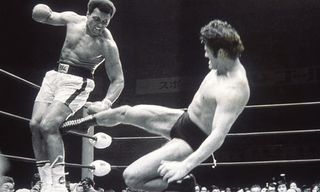
Competition – the chancing of fate and divine favour – is important but it is not the only kind of pleasure that sport can and should afford. The others though tend to make more demands on the spectator.
by Carl Pierer
Published in 1932, Sunset Song is famed as one of the most important Scottish novels of the 20th century. As the first part in Lewis Grassic Gibbon's Trilogy A 
As a classic text, it has received much attention and suffered many an interpretation, ranging from Marxist and Feminist to humanist and nationalist. But despite many doubtful attempts at classification, the work has defied reduction and remains a vivid testimony of rural life.
Perhaps the most striking of the novel's virtues is its language. Written in a distinctive style, it infuses Standard English with the rhythm and words of Scots dialect, giving the prose a unique lyrical flavour. Gibbon skilfully and consistently uses dialectal terms to be true to his motive, without rendering the text unintelligible to a non-Scots speaker. That the melody of the text is deeply rooted in the highlands has provoked remarks of the following sort:
The non-Scot can get a great deal out of Mitchell [i.e. Lewis Grassic Gibbon], but one can sympathize with Donald Carswell when he says that he did not appreciate the prose of Sunset Song until he heard a north-east girl reading it.[i]
Comments of this kind aptly illustrate the difficulty of appreciating the literary value of the novel without sliding into dubious political territory, against the author's intent.