by Daniel Ranard
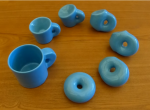 Maybe you've heard by now about last week's Nobel Prize in Physics, awarded to three physicists for their work on topological phase transitions. But if you didn't already know what a topological phase transition was, chances are you still don't. When a friend of mine read a few popular articles on the discovery, I asked him if he felt enlightened. “No, it felt like the authors were just free-associating: first they said ‘topological phase transitions,' then they said ‘topology,' and then ‘bagels.'” I sympathize with my friend, but also with anyone trying to explain this year's prize. It's true: you can't explain topological phase transitions without mentioning the underlying mathematics, a field called topology. And when you mention topology, you're tempted to talk about bagels. In fact, not long after the Nobel announcement, a Nobel committee member was waiving bagels and cinnamon buns on screen.
Luckily, I'm not going to talk about topological phase transitions. (I'll leave that to the professionals, like Philip Ball at Prospect.) But I am going to talk about bagels. Or really, I want to focus on the mathematical field of topology, which underpins these discoveries. Topology is the study of shapes. And while shapes are interesting in their own right, topology also demonstrates the unique ways that mathematicians conceive of objects and their properties.
First we can ask, what's a shape? Imagine explaining the concept to an alien whose language doesn't have the word for shape. Let's say our alien hasn't even grasped the basic schema of human perception.
Alien: “What's the ‘shape' of an object?”
Person: “The shape of something is just… how it looks.”
Alien: “So the shape of a basketball is orange and one foot long?”
Person: “Well, you need to ignore the color and the size, but…”
We've already learned something. Mathematicians and physicists are often trying to come up with new properties to describe and classify objects, whether they're talking about physical objects or abstract mathematical constructions. Sometimes, you can come up with a new type of description by asking what's left over in your description once you ignore certain other properties. For instance, the vague property of “how something looks” requires us to ignore exactly where the object is in space: we say that two stop signs look the same, even though they stand on different streets. If we picked up one stop sign and laid it on top of the other, they'd be hard to distinguish. That's what it means to “look the same.” Still, it can be hard to specify exactly what sort of description is left over when we choose to ignore certain properties like color and size.
Read more »