by Jonathan Kujawa
On November 8th everyone will be counting. Counting can be hard. Especially in messy real world situations like elections. But in pure mathematics we get to decide the questions in which we are interested. We can choose to count countable things. The secret to math is the art of asking “good” questions. A good question is one in which you can make progress and learn something you didn't know before.
Like Goldilocks, a mathematician looks for questions which are neither too easy nor too hard. An easy problem is boring, unenlightening, and not much fun — a 2x2x2 Rubik's cube of mathematics. But, like a 7x7x7 cube, a too difficult problem is also boring, unenlightening, and not much fun. The secret is to land somewhere in the middle.
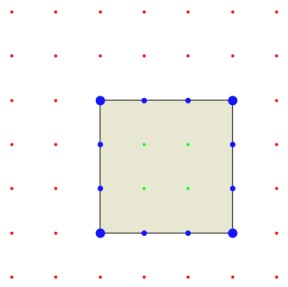
If I had played less Dots and Boxes and paid more attention in my math classes, I would have learned that our initial dots were nothing but lattice points. These are the points in the xy-plane where both coordinates are an integer. So (1,3), (0,-6), and (2,127) are lattice points, but (1, 3/2) and (1.6, π) are not. Lattice points are easy to count in any geometric shape we may draw. For example, here is a 3×3 square with lattice points for corners:
Counting we see there are 12 lattice points on the sides of the square and 4 in the interior. Stuck in a boring math class for long enough, we might even notice that the area of the square, 9, is also what we get from 12/2 + 4 – 1. And that a 1×1 square has area 4/2 + 0 – 1 and that 2×2 square has area 8/2 + 1 – 1. In fact, it seems like for any square we draw if it has S lattice points on the sides and M lattice points on the interior, then the area always works out to exactly equal S/2 + M – 1. A strange coincidence, indeed! This is when our mathematical sense starts tingling. Coincidences are rare in math.