by Jonathan Kujawa
On the occasion of Richard Guy's 100th birthday.
Human beings have a talent for spotting patterns. No doubt this was handy in our early days. If both Ug and Oka were violently ill after eating purple berries from a particular bush, our clan was well served to notice and avoid those berries in the future. If anything, evolution encourages us to be overly quick to infer patterns. Better safe than sorry. No need for a double blind, randomized trial with a large sample size when life and death are on the line.
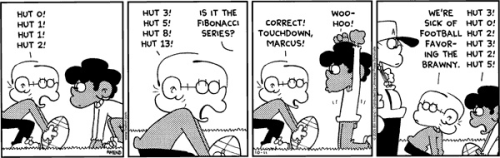
Our keen sense for what is random and what is not works both for and against us. After all, as we saw last month, it was Pick's keen eye for patterns which lead him to discover his beautiful formula. For an easier example, let's write down the first few numbers of the Fibonacci sequence:
1,1,2,3,5,8,13,21,34,….
It only takes a minute to spot the rule used to generate these numbers. With a little more time we can even guess exactly which ones are even and which ones are odd [2].
Now imagine I tell you that I flipped two coins twenty-one times and got:
Coin A: TTTTHTTHHTTHTTTTHHHTT,
Coin B: HTTHTTHTTHTTHTTHTTHTT.
You would have to be an awfully trusting person to believe that both are fair coins and that I faithfully flipped and recorded the results. Our pattern seeking brain notices the regularity of Coin B. It violates our sense of what a “random” sequence of coin flips should look like. Mathematically we know each string of coins flips is equally likely. But even the most steely mathematician would be hard pressed to bet against Coin B next coming up heads.
A great icebreaker on the first day of teaching is to ask the students generate two lists of 100 coin flips: one by flipping a real coin and one by hand. Even though they do this while the instructor is out of the room, the instructor invariably can identify which is list is which. The secret is to look for long runs of heads, tails, or other patterns (like Coin B). Since all outcomes are equally likely to the coin it will happily generate strings of heads in a row. Human brains, however, notice such patterns and veto them in their effort to fake a random sequence of heads and tails. There is a running joke on this theme in Rosencrantz and Guildenstern Are Dead.