by Carl Pierer
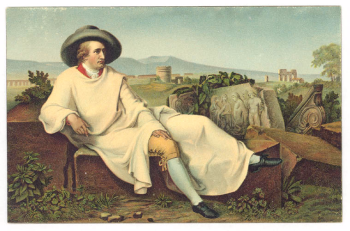
In 1786, Goethe began his famous journey to Italy, of which he kept a diary to be published as The Italian Journey in 1816. Even though his main interest lies elsewhere, he finds time to write about Italians. Early on his journey, he writes, for example (Goether, 1982):
So far I have seen only two Italian cities and only spoken to a few persons, but already I know my Italians well. They are like courtiers and consider themselves the finest people in the world, an opinion which, thanks to certain excellent qualities which they undeniably possess, they can hold with impunity.
22. September 1786
The generalisation at hand is striking. Whilst admitting a very limited experience, Goethe feels in a position to talk about Italians, as a whole. Or does he?
Who are the Italians Goethe is talking about? It seems unlikely that he is talking about all of them, at all times. Yet even restricted to his contemporaries, it would be bold to assert that this is a necessary feature of being Italian. Such a reading most surely would miss the point. It seems more appropriate to suggest that he is talking about some sort of Mentalität, a commonality or stereotypical property of Italians. Even if this were so, it would be a confusion to suggest, anachronistically, that Goethe means by “Italians” the citizens of Italy. The “Italians”, it seems, have a rather different, curious status.