by Yohan J. John
One way to check would be to try and explain Žižek’s ideas for myself. A handy sanity check might involve directing my explanations at other people, since I knew from first-hand experience that a set of ideas can seem perfectly coherent when they float free-form in one’s head, but when it comes time for the clouds of thought to condense into something communicable, very often no rain ensues. (This often happens when it’s time for me to translate my ruminations into a 3QD essay!)
Many of us like to see ourselves as members of a scientific society, where rational people subject ideas to rigorous scrutiny before filing them in the ‘justified true belief’ cabinet. But there are many sorts of ideas that can’t really be put to any kind of stringent test: my ‘social’ test of Žižek’s ideas doesn’t necessarily prove anything, since most of my friends are as left-wing (and susceptible to pop cultural analogies) as I am. This is the state of many of the ideas that seem most pressing for individuals and societies: there aren’t really any scientific or social tests that definitively establish ‘truth’ in politics, history or aesthetics.
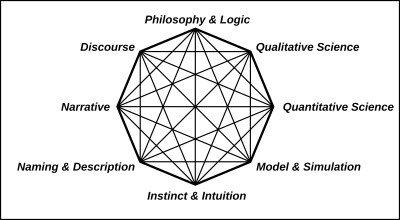
To attempt an understanding of understanding, I think it might make sense to situate our verbal forms of knowledge-generation in the wider world of knowing: a world that includes the forms that we share with animals and even plants. To this end, I’ve come up with a taxonomy of understanding, which, for reasons that should become apparent eventually, I will organize in a ring. At the very outset I must stress that in humans these ways of knowing are very rarely employed in isolation. Moreover, they are not fixed faculties: they influence each other and gradually modify each other. Finally, I must stress that this ‘systematization’ is a work in progress. With these caveats in mind, I’d like to treat each of the ways of knowing in order, starting at the bottom and working my way around in a clockwise direction.