The primacy of doubt in an age of illusory certainty

by Ashutosh Jogalekar

Image001We live in a fractured age when many seem to be convinced that their beliefs are right, and that they can never agree with the other side on anything to any degree. Science has always been the best antidote against this bias, because while political truths are highly subjective and subject to the whims of the majority, most scientific truths are starkly objective. You may try to pass a law by majority vote in Congress saying that two and two equals five, or that DNA is not a double helix, but these falsehoods are not going to stay hidden for too long because the bare facts say otherwise. You may keep on denying global warming, but that will not make the warming stop. What makes science different is that its facts are true irrespective of whether you believe they are true.

But combined with this undeniable nature of scientific facts exists a way of doing things that almost seems paradoxical to proclamations about hard scientific truth. That is the essential, never-ending role of doubt, skepticism and uncertainty in the practice of science. Yes, DNA is a double helix, and yes, it almost seems impossible that this fact will someday be overturned, but even then we should not hold the fact as sacrosanct. “Truth” in science, no matter how convincing, is always regarded as provisional and subject to change. Some scientific facts are now so well documented that they approach the status of “truth”, and yet considering them so literally would mean abandoning the scientific method. Seen this way, truth in science can be considered to be an asymptotic limit, one which we can always get closer to but can never definitively reach.

It’s this seemingly paradoxical and yet crucial yin-and-yang aspect of science that I believe is still quite hard to grasp for non-scientists. Niels Bohr would have appreciated the tension. Bohr bequeathed to the world the concept of complementarity. Complementarity means the existence of seemingly opposite ideas that are still required together to explain the world. In the physical world, complementarity was first glimpsed in the behavior of subatomic particles which can sometimes behave as waves and sometime as particles, depending on the experiment.

Read more »

Monday Poem

Beginning

I’m thinking
of cartoons
that say
the end is nigh
on a sign
held by a guy
on a corner,
rag coat,
hunched,
forlorn,
whose years
went south,
didn’t pan out as
he thought they would

when he was a boy,
the way
they should’ve but
never made it
over a midlife hump
when the light at a
tunnel’s end
everybody talks about
when things fall apart
went
slowly dim
went
from sun
to lighted pinprick
in a scrim
on a stage
where all are merely
players,
women, men
strong, lame
clowns, crooks
politicians running
showing up
puking
mewling
like a child

in a
mother’s arms
….and I was thinking
of the moment just before
when
in the dark
nothing is
but a
beginning
that is always
coming
.

Jim Culleny
11/1/16
.

On “Quality”

by Elise Hempel

Pizzas1It arrived today in the mail – a certain poetry journal I've been waiting for and wondering about, a journal I've been rejected by several times, that I've come to imagine, because of those rejections, as sophisticated and discriminating, a journal now containing a poem of mine nearly a year and a half after the poem was accepted. It's not uncommon for print journals to take that long, the time between acceptance and publication often being a full year, and I know that the editor of this journal was struggling with some personal difficulties during the publication of this particular issue, and had lost some of her production staff to boot. But still … though the journal looks good, professionally made – no stapled spine or cheap paper – the glossy cover sports a rather underwhelming photo, and my now-outdated bio in the contributor notes maintains the future tense for the publication of my 2016 book. Someone else's bio ends with a comma instead of a period, while several others are missing the italics on a journal or book title, sometimes randomly within a list of other, italicized titles. There are both missing and misused commas, and one poem title is, inexplicably, in all capitals amid its upper/lowercase neighbors. And though I've barely begun reading, I've already spotted some surprisingly awkward lines of poetry, not to mention a sonnet that's merely titled "Sonnet."

How can I be so tough on a poetry journal from a small press, one that most likely has limited funds, on a poetry journal that I know has just a small audience anyway? My displeasure with typos, errors, and general sloppiness springs perhaps from a perfectionist type of personality, a personality that won me a job as a proofreader in the Chicago area in the 1980s, that prompted a friend to say to me, as I pointed out a "grocer's apostrophe" on a bar sign one downtown Saturday night, "Relax, Elise, you're off the clock now." Perhaps. But my cluttered desk and dusty bedroom say the opposite about my personality. And I know I'm not alone, with many more of us throughout the world, including the "grammar vigilante" (or the "Banksy of punctuation") who secretly corrects the punctuation of business signs in the dark of night in Bristol, England.

Read more »

Why We Should Repeal Obamacare and not Replace It with Another Insurance Plan: Thinking Out of the Box for a Health Care Solution

by Carol A Westbrook

Before you, progressive reader, quit in disgust after reading the title, or you, conservative reader, quit in disgust after reading a few more paragraphs, please hear me out. I'm proposing that we repeal Obamacare (The Affordable Care Act, ACA) but not replace it with another medical insurance program. Instead, I propose that we re-think the entire concept of how we provide health care in this country. 110126_obama_sign_health_bill_ap_605

The ACA's stated purpose is "to ensure that all Americans have access to high-quality, affordable health care." Regardless of whether or not you believe good health is a fundamental human right, it is inexcusable for an affluent, first world country like ours not to provide it for its citizens. The good health of our nation is vitally important to its success, guaranteeing as it does a capable workforce, a strong military, and a healthy upcoming generation. However, I have seen the results of Obamacare from many perspectives, including that of a physician provider in a rural community, as well as that of a personal user of both insurance and Medicare. I do not believe the ACA succeeded in meeting its objectives.

It is true that the ACA provided health care insurance for millions of Americans who didn't have it previously, expanded Medicaid for the uninsured, got rid of the pre-existing condition exclusions, allowed our grown adult children to remain on our policies longer, and started the ball rolling on electronic records. These are great results.

GTY-Obamacare2-MEM-161222_12x5_1600But the ACA also caused the cost of health insurance to skyrocket, caused many people to lose their coverage, and, for some, their jobs. It forced many small doctors' practices to close, especially in rural areas, resulting in an overall decline in the quality of care in many regions. It limited patients' choices of physicians and hospitals, separating patients from their longstanding doctors. There were no checks on health care costs, which even today continue to increase. But worst of all, it mandated that our health care would be taken out of the hands of doctors and put into the hand businessmen–the insurance companies.

Read more »

The Most Dangerous Word

by Max Sirak

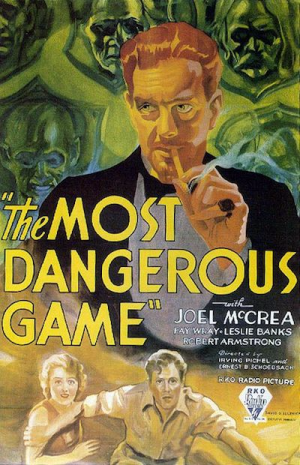
Most_Dangerous_Game_poster(Free audio version here. Or scroll down.)

Most of us, hunters and english teachers especially, know the answer to the question, "What's the most dangerous game?"

Maybe you remember reading Richard Connell's short story in middle or high school. Maybe, depending upon your age, you remember hearing Orson Welles portray General Zaroff. Or, maybe you've seen a variation of the tale told on a screen. It's been a steady storyline, easily found, since the titular RKO release in 1932.

Regardless of how it is you knew the correct answer, it's widely known. Humans are the most dangerous game. We aren't as strong as a bear, as fast as a cheetah, as poisonous as a snake, or as magical as a liger. But it doesn't matter.

We're smart and we're clever and that makes us perilous prey.

Now, if I were to ask you, what's the most dangerous word? what would you say?

A bit trickier, isn't it?

There are so many different directions you could go, which is why I've prepared some clues…

Read more »

Poetry in Translation

LENIN IN THE PRESENCE OF GOD

a trans creation after Iqbal, by Rafiq Kathwari

God
Aha! Comrade Ulyanov—
Welcome! Or I should say,
Dobro Pozhalovat!

Lenin
You’re alive? But “God is dead,” they said.

God
I inhabit men’s heart, passion’s home,
and for a brief moment
the gods themselves swayed to your tune.

Lenin
So, this is the source of the babble in churches.

God
Command and Control,
Shock and Awe,
@NoGodButGod.

Lenin
I need a drink…

God
Heaven is not your local pub,
but we’ve a house white on tap,
Water of Life. Glass or Goblet?

Lenin
Shot glass. Neat.

God
Think of it as Korsvodka.
Red blush on your cheeks—
it’s not rouge. Is it?

Lenin
When will the boat of Capitalism sink?

Read more »

The Wedding Singer: A Bride Who Said “I Don’t”

by Christopher Bacas

ImageEvery wedding merges rivers. In that confluence, ancient rites, family histories and baked-stuffed chicken breasts tumble in eddies and whirling spouts. As a hired hand, I looked for calm water, the safety of land and superior canapés.

Under crystalline light, I sailed the blacktop channel called I-95. My port, a giant shul in suburban Baltimore. The job was booked extra-long: pre-ceremony, ceremony, then marathon dance sets. In the parking lot, buses poured out throngs of dark-clothed men, women and scampering elves, some with bouncing side locks. Inside, I met my colleagues, mostly goyim, veterans of Orthodox gigs. In a dim storage closet, I put on my tux and fancy shoes. Three feet away, an ectomorphic man davened violently, as oblivious to my rituals as I was to his.

Our leader, the Rockin Rabbi, a Long Island kid. As a young guitar picker, he played along with Hendrix, T-Bone Walker and Les Paul, memorizing their brilliant commentaries on scripture. After Rabbinical school in Israel, he returned stateside; selling copiers by day, raising a family and playing weddings. In his yarmulke and frum black suit, he remained a virtuoso garage band rocker; undisciplined and selfish. Unwittingly, his repertoire a Downtown artist's conceit: Melodies by the Baal Shem Tov, yoked to a slamming backbeat, careening into grandstanding solos, a blur of blinding pick work and bent strings. Tunes couldn't end or segue; their exit strategy spinning out under bluesy hail. The horn section yelling to each other, searching for a cue or a bus gate, hopelessly lost.

Read more »

Monday, May 8, 2017

The antidotes to populism: stoicism and civil society

by Thomas R. Wells

ProtestThe politics of populist rage are on the ascendant in every democracy, even if thankfully not always triumphant. Authoritarian regimes like China and Russia, and cynics like John Gray, are relishing the collapse of the moral high ground and the return to good honest Machiavellianism. The old calumnies against democracy seem to be coming true. That the rule of the people is just the rule of the mob. That order, the uncontested rule of the powerful, is the best we can hope for. That there is no higher moral principle for a people to aspire to than their country's domination over others.

Something has certainly gone wrong in how we do democracy. We have forgotten what it is and how to do it. Specifically, we have gotten the idea that democracy consists in our right to command the government to give us what we want, when actually it is collective self-government. Democracy is not a reality TV-style contest in which the people are spectators and voters on who gets to win the prize of ultimate power. Rather, it is a relationship to ourselves and our fellow citizens that we develop and practise in our daily lives.

I

So how did we go so wrong?

We allowed the bonds between us to decay. The collapse of civic institutions outside work, well noted by Robert Putnam in ‘Bowling Alone', left more and more people isolated, unable to relate to each other as fellow citizens, unable to organise anything together.

Cable news and then social media came along to reorder us into bubbles of those we agree with. But worse, the economics of both cable news and social media depends on engagement – the more time we spend watching, or liking and sharing, the more of our attention these companies can chip off and sell to advertisers. And it turns out that outrage – besides cute cats – is extremely good at generating engagement. That's why Facebook's news feed algorithm has gotten so good at serving up the exact stories from around the world most likely to send us into paroxysms of anger, or the other dark emotions such as fear and disgust.

And that's where we are now. A society of millions of strangers, all alone together in front of our televisions and twitter feeds, shivering with indignant rage.

Read more »

On Frank Capra’s Apolitics

by Carl Pierer

Images-w1400[1]Much has been written about how the political centre today can be characterised by offering a choice between two spins of the same idea. Essentially, a choice that is not a really choice. But this point is nothing new. Indeed, this very mechanism can already be found in the 1938 film You Can't Take It With You.

In line with his other films, Frank Capra's You Can't Take It With You excels in a sentimentality and heart-warming humour that has won much popular appraisal. It is a film that is easy to watch, easy to enjoy and thus precisely of the charming sort that attracts fervent criticism. Too comforting, too nice, but most importantly too ideological. Capra's films are often seen to hide, behind a humanist façade, a stifling defence of the status quo and an outmoded idea of Americanness. This is not least due to his own descriptions in his autobiography. Against this sort of criticism, without defending Capra's non-existent ideas, it is possible to appreciate his You Can't Take It With You as a staple of ideological presentation of a pseudo-choice.

Read more »

America’s complicated execution methods bespeak a bad conscience

by Emrys Westacott

Last month the world witnessed a morally repulsive Imagesspectacle in Arkansas. The state sought to execute eight men over eleven days, and succeeded in executing four of them, including two within an hour of each other. The reason for the rush to complete the executions before the end of April was that the state's supply of a certain drug used in the process was about to pass its "best used by" date, and the authorities were concerned on two counts: that they wouldn't be able to acquire further supplies; and that once the stocks they had were past their expiration date, there might be legal grounds either for stopping the executions or for suing the state should the executions not proceed smoothly.

Arkansas' preferred method of execution is lethal injection. In the recent cases this involved administering three drugs in succession:

  1. Midazolam: a sedative that is supposed to render the condemned person unconscious
  2. Pancuromium bromide, which paralyses them
  3. Potassium chloride, which stops the heart

The use of midazolam is controversial. It is a benzodiazepine, a similar sort of drug to valium. Unlike the barbiturates that are usually used as anesthetics in surgery, it is not guaranteed to render a person completely unconscious. It is therefore possible that the subsequent injections could cause severe pain, and this sometimes appears to have happened. In 2014, the execution in Oklahoma of Clayton Lockett by lethal injection took 43 minutes; the condemned man writhed and groaned on the gurney, went into convulsions and eventually died of a heart attack. In Ohio that same year, Denis McGuire appeared to be suffering several minutes into the procedure. In Arkansas last month, witnesses reported that Kenneth Williams, the last of the four to be executed, groaned and suffered convulsions.

People often ask why these problems arise given that we routinely anaesthetize patients for surgery and euthanize animals painlessly. The main reason is that the companies that manufacture drugs like sodium thiopental, pentobarbital or propofol, which are commonly used for such purposes, will not provide these drugs to anyone who might use them for the purpose of capital punishment. Some of this reluctance might stem from the moral values of the main shareholders; but to a large extent it is dictated by legal and commercial considerations. The drugs in question are largely manufactured in Europe, and EU regulations prohibit the export of drugs that might be used in executions. Rather than risk having sales to the US banned, companies choose not to supply the drugs to prisons.

Read more »

A GENERATION FOR ITSELF? MILLENNIALS AND THE NEW OLD LEFT

by Richard King

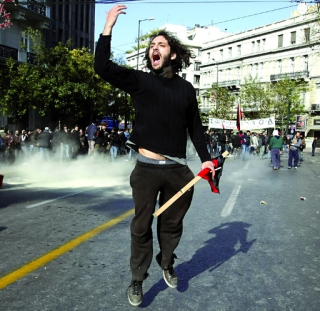
Greek_student_protestor_during_2009_G20_London_summit_protestsI wonder, do you believe that children are our future? I do. In fact, I often catch myself thinking how important it is to teach them well, and indeed to let them lead the way. Hell, some days I even resolve to show them all the beauty they possess inside – you know, give them a sense of pride, to make it easier, right? And their laughter reminds me … Okay I'll stop now.

Whitney had one thing right, at least. Children, young people, are the future. Or rather, they'll experience more of the future than I, at 46, am likely to. Not a difficult point to grasp, or a difficult point to make, and of course we should keep our hands on our wallets when politicians invoke The Young. Such invocations are to politics what The Bodyguard is to cinema: transcendentally anodyne.

And yet, and yet … Young people, youth, the kids, whatever, are facing a very uncertain future, and their place in it is fast becoming an inescapable modern theme. Indeed a healthy sense of grievance would appear to be brewing in their hormone-addled brains. The young are revolting, and by that I don't mean that their complexions resemble pizza dough or that their hair smells like a forest floor. No. I mean that they're pissed off with the world and with the indifference of our political Kevin Costners to their current and future prospects within it.

Read more »

Monday, May 1, 2017

My Big Fat Republican Government

by Michael Liss

"What do you expect from a Republican?" IMG_0222

Being the child of FDR Democrats, I can't tell you how many times I heard that. What does one expect from a Republican? Always siding with business and the wealthy over the interests of the common people. Loving wars; making them, spending big for the toys to make them, and questioning the patriotism of those who disagree. Displaying an unseemly admiration for pencil-mustached right-wing dictators who wear uniforms and mirrored Ray Bans. Having an unhealthy fascination about how others live their private lives—and a compulsion to tell them how to live it better. That's what you expected from a Republican.

With my limited world-view (my Dad insisted I read the incomprehensibly dense and partisan Ramparts magazine), I saw "Republicans" as sort of a duck-billed platypus. There were the kooks—what we would now call the tinfoil brigade—conspiracy spouting, rootin' tootin' Yosemite Sam types. There were the American Gothics, the Midwestern farmers who, to me, not understanding social issues particularly well, inexplicably voted against their own economic interests. There were the blue-collar ethnics who had started to move out of decaying cities to the suburbs and exurbs-Nixon voters in 1968. There was the beginning of the great political migration of the Solid South. And, most importantly, there were the guys at the top of the food chain, the well-heeled and the well-bred. Tall, good-looking, society-page weddings, Mayflower, SAR, DAR. Those guys—the ones who really ran things, and for whom the government always worked. Discreetly. As you can see, I had a very sophisticated view of things.

Of course, this was a caricature. There was an entire moderate wing of the GOP. A real one—not some lonely Rock Cornish Hen wingette, but a plump, juicy game-bird of an appendage. New York's very own Governor, Nelson Rockefeller, was in charge of that wing, having inherited it from one of our former Governors, Thomas E. Dewey. Dewey started the State University System, doubled aid to education, and pushed through the first non-discrimination-in-hiring law. Rockefeller built more colleges, supported environmental causes, and created the New York State Council on the Arts (it's exceedingly difficult to explain to my own children that there actually were Republicans like this).

Yet, humanity evolves (in a non-Biblically offensive way). The moderates went the way of the Giant Squid—we hear occasional reports of one washed up on a distant shore. The farmers' loyalty intensified with the ever-warming Earth. The South turned so beet red that it solemnly considers secession every time there's an election result it doesn't agree with. Yesterday's kooks are today's….White House staffers, Freedom Caucus, and Cabinet Secretaries. And the blue-collar ethnics, and a surprising number of white-collar workers stalled in a no-growth-for-them economy, found their hero in a four-times-bankrupt brigand.

Read more »

Viktor Orbán and the Central European University

by Maarten Boudry

967344464607494e0b56bFor the past week or so I’ve been in Budapest on a study visit at the Central European University (CEU), where I’ve been doing some research on cultural evolution with the anthropologist Dan Sperber and his group. I wouldn’t normally be blogging about this kind of everyday academic excursion, but if you’ve been following the news at all closely for the last few weeks then the name of the university might ring a bell, because of the well-publicised plans of the authoritarian Prime Minister of Hungary, Viktor Orbán of the right-wing populist party Fidesz, to close the place down.

The CEU was founded in 1991 by the American businessman and philanthropist George Soros. It awards both Hungarian and American degrees, the latter thanks to an agreement with the educational authorities of the State of New York. It’s one of the best universities in Central Europe, with a high Times Higher Education ranking. It’s also a bastion of liberalism and democratic values, with students from all over the world doing unfettered research into a wide range of subjects, often with generous grants and scholarships.

That last point does not go down well with Orbán, a self-proclaimed “illiberal democrat” who has been undermining the rule of law in Hungary for much of his political career, and especially since he was returned to office in 2010. As far as Orbán and his brand of muscular nationalism are concerned, Soros and his transnational, cosmopolitan worldview—as represented by institutions such as the CEU—represent a threat to the sovereignty of the nation state. It doesn’t help that Soros’s foundation finances a number of NGOs that have been strongly critical of Orbán’s policy towards refugees. So a few months ago, the government announced that Soros and his international network of subversive liberal influence needed to be reined in. And that meant that the CEU became a target.

At the end of March, Orbán’s government pushed through a bill, which the President of Hungary has since signed into law, to tighten the regulation of foreign educational institutions. Nobody is even trying very hard to pretend that this law has any other purpose than to close down the CEU. It imposes a legal requirement for any foreign university established in Hungary to also have a campus in its country of origin, a condition that the CEU just happens not to meet. Moreover, all staff of foreign universities who are not EU citizens (which, in the case of the CEU, means the majority) will need to apply for a Hungarian work permit, as the new law eliminates the existing waiver.

Read more »

The Pollinators of Technology

by Evan Edwards

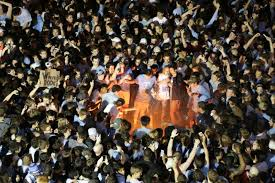
DownloadOn the night of Monday, April 3rd, a man stood in the middle of the intersection at Franklin and Columbia in Chapel Hill, NC. Within minutes, thousands of people poured out of bars, houses, apartments, fraternity and sorority homes, and who knows where else, barrelling down the largest streets in the town to join him. There’s a video that shows it happening in high speed. The University had just won the NCAA men’s basketball tournament which (if you don’t know) is a very big deal.

I grew up in North Carolina, and as the week drew closer to the game, I watched so many people that I know from Middle and High school making their way back to the state, just to be there if/when they pulled it off. If they couldn’t make it, many documented their excitement wherever they were, on social media, and sent messages and memes to one another as the game loomed closer, just brimming with enthusiasm. Although I never really got into sports, it was a bit moving to watch people get so very joyous about something when nearly everything else in the news is tinged with a kind of abysmal horror.

If you watch the video I linked to above, you notice that the frame shakes as it pans from side to side. Because we’re used to it, we can read this erratic movement as the work of a smartphone camera because professional cameras and drones aren’t this sloppy, and no one uses handheld video-cameras any more. In the shot, too, you see the arm of the man in the intersection upstretched in the first few frames, the luminous glow of his iPhone at its apex, almost giving him the look of an angler fish wandering the deep, or a single firefly waiting in a meadow. As the crowd rolls in, you can’t always make out the screen glow, but it’s clear that almost everyone in the crowd is either raising their phone up to take a picture, to record video, to go live, or to snapchat.

When I was younger, my friends and I did something similar to this. We would call each other during concerts, to leave voicemails or let them listen for a while if a song that meant something to both of us was being played. For me, it was a special way of using technology to deepen a personal friendship. This was before I was on Facebook (you had to have a college e-mail address to get an account when I was in High School), Myspace was not used for sharing things like this, and so the concert voice mail was, in some way, the most cutting edge social medium we had. It was extraordinary to wake up to a voicemail like that from a friend. Absolutely moving.

Read more »

“River of Heaven” (天の川)

by Leanne Ogasawara

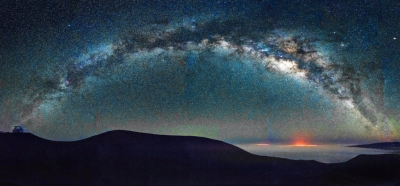
04HAWAII1-superJumboIt has been three long years since I was last on the summit of Mauna Kea. But at last, we were heading back up the mountain to see my husband's new instrument being installed on one of the telescopes at the KECK observatory. An experimental astro-physicist at Caltech, he and his team have designed a cutting-edge spectrograph for measuring and imaging the cosmic web. KCWI will be the ninth instrument between the two KECK telescopes on Mauna Kea and will become a wonderful boon to astronomers working in low brightness.

More importantly, though, this instrument had brought me back to Hawaii (Just kidding!).

The summit is other-worldly. In one respect, it reminds me of being in the Himalaya–as Mauna Kea is high enough to evoke that breathless, cloudless, stark lunar-scape quality one finds on the road to Ladakh. But this is Hawaii. So, rather than leaving behind the alpine beauty of Kashmir, on Mauna Kea you are but two hours away from mind-bogglingly gorgeous tropical beaches. It is unreal to see snow up there. Snow on Hawaii. A sleeping volcano, like Mt. Fuji, it is indescribably beautiful standing at the summit and watching the clouds roiling beneath you–on a good day you can see Hilo Bay off in the distance.

As you've no doubt heard, not everyone is happy to see this sublime landscape filling up with observatories. As of today, there are some twelve domes and a few scattered infrared and submilliter telescopes dotting the Martian-like landscape on the summit. In addition to KECK, other well-known observatories include the Gemini telescope (with its twin in Chile) and the Japanese beauty Subaru.

I wonder how many people probably have been reading about the controversy surrounding the Thirty Meter Telescope (TMT)?

Trying to do everything possible to meet the expectations of the native Hawaiian movement, the consortium (Caltech and UC; plus Canada, Japan, China and India) chose a spot not on the summit itself but in recessed spot below the summit, so that the massive dome would not be visible from below. The spot was cleared by archaeologists so as to guarantee it is not a burial place and it was also cleared by ecologists. Despite what would be a huge boon to the economy and great advantage to students in the University of Hawaii system, representatives of the movement felt enough was enough– and the gigantic telescope project is not going forward as planned. When I was there recently, I was talking on the beach with a couple from Canada about the situation, and they reminded me that this issue is not just about Mauna Kea or the native people of the Big Island, but rather all around the world, native peoples are being stepped all over. The pipeline immediately comes to mind. This controversy over TMT is bigger than this mountain. A small group was here protesting at Caltech Friday and one of the protester's signs really sticks in my mind.

It read, "Standing Rock is everywhere." (Article in local paper is here; my husband is the scientist quoted at the end).

So, the scientists might need to go elsewhere. It's not easy, of course, since Mauna Kea is one of only two nearly perfect spots in the world to make astronomical observations.

What makes it so perfect?

Read more »

This Populist Moment

by Akim Reinhardt

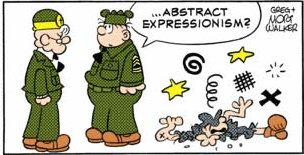
Beetle Baily by Mort WalkerLast week, Barack Obama got beaten up on social media and called out by the press for accepting a $400,000 speaking fee from a Wall Street investment firm. It was the day's major kerfuffle, the non-Trump story of the week, and reactions to it by many of my smart, well reasoned friends surprised me somewhat.

They began with the stance that this isn't an issue. Obama's a private citizen now, so who cares? But lots of people did care. When the story picked up steam despite their protestations, my friends then blamed the loony left for fabricating the issue, launching a general assault on fringe elements of the Democratic party and a firm defense of sensible centrist outlooks. Yet it wasn't just the left. The right predictably piled on as well, without any prompting from the left. The story also transcended the partisan divide as the centrist press ran with it. Christ, even the BBC, the vanilla pudding of international news, covered it.

In the end, the defense of Obama that gained the most traction among my friends, and to some degree in the national media, was a racial analysis. Some claimed that this brouhaha was another example of white people shaming a black man for earning a paycheck, the imposition of a racial double standard since white politicians and ex-politicians do this kind of thing all time.

This needs to be reckoned with. Obama was always held to a higher standard, precisely because he was black; he was always subjected to intense racism, and the racist backlash to his presidency as much as anything helps explain Trump's victory. Was this just another example of that racial double standard? It's an important question to ask.

Read more »

Disintermediating the trust equation or how to make sure you’re not talking to a dog

by Sarah Firisen

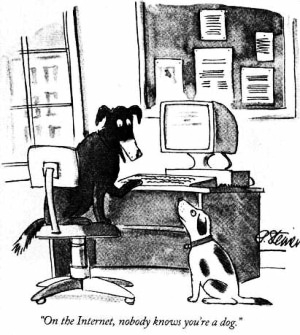
DogOn the Internet, nobody knows you’re a dog. This was the tagline of a great New Yorker cartoon years ago. The joke being that no one could ever be sure who the real person was sitting behind the online persona. Last night I was watching a re-run of the Big Bang Theory. Howard Wolowitz was trying to rekindle his relationship with Bernadette. Their relationship had ended when she had caught him pleasuring himself while “playing” in World of Warcraft with Glissinda the Troll. It’s later revealed that Glissinda the Troll is actually Steve, the greasy old fat guy in Facilities Management. The punchline speaks to a nagging fear that anyone who has flirted, or more, on the Internet with stranger.

Who are you? Prove it! We are asked to prove our identities all day, every day. And conversely most of us, in many situations, have a degree of skepticism about the identity of people when we first encounter them, particularly online. While the fears of being taken in by a con man or having one’s identity stolen have been around for as long as mankind has been, they’ve become far more of an everyday fear and valid concern since the rise of the Internet.

For the few painful years I participated in online dating, I learned to treat every new encounter with a healthy amount of suspicion; I became the queen of romantic sleuthing. And those suspicions proved over and over to not be the result of a paranoid mind but entirely valid. In fact, over time, I became more suspicious and skeptical about men I chatted with online because I encountered every form of deception: profile photos that were poached from the headshots of actors and models; lots and lots of married men pretending otherwise; made up careers; inaccurate geographic profiles. Some men were clearly outright con artists clearly hoping to lure some less guarded poor woman into some financial scam. Some were just trying to cheat on their significant others. Some wanted to get laid while they were passing through town and thought that their chances were better if they pretended to be locals. Almost everyone using online dating has told white lies about their age and or height. If nothing else, there’s a valid concern that if you tip over into a new decade that will immediately shut you out of searches and so saying 39 instead of 40 doesn’t seem so terrible. Of course, when you’re still saying 39 five years later, that white lie becomes an increasingly dingy shade of gray.

Read more »