by Paul Braterman
"Our MPs will be the 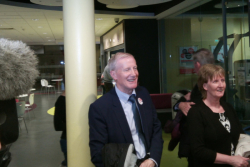 kingmakers, playing a huge role"
(From victory speech of Gregory Campbell, on right, 1 a.m. Friday 9th June, 2017)
Overview: I am assuming as I write this that the Conservative Party will remain in power in the UK for the immediate future. As a matter of arithmetic, this will require the cooperation of the Democratic Unionist Party. All this may, however, change at any time.
Update on the Orange Walk issue: it's already happening: "Supporters of the Democratic Unionist Party (DUP) are demanding Theresa May allow a banned loyalist march as part of an agreement by the Northern Irish party to prop up a minority Conservative government." Independent, Monday 12 June
Kingmakers. There is no doubt that this is how the Democratic Unionist Party (DUP) see themselves. And there is no doubt that they aim to exploit this role to the full. Not by formal coalition, the trap into which Nick Clegg so disastrously led his party in 2010, but "confidence and supply", which will leave them free to make new demands and to threaten to withdraw support at any time. I will not attempt to unravel the complex affairs of Northern Ireland, but with the settlement there more fragile than it has been for some years, the strengthening of one partisan faction must be a matter of concern. Anyone requiring evidence of the DUP's ruthless political infighting, inflammatory rhetoric, and skill at reopening old wounds is invited to visit their web site at http://www.mydup.com/.
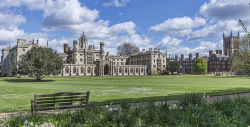 L: Saint John's College, Cambridge, where Nigel Dodds studied law
Nor should we fall into the trap of underestimating the DUP intellectually because of the crudeness of their dogmas. Nigel Dodds, of whom much more below, has a first-class honours degree in law from Cambridge University, while Ian Paisley Jr., MP for North Antrim and son of the charismatic Reverend Ian Paisley who founded the party, holds BA (hons) and MSSc degrees from Queen's University Belfast in History and Irish Politics.
Sectarianism and links to violence: The DUP is a sectarian party, founded by former members of the UUP (United Unionist Party) who considered that party's leadership too conciliatory towards the large Republican (i.e. Catholic) minority. In the late 1980s and 1990s, there were strong links between the DUP and Protestant paramilitary groups involved in arms smuggling and assassinations. The DUP now renounces violence, but there are strong family connections between the current contingency of DUP MPs, and the former leadership, and one of these MPs, Sammy Wilson, is on record as saying that if politically ignored, the people (i.e. Protestant people) of Northern Ireland may need to resort to violence.
Welfare: On welfare policy, the DUP is to the left of the Conservatives. They are opposed to the bedroom tax and means testing the winter fuel allowance, and wish to keep the "triple lock" on pensions.[1]
Read more »