bby Leanne Ogasawara
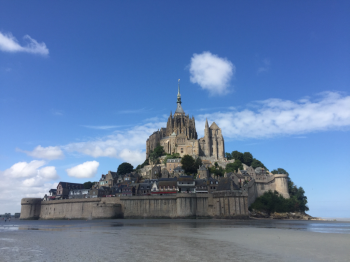
Ah, Mont Saint-Michel. We had just returned from the legendary floating island, and I had found myself utterly obsessed by the place. A fairy castle rising up out of the mist and waters of the tidal estuary in northern France, the abbey of Mont Saint Michel is sometimes associated with the ancient Breton myth of the submerged cathedral lying underneath the sea. The myth of the sunken cathedral was the inspiration for Debussy's famous piano prelude, La Cathédrale Engloutie. Debussy often frequented Mont Saint Michel, and while the abbey of Mont Saint-Michel never sinks beneath the sea, it does become inaccessible as it is surrounded by waters twice daily. In days past, completely cut off at high tide by the strongest tidal forces in Europe; those strong currents rush in at incredible speed, "like that of a galloping horse," said Victor Hugo.
Even today, the setting is indescribable. There is a short-story by Guy de Maupassant that I love because it so perfectly captures the magical and magnetic quality that Mont Saint-Michel holds on the imagination; especially on that of the pilgrim; for indeed, it has been a major place of Christian pilgrimage for over a thousand years.
The following morning at dawn I went toward it across the sands, my eyes fastened on this, gigantic jewel, as big as a mountain, cut like a cameo, and as dainty as lace. The nearer I approached the greater my admiration grew, for nothing in the world could be more wonderful or more perfect.
Seeing it for the first time last week, I simply could not believe my eyes. We had arrived as the abbey bells were ringing loudly in our ears and the army of day-trippers was pouring out in an endless tide back toward the parking lots to return to their cars and tour buses.
If you stay on the island overnight, I had read, you will have the place much to yourself after 7pm.