by Akim Reinhardt
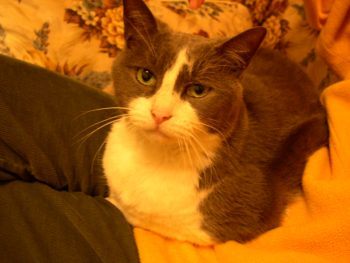
In early August of 2000, I made my way from Lincoln, Nebraska to Tempe, Arizona. I had recently completed my Ph.D. and was hustling off to begin work as a post-doc at Arizona State University. Everything I owned, including two cats, was jam packed into a red Ford Escort station wagon. As I zig-zagged my way from the Great Plains to the Southwest, I allowed the felines to roam free through its cramped quarters.
That was my first mistake.
Poopster, the sweet gray and white female with tons of charm but not a whole lot upstairs, settled in nicely, nestling on the floor board near my feet. But Shango, the tiger with white socks who was the brains of their operation, freaked out. Somehow he managed to wedge himself underneath the driver’s seat.
My second mistake was letting him stay there.
He’s scared, I thought to myself. If he feels safe, just let him hunker down there. What harm could it do?
Never once did it occur to me that, at some point during this cross-country trip, he would have to relieve himself.
I had that car another three years, but despite my best efforts at detailing and perfuming, the smell never really went away. More than a year later, it was still bad enough that my girlfriend refused to drive with me from Philadelphia to Detroit to attend a wedding.
Funny though. The Colorado state trooper who pulled me over for speeding, when that urine was really fresh and pungent, didn’t seem to notice at all while he was writing me up. Read more »
 Just about everyone who visits the famous
 My seventy-something year old uncle, who still uses a flip phone, was talking to me a while ago about self-driving cars. He was adamant that he didn’t want to put his fate in the hands of a computer, he didn’t trust them. My question to him was “but you trust other people in cars?” Because self-driving cars don’t have to be 100% accurate, they just have to be better than people, and they already are. People get drunk, they get tired, they’re distracted, they’re looking down at their phones. Computers won’t do any of those things. And yet my uncle couldn’t be persuaded. He fundamentally doesn’t trust computers. And of course, he’s not alone. More and more of our lives have highly automated elements to them,
  The Anna Karenina Fix
 In the Third Essay of On the Genealogy of Morality, Nietzsche levels a powerful attack on the modern Platonistic conception of mind and nature, urging us to reject such “contradictory concepts” as “knowledge in itself,” or the idea of “an eye turned in no particular direction, in which the active and interpreting forces, through which alone seeing becomes seeing something, are supposed to be lacking.” More recently, Donald Davidson’s attack on the dualism of conceptual scheme and empirical content, and thus of belief and meaning, requires us to see inquiry into how things are as essentially interpretative.
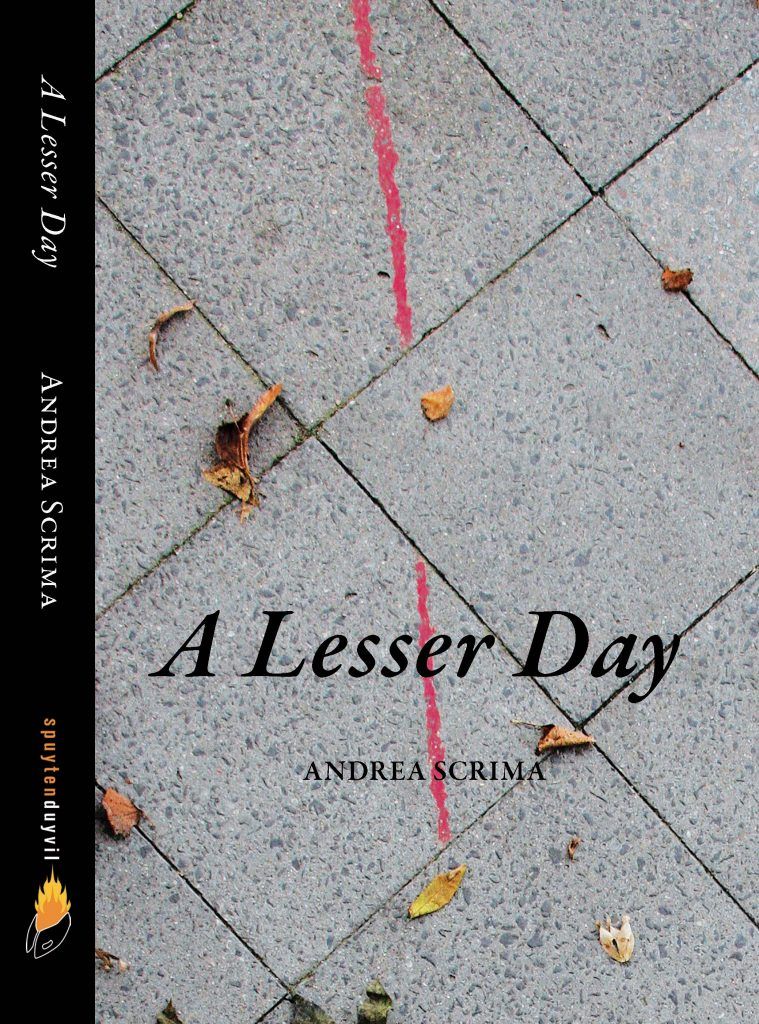 Andrea Scrima: As a visual artist, I worked in the area of text installation for many years, in other words, I filled entire rooms with lines of text that carried across walls and corners and wrapped around windows and doors. In the beginning, for the exhibitions Through the Bullethole (Bemis Center for Contemporary Arts, Omaha), I walk along a narrow path (American Academy in Rome) and it’s as though, you see, it’s as though I no longer knew… (Künstlerhaus Bethanien Berlin in cooperation with the Galerie Mittelstrasse, Potsdam), I painted the letters by hand, not in the form of handwriting, but in Times Italic. Over time, as the texts grew longer and the setup periods shorter, I began using adhesive letters, for instance at the Neuer Berliner Kunstverein, Kunsthaus Dresden, the museumsakademie berlin, and the Museum für Neue Kunst Freiburg. Many of the texts were site-specific, that is, written for existing spaces, and often in conjunction with objects or photographs. Sometimes it was important that a certain sentence end at a light switch on a wall, that the knob itself concluded the sentence, like a kind of period. I was interested in the architecture of a space and in choreographing the viewer’s movements within it: what happens when a wall of text is too long and the letters too pale to read the entire text block from the distance it would require to encompass it as a whole—what if the viewer had to stride up and down the wall? And if this back and forth, this pacing found its thematic equivalent in the text?
 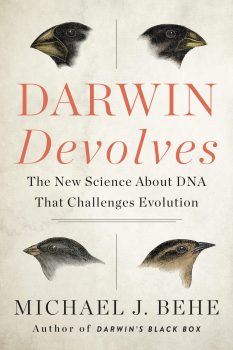 “[T]here is in fact nothing that can alleviate that fatal flaw in Darwinism” says Professor Behe,
  rapture, claiming that “Michael Behe’s Darwin Devolves Topples Foundational Claim of Evolutionary Theory” and that “Anyone interested in knowing the truth about the design/evolution debate will find Darwin Devolves a must read.”
 I wonder whether Behe’s most vociferous supporters actually understand his position. Unlike them, he


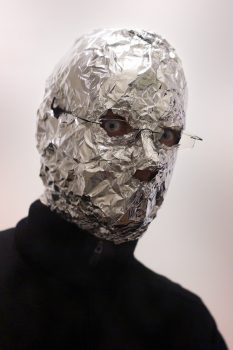 I was lugging several superheavy boxes of dishes up the concrete stairs from the sidewalk to the front door when a guy in a silver suit materialized in front of me. The first rule of moving is that when you pick something up, you don’t put it down until you have it where it goes. This is because picking it up and putting it down are half the battle. So, I tried to go around him.