by Rafaël Newman
Morgan Meis, The Drunken Silenus: On Gods, Goats, and the Cracks in Reality (Slant Books, 2020)
Reviewing a new translation of the Iliad, the military historian Edward Luttwak speculates about the enduring popularity of the ancient epic:
Why are our contemporaries so keen on buying and presumably reading the Iliad’s Iron Age reminiscence of Bronze Age combat? Publishers certainly view it as a paying proposition: at least twenty new English-language translations have been published since 1950, not counting ones from private presses. In Greece, as in Italy for students of the liceo classico, it is a compulsory school text (several modern Greek versions also serve as cribs), but why are the passengers at Terminal 2 in San Francisco buying the English versions? Uniformed and desert-booted soldiers are a common sight in US airports – the uniform secures lounge access and early boarding – and it is a fair surmise that warriors and would-be warriors, these days more often college-educated, are war-book buyers, of which the Iliad is the echt and ur. Some of course – nasty fellows – would widen the explanation by seeing Americans as a whole as war-lovers, hence war-book addicts, hence Iliad buyers. That’s lame to begin with, for there are countless ways of getting that fix much more easily than by reading 15,693 lines of hieratic verse bound to offend military history buffs, because of … the extreme, pervasive emotionalism – all the weeping wives of other war books are outdone by the floods of tears of Homer’s greatest warriors…
For the ancient heroes in Homer’s epic – Achilles, Agamemnon, Odysseus – are indeed often to be found weeping, whether in conventionally lachrymose settings, such as over the death of a comrade in battle or at a funeral, or when enraged and frustrated at the indignities visited on them, or, signally, when recalling their own brilliant past and lamenting their impending mortality, and subsequent obscurity. Read more »

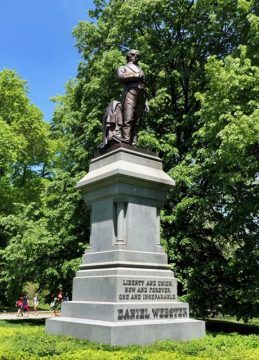 There is a statue of Daniel Webster in Central Park. It is tucked in at the intersection of West and Bethesda Drives, massive and unmoving, implacable and forbidding. Despite its size, it goes largely unnoticed, except as a meeting point.
 I’ve taught shittily these last two months. That’s nothing a teacher ever wants to admit and normally has no excuse for, but these are not normal times.


 Two months ago, COVID lockdown was still new; in the US it was horrific that
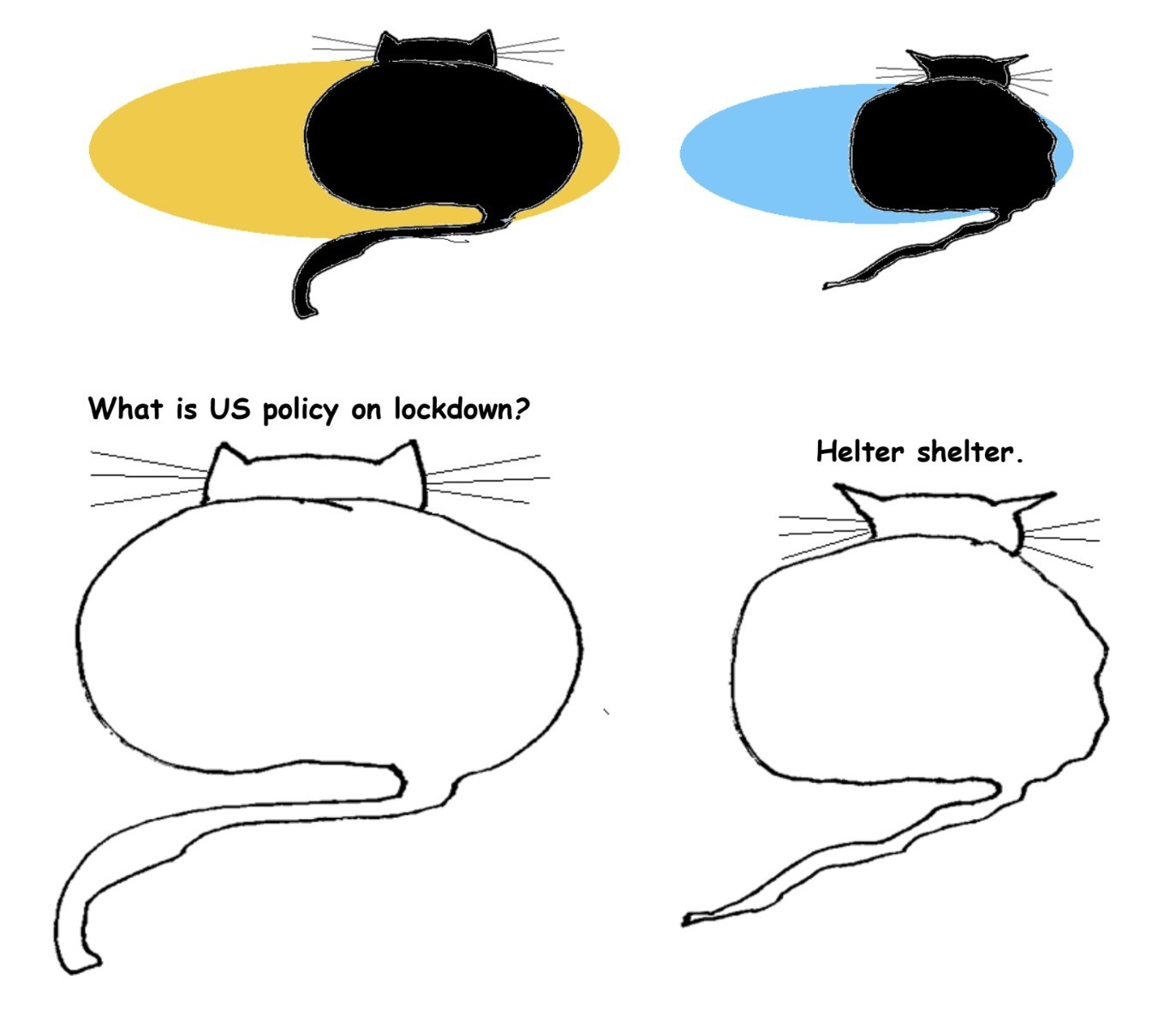
  Today will mark the death of at least one hundred thousand Americans because of COVID. The science was clear. Lockdown. Stop movement. Distance. This would have stopped large numbers of people dying. In short, stopping the virus from becoming a pandemic meant pausing the profit principle.
 Jon Hassell is one of America’s musical treasures, and I’ve been listening to his music for forty years, so when I heard he needed help for his medical care, I decided to make a mix of his music. This mix actually grew into two mixes, so look for another one next month. This one features Jon playing with other musicians, and part two will feature other musicians whom Jon has influenced (and a bit more from Jon himself).