by Rafiq Kathwari
Before the Modi regime annexed Kashmir on August 5th last, Jawaharlal Nehru, India’s first prime minster, in fact annexed Kashmir in 1947 just months after India partitioned herself to create the new state of Pakistan.
Delhi flew in a regiment of troops to Srinagar as soon as the Maharajah of Kashmir signed an Instrument of Accession. Even the great Mahatma Gandhi approved of Nehru’s action.
Modi’s so-called annexation last year was religiously motivated. Kashmir penetrates the core of Hindu nationalist idea of Akhand Bharat, united, undivided Hindu India from Afghanistan to Pakistan to Myanmar to Thailand, Cambodia and Laos.
That’s the map draped in orange the color of choice of the Rashtriya Swayamsevak Sangh, RSS, founded in 1924, a volunteer army of the young, world’s largest fascist organization, based in Nagpur. It’s the parent organization of the Bharatiya Janata Party, BJP, the present xenophobic regime in Delhi.
Modi’s functionaries told their Hindu goons that Kashmir’s Muslim majority population was now truly an integral part of India and that Hindus should at once apply for Domicile Certificates to buy property in Kashmir. and marry fair-skinned Kashmiri girls.
But Nehru loved Kashmir. It was his ancestral home. His family were Kashmiri pandits. There are 250,000 pandits in Kashmir, 3% of Kashmir’s 8 million Muslims. Pandits are 0.1% of India’s 1.2 billion, but Modi’s regime has weaponized the 0.1 % pandits to rouse India’s Hindus. Modi will dump the pandits after doing his feats, and the pandits know it. Read more »
 America is a truck rolling down a hill towards a cliff. The downhill slope is the erosion of democratic norms; the cliff is the point where anti-democratic forces become powerful enough to crush democratic opposition by authoritarian means. The re-election of Donald Trump would very likely see the country sail over that cliff.


 Actress Cameron Diaz and her business partner, the entrepreneur Katherine Power, have been all over various media promoting
 On November 11, 2019, I wrote a
 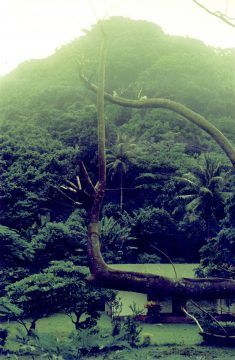 In 1997, I was living on Ambae, a tiny, tropical island in the western South Pacific. Rugged, jungle-draped, steamy, volcanic Ambae belongs to Vanuatu, an archipelago nation stretching some 540 miles roughly between Fiji and Papua New Guinea. There, under corrugated tin roofs, in the cinderblock classrooms of a small, residential school, I taught science to middle- and high-schoolers as a Peace Corps volunteer.