by Thomas O’Dwyer
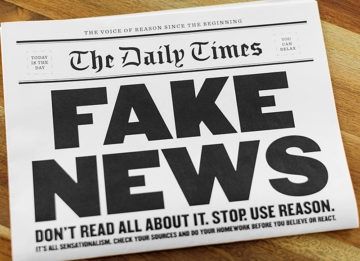 On 9 October 1990, President George H.W. Bush held a news conference about Iraqi-occupied Kuwait as the US was building an international coalition to liberate the emirate. He said: “I am very much concerned, not just about the physical dismantling but about some of the tales of brutality. It’s just unbelievable, some of the things. I mean, people on a dialysis machine cut off; babies heaved out of incubators and the incubators sent to Baghdad … It’s sickening.”
What’s sickening is that this was fake news, broadcast by the president at a time when there was plenty of real information coming out of Kuwait. Iraq had invaded Kuwait on 2 August 1990, and the following day Kuwaitis living in the US hired a public relations firm, Hill & Knowlton, in a $12–million deal, the biggest contract in the history of public relations at the time. The firm settled on a strategy of publicising atrocities being committed by Iraqi troops in Kuwait. Here was born the great incubator lie — a story claiming that Iraqi soldiers ransacked Al-Adan hospital, ripped sick and premature babies from incubators and left them on the tiled floor to die before shipping the incubators off to Baghdad. The story was an “eyewitness account” made public by a tearful 15-year old girl named only as Niyirah, who said she had worked as a volunteer in the hospital maternity ward. The tale was graphically told to Congress in November 1990 before it passed a crucial vote to send US troops to liberate Kuwait.
The move towards the First Gulf War was motivated by a blatant lie. Hill & Knowlton had coached the girl to tell her story without revealing that Niyirah was the daughter of the Kuwaiti Ambassador to the US, Saud Nasir al-Sabah and that she had not been in Kuwait during the invasion. Nurses who lived in accommodation opposite Al-Adan hospital told reporters they had never seen the girl before her public appearance. It took months for the truth to emerge, and Bush mentioned the incubator incident in five of his speeches. Seven senators also referred to it in speeches backing the pro-war resolution. The problem with fake news is not just its fakeness, but that it distorts and discredits real and essential information, especially regarding atrocities. It also undermines the credibility of actions based upon it. Read more »
 Escape. When I was a child, I read at every opportunity. If I could, I’d read on the playground; at one point, I was allowed to spend recess in the library and read there. Overall, teachers seemed unenthusiastic about the idea of a kid reading during recess. My mother, a great reader herself, used to tell me that reading was a treat, to be saved for the end of the day when all the work was done. When I was reading, I wasn’t playing with the other kids or helping out with the housework, as I should have been. But I was one of those people described by Penelope Lively, people who are “built by books, for whom books are an essential foodstuff, who could starve without.”
 Christmas is traditionally a time for stories – happy ones, about peace, love and birth. In this essay I’m looking at three Christmas stories, exploring what they tell us about Christmas: the First World War Christmas Truce,




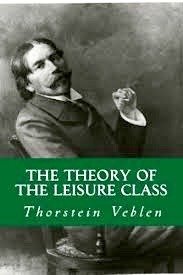 Thorstein Veblen’s The Theory of the Leisure Class is a famous, influential, and rather peculiar book. Veblen (1857 – 1929) was a progressive-minded scholar who wrote about economics, social institutions, and culture. The Theory of the Leisure Class, which appeared in 1899, was the first of ten books that he published during his lifetime. It is the original source of the expression “conspicuous consumption,” was once required reading on many graduate syllabi, and parts of it are still regularly anthologized.