
by Jonathan Kujawa
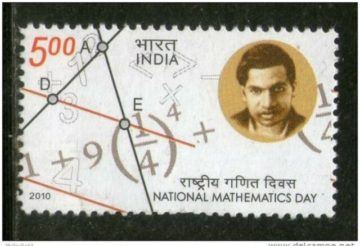
On December 22nd I started thinking about topics for this month’s 3QD essay. In a happy coincidence, someone posted to Twitter that Srinivasa Ramanujan was born on December 22, 1887. We’ve touched on Ramanujan’s work here at 3QD, but it seemed like a sign that we should dive a little deeper [0].
The story of Ramanujan is now famous, especially after the award-winning film “The Man Who Knew Infinity” [1]. He was born in southern India into a poor family. His talent in mathematics was noticed at an early age, but it wasn’t until he got hold of a copy of G. S. Carr’s “Synopsis of Pure and Applied Mathematics” at the age of fifteen that his talent was really revealed. Carr’s book was meant to be a Cliff Notes to undergraduate mathematics for students cramming for Cambridge University exams. It gave little to no explanations — just a thousand pages of raw, uncut mathematical formulae stated as gospel. Using Carr’s book, Ramanujan taught himself mathematics.
Ramanujan became consumed with his own mathematical explorations. So much so that he neglected his college studies and failed out after the first year. He continued to do math and live in poverty until his mother arranged for him to marry S. Janaki in 1909. Feeling the responsibility of marriage, Ramanujan eventually found employment as a clerk in the Madras Port Trust Office and in 1913, thanks to the encouragement of other mathematicians in India, finally sent a letter containing some of his results to several famous mathematicians in the UK.
Faithful 3QD readers might recognize the first of the following formulas from Ramanujan’s letter:

In one of my first essays for 3QD I talked about how you can make sense of infinite sums and how, properly interpreted, it is reasonable to think of the sum of all the counting numbers as equal to -1/12. Read more »


 It’s Monday, 1:45, and six men and I sit in a circle with our German-trained psychotherapist, an imperious woman who reminds us that she is here to help only if we get bogged down or offer guidance and that we men need to find our own way through our turmoil, which is the point of the group and the point of each of us paying $3000 per year. I’m fairly new, so before I speak, I’m seeking some level of comfort or commonality among us, and every week I come up short. I’m not yet adjusted and unsure what I should be adjusting to.
 We are entering the aftermath. Two of the most epic and wrenching struggles in American history are finally playing out to their conclusions. At last we see a conclusive democratic rejection of a presidency built on systematic lying and racism. At the same time we look just weeks or months ahead for vaccines that will liberate us from our deadly yearlong pandemic.
 A Task for the Left

 The first time I ever left home without leaving home I was twelve years old, recently back from a winter trip to Mexico. Routinely sent to bed at 8 pm (my parents were old and old-fashioned), always wondering how to fill the inevitable two hours of insomnia, I opted to return to Mexico, not as the sleepless chiquita that I was, but as the fierce guerilla chief I would become in the narrative, leading a band of outlaw Aztecs in raids against a host of injustices from base camp in a desert. No precedents existed for my leadership skills in real life, but within the carefully sculpted storyline of the daydream, I was both charismatic and respected, not merely proficient but also inspired, a warrior queen to rival any Amazon.
 In the summer of 2000, after completing my bachelor’s degree in engineering, I had to decide where to go next. I could either take up a job offer at a motorcycle manufacturing plant in south India, or I could, like many of my college friends, head to a university in the United States. Most of my friends had assistantships and tuition waivers. I had been admitted to a couple of state universities but did not have any financial support. Out a feeling that if I stayed back in India, I’d be ‘left behind’ – whatever that meant: it was only a trick of the mind, left unexamined – I took a risk, and decided to try graduate school at Arizona State University. I hoped that funding would work out somehow.
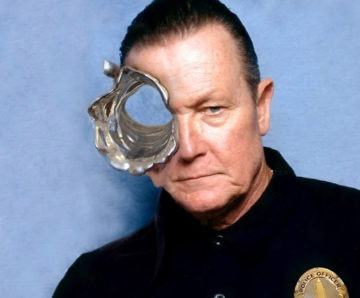 One of the most interesting and memorable characters in sci-fi films is the



 Bisa Butler. The Safety Patrol. 2018.
 On 9 October 1990, President George H.W. Bush held a news conference about Iraqi-occupied Kuwait as the US was building an international coalition to liberate the emirate. He said: “I am very much concerned, not just about the physical dismantling but about some of the tales of brutality. It’s just unbelievable, some of the things. I mean, people on a dialysis machine cut off; babies heaved out of incubators and the incubators sent to Baghdad … It’s sickening.”