
Editor’s Note: Frans de Waal’s new book, Different: Gender Through the Eyes of a Primatologist, has generated some controversy and misunderstanding. He will address these issues in a series of short essays which will be published at 3QD and can all be seen in one place here. More comments on these essays can also be seen at Frans de Waal’s Facebook page.
by Frans de Waal
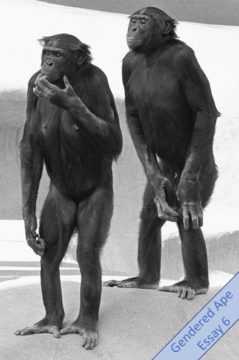
It’s not always easy to talk about bonobos at academic gatherings. There is no issue with fellow primatologists, who are used to straightforward descriptions of sexual behavior and know the recent evidence. But it’s different with people outside my field, such as anthropologists, philosophers, or psychologists. They become fidgety, scratch their heads, snicker, or adopt a puzzled look. Why do bonobos stump them?
One reason for the discomfort is excessive shyness about erotic behavior, which bonobos exhibit in all positions that we can imagine, and even some that we can’t. Moreover, these apes do it in all partner combinations. People assume that animals use sex only for reproduction, but I estimate that three quarters of bonobo sex has nothing to do with it.
But there is a deeper reason why bonobos are the black sheep of our extended family despite being as close to us as chimpanzees. They fail to conform to the traditional model of the human ancestor. Most evolutionary scenarios of our species stress male bonding, male dominance, hunting, aggression, and territorial warfare. This is how our species conquered the earth, it is thought.
Chimpanzee behavior, which can be quite violent, lends support to this narrative. This ape is therefore happily embraced as model. The peaceful, female-dominated bonobo, on the other hand, doesn’t fit. The species is sidelined, such as in “The Better Angels of Our Nature,” in which Steven Pinker calls bonobos “very strange primates.” And Richard Wrangham, in “The Goodness Paradox,” portrays them as an evolutionary offshoot, who “have gone their separate way.” In other words, bonobos may be delightful apes, they are bizarre and irrelevant. Let’s just ignore them! Read more »
 The Fate of the Animals: On Horses, the Apocalypse, and Painting as Prophesy (Three Paintings Trilogy), by Morgan Meis, Slant
 Scheduled departure at Dulles came and went as we waited for the last passenger to board. Although the non-smoking section in the rear cabin was full, the smoking section where I sat was half empty. Death by asphyxiation on the flight to Paris was a distinct possibility but with three empty, adjacent seats in the centre nave there was some chance that my obituary might read, “She died peacefully, in recumbent sleep.”
 Indifference is an attitude first theorised as a philosophical stance by ancient Greek Stoic philosophers from the 3rd century BC. It was conceived as the right attitude to cultivate in reaction to indifferent things. What was surprising were the things the Stoics considered to be indifferent and hence require us to be indifferent to. Not your usual ‘whether the number of hairs on your head is odd or pair’, or the number of billions of stars in the galaxy, or even what colour underwear your boss wears – though in some circumstances, the latter can start becoming titillating. And titillation is of course what it’s all about. It’s the tickle that spurs the Stoic to resist it. Resisting what exactly? Feeling, uncontrolled gratification, heart-melting, giving in, touching, kiss-&-make-up-ing.
 Deborah Roberts. Shankia and Grace. 2021.
 According to the meta-charity



 There are certain words that seem to take on a life of their own, words that spread imperceptibly, like a virus, replicating below the level of consciousness, latent in our environment and culture, until suddenly the word is everywhere, and we are afflicted with it. We may even use these words ourselves: we struggle to find the right phrase, the true word to capture our intention, and these words come to us unbidden, floating into our minds from somewhere out there, and we speak the word without understanding what we really mean, but we see understanding and acknowledgement in the face of our interlocutor, and we know we have hit upon the correct utterance that will mark us as one who belongs.


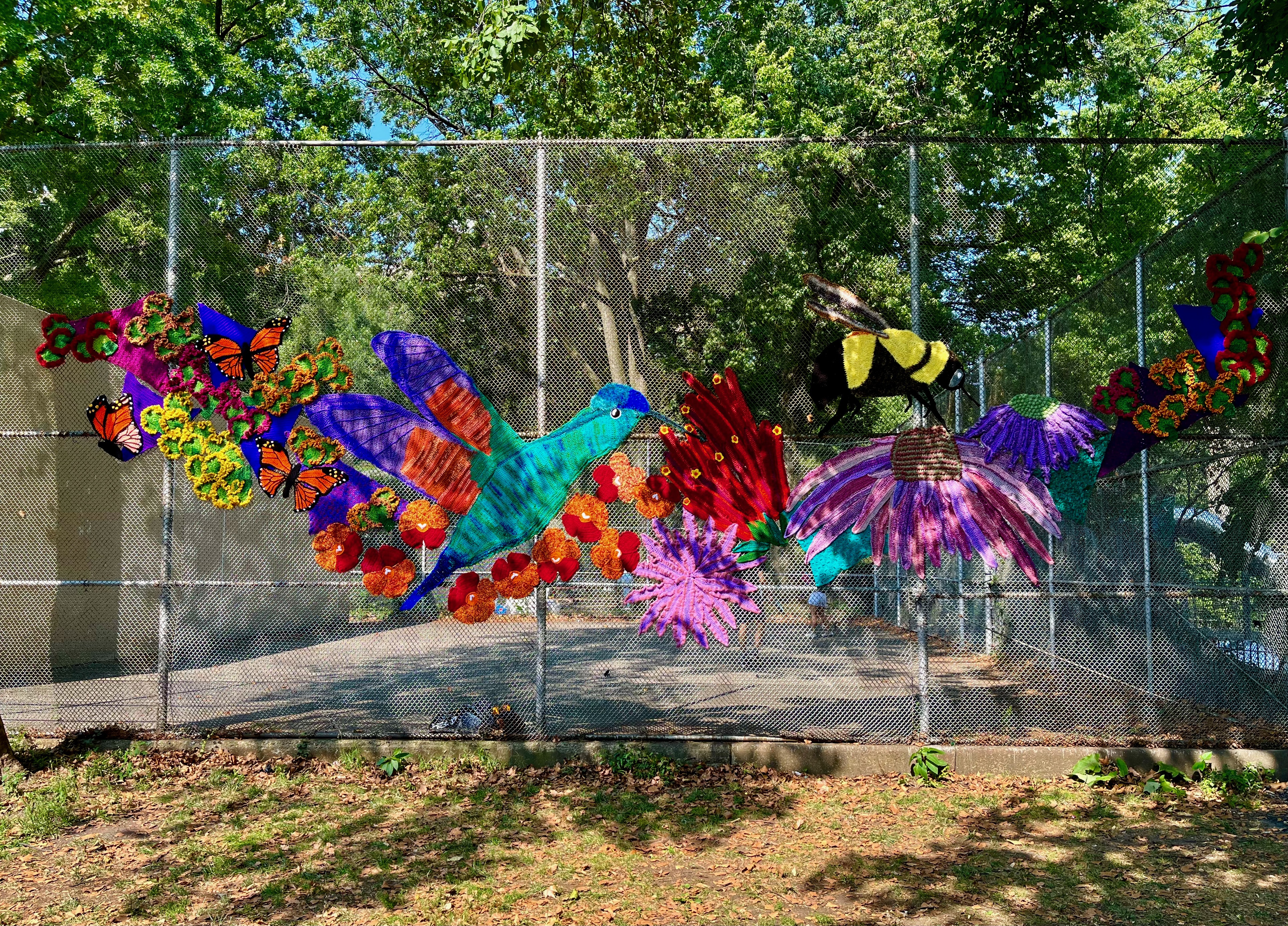 Naomi Lawrence. Tierra Frágil, 2022.