by Brooks Riley

by Brooks Riley
by O. Del Fabbro
 If a city could be an organism, then Kherson in Eastern Ukraine would be a sick body. For eight months, between March and November 2022, Kherson was occupied by Russian forces. Kidnapping, torture, and murder – in terms of violence and cruelty, Kherson’s citizens have seen it all. Today, even though liberated, the port city on the Dnieper River and the Black Sea is still being regularly bombarded: a children’s hospital, a bus stop, a supermarket. Even though freed, how could this city ever heal?
One of Kherson’s citizens is Andryi. As soon as the Russians left, Andryi and his friends started with humanitarian work. For months the former car mechanic had no job. He rather helped others. When the pastor of his church found out about Andryi’s skills to repair roofs, he gave him some money and assignments. “My friend and I started with a house in which an old grandmother and her son lived.” Before Andryi and his friend started their work, three different groups looked at the roof but did not dare to repair it, because the Russians were only four hundred meters away, on the other side of the Dnieper River, waiting to kill humanitarian aid workers. “We decided to do it, and we did it. Praise the Lord, nothing happened.” Three days later, the roof was finished.
While repairing roofs Andryi has been exposed, both indirectly or directly, to a variety of weaponry: mortars, snipers, rockets, you name it. “When we repaired roofs, artillery fire was constantly active. Once, we saw phosphorous bombs in the near distance, then we hid in the basement.” The last roof was the scariest experience. Some of the material that Andryi and his partner use is a plain white awning, easily detectable by the Russians. Being only one kilometer away, the Russians bombarded Andryi and his friend with mortars, but luckily, they missed. “That was scary, but they did a bad job in trying to hit us.” In total, Andryi counted twenty-six explosions. “It was frequent, loud, and very close.” When talking about his war experience, Andryi has, as many Ukrainians, a dry and succinct way of expressing himself. “You realize that you can get hit, when you hear the bomb exploding.”
Friends, family, donations via social media, the pastor, and the members of his church helped to buy materials such as nails, wood and so on, but at some point, Andryi and his friend ran out of money. He then simply helped the military by using his skills as a car mechanic. He built a heavy machine gun on the back of an old Rada, or repaired the sewage system of a village in the countryside near Kherson. Read more »
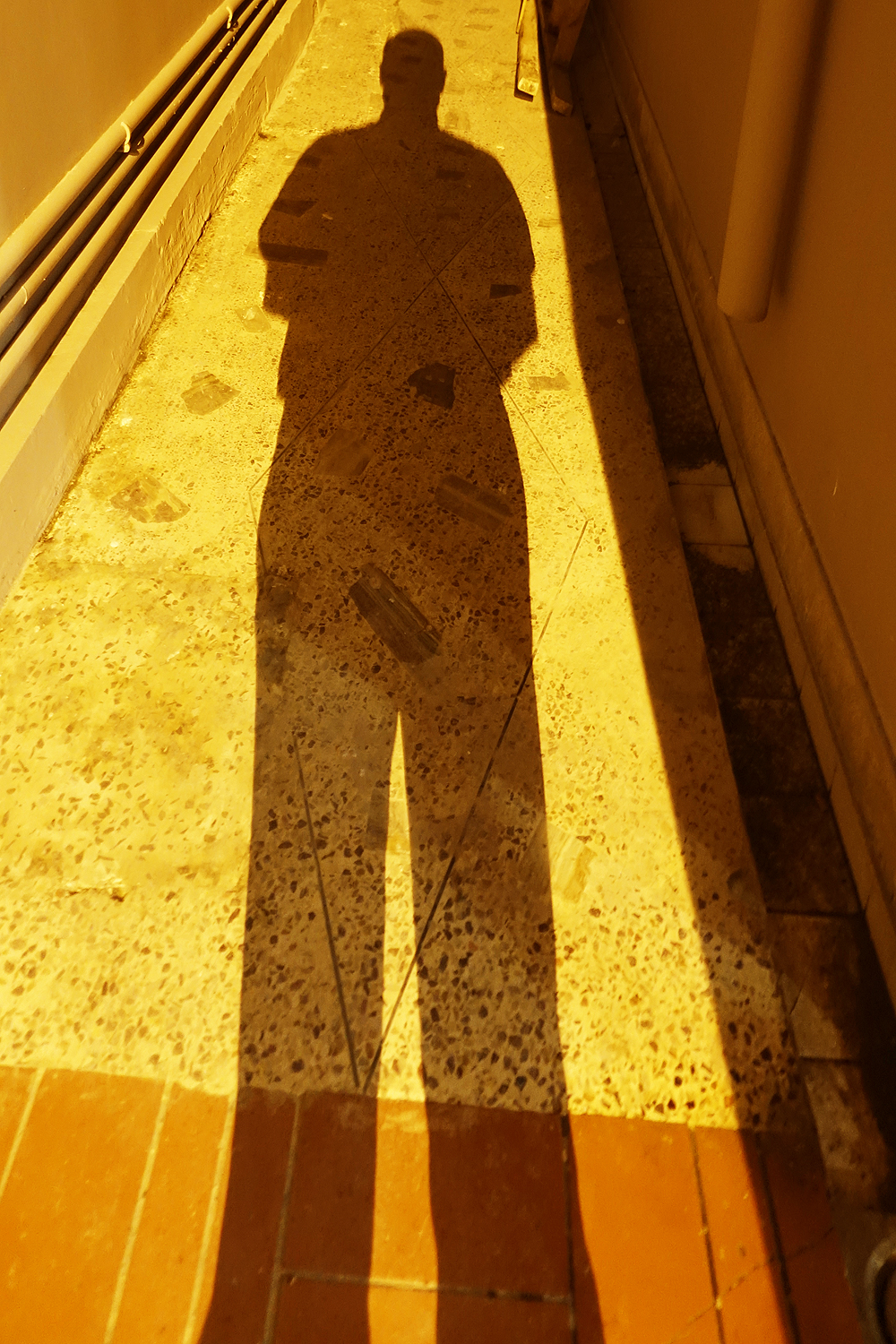
At my brother Javed’s house in Karachi last night.
by Ethan Seavey
Exile is on my mind and there’s a large full moon above my head I cannot see through the clouds.
I am part of a family of three exiles who are doing it again, recovering after exile, and working hard to stay together. Our shared communities have dropped us for the third time and it feels like I finally recognize the pattern we’ve always fallen into :
1) Find a community that embraces us because it excludes others; and 2) get rejected when we grow to learn that we have become the others.
When I came out as gay in 2015 my family stopped going to Church, specifically the one where we had been attending weekly (with few exceptions) for somewhere around a decade.
It was a personal decision for each one of us. It was an effort to support me. It was also a social decision. While this Church was more progressive than others, it was still a Catholic Church. It seemed to me that priests were required to spend a Sunday sermon every year talking about how being gay is a sin; sometimes hiding it behind the idea that being gay was not a sin so long as you never acted on it.
Many people within that Church remained close friends. They’d ask why we’d stopped attending and I was the reason. It didn’t distance most of our friends, but I remember my younger sibling was forbidden from spending time with one of their friends outside of the friend’s home, because the friend’s mom saw me as a bad influence. Read more »
by Oliver Waters
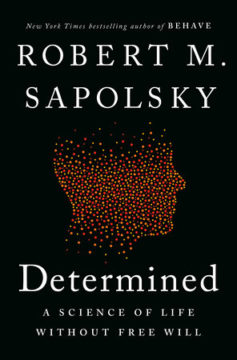 Two popular books released this year have breathed new life into the ancient debate over whether we have free will.
In Free Agents, Kevin Mitchell argues that we do, and in Determined, Robert Sapolsky argues that we don’t. To be blunt, on the big issue at hand – Mitchell is right and Sapolsky is wrong.
Despite this, Sapolsky does make a compelling case however for not excessively condemning or praising people for their decisions. The sections of his book that focus on well-evidenced pathologies that drive criminal behaviour and why policymakers should take these into account are insightful and engagingly written.
The problem is that Sapolsky extrapolates from this to an outrageously untenable position:
“We are nothing more or less than the cumulative biological and environmental luck, over which we had no control, that has brought us to any moment.”
Sapolsky mistakenly infers that because there are many factors beyond your control that influence your decision-making, those factors entirely caused your decision. But all that is needed for a reasonable concept of ‘free will’ to get off the ground is that part of the decision was within your control. This of course begs the question whether a meaningful entity called you actually exists, which has causal power beyond the sum its parts. Read more »
by Nate Sheff
 We all naturally take an interest in the night sky. Just last week, my fiancee and I attended an event put on by the Astronomical Society of New Haven. Without a cloud in the sky, near-freezing temperatures, and a new moon, the conditions were ideal for looking through telescopes the size of cannons. To see anything, you had to stand in line, in the cold, for your opportunity to look at something for a minute.
A surprising number of people turned out for this opportunity. By the time we left, there had to be about a hundred people (and more likely arrived later), making up a good cross section of society. And they all enjoyed themselves. The most memorable attendee was a woman in front of us in line to see Jupiter. The astronomer at the telescope told her to look at the dark bands that are the eternal storms in the planet’s atmosphere.
“Wow,” she said, stepping away.
The astronomer asked, “Did you see the moons?”
“The moons?” She looked again. We could see them through the binoculars we brought: four points almost in a line near the planet, glittering in the dark.
“Those are moons?”
That one piece of information transformed the appearance of the planet from a lonely island to a tidy neighborhood.
Immanuel Kant’s tombstone has a line from the Critique of Practical Reason: “Two things fill the mind with ever new and increasing admiration and awe, the more often and steadily we reflect upon them: the starry heavens above me and the moral law within me.” Whether or not you agree with him on the moral law, you can’t fault him for his view of the stars. Read more »
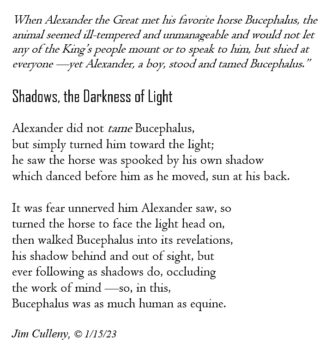
by Mary Hrovat

The other day I was looking up an anthropological discovery I’d seen mentioned online someplace. The discovery seemed a little dodgy upon closer inspection, but in my search I found the Wikipedia page List of places with columnar jointed volcanics. I wasn’t looking for information about volcanic rocks that have undergone columnar jointing, but I was happy that this wonderfully browsable list exists.
When I hear the word lists, I tend to think of the kind that are perhaps necessary but rarely enjoyable: the shopping list (often incomplete, seldom structured well with regard to the layout of the grocery store) or the to-do list (possibly a bad idea altogether). There are also lists that make me feel like I’m being forced down the neck of a narrow funnel with small benefit to myself: anything that begins “Your application must contain the following” or “You may be eligible for this tax credit if any two of the following are true (but see also the table on page 129).”
I’m also not fond of the lists encountered when seeking healthcare, although on rare occasions I’ve found them mildly entertaining. Once I was going down a list of symptoms to identify the ones I’ve experienced, and I asked my companion the difference between anxiety and nervousness. “If you have to ask…,” he said, smiling. “Oh yes, I’m going to check both boxes,” I said. “I was just curious.” A little further down the list, we puzzled over whether “dry mough” meant dry mouth or dry cough. In short, this list seemed a bit slapdash. Technical checklists should be the clearest and least ambiguous of all lists, but at least this one’s ambiguity was amusing. (Besides, it was an eye doctor’s office; if they really cared about my mough, they would have corrected that error long ago.) Read more »
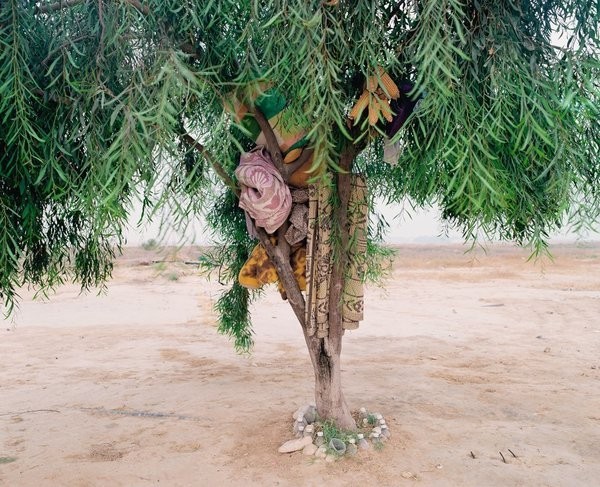 Ron Amir. Bisharah and Anwar’s Tree, 2015. From the exhibition titled Doing Time in Holot.
C print.
“The work of Israeli artist Ron Amir exposes complex social situations that tend to stay outside our field of vision. Between 2014 and 2016, Amir photographed African asylum seekers living in the Holot Detention Center in the Negev, and this important project of politically engaged photography was the subject of his first solo exhibition at the Israel Museum. The publication accompanying the exhibition presents an album of Amir’s images and an analysis of his work by curator Noam Gal. Texts by Reut Michaeli of the Hotline for Refugees and Migrants in Israel and by the eminent social-cultural anthropologist Arjun Appadurai extend the discussion to address the project’s national and global aspects.”
by Mike Bendzela
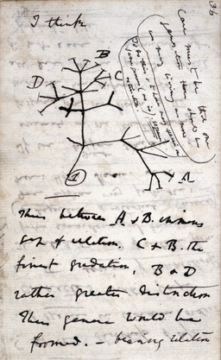
The greatest of stories has no proper beginning, at least none that we can yet discern, but proceeds from a warm, shallow shore some 375 million years ago.
There a lobe-finned fish found a way to use its bony limbs to stand up under water. It was thus able to lift its head out of the murk and gaze upon new shores that its descendants would populate.
Down through seemingly endless iterations of change, these fins were further exapted for such tasks as slogging through mud, scurrying through grass, clambering up trees, plucking fruit, scribbling letters.
The story continues on a cool, northern island, in a place called Downe, in June of the year 1858. There one of this fish’s descendants, Charles Darwin–a travel-weary, physically ill, gentleman scientist–holds in his hand an envelope addressed from the island of Ternate in Indonesia. The enclosed missive will change his world–and everyone’s–forever.
Darwin is not ready for this blow. His infant son, Charles Waring Darwin, born with Down syndrome, is not doing well: the boy is infected with the bacterium that causes scarlet fever, the same disease that killed his older sister seven years ago.
After this girl, Anne, had finally succumbed to the disease, Darwin wrote that his wife Emma and he had buried “the joy of the household,” and he settled into a long sadness.
And now it is happening again. Read more »
by Brooks Riley
by Mindy Clegg
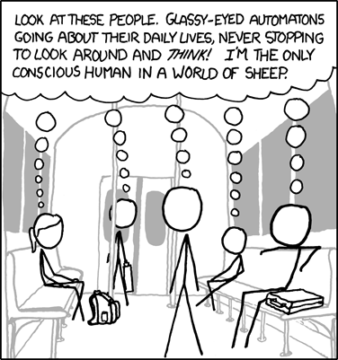
In recent years, some of the most powerful people in our society have claimed to be beleaguered outsiders. The former president is just one of the many powerful, wealthy, privileged people who declared themselves victims of a society out to destroy them and their way of life, which we’re meant to understand represents that of “real” Americans. Despite experiencing an incredibly privileged life, they claim to be the ones who are victims of jackbooted leftist thugs. There seems to be a whole cottage industry of people who rake in money by the bucketload while claiming to speak truth to the oppressive liberal/marxist power structure. They claim to be the authentic voice of the American working class, unlike the coastal elites who have no understanding of “real” life, but of course, despite their obvious privilege, they do understand the struggles of the common man. How did we get here, where men who benefit most from our social structures, position themselves as the little guy? This comes from a longer history of political shifts in America and of the rise of mass cultural consumption as a means of political expression. As culture came to stand in for political rebellion, the far right sought to weaponize mass culture to sneak in far right, reactionary ideology via the back door. But their ability to embrace an outsider status is evidence of their own privilege, as being an outsider has a strong cultural cache in our current mass mediated environment. Read more »

Take her and cut her out in little stars,
And she will make the face of heaven so fine
That all the world will be in love with night
And pay no worship to the garish sun.
by John Allen Paulos
Philosopher Daniel Dennett’s new book, I’ve Been Thinking, just came out, and I was reminded of a party game he’s written about. A variant of the child’s game of twenty questions, it is relevant to an increasingly pressing question: How do different social bubbles, media subcultures, or cults develop. Let me start with the game, generalized versions of which are ubiquitous. It’s probably one of Dennett’s most compelling intuition pumps; that is, thought experiments with made-up, but plausible outcomes.
Imagine a group of people at a party who choose one person and ask him (throughout, or her) to leave the room. The “victim” is told that while he is out of the room one of the other partygoers will relate a recent dream to the group. He is also told that on his return to the party, he must try, asking Yes or No questions only, to do two things: describe the dream and possibly figure out whose dream it was.
The big reveal is that no one relates any dream. The party-goers decide to respond either Yes or No to the victim’s questions according to chance or, perhaps, according to some arbitrary rule. Any rule will do and may be supplemented by a non‑contradiction requirement so that no answer directly contradicts an earlier one.
What might happen is that the victim, impelled by his own obsessions, constructs a phantasmagoric, or at least a, weird dream in response to the random answers he elicits. He may even think he knows whose dream it was, but then the trick is revealed to him. The dream, of course, has no author, but in a sense the victim himself is. His preoccupations dictate his questions, which even if answered negatively at first, frequently receive a positive response when slightly reformulated. These positive responses are then pursued. Read more »
after Iqbal (1877-1938)
Sir Mohammad or Allama Iqbal, a giant of South Asian poetry in the 20 th Century writing in Urdu, attended in 1931 the General Islamic Conference in Jerusalem. Iqbal’s message to the Arab world was: “. . .not have any trust in the West and the League of Nations,” the earlier incarnation of the UN, which was headquartered in Geneva.
Neither Geneva nor London will honor your claim
because Arabs haven’t yet learnt to manipulate
the West which is still impassive
to the passion igniting your soul.
History shows, people with unyielding spirit
themselves free from occupation.
Translated from the original Urdu by Rafiq Kathwari
by Richard Farr
 You’ve always dreamed of foreign travel and you’re aware that there’s a long history of people doing it, and benefiting from it. But you live under a regime that closed the borders a couple of generations ago, at the same time criminalizing the act of researching potential destinations. (Many countries were dangerous, they said, and some tourists were coming home with tie-dyed shirts and peculiar ideas.) To protect the vulnerable, a War on Travel was announced. In the years since, you have grown up with little more than rumors of other cultures, climates, cuisines.
Change is afoot, however: members of a professional group, the globiatrists, are pushing back. They have looked into the history of travel and they agree it’s fraught with peril. But there’s evidence that some destinations may be the best way to treat Immobility Syndrome (IS), a condition involving chronic inability to be happy with never going anywhere. Drugs have been developed that sometimes help IS sufferers think about something else, but more and more globiatrists say that “for treatment-resistant patients travel may be a risk worth taking, so long as they are chaperoned. By one of us.”
In due course things do loosen up. Amid concern that unwise people might attempt to travel alone (or are already doing so illegally), permits are issued for some IS patients to take “trips.”
Unfortunately, even seeing a globiatrist and being tested for IS is too expensive for many people. Also the diagnosis may be negative, in which case you have to go to a different globiatrist and try again. Read more »
by Ali Minai
 Artificial intelligence – AI – is hot right now, and its hottest part may be fear of the risks it poses. Discussion of these risks has grown exponentially in recent months, much of it centered around the threat of existential risk, i.e., the risk that AI would, in the foreseeable future, supersede humanity, leading to the extinction or enslavement of humans. This apocalyptic, science fiction-like notion has had a committed constituency for a long time – epitomized in the work of researchers like Eliezer Yudkowski, Nick Bostrom, Steve Omohundro, Max Tegmark, Stuart Russell, and several others. Yudkowsky, in particular, has been a vocal proselytizer for the issue of existential AI risk. This might have remained a niche issue but the emergence of ChatGPT and other extremely large artificial intelligence (AI) models in late 2022 has made it both more mainstream and more urgent. A major factor in this is that some of the most important pioneers in the area, such as Geoff Hinton and Yoshua Bengio, have expressed great alarm. Hinton, whose pioneering work on neural network learning is at the core of today’s big AI systems, is quoted as saying: “My intuition is: we’re toast. This is the actual end of history.” Understandably, such statements have elicited skepticism from many others such as Yann Le Cun, who see AI as promising great benefits to humanity. The problem is that both groups are likely right, and we have no way of knowing who is more correct. Though various people have thrown probabilities around, there is no way to credibly estimate the probability of an event that has never happened.
Most of the debate outlined above is focused on risks posed by artificial general intelligence (AGI), which refers – approximately – to the kind of versatile, flexible, and autonomous intelligence seen in humans. The argument of those raising the alarm is that such intelligence, if it were to be achieved, would necessarily entail capabilities in the machine that would make it very dangerous to humans. This is an interesting and vast topic with philosophical, psychological, and engineering dimensions. It will be treated separately in the second part of this two-part series of articles. The present article, i.e., Part I, will attempt to lay out a principled framework for characterizing the large range of risks posed by powerful AI, and briefly discussing those that stem from sources other than the very nature of AI. Read more »
by Thomas R. Wells

The term ‘problematic’ seems to be everywhere these days – even in academic philosophy settings where people are supposed to take some care about what they are saying. Both intellectually and morally it is a bad word to use and we should stop.
In ordinary conversation, social media, and even mass-media and academic publications it has now become routine to come across the claim that such and such a person, idea, word or other thing is ‘problematic’.
For example in popular culture: “Sorry, Ross Geller From ‘Friends’ Is Very Problematic”
Or, more specifically to academic moral philosophy: “Kant is problematic these days”
The general point being communicated is negative – the audience is definitely supposed to understand that there is something significantly morally wrong with those ideas or people. But what is it that is so wrong? Despite the consequences such allegations can have – and are often fully intended to have – the accuser seems to feel little responsibility to explain or justify their claim.
In particular, while the problematiser will generally give some indication of the source of the wrongfulness (e.g. Ross tried to kiss his cousin in season 7; Kant made several seemingly very racist remarks in his writings on anthropology), these are rarely set out as a proper argument that includes all 3 required elements:
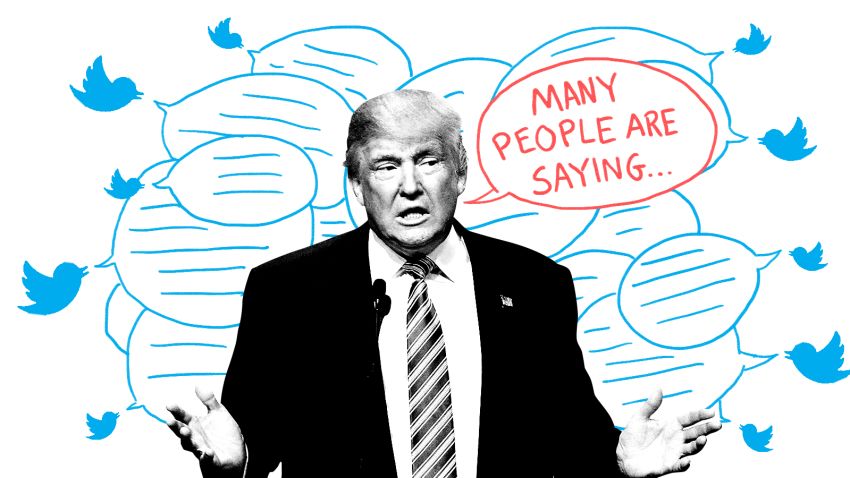
Not only do we lack reasons to take the claim seriously; we don’t even know what the claim is! Like the “many people are saying” model of misinformation, the problematiser positions themself as merely passing on potentially helpful information for others to make their own use of, without taking any responsibility for its reliability. Sometimes they back away even further and say only that “Such and such might be problematic“. Read more »
“It was only when my father died in 2016 that this deep truth of human existence
hit me: there are two basic categories of people, the living and the dead, and the
members of both categories are equally people. Some people are dead people,
in other words.” —Justin Smith-Ruiu, from 3 Quarks Daily
There are days I speak to Mom or Dad, who are
no longer here so to speak, but I hear no reply
unless I count a coincidental breeze
riffing through the leafy larynx of a tree,
or a hawk or crow who, perfectly timed,
swings into a downdraft to close the space between,
calling to an offspring still learning
—but I am not a hawk or crow and am
ignorant of their language
The thing is the opacity of this enigma: the Celtic knot
of their once having been, a tangle as incomprehensible
as their not having been once before:
….. before they ever were,
….. before they ever breathed
….. then both suddenly did
But (and so), I engage them hoping (but little) that they’ll
come to me in a dream or sudden fabulous thought, and they do,
each seizing an end of that impossible knot, snapping it into
a single line but longer than anything that can be reduced to words
Jim Culleny 11/11/23
by Barbara Fischkin

Our elder, adult son, Dan Mulvaney, has non-speaking autism. For the most part, Dan has a good life. He lives near us—his mother and father—in a lovely group home on Long Island in suburban New York and often surfs the Atlantic Ocean off Long Beach. During quiet moments when Dan is out at sea, waiting with his surf instructor for a great wave to bring him to shore, I watch from the beach.
Since October 7, I also worry about his compatriots in autism—younger and older—in Israel and in Gaza.
Dan may not speak but he does have his own way of communicating. He has given me permission to write about him here and to relate that he is well informed about world events. He is a devoted viewer of CNN, in particular.
Dan also knows that surfers call the big waves “bombs.” Once in a while a word or two springs from his mouth, sometimes a sentence. Recently, bobbing on his board at the “break” where the waves rise from the ocean in their final push to the shore, he told his instructor they should: “Wait for a bomb.”
There are no real bombs in Long Beach, New York. Before Dan was born I lived and worked in Belfast. I know about bombs. Read more »