The Joy of Abstraction

by Jonathan Kujawa

Eugenia Cheng

On “The Joy of Abstraction” by Eugenia Cheng.

Category theory has variously been called “abstract nonsense,” “diagram chasing,” or the “mathematics of mathematics.” Some mathematicians find it a useful language, some a crucial tool for developing insights and obtaining new results, and more than a few have no use for it at all. I am currently teaching one of our first-year graduate courses. Because of the topic and my tastes, the students have seen a smattering of category theory. Another professor might skip that point of view entirely. This is all to say that even serious students of mathematics are unlikely to see category theory until graduate school.

Eugenia Cheng wrote a Ph.D. thesis entitled “Higher-Dimensional Category Theory: Opetopic Foundations”, has written more than a dozen research papers on all sorts of serious categorical topics, and was formerly a tenured professor at the University of Sheffield, UK. A decade or so ago, Dr. Cheng decided to give up the traditional academic track and put her energy into bringing mathematics to a broad audience. Dr. Cheng is now a Scientist in Residence at the School of the Art Institute of Chicago, a writer of popular math books, a frequent guest on TV shows, and an all-around evangelizer for thinking about math in novel and humanistic ways.

Eugenia Cheng recently wrote a most peculiar book. It is an introduction to category theory for people whose math education might have stopped with high school. With such modest prerequisites it is remarkable that by the end of the book you are wrestling with advanced topics that my first-year graduate students still haven’t seen! It sounds ambitious and even a little nuts. Dr. Cheng is about the only person in the world with the very particular set of skills needed to write such a book. Read more »
Monday Poem

Fugitive

big brown bison walks the white line
of a two-lane, black eyes scanning for a sign,

regarding asphalt he wonders
what happened to the grass

how did this black ribbon come to bisect
my meadow between talus and hundred-foot pines
and where are the columbine?

he asks no one in particular because
not even the alpha male in a herd would know
as a car crawls slowly up behind
capturing the remains of a wilderness,
and smart phones gripped in the hands of small
homos sapiens click & snap at the ends of arms
thrust through windows catching
an outlaw bison who broke from a farm,
whose humped shade steps like a rope-walker
down the white line’s length wondering
where the stillness went

where are the laurel and clover?
what are these beasts
that glide like murmuring ghosts along
this scar in my pasture clicking like crickets
trailing a burnt Cenozoic scent?

Jim Culleny
© Oct 31, 2010

Is the Simulation Argument an Improvement on the Dream Argument?

by Tim Sommers

“Suddenly he woke up and there he was, solid and unmistakable Zhuang Zhou. But he didn’t know if he was Zhuang Zhou who had dreamt he was a butterfly, or a butterfly dreaming that he was Zhuang Zhou.” — Zhuangzi (translation by Burton Watson)

“We are almost certainly living in a computer simulation.” – Nick Bostrom*

Is the hypothesis that we live in a computer simulation an improvement, in some way, on the classic skeptical argument that life is but a dream? The dream argument seems to show that life could be a dream. Some claim that the simulation argument shows that not only is it possible that we live in a computer simulation, but that we almost certainly do live in a simulation.

I’ll argue that the simulation argument does not make it any more likely than the dream argument does that this is not reality. Furthermore, the simulation argument might even be worse (as a skeptical argument) in one way. If I am dreaming, there is not just another world, but, in some sense, another me, out there beyond the dream. But if I am a being that only exists in a simulation, it follows that there is no other me out there – and challenges the very idea that this scenario is really “skeptical,” in the same way, as the dream argument.

From Zhuangzi to Descartes to The Matrix, people have worried and wondered over global epistemological skeptical scenarios like these. Let’s call them GESSes.

They are global because they cover all knowledge from our senses, they are epistemological because they raise the question of what we can know, skeptical because they answer, ‘we can’t know anything,’ and scenarios in the sense that they offer a story about why our senses systemically fail to make contact with reality.

So, how do you know whether we are currently being deceived about everything around us by an evil demon or dreaming it all, as Descartes says, or if we live in some kind of simulation? Read more »

Lost in Vocalization: Adventures in Listening

by Brooks Riley

1. In nature the act of listening is primarily a survival strategy. More intense than hearing, listening is a proactive tool, affording animals a skill with which to detect predators nearby (defense mechanism), but also for predators to detect the presence and location of prey (offense mechanism).

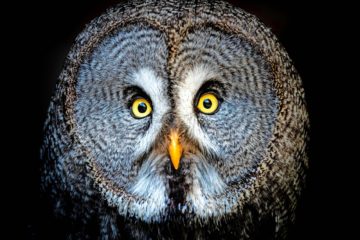
My favorite listener of all time (FLOAT) is a predator, the magnificent great grey owl (Strix nebulosa), whose gorgeous fifty-shades-of-grey plumage serves as a soundproofing puffer coat over a surprisingly diminutive body, making the creature both the world’s largest owl in length and one of its lightest in weight. That sweet funny face serves a purpose far more practical than irresistible charm. What happens up there in the frozen arctic latitudes where the great grey owl lives is a match between two well-equipped, cunning adversaries—both good listeners—the owl high up in a tree and the vole deep under a blanket of snow.

If evolution were music, this owl’s hunting technique would be one of nature’s greatest hits, a masterpiece of carefully designed and calibrated physical traits functioning in sync like an orchestra—to enable the owl to hear, locate and capture the unseen vole under two feet of snow from up to a hundred feet away. Read more »

Fire Alarm

by Chris Horner

The alarm bells are deafening, and the evidence is irrefutable:  greenhouse gas emissions from fossil fuel burning and deforestation are choking our planet and putting billions of people at immediate risk.…[…] We are sleepwalking to climate catastrophe. […] It is a a “code red for humanity. —António Guterres, United Nations Secretary General.

The world is moving ever closer to catastrophic climate crisis and yet the economies of the world are still going for growth, while the major fossil fuel extractors row back on their pledges to switch to renewables instead of dragging out yet more oil and gas. Automobiles are everywhere; planes fly across the globe to all destinations. And the weather gets more and more extreme: flood, fire, hurricane and drought. And still we continue down the mad path to an unliveable planet.

A catastrophe is developing, not in the future, nor in some distant scenario but right now. And it is clear that far too little, too late, is being done in response. What is less obvious is why this should be so. The reasons for the slowness and inadequacy of the measures taken can, of course, be identified as lying in the kind of political log jams that characterise the present time, along with bureaucratic inertia, weak leadership and the influence of special interest groups in delaying and obfuscating. Yet if we really are on the edge of an abyss, as Guitterez says, one might expect more to be happening. 

If nothing less than war time measures need to be taken, why are we not taking them? Read more »

A Bedroom Autopsy

by Ethan Seavey

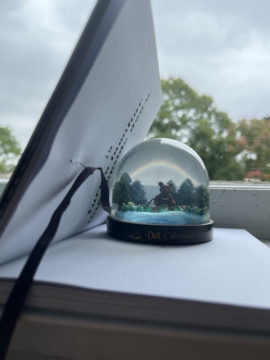
A metal bucket with a snowman on it; a plastic faux-neon Christmas tree; a letter from Alexandra; an unsent letter to Alexandra; a small statuette of a world traveler missing his little plastic map; a snow globe showcasing a large white skull, with black sand floating around it.
When I was much younger, there was this vague idea that my death (however randomly it may come about) would result in the total autopsy of my bedroom, which would allow loved ones and biographers the opportunity to analyze my psyche. I planned for them to find my journals and publish my stories posthumously; and it was nice to think about, because I would do none of the work of publishing myself and I would receive all the fame from the grave. For most of the stories I was writing, I would have been similarly satisfied if a thief had stolen them from me to publish under my name while I was still breathing, but as a little boy I had secrets in abundance. It would be absolutely asinine of myself to have secrets lying around my room, ready to be discovered. At least, not without making them work for it first.

One such object is a small book with the title 99. It’s a book you might pick up as a gift for someone you might not know very well. It was given to me by some friends who knew me extremely well and who knew I liked pretty (but practically unreadable) books to leave around as decoration. This book had a pure white cover. Its pages contained 99 “activities” to “do” when you’re bored. Both of these words are in quotes because they wrongly imply that you will be doing something. Some examples: sign up for a class (an activity of waiting which is not immediately invigorating enough to satisfy my boredom); try out an instrument you’ve never played before (an activity I will immediately become discouraged in); set up your single friend with your other single friend (an activity that would not service my own boredom but other people’s).

The one that matters here, though, was a page labeled “flip something familiar upside down.” If you open to the page where the black ribbon sits comfortably, near the middle of the book, you’ll see that the ribbon is fixed with a large sewing pin. Certainly the quest-taker would take notice of this page in particular and realize that it is a clue. Read more »

A Piece of “A Piece of Chalk”

by Eric Bies

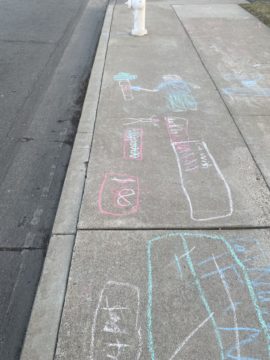
I liked to play with chalk when I was little. Little kids did then. As far as I can tell they still do now. I walk and jog and drive around town for every other reason. Inevitably, I end up spotting many (maybe not as many, but a good many) of them doing as I did: crouching between buildings, hunkering down on driveways and sidewalks to draw mommies and daddies and monsters; moons and suns; circles and squares. One minute they’re sketching their darling doggy; the next, they’re dreaming up cross sections of skyscrapers to hop across their faces. A very little one down the block, crab-walking with a piece of pink clasped in his left hand, practices divination with squiggles like the entrails of a bird. Recently, the rain has washed it all away, but only for the moment.

The Englishman G. K. Chesterton, one of those writers who wrote a lot of everything—novels about men with names like Thursday and Innocent Smith, biographies of Francis and Aquinas, a long poem about the Battle of Lepanto, detective stories Borges loved—also liked to play with chalk.

In “A Piece of Chalk,” one of many memorable articles written for the Daily News in the first years of the last century, Chesterton recounts a morning outing while on vacation. Read more »

Monday, February 13, 2023

Some Comments on Writing Popular Mathematics

by John Allen Paulos

Intelligibility or precision: to combine the two is impossible. ―Bertrand Russell.

Please forgive the long letter; I didn’t have time to write a short one. ―Blaise Pascal

I have always resonated with the two quotes above and believe they’re particularly germane to writing popular mathematics. Let me start with Russell. If his remark is taken literally, I would disagree with it, but if we take it merely as pointing out the often inevitable trade-off between precision and intelligibility, I find it rather profound.  In my books I’ve certainly tried to be both precise and intelligible and hope that for the most part I have succeeded, as have so many other popular author of mathematics. The fact remains that combining the two is often a difficult task that at times depends on extra-mathematical understandings.

Take, for example, the notion of a continuous function in mathematics. Perhaps as a first approximation we might say that a function is continuous of we can graph it without lifting our pencil off the page. No breaks. This is intelligible, but is hardly precise and is, in fact, not what we mean by a continuous function. As generations of calculus students have understood (or misunderstood), the standard definition is simply not intuitive, involving as it does a complex statement involving the function in question and deltas and epsilons, Greek letters measuring distances along x- and y-axes. Unfortunately, immediately insisting on precision is a good way to discourage students from taking calculus. Read more »

Ted Bundies I Have Known

by Deanna K. Kreisel [Doctor Waffle Blog]

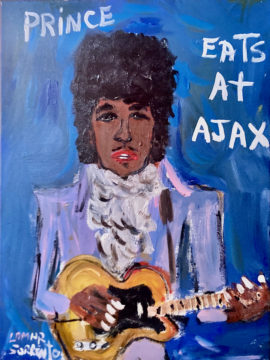
Painting of Prince holding a guitar with caption "PRINCE EATS AT AJAX"
Painting by Lamar Sorrento

I really don’t understand those podcasts where young women with their whole lives ahead of them spend an hour each week obsessing over serial killers. There are between one and 87 of these shows—I don’t know their names, I’ve never listened to them, and frankly I don’t want to know more than I already do. I am resisting Googling. But I’m aware of their existence because middle-aged women with half their lives ahead of them keep urging me to listen. The last time this happened, I was at a dinner party where I was regaled with a description of a podcast’s description of the Golden State Killer (do not Google!) over pasta carbonara and a nice Soave Classico. I spent the next few months obsessively checking and re-checking the door and window locks every night, then huddling under the covers in fear as I waited for sleep. I’m pretty sure there’s still a knife under the mattress “just in case.”

To be clear: I understand the pleasure of these shows. In fact, I understand it all too well—which is why I have no desire to start listening. I too have found myself crawling out of a Wikipedia rabbit hole of an evening, blinking in confusion and wondering why I just spent two hours of my time on earth compulsively reading about the exploits of Robert Pickton (do not Google!). What I don’t understand is how people can wallow in gruesome descriptions of psychopathy, gleefully taking in all the grisly details of murders, rapes, cannibalism, and the rest of it, and then calmly go about their daily lives. I’m not sure if my problem is mild undiagnosed OCD or just a hyper-sensitive nervous system, but once I get those images in my head I cannot get them out. Even the movie Titanic was too much for me—I left the theater shaking and sick with crying, watching in amazement as people around me in the lobby chatted about where to go for dinner. Avoiding images and descriptions of murderous mayhem is a discipline I follow that allows me to continue functioning as a moderately productive member of society.

But I think there’s something else going on with these serial killers, at least for me. Read more »

Monday Poem

Now Only Knocks Now

Add 30 seconds to anytime,
what’s that interval?
Hell, double it
what’s that?

Have you ever had a day that lasts three
or one that goes so fast it’s past instantly?
Are those durations short or long, if
hours mean anything?

Subtract five hours from anytime
do we really think we’ve minced minutes,
as we tick them off are they really not there?

There’s a continuum called now
outside of which is guesswork
because our instruments only work here,
slice it anyway you want
it remains……… still ………. whole
our clocks do not
affect it.

Now is never what it was before
because things change
and will change again, now,
not yesterday or tomorrow
it only happens now

now is the only thing we have to work with
now only knocks now

by Jim Culleny
9/5/14

Artificial Intelligence [sic: Machine Learning] and The Best Game in Town; Or How Some Philosophers, and the BBS, Missed a Step

by David J. Lobina

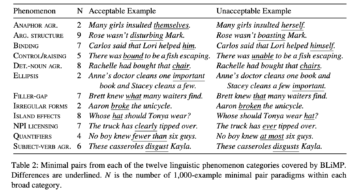
Not the most impressive tests of linguistic competence.

Where was I? Last month I made the point that Artificial Intelligence (AI) – or, more appropriately, Machine Learning and Deep Learning, the actual paradigms driving the current hype in AI – is doomed to be forever inanimate (i.e., lack sentience) and dumb (i.e., not smart in the sense that humans can be said to be “smart”; maybe “Elon Musk” smart, though).[i] And I did so by highlighting two features of Machine Learning that are relevant to any discussion of these issues: that the processes involved in building the relevant mathematical models are underlain by the wrong kind of physical substrate for sentience; and that these processes basically calculate correlations between inputs and outputs – the patterns an algorithm finds within the dataset it is fed – and these are not the right sort of processing mechanisms for (human) sapience.

These were technical points, in a way, and as such their import need not be very extensive. In fact, last time around I also claimed that the whole question of whether AI can be sentient or sapient was probably moot to begin with. After all, when we talk about AI [sic] these days, what we are really talking about is, on the one hand, some (mathematical) models of the statistical distributions of various kinds of data (tokens, words, images, what have you), and on the other, and much more commonly, the computer programs that we actually use to interact with the models – for instance, conversational agents such as ChatGPT, which accesses a Large Language Model (LLM) in order to respond to the prompts of a given user. From the point of view of cognition, however, neither the representations (or symbols) nor the processes involved in any of the constructs AI practitioners usually mention – models, programs, algorithms – bear much resemblance to any of the properties we know about (human) cognition – or, indeed, about the brain, despite claims that the neural networks of Machine/Deep Learning mimic brain processes. Read more »

Now That The End Is Here

by Mike Bendzela

While changing keys during a recent old time jam session, a friend asked for my thoughts about this new ChatGPT thing, seeing as I teach writing to college students and the fear is that this text-generating gadget will disrupt how such courses are taught. I had to answer that I did not have any thoughts about it, because I was assured early on, AI is coming and there is absolutely nothing you can do about it! Thus, safely relieved of the burden of having to dwell on the inevitable, I have chosen to ignore it instead. As a famous Republican once said, “Why should I waste my beautiful mind on something like that?” Besides, I am an adjunct and not paid to worry about pedagogy. I can worry about more important things, such as the low tire pressure light that will not go off on my dashboard. How to deal with techno tyranny with aplomb is something I can put off. I will be retiring in a few short years anyhow.

This friend* who asked me about ChatGPT technology seemed about as ignorant in it as I am: “Do you know how it works?”

He was trying to tune his banjo. This could take a while, and I was afraid I would have to . . . chat about ChatGPT in the meantime. Read more »

Allowing For Uncertainty

by Mary Hrovat

In The Art of Revision: The Last Word, Peter Ho Davies notes that writers often have multiple ways to approach the revision of a story. “The main thing,” he writes, “is not to get hung up on the choice; try one and find out. … Sometimes the only way to choose the right option is to choose the wrong one first.” I’m easily hung up on choices of all kinds, and I read those words with a sense of relief.

Interestingly, Davies puts this advice in the context of scientific experiments. He writes that an experiment that doesn’t yield the desired result is still valuable because you can learn from it. Not long after I finished The Art of Revision, I ran across very similar ideas in the context of learning game theory. Shengwu Li at Harvard tweeted his advice for second-year grad students who are working on his problem sets, which previous students have found to be emotionally stressful. He notes that one reason research is hard is that you don’t know the answer in advance. When solving problem sets, as in research, it’s important to be comfortable with uncertainty, to be willing to make guesses and see where they lead. Read more »

Why a key creationist climate change denier has gone antivaxx

by Paul Braterman

A friend just sent me a copy of materials that the Cornwall Alliance is sending to its supporters. Here is an extract [fair use claimed]:

BE ARMED AGAINST THE DANGERS OF SCIENCE SO CALLED

Question any part of the climate-change “consensus” (how much climate change is going on, how much humans contribute to it, what if anything we should do about it), and you’re instantly declared “anti-science” or even a threat to the future of the human race.

But don’t be intimidated—or fooled. That response is itself anti-science. It is rhetoric designed to win not by persuading others but by silencing them.

And it arises not just about climate change. From good old Darwinism (goo to you by way of the zoo) and Malthusianism (population growth inexorably exceeds food production and causes a sudden die-off), to the Obama Administration’s insistence that employers must provide insurance coverage for contraception and abortion regardless of their religious conscience, and COVID-19 mask, social distancing, travel, church worship, and vaccine policies.

People in America and around the world are in danger of becoming slaves of scientism and scientocracy.

The rest of the piece is a blurb for an essay by John G West that forms part of a forthcoming book on CS Lewis and his views on the relationship between science and religion (science ought to know its place), leading up to an appeal for funds. The Cornwall Alliance is a charity under US law, rather than a political body, and contributions are tax-deductible.

Why am I bothering you with this nonsense? Two reasons. Read more »

The Rise of the Intellectual Influencer

by Mindy Clegg

Youtube screencaps of Lady Izdihar and FD Signifier

I recently discovered a youtuber, Andy Stapleton. A former academic from a STEM field, his videos breakdown problems within academia and explores his perceptions of his failures in within that space. Although coming from a STEM field, his videos address academics across fields and he provides useful information for those within academia. But Stapleton is also a part of a new economic ecosystem that has grown up around the crises facing academics. As higher education continues to over-produce PhDs, many have sought to forge an alternative path that will allow them to continue in an intellectual stimulating professional life. This genre has become a new niche of the online info-tainment ecosystem. These intellectual influencers produce content for an audience that they hope will embrace and financially support their work.

Those who find themselves on the margins of the modern corporate university might find such an alternative attractive. But do we lose something in using social media to explore topics found in academia? Is it materially different from publishing books, journal articles, newspaper essays, or anything else that academics have done for years? Is it somehow less pure to fund intellectual pursuits via a combination of corporate or patreon sponsorships as opposed to from a university salary? The role of the public intellectual have been highly prized and being an intellectual influencer seems one such way to pursue that path. Where is the line between forging one’s own path and cynically trading knowledge for a paycheck (and is a university salary really any less fraught)? While we should interrogate how intellectually pursuits are funded, I argue that knowledge production is always historically situated. Much like art, there is no “pure” form of knowledge production, free of its historical context. Rather, knowledge production is shaped by the economic possibilities of the society in which it’s produced. Read more »