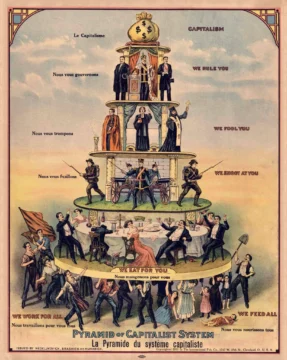
Sonnet to spring:
We feel tremendous joy, though it is not anything we would ever mention.
_____________________
by Garrison Keillor
Enjoying the content on 3QD? Help keep us going by donating now.

by Garrison Keillor
Enjoying the content on 3QD? Help keep us going by donating now.
Jessie Sun at Psyche:
Most of us have experienced both how good it can feel and how hard it can be to do the right thing. Helping strangers or supporting a friend can leave you with a deep sense of satisfaction at making a difference in someone’s life. But you’ve likely also felt the strain of showing up for others when you’re already stretched thin, or the discomfort of being honest about a difficult truth. In other words, being good is sometimes uplifting, and sometimes it’s a bit of a drag. These ordinary moments speak to a puzzle that philosophers have long debated: are moral people happier? Or is there some tradeoff between doing good and feeling good?
More here.
Enjoying the content on 3QD? Help keep us going by donating now.
Scott Aaronson at Shtetl-Optimized:
I thought that the filmmaker, Daniel Roher, did about as good a job as can be done, in fitting into a 100-minute film a question that honestly seems too gargantuan for any film — the question of the future of life on earth. He tries to hear out every faction: first the AI existential risk people, then the AI optimists and accelerationists like “Beff Jezos,” then the “stochastic parrot” / “current harms” people like Emily Bender and Timnit Gebru, and finally the AI company CEOs (Altman, Amodei, and Hassabis were the three who agreed to be interviewed), with Yuval Noah Harari showing up from time to time to insert deepities.
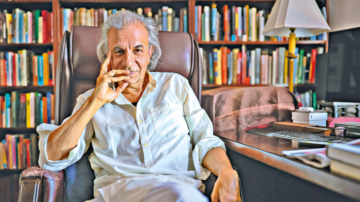
Roher plays the part of an anxious, curious, uninformed everyman, who finds each stance to be plausible enough while he’s listening to it, and who mostly just wants to know what kind of world his soon-to-be-born son (about whom we get regular updates) will grow up in.
I didn’t think all the interviewees were equally cogent or equally deserved a hearing. But if any viewers were actually new to AI discourse, rather than marinated in it like me, the film would serve for them as an excellent introduction to the parameters of current debate (for better or worse) and to some of the leading representatives of each camp.
More here. And here’s the trailer…
Enjoying the content on 3QD? Help keep us going by donating now.
Priyam Paul at The Daily Star:
The Daily Star (TDS): Could you elaborate on the origins of secularism in Europe? How did the idea evolve there?
Akeel Bilgrami (AB): ‘Secularism’, first of all, should be distinguished from ‘secularisation’. Both emerged initially in Europe. Secularisation is the name of a process of change—part intellectual, part societal. In the simplest terms, it can be described as a decrease in both religious belief and religious practice, that is, a decrease in belief in God and the myths of creation, as well as a decrease in various practices such as church-going, rituals, habits of religious dress, diet, etc. By contrast, secularism is the name of a political doctrine that sought to usher religion out from having the kind of direct bearing that it so often had on the polity and the state. Your question is about the origins of secularism, not secularisation. But I mention this distinction because there are subtle ways in which these two distinct notions get run together, which, for the sake of clarity, they should not be.

So, for instance, in my view, Kemalist Turkey (or indeed, the Soviet Union) adopted not just secularism but also a kind of state-enforced secularisation, and France, to a much less comprehensive degree, also did that when, for instance, it banned the hijab from being worn in some public places such as schools. In countries like India, Pakistan, and Bangladesh, in which there is not as much secularisation as there is in Europe—nor does one expect there to be in the foreseeable future—the point of focus is on secularism.
So now let me answer your question about secularism.
More here.
Enjoying the content on 3QD? Help keep us going by donating now.
Karen Stollznow at Aeon Magazine:
In its most literal sense, a bitch is a female dog, and this is also the word’s earliest meaning. Because bitch feels so contemporary, so casually present in everyday speech, it’s easy to assume it’s a relatively recent addition to the language. The etymology, however, tells a different story. ‘Bitch’ meaning ‘female dog’ dates to around 1000 CE, giving the word a pedigree that stretches back more than 1,000 years. It is older than ‘fuck’ and ‘cunt’, and older than many of the insults we now think of as timeless.
In those early centuries, the word didn’t quite look, or sound, the same. Bitch is an Old English word, inherited from Germanic, and during the Anglo-Saxon period it would have been unfamiliar to modern readers. Old English was the spoken and written language of the time, though literacy was limited, and bitch appeared as bicce, pronounced roughly as ‘bitch-eh’. The earliest recorded use of bitch is from a medieval text known as the Medicina de Quadrupedibus – Medicines from Four-Footed Creatures: a compendium of traditional remedies made from animal parts. Originally written in Latin and translated into Old English in the 11th century, the manuscript contains two early examples of bitch used in its literal sense.
more here.
Enjoying the content on 3QD? Help keep us going by donating now.
Peter Davidson at Literary Review:
An Oxford-educated Wiltshire gentleman who lost his small estates to lawsuits and debts after the Civil Wars, he was somehow set free by this personal disaster to live, in Auden’s words, ‘a wonderful instead’. Instead of worrying about lawsuits and estate work, he lived on and with his innumerable friends. He travelled and observed places, traditions and monuments, always with a sense that many of his contemporaries, especially during the wars, were intent on the destruction of all these things. His drawn records of the megaliths at Stonehenge and Avebury are still valued today; but so are his records of people’s customs, songs and beliefs, which he gathered in Remaines of Gentilisme and Judaisme (1686–7). Both comic and melancholy, his writings offer a paper museum of people and things. ‘How these curiosities would be quite forgot,’ he writes in his celebrated Brief Lives, ‘did not such idle fellows as I am put them down.’
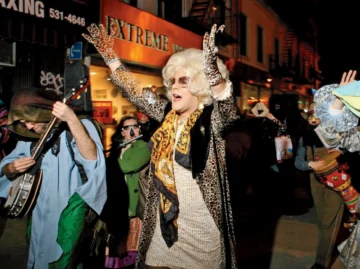
The context for this delightful sentence about memory comes at the end of one of his most intricate and memorable pieces of writing. His notes for a life of the short-lived beauty Venetia Digby (as edited from Aubrey’s manuscript by Kate Bennett) are haunting: She had a most lovely sweet turn’d face, delicate darke browne haire … her face, a short oval, darke browne eie-browe: about which much sweetness, as also in the opening of her eie-lidds. The colour of her cheeks, was just that of a Damaske-rose: which is neither too hot, nor too pale.
more here.
Enjoying the content on 3QD? Help keep us going by donating now.
Tim Murphy in Harvard Magazine:
Sabbath Queen, the 2025 documentary produced and directed by Sandi DuBowski ’93, opens tensely: in the courtyard of a Manhattan home, Rabbi Amichai Lau-Lavie prepares to flout the doctrine of the Conservative Judaism movement in which he was ordained by officiating the marriage of two men, Koshin and Chodo. The problem isn’t that they’re gay—Conservatism allows same-sex unions. It’s that Koshin is Jewish and Chodo is not, and the movement forbids interfaith marriage. That opening is intended “to establish a frame,” says DuBowski. “It says to the audience, ‘This is a burning question that the film will return to, and also here are the larger stakes around these two versions of Judaism—one traditional and fundamentalist, and the other progressive and open.’”
That tension is at the heart of Sabbath Queen’s very intense subject, Lau-Lavie, 56, the Israeli-born descendant of one of Judaism’s most prominent dynasties of rabbis. His quest to forge a community of Judaism more in tune with modern life and pluralistic values led him down several paths.
More here.
Enjoying the content on 3QD? Help keep us going by donating now.
Kate Mackenzie and Tim Sahay in The Polycrisis:
The illegal war launched by the United States and Israel against Iran has triggered the mother of all commodity-supply shocks. In response to the unprovoked onslaught, Iran’s closure of the Strait of Hormuz, the narrow waterway between Iran and Oman’s Musandam peninsula, has brought to a standstill the delivery of huge amounts of the world economy’s critical inputs.
Iran is the seventh country to undergo US military intervention in the first fifteen months of Trump’s presidency; five of these seven are rich in oil. Oil wars might make sense if American companies actually wanted to drill more. But they are hesitant to do so when oil is oversupplied and under-demanded. The raid on Caracas in January earned little interest among international oil majors, who were unenthused about the prospect of resuscitating Venezuela’s decrepit infrastructure and bitumen-like oil reserves, despite White House exhortations.
The world has never seen an interruption on this scale to the supply of stuff. It easily surpasses the 1979 oil crisis, sparked by the Iranian revolution, in which crude oil production declined by 4 percent. Forty-seven years later, Hormuz is the passageway for one fifth of the world’s crude oil and one fifth of its liquefied natural gas. It’s also the transit point for a third of exported urea—a feedstock used for making fertilizer which grows the food for an estimated half of the world’s population.
More here.
Enjoying the content on 3QD? Help keep us going by donating now.
Thomas Meaney on Jurgen Habermas in Sidecar:
The funeral cortège for Jürgen Habermas was carried out, appropriately enough, in what still passes for the German public sphere – the national newspapers where he first made his name, more than 70 years ago. One article after another in the long convoy declared it was the end of an era, that it was incumbent upon every rational person to take up the banner of the ‘unfinished project’ of modernity, and that the faithful carry on the ‘learning process’ of humanity. ‘He was a tireless source of far-reaching political norms’, Charles Taylor declared. ‘His thinking was political right down to the most abstract questions’, Rahel Jaeggi wrote. Habermas’s prose, Gustav Seibt assured readers in the Süddeutsche Zeitung, could be ‘brilliant, even snappy’. Eva Illouz thanked Habermas for protecting Europe against Foucault. The Chancellor of the Federal Republic, Friedrich Merz, affirmed that Habermas ‘was one of the most important thinkers of our time’, and that ‘his analytical rigor shaped democratic discourse in Germany’. Perhaps the only dissonant note was sounded in Die Zeit by the Chinese philosopher Tsuo-Yu Cheng, who noted that Habermas had been the rage in China in the 1980s, but was no longer really read there. This stately procession was in marked contrast to the bruitings of the Anglo left, for whom Habermas seemed to figure as a presence hazily remembered from college syllabuses, and anyway wasn’t he in the Hitler Youth and wrong about Gaza?
Born in 1929, in far-west Rheinpreußen, Habermas was part of the generation of Germans who felt saved by the US Army when it liberated his town. He had been in the Deutsches Jungvolk, but as biographers are firm in pointing out, he found Nazism repellent from the beginning.
More here.
Enjoying the content on 3QD? Help keep us going by donating now.
Ben Recht over at his substack, arg min:
I’ve been wanting to write a summary of the Cultural AI conference I attended at NYU last week, but I’ve been struggling to succinctly capture my thoughts. That’s indicative of the depth and complexity of how AI meets culture, and the different perspectives and disciplines might not lend themselves to a tidy summary. As I often do when trying to wrap my head around complex things, I will stop worrying and just blog through it.
The talk that serves as my hub in the complex network of cultural AI is Cosma Shalizi’s “Aware of All Internet Traditions: Large Language Models as Information Retrieval and Synthesis.” That language models simultaneously retrieve information and synthesize new content isn’t controversial. Nor is the fact that this synthesis is formulaic. The current synthesis is next-token prediction trained on all written information, whose output is warped by some selective post-training. By design, language models mechanistically reproduce the recurring regularities in their training data. That training data consists of all the text files on the internet and what is easily available in printed books. Hence, the regularities are the tropes, stereotypes, templates, conventions, and genres of language and code.
The formulaic generation of discourse looks like discourse in ways we could never have imagined. But with hindsight, we shouldn’t be surprised. Human culture is very formulaic! There are long-standing formulas for oral tradition, for generating small talk, or for generating scientific papers. As Cosma put it, in the single sentence that summarizes the entire Cultural AI conference:2
Following a tradition means not having to think for oneself.
Not having to think is often a good thing! Tradition lets us externalize certain processes so we can focus on other tasks. Formalities strengthen cultural connections. Traditions in communication help us understand each other better and come to consensus faster.
Indeed, our vast externalized cultural intelligence is the jewel of human tradition. Cosma cites Jacques Barzun’s conception of the House of Intellect: intellect is the communal form of society’s intelligence.
More here. (Cosma Shalizi’s slides can be found here.)
Enjoying the content on 3QD? Help keep us going by donating now.
Jennifer Szalai in The New York Times:
In 2003, the literary theorist Fredric Jameson wrote that it was “easier to imagine the end of the world than to imagine the end of capitalism.” Trevor Jackson seems to agree, but only to a point. In “The Insatiable Machine: How Capitalism Conquered the World,” Jackson says that the prevailing economic system has already gone a long way toward destroying our “finite planet.” He argues that if we don’t find a way to change course, the end of the world won’t be something we have to imagine; it will actually arrive.

Such is the grim foundation for Jackson’s book, which offers a compact and vivid account of several centuries of capitalist expansion. Jackson, an economic historian at Berkeley, is a critic of capitalism, which he defines as a system that turns things like labor and land into assets for market exchange. But he adds that the reasons for capitalism’s dominance are far from simple, and not all damning. Colonialism and violence are part of the story, yes — but so is a 16-fold increase in average living standards.
More here.
Enjoying the content on 3QD? Help keep us going by donating now.
From lensculture:
The Photography Show presented by AIPAD will take place April 22-26, 2026 at the Park Avenue Armory in New York City. This yearly gathering features a wide variety of historically significant and formally innovative work, as well as some of the most dynamic examples of contemporary voices. The breadth of work reminds you how wonderfully diverse and inspiring the language of photography can be.
Showcasing more than 60 exhibitors, daily programming from the acclaimed AIPAD Talks Series, in-booth artist talks, book signings, and more, this is a delightful treat for collectors and photography enthusiasts. LensCulture is pleased to share 24 photos here — just a small preview of what you can discover at the show. Don’t miss it!
More here.
Enjoying the content on 3QD? Help keep us going by donating now.
Nothing was where it was supposed to be
or even where it was twenty minutes ago,
one of the only times I’ve understood
what nature was trying to say
to me. But the people I always see
at the farmers market being very specific
about their mushroom selection weren’t
listening, already dragging branches
onto the curb, fixing their lawns,
resetting their Black Lives Matter signs.
These were the people blasting
‘Celebrate good times, come on!’
from their front porch window
on the day Joe Biden was elected.
One of them was high-fiving
a police officer. The branches were still green,
on the ground. The sun hadn’t browned
the dead leaves yet. There was part
of me that trusted them, my neighbors.
I hadn’t locked my door when I left.
One neighbor said, I hired an arborist
just a few weeks ago, and he said
this tree was fine. The neighbor
motioned toward a tree currently
pulling black power lines down
on top of their red Subaru.
Who could afford an arborist?
I would never own a house,
or a tree, or my own car,
but these were my neighbors, and we
had to clean this up together.
by Sasha Debevee-McKenny
from The Poetry Society Literary Hub
Enjoying the content on 3QD? Help keep us going by donating now.