
Priyam Paul at The Daily Star:
The Daily Star (TDS): Could you elaborate on the origins of secularism in Europe? How did the idea evolve there?
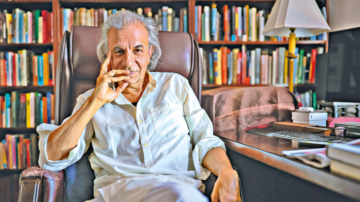 Akeel Bilgrami (AB): ‘Secularism’, first of all, should be distinguished from ‘secularisation’. Both emerged initially in Europe. Secularisation is the name of a process of change—part intellectual, part societal. In the simplest terms, it can be described as a decrease in both religious belief and religious practice, that is, a decrease in belief in God and the myths of creation, as well as a decrease in various practices such as church-going, rituals, habits of religious dress, diet, etc. By contrast, secularism is the name of a political doctrine that sought to usher religion out from having the kind of direct bearing that it so often had on the polity and the state. Your question is about the origins of secularism, not secularisation. But I mention this distinction because there are subtle ways in which these two distinct notions get run together, which, for the sake of clarity, they should not be.
So, for instance, in my view, Kemalist Turkey (or indeed, the Soviet Union) adopted not just secularism but also a kind of state-enforced secularisation, and France, to a much less comprehensive degree, also did that when, for instance, it banned the hijab from being worn in some public places such as schools. In countries like India, Pakistan, and Bangladesh, in which there is not as much secularisation as there is in Europe—nor does one expect there to be in the foreseeable future—the point of focus is on secularism.
So now let me answer your question about secularism.
More here.
Enjoying the content on 3QD? Help keep us going by donating now.