Eating Our Popcorn While We Weep: Remembering Karen Ballentine

7726_143972584424_513199424_2474849_7414566_n 3qd friend Karen Ballentine died Friday after a struggle with cancer. Her comments and insights revealed a keening intellect that dissolved what Auden called the “conventions [that] conspire to make this fort assume the furniture of home,” but one that was still infused with a deep compassion. Her letter to Abbas on the 5th anniversary of September 11th is telling:

Dear Abbas,

When I read that 3QD was devoting all of Monday's blog to 9-11, I had mixed feelings. I know you grieve it, as many of us do. I know you lost a friend. And even for those New Yorkers who came out with themselves and their loved ones unscathed, as I did, still, it was traumatic.

Since then, as we know, so many others…the Bush Administration, the Hollywood executives, the lawyers, the real estate moguls, Anne Coulter, Osama, and every justifiably angry but tragically misguided jihadist has found what they need to promote their own agendas in that tragedy.

Even as we “New Yorkers”, the children of so many different nations, religions, races, and beliefs found our own community, and our own hope, the rest of the nation has been stuck on the virtual (via CNN and the web) trauma, without experiencing recovery, as we all did through the force of our common humanity.

That might be the key difference between 911 and Katrina: both Manhattan and D.C. recovered from the terrorist attacks on 911. But the nation did not.

With Katrina, on the other hand, the nation got over it, but the victims, the dead, their loved ones, their comunities, especially the poor African Americans of the lower ninth, as well as the working people all along the gulf…they did not.

In both cases, albeit for different reasons, America has let its people down.
Die Young, Live Fast: The Evolution of an Underclass

Mg20727692.100-1_300 Mairi Macleod in New Scientist:

FROM feckless fathers and teenaged mothers to so-called feral kids, the media seems to take a voyeuristic pleasure in documenting the lives of the “underclass”. Whether they are inclined to condemn or sympathise, commentators regularly ask how society got to be this way. There is seldom agreement, but one explanation you are unlikely to hear is that this kind of “delinquent” behaviour is a sensible response to the circumstances of a life constrained by poverty. Yet that is exactly what some evolutionary biologists are now proposing.

There is no reason to view the poor as stupid or in any way different from anyone else, says Daniel Nettle of the University of Newcastle in the UK. All of us are simply human beings, making the best of the hand life has dealt us. If we understand this, it won't just change the way we view the lives of the poorest in society, it will also show how misguided many current efforts to tackle society's problems are – and it will suggest better solutions.

Evolutionary theory predicts that if you are a mammal growing up in a harsh, unpredictable environment where you are susceptible to disease and might die young, then you should follow a “fast” reproductive strategy – grow up quickly, and have offspring early and close together so you can ensure leaving some viable progeny before you become ill or die. For a range of animal species there is evidence that this does happen. Now research suggests that humans are no exception.

Certainly the theory holds up in comparisons between people in rich and poor countries. Bobbi Low and her colleagues at the University of Michigan at Ann Arbor compared information from nations across the world to see if the age at which women have children changes according to their life expectancy (Cross-Cultural Research, vol 42, p 201). “We found that the human data fit the general mammalian pattern,” says Low. “The shorter life expectancy was, the earlier women had their first child.”

But can the same biological principles explain the difference in behaviour between rich and poor within a developed, post-industrialised country?

Blindly Working Through the Past

Bookcover Jörg Magenau reviews Christa Wolf's autobiography, in Signandsight (originally in Die Taz):

Las Vegas is not the first place you would associate with Christa Wolf. She doesn't stay long. She sets herself a 60 dollar limit at roulette and stops there. She throws a few joyless coins into the one-armed bandit before retiring wearily to bed, early. A welcome escape from gambling hell. As far as earthly pleasures go, she is not easily led into temptation.

This scene comes at the end of what her publishers somewhat boldly describe as her new “novel”. “Stadt der Engel oder The Overcoat of Dr. Freud” (city of angels or The Overcoat …) is in fact memoirs couched in fiction and it is all about being seduced. It is only here, on the road to Navajo – and the Hopi Indians – that she finally manages to let go and show some interest in the things that come her way: the landscape, the people. It's no coincidence that her journey ends in Death Valley where she glides over into a dream vision. A pull “towards the end” is ever-present in this book. Death nears with old age; it is time to take stock.

In the months beforehand, between September 1992 and May 1993, when Christa Wolf was a guest at the Getty Center in Los Angeles – almost everything revolved around herself and her history, her life in the GDR, socialism, and most of all, the shock that she experienced in the summer of 1992, when the Gauck Authority (for the Stasi Archives -ed.) presented her with the 42 folders of so-called “Stasi victim files” and a slim portfolio that detailed her activities as an “IM”, or informal cooperator, between 1959 and 1962.

The acronym “IM” was the mark of the devil in year two of a reunified Germany. The public had taken to the moral high ground and was in no position to make nuanced differentiations. And now the great moralist herself, Christa Wolf, had been caught red handed.

The Web Means the End of Forgetting

25privacy-span-articleLarge Jeffrey Rosen in the NYT Magazine:

We’ve known for years that the Web allows for unprecedented voyeurism, exhibitionism and inadvertent indiscretion, but we are only beginning to understand the costs of an age in which so much of what we say, and of what others say about us, goes into our permanent — and public — digital files. The fact that the Internet never seems to forget is threatening, at an almost existential level, our ability to control our identities; to preserve the option of reinventing ourselves and starting anew; to overcome our checkered pasts.

In a recent book, “Delete: The Virtue of Forgetting in the Digital Age,” the cyberscholar Viktor Mayer-Schönberger cites Stacy Snyder’s case as a reminder of the importance of “societal forgetting.” By “erasing external memories,” he says in the book, “our society accepts that human beings evolve over time, that we have the capacity to learn from past experiences and adjust our behavior.” In traditional societies, where missteps are observed but not necessarily recorded, the limits of human memory ensure that people’s sins are eventually forgotten. By contrast, Mayer-Schönberger notes, a society in which everything is recorded “will forever tether us to all our past actions, making it impossible, in practice, to escape them.” He concludes that “without some form of forgetting, forgiving becomes a difficult undertaking.”

It’s often said that we live in a permissive era, one with infinite second chances. But the truth is that for a great many people, the permanent memory bank of the Web increasingly means there are no second chances — no opportunities to escape a scarlet letter in your digital past. Now the worst thing you’ve done is often the first thing everyone knows about you.

Against Eighties Music

6a00d83453bcda69e20133f28a49ae970b-800wiJustin E. H. Smith over at his eponymous blog:

There is a bind in which not every generation has found itself, though the one I know best certainly has: one is, in respect of music, caught between the Scylla of trying too hard to stay with it, and the Charybdis of ridiculous nostalgia for that period of life when one did not have to try at all.

How much longer will we have to listen to the cries of melancholy longing of those now pushing 40: a longing for a more authentic time, in which something we now call 'eighties music' held us all together, forged us, made us better than the current crop of manipulated stooges with their ephemeral junk? The problem with this way of remembering things is that it wasn't 'eighties music' at the time, and it didn't hold us together. It was mostly garbage, just like today; and just like today it had, seen from the inside, internal contours and divisions that made it entirely impossible to think of it all as belonging to the same decadal genus.

That is a first point: that you are simply misremembering when you hear The Cure in some public place and you announce: I love '80s music! A second point is that no one cares, and, worse, you're embarrassing yourself. To say 'I love '80s music' might have a different semantics than 'I'm pushing 40', but out of your mouth, dear coeval, it is pragmatically exactly the same.

What is the alternative? Well, you can try to stay au courant. You can do the 2010 equivalent of what Houellebecq's protagonist did in Le plateforme, just seven or eight years ago, when he stretched a Radiohead t-shirt, having never listened to Radiohead, over his 40-year-old gut. Hell, if you are really unconcerned with maintaining credibility you can just try it with a Radiohead shirt today and see what happens. You can try to get tips from your younger coworkers or from your students about local bands or about obscure imports. As if anything had to be 'imported' anymore! You can try your best to overlook the fact that you will always remain rooted in a now defunct system, in which music was an object that could be collected, owned, and traded, rather than something whose tokens might be gleaned as desired out of the universal storehouse of the Internet.

Photos-Souvenirs

Carolle Benitah in lensculture:

Benitah_9 I started to be interested in my family pictures when I was leafing through a family album and found myself overwhelmed by an emotion that I could not define the origin of. These photographs were taken 40 years earlier, and I could not even remember the moments they were shot, nor what preceded or followed those moments. But the photos reawakened an anguish of something both familiar and totally unknown, the kind of disquieting strangeness that Freud spoke about. Those moments, fixed on paper, represented me, spoke about me and my family, told things about my identity, my place in the world, my family history and its secrets, the fears that constructed me, and many other things that contributed to who I am today.

I decided to explore the memories of my childhood to help me understand who I am and to define my current identity. To begin, I carry out “excavations”. Like an archeologist, I dig out the pictures in which I appear from family albums and the shoe boxes full of photographs. I choose snapshots because they are related to memories and to loss.

More here.

India develops 35-dollar ‘laptop’ for schools

From PhysOrg:

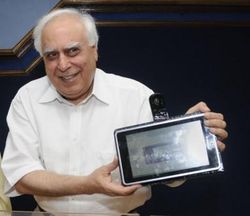
Indiadevelop The gadget, developed by the elite Indian Institute of Technology and the Indian Institute of Science, is part of a push to give students a better education and technical skills needed to boost India's economic growth. The first users are expected to be university students with introduction of the Linux-based computing device targeted for next year. The ministry is going to install broadband Internet at all of its 22,000 colleges so students can use the 1,500-rupee (35-dollar) device, government spokeswoman Mamta Verma told AFP on Friday in New Delhi. The tablet gadget, which can be run on solar power, is equipped with an Internet browser, video-conferencing capability and a media player, among other facilities. “This is part of the national initiative to take forward inclusive education,” Human Resource Development Minister Kapil Sibal told reporters on Thursday.

“The solutions for tomorrow will emerge from India,” he said.

More here.

Sunday Poem

After Ecstacy
…………………..
Next morning
on the phone to her—
the all of it

reduced to words—
How lovely the way
we redefined wrong.

Yes, she agreed,
then slowly, in a hush,
It went beyond
pleasure, beyond fun.

They laughed
without gaiety.
I feel numb, he said,

and hung up to begin
what he’d later describe
as a long slide into himself.

Conversation with others
seemed like chatter.
Work felt like work.

He’d call her up
and say things like Holy shit,
which she understood
to be accurate.

by Stephen Dunn
from
The Boston Review
March/April 2010

The only novel that doesn’t embarrass me

41hmy0qwmgl-_sl500_-e1279113553548

On the back of my copy of Robert Bolaño’s novel Antwerp is the following quotation from the man himself, “The only novel that doesn’t embarrass me is Antwerp.” I assume he was speaking only of the novels he wrote, but maybe not. Maybe he meant all the novels, every single one. There is nothing sexier than a book you haven’t read yet. Especially if it has a nice cover and nice fonts. Especially if it is by someone with an aura. The volumes of Kierkegaard’s writings put out by Princeton University Press used to drive me crazy. The block of color on top and the pure black underneath. The line drawing of Kierkegaard’s profile in an oval in the middle of the book.

more from me at The Owls here.

Saturday, July 24, 2010

Songs of the Saints, With Love, From Pakistan

Jon Pareles in The New York Times:

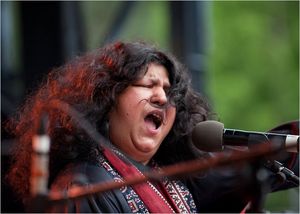
SUFI-2-popup Hands waved overhead. Voices shouted lyrics and whooped with delight. Children were hoisted onto parents’ shoulders. In the tightly packed crowd a few dancers made room to jump. T-shirts were tossed to fans from the stage. Yet in the songs that Abida Parveen was singing, saints were praised. They were Islamic saints, the poets and philosophers revered by Sufism, the mystical branch of Islam. It was the first New York Sufi Music Festival, a free three-hour concert on Tuesday in Union Square, and it had music from the four provinces of Pakistan, including traditional faqirs who perform outside temples, Sufi rock and a kind of rapping from Baluchistan. The concert was presented by a new organization called Pakistani Peace Builders, which was formed after the attempted bombing in Times Square by a Pakistani-American. The group seeks to counteract negative images of Pakistan by presenting a longtime Pakistani Islamic tradition that preaches love, peace and tolerance. Sufism itself has been a target of Islamic fundamentalists; on July 1 suicide bombers attacked Pakistan’s most important Sufi shrine. Pakistan’s ambassador to the United Nations, Abdullah Hussain Haroon, spoke between sets on Tuesday. “What we’re here to do today,” he said, is “to be at peace with all of America.”

The music’s message was one of joyful devotion and improvisatory freedom. Ms. Parveen, one of Pakistan’s most celebrated musicians, was singing in a Sufi style called kafi. Like the qawwali music popularized worldwide by Nusrat Fateh Ali Khan, kafi sets classical poems — about the love and intoxication of the divine, about seeking the spirit within — to visceral, handclapping rhythms and vocal lines that swoop and twist with passionate volatility. Ms. Parveen carried songs from serene, hovering introductions to virtuosic euphoria. Long, sustained notes suddenly broke into phrases that zigzagged up and down an octave or more; repeated refrains took on an insistent rasp and became springboards for elaborate leaps and arabesques; quick syllables turned into percussive exchanges with the band. Each song was a continual revelation, making the old poems fully alive.

More here. (Note: I was there. I heard Ms. Parveen for three nights in a row in New York. Her renditions of Khusro and Bullay Shah were a transformative experience. Listen to her.)

The Errors of Our Ways

From The New York Times:

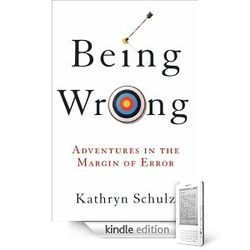
Wrong In 1650, Oliver Cromwell asked the Church of Scotland to reconsider its decision to side with the royalists instead of him. “I beseech you, in the bowels of Christ, think it possible you may be mistaken.” The church didn’t think it possible, of course, so Oliver’s army took Scotland. According to Kathryn Schulz, each of us is our very own Church of Scotland — ­often mistaken, oddly oblivious and typically immune to a good beseeching. ­“Being Wrong: Adventures in the Margin of Error” is an insightful and delightful discussion of the errors of our ways — why we make mistakes, why we don’t know we are making them and what we do when recognition dawns.

Schulz begins with a question that should puzzle us more than it does: Why do we love being right? After all, she writes, “unlike many of life’s other delights — chocolate, surfing, kissing — it does not enjoy any mainline access to our biochemistry: to our appetites, our adrenal glands, our limbic systems, our swoony hearts.” Indeed, as she notes, “we can’t enjoy kissing just anyone, but we can relish being right about almost anything,” including that which we’d rather be wrong about, like “the downturn in the stock market, say, or the demise of a friend’s relationship or the fact that at our spouse’s insistence, we just spent 15 minutes schlepping our suitcase in exactly the opposite direction from our hotel.”

More here.

Saturday Poem

Lascaux

The writing is on the wall…Lascaux
With dirty, ochre fingers, black soot
Crocus yellows, and white wax,
I smear my woes, my dreams, my story,
Onto the granite canvas of time.

Bison, horses, buffalo run,
Run off my fingertips
Into a forever story of running.
Run solo, run with the herd,
Neither toward, nor from.
Run in dreams… finger dreams.
My own dreams of running free,
Free from hungry thought.

By firelight,
My oily fingers caress
Stone walls of home, so
That my grandchildren's
Grandchildren may learn
Of the herd and the hunt,
And my dreams.

I tell of my dreams
With soiled fingers –
That they may learn
To tell their stories
With their own oily hands.

by Daniel Armstrong
from The Delaware Poetry Review,
Spring 2010

the moral sense

Paris-sep07.1188873000.evil-baby-within-giant-painting

Where does our sense of right and wrong come from? Most people think it is a gift from God, who revealed His laws and elevates us with His love. A smaller number think that we figure the rules out for ourselves, using our capacity to reason and choosing a philosophical system to live by. Moral naturalists, on the other hand, believe that we have moral sentiments that have emerged from a long history of relationships. To learn about morality, you don’t rely upon revelation or metaphysics; you observe people as they live. This week a group of moral naturalists gathered in Connecticut at a conference organized by the Edge Foundation. One of the participants, Marc Hauser of Harvard, began his career studying primates, and for moral naturalists the story of our morality begins back in the evolutionary past. It begins with the way insects, rats and monkeys learned to cooperate.

more from David Brooks at the NYT here.

a cockroach crawling about amidst dismantled splendors

C14326

In 1939, with Europe already sinking into World War II, 46-year-old Henry Miller left Paris, knowing that a cycle of his life had come to an end. As an expatriate in Paris he’d found his voice, and published the novels — “Tropic of Cancer,” “Black Spring” and “Tropic of Capricorn” — which made his name. He’d had his legendarily steamy and dangerous affair with Anais Nin, and George Orwell had fired a salute on his behalf, hailing him as “a Whitman among the corpses.” Miller, although banned in America, had arrived, and then, restless as ever, he accepted the invitation of another writer, his friend Lawrence Durrell, to visit Greece and the island of Corfu. Miller, being Miller, didn’t merely nibble and float in Lotus-land: First published in 1941, “The Colossus of Maroussi” (New Directions: 240 pp., $12.95), which has been reissued with accompanying essays by Will Self and Ian S. MacNiven, documents his attempt to devour the Hellenic experience and turn it to advantage.

more from Richard Rayner at the LAT here.

secret somerset

Tbrcover-custom1

In 1962, William Somerset Maugham’s nephew, Robin, his own literary efforts having not amounted to much, informed his wealthy and famous uncle that an American publisher, Victor Weybright, had offered him an advance of $50,000 to write Maugham’s biography. “Obviously I can’t afford to turn down such a good offer,” the younger Maugham explained. “As you know, although I earn enough from my writing to keep me going each year, I haven’t a penny of capital.” The letter’s affectionate tone notwithstanding, Maugham had no trouble grasping its import and responded by sending Robin a check equal to the one he would have received from Weybright. “I give you my word that I shall not write any other biography about you — ever,” Robin replied. “I’m really awfully shy about all this, but I’m also very ­grateful.” “Shy” is a peculiar adjective to use to describe blackmail, which was, as Selina Hastings makes clear in her biography, “The Secret Lives of Somerset Maugham,” Robin’s intention. Himself homosexual, Robin had been privy to Maugham’s erotic and emotional involvements with other men since he was a teenager, and might well have been the object of more than avuncular interest on Maugham’s part. (“I’m not saying I think there was incest,” ­Glenway Wescott recalled, “but Willie was infatuated with Robin.”)

more from David Leavitt at the NYT here.

Live From Ground Zero

Amy Davidson in The New Yorker:

I must say that this ad leaves me almost speechless with rage:

Just to be clear, the plan for the proposed community center, to be called Park51, does not, as the ad, which was paid for by something called the National Republican Trust PAC, might suggest, actually involve spiking a minaret into some smoldering ruins, to the sound of masked men cackling. (“Where we weep, they rejoice.”) It would be on the site of a defunct Burlington Coat Factory, on Park Place, two blocks away from Ground Zero. In the same vicinity, there are several fast-food places, bagel shops, banks, shoe stores, a movie theatre, a couple of churches, at least one gentleman’s club, and, even nearer, Century 21, the discount department store.

I do not mean—I hope this is obvious—to call for an expulsion of strip clubs or designer-sale free-for-alls from the zone around Ground Zero, but to point out that the area is a busy, living neighborhood that has flourished since and in defiance of the terrorist attacks. (It is home, among other things, to a great Little League, on whose fields there is, depending on how the games go, both weeping and rejoicing.) A mosque near Ground Zero is not, as the ad says, a way to “celebrate that murder,” but a celebration and sign of everyday life, and the way it continues, as well it should. Downtown is a community, one in which Muslims live. Why on earth shouldn’t there be an Islamic community center?

More here.