Darwin’s Method

Kamil Ahsan in The Box Move:

Darwin_5[1] This essay takes the view that Darwin never worked either purely inductively or deductively. It will demonstrate how Darwin often worked on a hunch, and thus collected his facts not blindly as one might be inclined to believe, but essentially searched for the evidence that could support his hunch of evolution by natural selection. It will further argue that Darwin’s method did not involve mere wide-eyed observation but instead was based on hypotheses that he had already clearly thought about and on analogies from social thought as varied as that of Thomas Malthus and Adam Smith. In order to assess Darwin’s methodology, two levels of analysis will be used. A: Using the Notebooks, Darwin’s recorded thought process will be traced chronologically, marking important occurrences such as his meeting with ornithologist John Gould, and demonstrating through the early effect of Lyell’s geology and Darwin’s unsuccessful hypotheses, that he could not have proceeded inductively. B: Using Darwin’s letters and the Origin, the general themes in Darwin’s collection of evidence to support a work that was two decades or more in preparation will be propounded upon. The themes will thus demonstrate how Darwin selectively chose information to suit his needs especially in the context of Malthusian ideas, and that the best analysis can be made by approaching On the Origin of Species primarily as a work of synthesis and not merely as Darwin’s extrapolation following a great deal of objective observation. When viewing the Origin as a cumulative work, it will also be stressed that Darwin did not simply string together facts from observations in the field of biology, but drew from analogies across disciplines including geology and economics.

More here.
Monday, July 19, 2010

Sunday, July 18, 2010

Netanyahu admits he deceived U.S. to destroy Oslo accord

Jonathan Cook in The National:

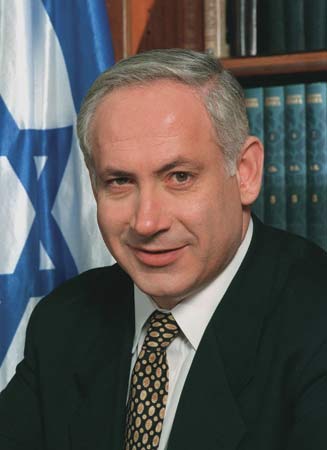
Ben_netanyahu47357 The contents of a secretly recorded video threaten to gravely embarrass not only Benjamin Netanyahu, the Israeli prime minister but also the US administration of Barack Obama.

The film was shot, apparently without Mr Netanyahu’s knowledge, nine years ago, when the government of Ariel Sharon had started reinvading the main cities of the West Bank to crush Palestinian resistance in the early stages of the second intifada.

At the time Mr Netanyahu had taken a short break from politics but was soon to join Mr Sharon’s government as finance minister.

On a visit to a home in the settlement of Ofra in the West Bank to pay condolences to the family of a man killed in a Palestinian shooting attack, he makes a series of unguarded admissions about his first period as prime minister, from 1996 to 1999.

Seated on a sofa in the house, he tells the family that he deceived the US president of the time, Bill Clinton, into believing he was helping implement the Oslo accords, the US-sponsored peace process between Israel and the Palestinians, by making minor withdrawals from the West Bank while actually entrenching the occupation. He boasts that he thereby destroyed the Oslo process.

He dismisses the US as “easily moved to the right direction” and calls high levels of popular American support for Israel “absurd”.

He also suggests that, far from being defensive, Israel’s harsh military repression of the Palestinian uprising was designed chiefly to crush the Palestinian Authority led by Yasser Arafat so that it could be made more pliable for Israeli diktats.

More here.

Sunday Poem

Stanley Kunitz

I used to imagine him
coming from his house, like Merlin
strolling with important gestures
through the garden
where everything grows so thickly,
where birds sing, little snakes lie
on the boughs, thinking of nothing
but their own good lives,
where petals float upward,
their colors exploding,
and trees open their moist
pages of thunder –
it has happened every summer for years.

But now I know more
about the great wheel of growth,
and decay, and rebirth,
and know my vision for a falsehood.
Now I see him coming from the house –
I see him on his knees,
cutting away the diseased, the superfluous,
coaxing the new,
know that the hour of fulfillment
is buried in years of patience –
yet willing to labor like that
on the mortal wheel.

Oh, what good it does the heart
to know it isn’t magic!
Like the human child I am
I rush to imitate –
I watch him as he bends
among the leaves and vines
to hook some weed or other;
I think of him there
raking and trimming, stirring up
those sheets of fire
between the smothering weights of earth,
the wild and shapeless air.

by Mary Oliver

Fun And Intrigue With The Periodic Table

From NPR:

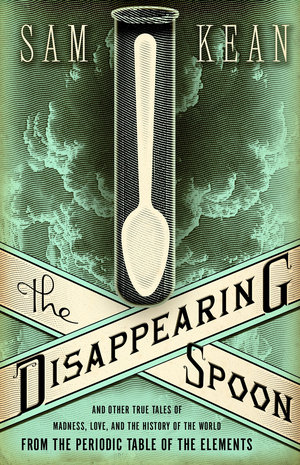
Spoon_custom Most people wouldn't describe the periodic table of elements as gripping. But Sam Kean makes it just that in his new book, The Disappearing Spoon.

The book tells the histories of the elements in the periodic table, and in the process, gives a history of famous thinkers, war, literature, protest and more. Kean spoke with NPR's Guy Raz about how he made the periodic table exciting.

Growing up, Kean says, the science teachers that captured his attention most were the ones who explained science through stories. He uses the same technique for his book.

In one story, a single element from the periodic table changed U.S. Senate candidate Stan Jones forever.

“Stan was a big believer that the Y2K virus was going to wipe out civilization,” Kean says. “He was especially concerned that people wouldn't be able to find antibiotics. So he decided he was going to get his immune system ready for the apocalypse in 2000.”

The Montana Libertarian began drinking liquid silver. He'd heard silver had antibacterial effects. It was so, Kean says, but there was a serious — or hilarious — side effect.

“Stan ended up with blue skin while he was running for the Senate,” Kean says. It was permanent.

More here, including an excerpt from the book. [Sam Kean, has been, of course, a longtime writer at 3QD.]

A rose by a local name

From Himal Southasian:

You know the name you were given,
You do not know the name that you have.
The Book of Certainties

‘I am a Czechoslovakian, sir’ says the one.
The other slaps him and says, ‘So what?’
– Bohumil Hrabal, The Betrayal of Mirrors

Qudds_mirza What’s in a name, one may ask. But names and descriptions can pose serious existential questions. One remembers a short story, Shahadat, by the Urdu writer Intizar Hussain, in which a man, during the turmoil of Partition, is reluctant to disclose his actual name. Instead, he decides to use a few other names, which generally signify other faiths. In so doing, the protagonist ponders the significance of a name, and its logical link to the person who ‘owns’ it.

Besides posing existential questions, names have acquired much weight and visibility in the cultural sphere in Pakistan in recent years, especially in the art world. This has become particularly apparent in the tendency to name art events, galleries and publications using ‘local’ terms, such as Vasl, Shanakht, Khayal Khana, Taza Tareen (art events) Nukta, Nigaah, Suhbat (publications) Nairang, Majmoo’a, Kunj, Koel, Khaas, Royaat, Gulmohur (galleries) and so on. A similar propensity is visible in art scenes around Southasia, in a trend that has been visible for the past decade but has shown no signs of slowing down in recent years. All such usages reflect a longing to employ ‘profound’ local terms in connection with art.

More here.

The Prose and the Passion

From The New Republic:

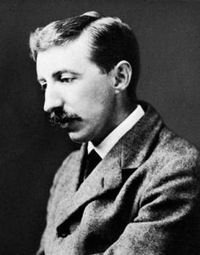
Forster Whenever E.M. Forster is discussed, the phrase “only connect” is sure to come up sooner or later. The epigraph to Howards End, the book he described with typical modesty as “my best novel and approaching a good novel,” seems to capture the leading idea of all his work—the moral importance of connection between individuals, across the barriers of race, class, and nation. What is not as frequently remembered is that, when Forster uses the phrase in Howards End, he is not actually talking about this kind of social connection, but about something more elusive and private—the difficulty of connecting our ordinary, conventional personalities with our transgressive erotic desires.

“Only connect” makes its entrance shortly after Margaret Schlegel, the novel’s liberal intellectual heroine, is first kissed by Henry Wilcox, the conservative businessman whom she has rather surprisingly agreed to marry. Passion has played little part in their relationship, and though they have gotten engaged they have not yet touched. When Wilcox suddenly embraces her, then, Margaret “was startled and nearly screamed,” and though she tries to kiss “with genuine love the lips that were pressed against her own,” she feels afterwards that “on looking back, the incident displeased her. It was so isolated. Nothing in their previous conversation had heralded it, and, worse still, no tenderness had ensued … he had hurried away as if ashamed.” A few pages later, Margaret’s reflections on this erotic incompetence lead, as often happens in Forster’s fiction, into an authorial homily:

Outwardly [Henry Wilcox] was cheerful, reliable, and brave; but within, all had reverted to chaos, ruled, so far as it was ruled at all, by an incomplete asceticism. Whether as boy, husband, or widower, he had always the sneaking belief that bodily passion is bad…. And it was here that Margaret hoped to help him.

It did not seem so difficult. She need trouble him with no gift of her own. She would only point out the salvation that was latent in his own soul, and in the soul of every man. Only connect! That was her whole sermon. Only connect the prose and the passion, and both will be exalted, and human love will be seen at its height. Live in fragments no longer. Only connect, and the beast and the monk, robbed of the isolation that is life to either, will die.

More here.

Saturday, July 17, 2010

FIFA’s Foul Play

Parks-071510-FIFA_jpg_470x456_q85 Tim Parks in the NYRB blog:

The final saw Holland playing Spain, two European colonizers on African territory. Before the game Nelson Mandela’s grandson complained that FIFA had put “extreme pressure” on the elderly hero to attend, despite the fact that he was in mourning for the loss of a great-granddaughter. “Their focus is on having this world icon in the stadium, yet not really paying attention to our customs and traditions as a people and as a family.” The miracle is that anyone ever imagined that FIFA might behave otherwise.

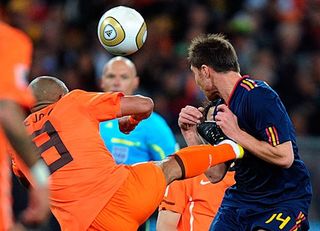
In the event, the grand finale was a disgrace; it also offered another pathetic “English” performance in the shape of the referee, Howard Webb. Having seen German youth outclassed by Spanish skills, the Dutch decided for spoiling tactics. That is fair enough, but their harrying and pressing came with a systematic intimidatory violence that amounted to the worst possible advertisement for football. A “filthfest,” the Guardian’s commentator called it. Webb showed plenty of yellow cards but didn’t have the courage to send a man off until the last minutes of extra time. The moment when Nigel De Jong lifted his leg high to kick his studs into Xabi Alonso’s chest and then was not shown a red card was emblematic of the mentality that FIFA has created in players and officials.

The Dutch team knew that Webb would not want to be responsible for ruining a TV spectacle with a dismissal, so they ruined the game themselves in the hope of grabbing a goal from the shambles they had created. Andres Iniesta’s wonderful strike just five minutes away from a penalty shoot-out was the tournament’s only moment of poetic justice and FIFA’s only fig leaf. On this ugly showing 2014 is rather too soon for a repeat performance.

The French Way of Crisis

Dr3606_thumb3Michel Rocard in Project Syndicate:

The size of France’s political crisis seems to be out of proportion with the country’s real situation. To be sure, France has been severely hit by the global financial crisis and economic downturn. But the consequences have been somewhat less dramatic than in many other European countries.

Two of the three Baltic countries and Greece are in deep financial distress. Much the same is true of Portugal, Spain, Hungary, and Iceland. Ireland, Belgium, Italy, and the United Kingdom are still under threat, owing to large public debts or current-account deficits. But the Netherlands, and Austria – and, to a lesser extent, Germany and France – are faring slightly better.

In the short term, the situation in Germany is less severe than in France. Its trade balance is positive, and total public debt is not as high as it is in other countries. Despite high unemployment and low growth, Germany does not face a short-term threat to macroeconomic stability, though the country’s population is declining and aging, implying huge challenges in the decades ahead.

The short-term situation for France is more worrying. The fiscal deficit is higher than 6% of GDP, the trade balance is negative, and public debt – albeit lower than in all other European countries except Germany and the Netherlands – is nonetheless 80% of GDP. France urgently needs structural reforms – and thus a strong government.

OMG! It’s Muhammad’s footprint

The-Chakwal-MiraclePervez Hoodbhoy in New Humanist:

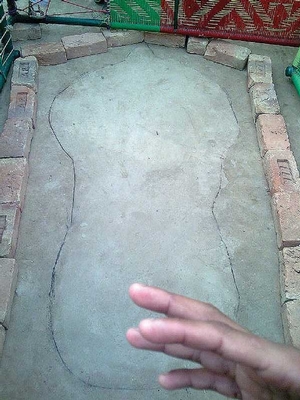
The sudden appearance of the Prophet Muhammad’s alleged footprint in the sleepy village of Dharabi near Chakwal has sent a wave of religious excitement across Pakistan. At a three-hour drive from Islamabad, Dharabi is now attracting tens of thousands of visitors from Swat to Karachi. They seek blessings, spiritual enlightenment, miracle cures and relief from life’s other stresses. A road that is sparsely travelled in normal times is now clogged with traffic, vendors of food and drink are having a field day, new businesses selling pictures and holy paraphernalia have sprouted, and a permanent shrine is under construction. The village could not have hoped for better.

My encounter with this phenomenon was accidental and preceded the heavy rush that came in subsequent weeks. While on the way to Chakwal, I became curious about the heavy police presence. Upon inquiring, I was told of a recent momentous event – a giant footprint was said to have suddenly appeared, which the local Muslim scholars promptly declared to belong to the Holy Prophet. But this had ignited a fierce war of words between various religious factions in the larger Chakwal area. Some believers insist that the Prophet had left the earthly world once and for ever, while others contend that he revisits it periodically to remind followers of his presence. The police had been called to prevent physical violence.

Several weeks later the story hit the national press. And when I spoke villagers I had met in Dharabi I discovered that new embellishments and inventions are being added to the original narration of events. Village sceptics, on the other hand, are being silenced and speak only on condition of anonymity.

Through the Valley of the Nest of Spiders

Samuel R. Delany in The Boston Review:

Barbara said, “That’s a lot of trouble.”

“Ain’t no trouble at all,” Jay said. “It’s nice out on Gilead. Next time you get a day off, we should take you both. Cook hamburgers and hotdogs on the back deck. Bring that boyfriend of yours, Mr. Bodin, out, if y’all can stand us for an afternoon.”

“Oh, Mom—come on! I’m seventeen, now. I wanna go out there. Today—tonight! Please?”

Jay said, “He ain’t got to be back at work with Dynamite on the garbage run till Tuesday. The boy can come on out and see the place. We ain’t gonna let him stay up all night, believe me. We’re up and movin’ by four-thirty—we’ll have him back here when you get in for your shift. And we’ll give you a call.”

Twenty feet away, below the shingle, the sea made the sound of something rushing off somewhere, even while late-summer waves moved in toward grass, sand, and rock. At the world’s rim, an elongated gray-green scab crossed part of the horizon, one end thicker than the other: Gilead Island.

Barbara started up the steps, a sack hanging from each hand by twine handles. She looked back. “All right. You can go. Thank you, Jay, Mex—really, that’s nice of you two. I mean it’s something for Eric to do besides sitting around at Dynamite’s all afternoon.”

“Oh, Mom—thanks!”

“You thank Mr. MacAmon—and Mex.” She managed to open the door and went in.

“We’ll phone you,” Jay said. “We won’t let him forget.”

So, among anticipations of new orgies and excesses, with the two boatmen Eric wandered down dusty Front Street to the wooden gate of the Gilead Boat Dock, joking and relating his recent adventures on the garbage run with Dynamite and Morgan, while Jay swaggered and laughed and fumed in disbelief, and, with his blasted face, barefoot Mex looked about the silent autumn and western light gilded the glass and made white enameled window frames near platinum on the evening street.

Between Riddle and Charm

From Guernica:

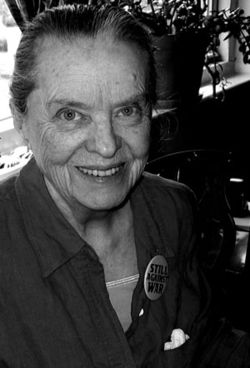
MPonsot-Body It is no surprise that Marie Ponsot’s latest poetry collection, Easy, should feature a poem titled “Language Acquisition.” Ponsot’s engagement with sound, as both a poet and a mother, is insistent; she seeks poems, she says, that use “whatever we can find in our language to catch the world and offer it to each other.” How ironic, then, that mere months after the book was published, Ponsot suffered a stroke, from which she is now recovering, that partially impaired her speech and memory. For the woman who wrote “The delicious tongue we speak with speaks us,” the resulting loss of language and syntax must have been terrifyingly dislocating. Yet she has managed to find humor in it: laughingly observing, in a subsequent interview with the New York Times, that some people have mistaken her newfound confusion of gendered pronouns for sociopolitical commentary.

Laughing at mortality, Marie Ponsot’s accomplishments are legion; among her many fellowships and prizes is a National Book Critics Circle Award for her 1998 collection, The Bird Catcher, and her recent election to the Academy of American Poets. She is also a translator and a beloved teacher. A professor of English at Queens college until 1991—during which time she co-authored with Rosemary Deen two books on writing fundamentals, Beat Not the Poor Desk and The Common Sense—she has since taught creative writing at Columbia University, New York University, and the 92nd Street Y, among other institutions. And lest we forget triumphs closer to home, Ponsot will remind us of her seven children, sixteen grandchildren, and nine great-grandchildren.

More here.

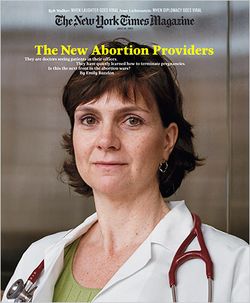
The New Abortion Providers

From The New York Times:

Cover On a clear and mild March day in 1993, the Operation Rescue leader Randall Terry spoke at a rally in southern Florida against abortion. “We’ve found the weak link is the doctor,” he told the crowd. “We’re going to expose them. We’re going to humiliate them.” A few days later, Dr. David Gunn, an abortion provider, was shot and killed outside his clinic in Pensacola, Fla., about 500 miles away. It was the first of eight such murders, the extreme edge of what has become an anti-abortion strategy of confrontation.

Terry understood that focusing on abortion providers was possible because they had become increasingly isolated from mainstream medicine. That was not what physicians themselves anticipated after the Supreme Court’s 1973 decision in Roe v. Wade. An open letter signed by 100 professors of obstetrics and gynecology predicted that free-standing clinics would be unnecessary if half of the 20,000 obstetricians in the country would do abortions for their patients, and if hospitals would handle “their proportionate share.” OB-GYNs at the time emphasized that abortion was a surgical procedure and fell under their purview.

More here.

Saturday Poem

Beans with Tabasco for Breakfast

I sat down to drink an espresso
on a morning of dry desert winds
and near me sat a well-known poet
less famous than I am though
and he was speaking with an intellectual or a man from the TV or the radio
they were speaking about ars poetica
about ethos pathos and epos
and science and education and
the mixing of cultures and the integration of cultures
in a very western language
and I asked myself
what the hell are these people eating for breakfast,
red beans with tabasco?
And I consoled myself that I don’t have this kind of friends.
Anyway
they completely spoiled
the taste of the coffee.

by Mois Benarroch
translation by author
from
Bilingual Poems
publisher: Moben, Jerusalem, 2005

off the grid

54959731-15131253

It’s all Thoreau’s fault. In the whirring, churning American imagination, that vast and lovely virtual world — fed by books and stories — with territory one can still “light out” for, Thoreau is the guy who showed it was possible to get off the merry-go-round, the constant forward movement, and still walk into town from time to time. Plant yourself within spitting distance of civilization, refuse to participate in the orgy of commercialism, refuse to pay taxes if you don’t agree with how they’re spent. You don’t need everything they tell you that you need. You can do more for yourself than they tell you that you can. The message was political, spiritual, practical and environmental. It contained a fine amount of humor, a pinch of self-doubt and a smidgeon of hypocrisy. Today we would call Thoreau’s move to the banks of Walden Pond going off the grid. Although books about carving out your own piece of the pie have been written ever since the Transcendentalists took issue with the direction that American democracy was taking, never before have I seen the current deluge of books on how to escape the American Dream. I grew up in New York City in an apartment full of them — my mother spent her short life trying to get out of Dodge and into the hills, though the schools she attended surely did not teach survival skills. I’ve chosen seven new tomes that represent various approaches, or should I say escape routes, but there are at least a dozen more. Why? Why now?

more from Susan Salter Reynolds at the LAT here.