Biological roots of today’s anger

David P. Barash in the Chronicle of Higher Education:

Photo_6128_carousel “No fair” must rank among the loudest and most readily evoked complaints. Nor is the din of inequity limited to children. Consider the widespread anger generated by the Wall Street and AIG bailouts: Regardless of whether they were justified as national policy, those and other departures from perceived evenhandedness have a long history of rousing departures from citizen complacency, and even from civility. Ditto for outrage over executives getting outsized bonuses and golden parachutes while the rest of us are left to soldier on as best we can.

In evolutionary terms, what's going on here?

Another way of asking that question is to turn it around. Why do we feel so violated? Lixing Sun, a professor of biology at Central Washington University, thinks we have a “fairness instinct.” And he may be right. He maintains that high on the roster of human propensities is a “Robin Hood mentality” that characterizes our species and qualifies as one of those “mental modules” that evolutionary psychologists consider part of our likely biological inheritance.

More here. [Thanks to Ali Altaf.]
Friday, July 23, 2010

UK government acts to prevent arrest of Pope

Andrew John in Digital Journal:

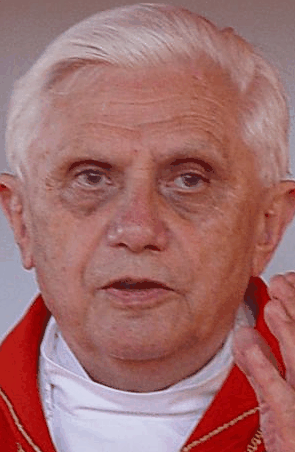
ScreenHunter_04 Jul. 23 23.43 The UK government is said to have set in motion a law change that will prevent the Pope from being arrested when he visits the country in September.
Officials in Whitehall – the UK government’s administrative offices – are said to be worried over plans by the atheist authors Richard Dawkins and Christopher Hitchens to have Pope Benedict arrested for crimes against humanity, because of his alleged cover-upof priestly assaults on children.
“Mr Dawkins, the atheist campaigner, and Mr Hitchens, an atheist author, asked human rights lawyers in April to put together a case for charging the Pope over his alleged cover-up of sexual abuse of children in the Catholic church,” reportsPink News today.
Its report adds: “Justice Secretary Ken Clarke proposed changes to the law today which would require the consent of the Director of Public Prosecutions to any arrest warrant issued under universal jurisdiction.”
The Pope’s proposed visit has ever been free of controversysince it was announced last year.
A recent suggestion by the Pope’s second-in-command, Cardinal Tarcisio Bertone, that child abuse and paedophilia were connected with homosexuality brought condemnation even from fellow Catholicsin the UK.
More here.

Frans de Waal: Fair is fair

This post is the first in a four-part series of essays for Scientific American by primatologist Frans de Waal on human nature, based on his ongoing research. De Waal and other researchers appear in a series of Department of Expansion videos focusing on the same topic. [See below for parts 2, 3, and 4.]

Frans de Waal in Scientific American:

FransWeb Fairness is viewed differently by the haves and have-nots. The underlying emotions and desires aren't half as lofty as the ideal itself. The most recognizable emotion is resentment. Look at how children react to the slightest discrepancy in the size of their pizza slice compared with their siblings'. They shout, “That's not fair!” but never in a way transcending their own desires.

An experiment with capuchin monkeys by Sarah Brosnan, of Georgia State University's CEBUS Lab, and myself illuminated this emotional basis. These monkeys will happily perform a task for cucumber slices until they see others getting grapes, which taste so much better. They become agitated, throw down their measly cucumbers, and go on strike. A perfectly fine vegetable has become unpalatable! Not all economists, philosophers and anthropologists were happy with our interpretation, because they traditionally consider the “sense of fairness” uniquely human. But by now there are many other experiments, even on dogs, that confirm our initial findings.

More here. And here are parts two, three, and four.

The worst poster boys for Islam

Nadeem F. Paracha in Dawn:

2905 While formulating Islamic laws, a rationalist and contextual approach to Islamic sources should be taken, keeping in mind Islam’s core values i.e., justice and mercy.

Islamic rules should always meet the following criteria: Compatibility with reason and compatibility with the requirements of (modern) times and people’s preferences.

How is that possible, wouldn’t the traditionalists protest?

Well, let’s take the example of Quranic verses dealing with slavery. Understandably, the institution of slavery was perceived as perfectly acceptable in the seventh century. But from eighteenth century onwards, through a widespread civil consensus between various world civilisations (including the Muslims), slavery was abolished as being an inhuman act.

Just imagine what the state of the Muslims would have been had they insisted on retaining slavery. The so-called Muslim ummah would have stood completely isolated with millions of Muslims preferring to adopt a more accommodating religion.

So my point is that when traditionalists demand that the Quran be understood literally and laws should then be based on this literalist reading, they are actually undermining the evolutionary spirit of the Holy book and relegating its status to being a document frozen in the social, political and cultural ethos of a distant past.

Islam and Islamic law should be understood and implied by each generation according to its own conditions.

We should define Islam in such a way that it does not undermine its global standing. For this we need educated, pragmatic and rational political and cultural spokespersons. Obviously, people like the Al Qaeda and the Taliban are the worst poster boys for Islam in the modern world.

More here.

Your Move: The Maze of Free Will

Galen Strawson in the New York Times:

Clip_image002_057 You arrive at a bakery. It’s the evening of a national holiday. You want to buy a cake with your last 10 dollars to round off the preparations you’ve already made. There’s only one thing left in the store — a 10-dollar cake.

On the steps of the store, someone is shaking an Oxfam tin. You stop, and it seems quite clear to you — it surely is quite clear to you — that it is entirely up to you what you do next. You are — it seems — truly, radically, ultimately free to choose what to do, in such a way that you will be ultimately morally responsible for whatever you do choose. Fact: you can put the money in the tin, or you can go in and buy the cake. You’re not only completely, radically free to choose in this situation. You’re not free not to choose (that’s how it feels). You’re “condemned to freedom,” in Jean-Paul Sartre’s phrase. You’re fully and explicitly conscious of what the options are and you can’t escape that consciousness. You can’t somehow slip out of it.

You may have heard of determinism, the theory that absolutely everything that happens is causally determined to happen exactly as it does by what has already gone before — right back to the beginning of the universe. You may also believe that determinism is true. (You may also know, contrary to popular opinion, that current science gives us no more reason to think that determinism is false than that determinism is true.) In that case, standing on the steps of the store, it may cross your mind that in five minutes’ time you’ll be able to look back on the situation you’re in now and say truly, of what you will by then have done, “Well, it was determined that I should do that.” But even if you do fervently believe this, it doesn’t seem to be able to touch your sense that you’re absolutely morally responsible for what you next.

More here. [Thanks to Jonathan Kramnick.]

Sticking the world together with words

From The Guardian:

Antony-Sher-as-Prospero-i-002 We're so used to hearing writers worship words: “Oh, I've always been passionate about language, every sentence is crafted with loving care.” So used to hearing of the positive power of literature: “If only she'd read some serious fiction, the break-up wouldn't have come as such a trauma!” Even of its supposed political importance: if only Israelis and Palestinians would read each others' novels, says Amos Oz, they would begin to come to some accommodation. If only Americans translated more foreign literature, says translator Edith Grossman, US foreign policy would be more understanding. The mafia can be beaten, says Roberto Saviano, with words! And then, the Bible's weird announcement: “In the beginning was the Word”. As if everything outside language were secondary and irrelevant.

But what if language and literature were as much a part of the problem as the solution?

Consider.

Invented, not part of nature, words are thrust upon us the moment we emerge from the womb. Heads stuffed with them, we start to imitate. The right sounds in the right sequences get us what we want. Soon these patterns of sound seem as natural as breathing. For stream of consciousness, read stream of words.

More here.

Top 10 new species of 2009 named

From MSNBC:

Fish In this age of vampire hysteria, a minnow with toothlike fangs is a shoo-in for a top 10 list.

The translucent Dracula minnow, Danionella dracula, is a member of the Cyprininform group of fish, most of which lost their teeth about 50 million years ago. Males of the Dracula minnow species, however, re-evolved fanglike structures that protrude from the jaw bone.

The freshwater minnow was discovered in Myanmar. Scientists say the males use their fangs for sparring with each other. Females lack the vampiresque structures.

Morehere.

I wrote “How to Write about Africa” as a piss-job

Wainaina

“How to Write about Africa” grew out of an email. In a fit of anger, maybe even low blood sugar — it runs in the family — I spent a few hours one night at my graduate student flat in Norwich, England, writing to the editor of Granta. I was responding to its “Africa” issue, which was populated by every literary bogeyman that any African has ever known, a sort of “Greatest Hits of Hearts of Fuckedness.” It wasn’t the grimness that got to me, it was the stupidity. There was nothing new, no insight, but lots of “reportage” — Oh, gosh, wow, look, golly ooo — as if Africa and Africans were not part of the conversation, were not indeed living in England across the road from the Granta office. No, we were “over there,” where brave people in khaki could come and bear witness. Fuck that. So I wrote a long — truly long — rambling email to the editor. To my surprise, Granta wrote back right away. The editor, Ian Jack, disavowed the “Africa” issue — that was before his time, he said. A year or so later, another Granta editor called. They were doing a new “Africa” issue, and they wanted my perspective. Sure, sure, I said. And then forgot. And then remembered, felt guilty, felt the weight of a continent on my back. I was blocked and more blocked. I drank a Tusker. Finally I wrote something about Bob Geldof. It was shit, said the editor — not his words, but he meant to say that, and he was right. So I went back to work. The deadline came. The deadline went. I was busy working on a short story, busy working on my novel. A cold Tusker. The new Kwani. The beach, in Lamu. The editor called with an idea — why don’t we publish your long crazy email?

more from Binyavanga Wainaina at Bidoun here.

Ghana’s turn

Ghana-1

Early one December morning in 1965, a few months after my arrival in Ghana, I was jolted out of a tropical sleep by a pile of Daily Graphic newspapers whumping onto the concrete floor of my small room. “What are those for, Atinga?” I called out groggily to Atinga Naga, the residence cleaner, as he stood at the door, several more such loads balanced in his arms. “You’ll see!” And indeed I did. Within minutes came an eruption of shouts, rubber flip-flopped footsteps, and slamming screen doors — unusual noises amid the staid gentlemanliness of Legon Hall, my University of Ghana residence. I leaped up and joined the swarm now flying from bathroom to bathroom, where we found our worst fears realized: the country, in its ninth year of independence, had run out of toilet paper. The new Ghana on which I had staked my future was in crisis. Not many weeks later, in the dark early morning of February 24, 1966, we heard the sound of distant guns and knew instantly there had been a coup d’état. The campus — and the capital, Accra — erupted as cheering crowds danced in euphoric and spontaneous celebration.

more from John Schram at The Walrus here.

sesame street socrates

Aristotle

“My ideas evolved from long hours in local bars, talking, talking, talking, always about morality. People were always asking ‘Who do you think you are, Socrates?’ They said it with contempt, but I would smile and say, ‘Thank you.’” – Tim Cooney

The television show Sesame Street recently celebrated its 40th anniversary. To commemorate the occasion there have been a host of events, including the publication of several books. A review of one of them, Street Gang: The Complete History of Sesame Street by Michael Davis, caught my eye when I saw a mention in it of the late Timothy J. Cooney, ex-husband of J oan Ganz Cooney, the creator of Sesame Street. Tim was a fascinating person in his own right, and I immediately bought the book to see what it had to say about him, for I had gotten to know Tim in the last decade of his life, well after his marriage had ended.

more from Tim Madigan at Philosophy Now here.

Thursday, July 22, 2010

Europe starting to realize homeopathy is nonsense

From Der Spiegel:

ScreenHunter_01 Jul. 23 12.37 For months now, a bitter battle has been taking shape in Great Britain between defenders of homeopathy, who are supported by no less than Prince Charles, and detractors who point to the lack of scientific evidence that the remedies offer anything more than a placebo effect. The royal family themselves have been adherents to homeopathy for generations and even Queen Elizabeth is given homeopathic remedies. After the war, her father King George VI even saw to it that Britain's National Health Service (NHS), the country's subsidized healthcare system, picked up the tab for homeopathic treatments.

Homeopathy is based on two fundamental ideas that skeptics like Singh can only shake their heads at. The first is the idea of the law of similars. The inventors of homeopathy believe that the cause of a symptom should also be treated with the cause. When treating someone, a homeopath considers which substance would cause the same symptoms in a healthy person. Arsenicum album, for example, which the activists in the campaign tried to overdose on, should in theory cause restlessness and nausea in a healthy person. But in an ill person, it is supposed to heal exactly these symptoms. If a patient has a fever, then a homeopath will look for a substance than can cause a fever in a healthy person.

The second principle is that of dilution: The more a medical ingredient is diluted and shaken, the stronger its effect will be — at least that's the assumption. But most homeopathic substances are so strongly diluted that molecules of the active ingredient can no longer be traced. Homeopaths still believe in the effects because they are convinced the water has a “memory.” Scientific proof for the claim is wanting.

More here.

Beware those Black Swans

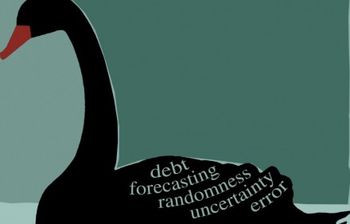
The bestselling economist Nassim Nicholas Taleb argues that we can’t make the world financial system immune to shocks –– but we can make sure it’s much more robust by building randomness into our planning.

Nassim Nicholas Talib in The New Statesman:

20100630_2010+26swan_w Let me summarise my ideas of how Mother Nature deals with the Black Swan. First, she likes redundancies. Look at the human body. We have two eyes, two lungs, two kidneys, even two brains (with the possible exception of company executives) – and each has more capacity than is needed ordinarily. So redundan­cy equals insurance, and the apparent inefficiencies are associated with the costs of maintain­ing these spare parts and the energy needed to keep them around in spite of their idleness.

The exact opposite of redundancy is naive optimisation. The reason I tell people to avoid attending an (orthodox) economics class and argue that economics will fail us is the following: economics is largely based on notions of naive optimisation, mathematised (poorly) by Paul Samuelson – and these mathematics have contributed massively to the construction of an error-prone society. An economist would find it inefficient to carry two lungs and two kidneys – consider the costs involved in transporting these heavy items across the savannah. Such optimisation would, eventually, kill you, after the first accident, the first “outlier”. Also, consider that if we gave Mother Nature to economists, it would dispense with individual kidneys – since we do not need them all the time, it would be more “efficient” if we sold ours and used a central kidney on a time-share basis. You could also lend your eyes at night, since you do not need them to dream.

Almost every major idea in conventional economics fails under the modification of some assumption, or what is called “perturbation”, where you change one parameter or take a parameter henceforth assumed to be fixed and stable by the theory, and make it random.

More here. [Thanks to Ali Altaf.]

long shadow of the confederacy

CSA_Map_-_cropped5

The bicentennial of Abraham Lincoln’s birth has come and gone, and with it a flood of books about the sixteenth president. But the sesquicentennial of the Civil War now looms on the horizon, promising its own deluge of books of every size, shape and description. We will be fortunate indeed if in sheer originality and insight they measure up to Confederate Reckoning and The Long Shadow of the Civil War, new works by Stephanie McCurry and Victoria Bynum, respectively, on the Confederate experience. Most scholarly history on the Confederacy has been shaped, implicitly or explicitly, by a desire to explain Southern defeat. Devotees of the Lost Cause insist that gallant Southern soldiers inevitably succumbed to the Union’s overwhelming advantages in manpower and economic resources. The stronger side, however, does not always win a war, as the United States learned in Vietnam. This fact has led historians to try to locate internal causes for the failure of the quest for Southern independence. They have identified such culprits as poor political leadership, excessive individualism, desertion from the army by non-slaveholding soldiers, waning enthusiasm for the war among upper-class white women and disaffection among the slaves.

more from Eric Foner at The Nation here.

dead tolstoy

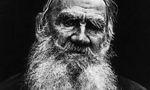
Leo-Tolstoy-in-1908-001

William Nickell describes the death drama itself as Russia’s first great mass media event. The room in the stationmaster’s house in Astapovo where the dying Tolstoy was lodged was the eye of a news hurricane. A horde of reporters elbowing their way through crowds of onlookers sent out their despatches in thousands of telegrams to hundreds of newspapers, some of which gave over half their editorial space to a kind of frozen proto-blog. ‘Please delete that Tolstoy ate two eggs, incorrect: drank only milk tea,’ one telegram reads. The cameras were there, and the cinematograph. You can see Tolstoy on YouTube. The essential modern corollary of a media feeding frenzy, the self-flagellating analysis by the media of its own actions, was rampant, as reporters masochistically savoured the irony that they were trying to grab and sell a piece of the great anti-materialist. ‘We’re shams!’ wailed Sergei Yablonovsky, correspondent of the Voronezh Telegraph. ‘With counterfeit bodies, counterfeit souls.’ The result of the public scrutiny of Tolstoy’s death was that all those closest to him at the end, even those he bumped into by chance, came out with their own versions of events. Six doctors kept separate medical records of his last days. Government spies sent secret reports back to St Petersburg. Before Tolstoy fled Yasnaya Polyana, he was one of eight people keeping supposedly private diaries of life there. Dushan Makovitsky, Tolstoy’s personal physician, was a doctor and a diarist.

more from James Meek at the LRB here.

toxic emanations

TLS_Cardinal_727094a

It soon becomes evident that there are only a few protagonists in Maldoror’s grisly recitals, and that the chief one is none other than Maldoror, identical with the narrator himself. A few minor characters, with names such as Lohengrin or Lombano, flit past as occasional partners in crime; and there is an ample provision of nameless innocents, the victims of Maldoror’s tireless intentions. The one protagonist who might be expected to resist this paragon of evil is the Creator himself, but Maldoror has no truck with divine privilege, and sees off the deity in a stanza (strophe) steeped in blasphemous fantasy, in which the “Celestial Bandit” is depicted as a drunken debauchee shuffling away after a night at the brothel. Rather than simply suborn us through glamorous evocations of criminal pleasures, the deeper purpose of Les Chants de Maldoror is to sabotage the central clauses of the writer–reader contract, if not the protocols of literature at large. As a corpus of highly self-conscious prose cantos, Ducasse’s text is not only a compendium of boasts and blasphemies: it is constantly sharpening itself as it advances, providing a succession of ironic disclaimers that entirely wrong-foot its reader. Some will scoff and shrug off the book as a laughable parody of the Gothic; yet it is more accurate to say that it takes its genre seriously, so seriously as to transcend horror and disgust and ultimately to thrust the enthralled reader into a state of pure acquiescence to the narratorial will, as if to “de-brain” (“décerveler”, to use Alfred Jarry’s term) the innocent page-turner, who sinks into a shellshocked numbness, no longer even capable of “blushing at the thought of what the human heart is really like”.

more from Roger Cardinal at the TLS here.

He impersonated a human

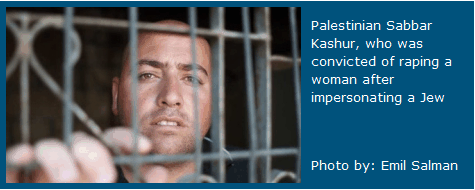
ScreenHunter_07 Jul. 22 16.05

Gideon Levy in Haaretz:

Sabbar Kashur wanted to be a person, a person like everybody else. But as luck would have it, he was born Palestinian. It happens. His chances of being accepted as a human being in Israel are nil. Married and a father of two, he wanted to work in Jerusalem, his city, and maybe also have an affair or a quickie on the side. That happens too.

He knew that he had no chance with the Jews, so he adopted another name for himself, Dudu. He didn't have curly hair, but he went by Dudu just the same. That's how everyone knew him. That's how you know a few other Arabs too: the car-wash guy you call Rafi, the stairwell cleaner who goes by Yossi, the supermarket deliveryman you know as Moshe.

What's wrong? Is it only fearsome Shin Bet interrogators like “Capt. George” and “Abu Faraj” who are allowed to adopt names from other peoples? Are only Israelis who emigrate allowed to invent new identities? Only the Yossi from Hadera who became Joe in Miami, the Avraham from Bat Yam who became Abe in Los Angeles?

No longer a youth, Sabbar/Dudu worked as a deliveryman for a lawyer's office, rode his scooter around Jerusalem and delivered documents, affidavits and sworn testimonies, swearing to everyone that he was Dudu. Two years ago he met a woman by chance. Nice to meet you, my name is Dudu. He claims that she came on to him, but let's leave the details aside. Soon enough they went where they went and what happened happened, all by consent of the parties concerned. One fine day, a month and a half after an afternoon quickie, he was summoned to the police on suspicion of rape.

His temporary lover discovered that her Dudu wasn't a Dudu after all, that the Jew is (gasp! ) an Arab, and so she filed a complaint against the impostor. Her body was violated by an Arab. From then on Kashur was placed under house arrest for two years, an electronic cuff on his ankle. This week his sentence was pronounced: 18 months in jail.

More here.

Thursday Poem

The Mystic Marriage

The fountain is stopped now
That made its water-noise
Into the small hours. Years ago
You thought it was rain,

Now, you sleep through everything
With the window open—
Late night jazz, a couple quarrelling,
Headlights, one mosquito.

‘It is three o’clock
In the morning. I am going
To the lovers’ bridge
In white mist, without you . . .’

I wake from that dream
Towards daybreak. You beside me
Still sleeping.
You were never a dawn person.

The fountain is on again.
Whole years have passed. And still
We have never left the south—
From which, if ever, each returns

Eternally changed, or not at all.
A white noise of swifts
Outside. Swallows sipping
Old dregs of misery—

The drained glass on the wooden table
Slowly filling with light.
And suddenly, a crash of bells
From Saint John of Malta

Hard by, and two flights down,
Approaching, lifting the spell,
A river of children’s voices
Growing and growing, out of the future,

• • •

Pure annunciation. Just in time
I retrieve it, like a dream transcript—
Our mystic marriage. Something, at last,
Has earthed itself inside you.

by Harry Clifton
from The Boston Review,
July/August 2010

Eclipse of the Sunnis

From The Telegraph:

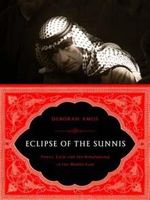
Eclipse_main_1679560f Before the 2003 invasion of Iraq, I doubt many people in Britain knew the difference between a Sunni and a Shia. But since the civil war began in 2003, there has been considerable curiosity about the complexity of religious and political divisions in the Arab world.

In Eclipse of the Sunnis, the American journalist Deborah Amos describes how nearly two million mainly Sunni Iraqis have fled their country since the Americans and British invaded seven years ago. Her title references a now famous theory proposed by King Abdullah of Jordan that since the war a “Shia crescent” of influence has developed from a newly emboldened Iran through Shia-ruled Iraq, Syria and Hizbollah in Lebanon. Abdullah contrasted these radical forces with the settled (some might say pliant and undemocratic) Sunni states such as Jordan, Saudi Arabia and Egypt. The message was designed as a rebuke to the US for unleashing a Shia revival that would work against its interests.

More here.