Researchers discover water on the moon is widespread, similar to Earth’s

From PhysOrg:

Moon Last fall, researchers, including Larry Taylor, a distinguished professor in the Department of Earth and Planetary Sciences, discovered “lunar dew” on the moon's surface — absorbed “water” in the uppermost layers of lunar soil. This discovery of water debunked beliefs held since the return of the first Apollo rocks that the moon was bone-dry. Now, scientists, including Taylor and Yang Liu, research assistant professor in the Department of Earth and Planetary Sciences, have discovered that water on the moon is more widespread — on the outside and inside of the moon — with some similarities to water in volcanic systems on Earth.

Their research will be featured in the article, “Lunar Apatite with Terrestrial Volatile Abundances” in the July 22 edition of the scientific journal, Nature. Unlike lunar dew which is believed to come from an outside source such as solar wind which brings hydrogen into contact with the Moon's oxygen, the water discovered by Taylor and Liu is internal, arising from an entirely different origin. How it got there is not yet known. The water may have been added by impacting comets, which contain ice, during or after the formation of the moon and Earth.

More here.
Wednesday, July 21, 2010

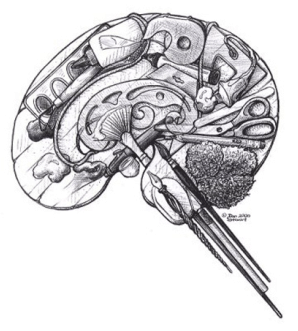
A neuroscientist imagines life beyond the brain

Robert Jensen in Killing the Buddha:

ScreenHunter_05 Jul. 22 12.59 There’s a struggle inside the brain of David Eagleman for the soul of David Eagleman.

That is, there might be such a struggle if Eagleman’s brain believed that Eagleman had a soul, which he is not sure about. In fact, Eagleman’s brain is not completely sure that there is an Eagleman-beyond-Eagleman’s-brain at all—with or without a soul, whatever that term might mean.

Welcome to the world of “possibilian” neuroscientist-writer David Eagleman, to life in the space between what-is and what-if, between the facts we think we know and the fictions that illuminate what we don’t know.

Eagleman-the-scientist would love to rev up his high-tech neuroimaging machines to answer the enduring questions about the brain and the mind, the body and the soul. But Eagleman-the-writer knows that those machines aren’t going to answer those questions.

Eagleman rejects not only conventional religion but also the labels of agnostic and atheist. In their place, he has coined the term possibilian: a word to describe those who “celebrate the vastness of our ignorance, are unwilling to commit to any particular made-up story, and take pleasure in entertaining multiple hypotheses.”

More here.

Julian Assange: Why the world needs WikiLeaks

The controversial website WikiLeaks collects and posts highly classified documents and video. Founder Julian Assange, who's reportedly being sought for questioning by US authorities, talks to TED's Chris Anderson about how the site operates, what it has accomplished — and what drives him. The interview includes graphic footage of a recent US airstrike in Baghdad.

Wooden “Stonehenge” Emerges From Prehistoric Ohio

From National Geographic:

ScreenHunter_04 Jul. 22 11.52 Just northeast of Cincinnati, Ohio, a sort of wooden Stonehenge is slowly emerging as archaeologists unearth increasing evidence of a 2,000-year-old ceremonial site.

Among their latest finds: Like Stonehenge, the Ohio timber circles were likely used to mark astronomical events such as the summer solstice.

Formally called Moorehead Circle but nicknamed “Woodhenge” by non-archaeologists, the site was once a leafless forest of wooden posts. Laid out in a peculiar pattern of concentric, but incomplete, rings, the site is about 200 feet (57 meters) wide. (See a picture of reconstructed timber circles near Stonehenge.)

Today only rock-filled postholes remain, surrounded by the enigmatic earthworks of Fort Ancient State Memorial (map). Some are thousands of feet long and all were built by Indians of the pre-agricultural Hopewell culture, the dominant culture in midwestern and eastern North America from about A.D. 1 to 900.

This year archaeologists began using computer models to analyze Moorehead Circle's layout and found that Ohio's Woodhenge may have even more in common with the United Kingdom's Stonehenge than thought—specifically, an apparently intentional astronomical alignment.

More here.

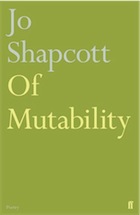
Of Mutability

From The Guardian:

Of-Mutability “Nought may endure but Mutability,” wrote Shelley, joining an imposing line of English poets to have tackled this theme of perpetual change, including Spenser, Shakespeare, Marvell and Wordsworth. Jo Shapcott's new collection – her first in 12 years, barring the Rilke translations of Tender Taxes – meets the term and its history head-on, even going so far as to call itself Of Mutability, a nod towards the grammar of those predecessors as well as their preoccupations. The excellent title poem, a deceptively casual sonnet, acts as something of a tissue sample for most of the book's concerns, from the mutations of cells to the disruption of the seasons, in a voice as mutable as the phenomena it describes, speaking sympathetically in the year 2004 to those who “feel small among the numbers. Razor small”, and suspect the pavement might be about to open under their feet.

Curiously, many of the poems seem more interested in equilibrium than mutability: those moments when opposing forces of change match or negate one another. Bubbles and droplets, which depend upon a perfect balance between internal and external air pressure to maintain their surface tension, bear much of the emblematic weight, appearing literally in a fountain or a stream of piss, or as metaphors for physical experience: “My body's / a drop of water”, “the soap film is my skin”. Even the poems themselves can feel like bubbles – formal, delicate, trembling with immediacy – and it seems that Shapcott craves the clarity or guilelessness these metaphors permit: “I breathe in and become everything I see”.

More here.

Why music is good for you

From Nature:

News_2010_362-music Remember the Mozart effect? Thanks to a suggestion in 1993 that listening to Mozart makes you cleverer, there has been a flood of compilation CDs filled with classical tunes that will allegedly boost your baby's brain power. Yet there's no evidence for this claim, and indeed the original 'Mozart effect' paper1 did not make it. It reported a slight, short-term performance enhancement in some spatial tasks when preceded by listening to Mozart as opposed to sitting in silence. Some follow-up studies replicated the effect, others did not. None found it specific to Mozart; one study showed that pop music could have the same effect on schoolchildren2. It seems this curious but marginal effect stems from the cognitive benefits of any enjoyable auditory stimulus, which need not even be musical.

The original claim doubtless had such inordinate impact because it plays to a long-standing suspicion that music makes you smarter. And as neuroscientists Nina Kraus and Bharath Chandrasekaran of Northwestern University in Evanston, Illinois, point out in a review published today in Nature Reviews Neuroscience3, there is good evidence that music training reshapes the brain in ways that convey broader cognitive benefits. It can, they say, lead to “changes throughout the auditory system that prime musicians for listening challenges beyond music processing”.

More here.

Wednesday Poem

Hero
………………….
On a cold winter night in 78
he drank two liters of Russian tea,
went to Red Square before light
and wrote on snow: “Brezhnev is an idiot!”

He was my god, my hero, my model world.
I imagined him struggling with his fly
when, busted by police, he had managed
to end the sentence with an exclamation mark.

Imagine doing something like this nowadays.
Imagine a hero dressed in a short sheepskin coat
standing in the piercing wind, his pants pulled down.
“Gross!” you’ll say and will be wrong.

Sometimes truth necessitates madness, and beauty is hidden
behind obscure details. To tell you the truth,
I’m still jealous of him who shed his urine
in the imperial garden of snow and laughed in the face

of the guards. Nothing beats in my eyes
a jester, his smile full of broken teeth.
When times in the yard are full of lies,
why sing like a nightingale in the emperor’s cage?

by Katia Kapovich
from Cossacks and Bandits
Salt Publishing, London, 2008

Video games come of critical age

Our own Morgan Meis in The Smart Set:

Morgan DFW's essay collection A Supposedly Fun Thing I'll Never Do Again contains “E Unibus Pluram: Television and U.S. Fiction.” In that essay, Wallace wrote these momentous sentences:

Most scholars and critics who write about U.S. popular culture … seem both to take TV seriously and to suffer real pain over what they see. There's this well-known critical litany about television's vapidity, shallowness, and irrealism. The litany is often far cruder and triter than what the critics complain about, which I think is why most younger viewers find pro criticism of television far less interesting than pro television itself.

It would be difficult to overestimate the relief this sentence brought to many critics under the age of 40. It signaled that we had definitively turned the page on an era in which you had to go through the motions of holier-than-thou derision every time you wanted to discuss television or similar aspects of popular culture. Going through these motions had become painful and boring.

Wallace understood the huge role television plays in who we are and how we act. He proposed we take television seriously and do away with the knee-jerk scorn. Television, Wallace seemed to be saying, is beyond good and evil. It is both and neither. It is, simply, part of the structure of our experiences and any student of the human beast in his triumphs and foibles must pay attention to the medium.

A brief survey of how human beings in the developed world spend their time today will reveal that what is true about television is also true of video games. Everyone knows, by now, that these games are big business. Eleven billion dollars is, I'm told, quite a lot of money.

More here. [Photo of Morgan Meis by Stefany Anne Golberg.]

Flesh and Stardust: C. P. Snow’s Two Cultures Fifty Years On

Richard King in his eponymous blog:

Mush&tim_013 ‘When I find myself in the company of scientists,’ wrote W. H. Auden in ‘Poet and the City’, ‘I feel like a shabby curate who has strayed by mistake into a drawing room full of dukes.’ But Auden was exceptional. In Unweaving the Rainbow (1998), Richard Dawkins swaps the costumes on this little playlet, suggesting that, more often than not, it’s the scientists who feel like shabby curates and the poets who are regarded as dukes. Of course, such timidity is entirely misplaced. Dawkins’s title refers to Lamia (1819), in which Keats accuses Isaac Newton of having destroyed the poetry of the rainbow by reducing it to prismatic colours. But Newton, of course, had done nothing of the kind. He had made one of the great discoveries of all time, a discovery that led on to spectroscopy, which has, in turn, immeasurably deepened our understanding of the observable cosmos, surely as proper a subject for poetry as any nightingale or Grecian urn.

Dawkins’s book began life as a lecture, delivered in 1997 in honour of the author C. P. Snow. And it so happens that last year marked the fiftieth anniversary of Snow’s Rede Lecture for 1959, in which Snow identified, or claimed to identify, a division between ‘literary intellectuals’ on the one hand and scientists and engineers on the other. Delivered at Cambridge University and entitled ‘The Two Cultures and the Scientific Revolution’, its effect was to ignite a widespread debate – such, indeed, that the term ‘The Two Cultures’ was quickly absorbed into cultural life.

More here.

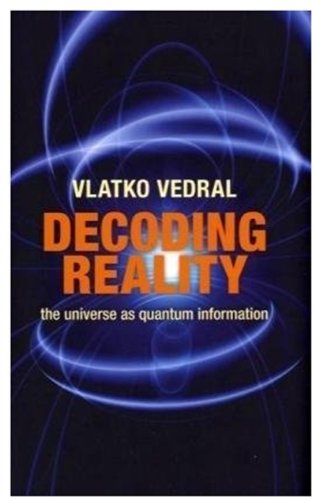
Vlatko Vedral recommends five books

Tom Dannet in Five Books:

41CuGQa3uJL Your first book is Quantum Physics: Illusion or Reality? by Alastair Rae.

This is a completely popular book about quantum physics: there is not a single equation in there, I think. What he does is to go through all the major ways in which we try to understand quantum physics, all the major interpretations. It’s extremely good in that he writes in a very objective way and it’s very difficult to tell which one he supports. It’s very passionately argued as well, and it’s a beautiful exposition, very philosophical. I think it’s the best, probably my favourite, popular account of all the things we argue about on the fundamental side of quantum physics.

There are all kinds of strange views on what quantum physics actually is.

Right. There are connections with religion, then there are extremes saying it’s all in the mind: basically that nothing becomes real until we measure it and look at it and consciously record it. On the other side there is a point of view that it’s as real as anything else, out there independently of us and so on. He talks about these two extreme views and what quantum physics tells us about this very old question: whether the world is ideal or real.

Does he resolve it?

He really leaves it open because, to be completely honest about these issues, I don’t think we have something that’s universally accepted as the view: each has lots of positive points but also something that makes it a not completely plausible view to hold. That’s a really nice book.

More here.

Tuesday, July 20, 2010

Tuesday Poem

Mating Chain

When three or more sea slugs mate in unison, the first animal in the chain acts exclusively
as female, the last as male, and the others as male/female simultaneously.

Learning the difference takes so long. Of being demeaned or being
taught to navigate the seafloor. It’s a language of stoplights
and dark folds you never saw creasing. For example, left is actually
below your stomach and to the right is a reef of indigo. Patches of grey
and pink fondle me to sleep. I want to be one of the species
that pins down the other, circling two or more lovers. To push
my flimsy heart forward in the currents. Lithe as eelgrass,
drunk on endorphins. The best a body can do
is fold itself in half, flapping flail, repetition
of loneliness. But what’s the difference between this hunger
and parasitic tendency? I twist and steer each tentacle,
tying knots against the stillness. This one to symbolize love and the other,
savagery. I’m learning the subtlety, braiding between them.

by Kelly Anne Noftle
from Blackbird, Vol. 9 No. 1

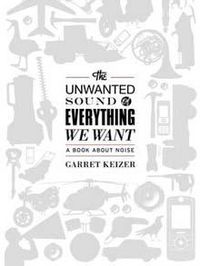
Two Books about Noise

From The Telegraph:

Noise_main_1679524f Loudness isn’t all bad and silence can be deathly. A padded cell would be more terrifying than the roar over Heathrow, and deafness is well known to be more alienating than blindness. Noise is invigorating: it wakes us up and warns us of danger. There are millions like Spinal Tap’s Nigel Tufnel who delight in turning the volume up to 11 as they listen to heavy metal and hip hop.

Mother Nature seems to agree: she abhors silence. The explosion of Krakatoa was heard 3,000 miles away, and the peace of the countryside is an urban myth: rushing water, the dawn chorus, mating animals or a storm are far noisier than the hum of traffic. Another myth is the peace of the past. Blacksmiths, horses’ hooves on cobbles and hawkers made a filthy racket in the pre-industrial city. Whenever I am tempted to rip that wretched iPod from a teenage ear, I remind myself of the ghetto-blasters and transistor radios a generation ago. Manual typewriters clattered far louder than computer keyboards. Yet noise is a terrible problem in the modern world, and one salutes both George Prochnik and Garret Keizer for proselytising on behalf of a bit more hush. Although they both write from the United States, the noisiest country in the world, and inevitably cover a lot of the same ground, their approaches are different and complementary.

Morehere.

Earliest Steps to Find Breast Cancer Are Prone to Error

From The New York Times:

CANCER-1-articleInline Monica Long had expected a routine appointment. But here she was sitting in her new oncologist’s office, and he was delivering deeply disturbing news. Nearly a year earlier, in 2007, a pathologist at a small hospital in Cheboygan, Mich., had found the earliest stage of breast cancer from a biopsy. Extensive surgery followed, leaving Ms. Long’s right breast missing a golf-ball-size chunk. Now she was being told the pathologist had made a mistake. Her new doctor was certain she never had the disease, called ductal carcinoma in situ, or D.C.I.S. It had all been unnecessary — the surgery, the radiation, the drugs and, worst of all, the fear. “Psychologically, it’s horrible,” Ms. Long said. “I never should have had to go through what I did.” Like most women, Ms. Long had regarded the breast biopsy as the gold standard, an infallible way to identify cancer. “I thought it was pretty cut and dried,” said Ms. Long, who is a registered nurse.

As it turns out, diagnosing the earliest stage of breast cancer can be surprisingly difficult, prone to both outright error and case-by-case disagreement over whether a cluster of cells is benign or malignant, according to an examination of breast cancer cases by The New York Times. Advances in mammography and other imaging technology over the past 30 years have meant that pathologists must render opinions on ever smaller breast lesions, some the size of a few grains of salt. Discerning the difference between some benign lesions and early stage breast cancer is a particularly challenging area of pathology, according to medical records and interviews with doctors and patients.

More here.

no living room

LivingRooms-Dejean3-custom1

What exactly is a living room? Is it a formal room for special occasions, or a casual space for everyday life? The meaning has been unclear ever since the late 17th century, when architects first considered what “living” in the home meant. In 1691, in the first edition of what was to become a hugely influential architectural manual, “Lessons of Architecture,” Charles Augustin d’Aviler drew a distinction between formal display spaces and a new kind of room, spaces that were “less grand.” D’Aviler used an unusual phrase to describe these new rooms: “le plus habité” — literally the most lived in. This marked the first time that an architect discussed the notion of living rooms, rooms intended for everyday life. Before this, anyone who could afford an architect-designed residence wanted it to serve as proof of status and wealth; almost all rooms were display spaces. But once d’Aviler opened the door, French architects began making rooms for specific activities of daily life integral to the design of the home: initially the bedroom, then dressing rooms and bathrooms. These “less grand” rooms were the original living rooms.

more from Joan Dejean at The Opinionater here.

a secret Plato

Plato-006

It may sound like the plot of a Dan Brown novel, but an academic at the University of Manchester claims to have cracked a mathematical and musical code in the works of Plato. Jay Kennedy, a historian and philosopher of science, described his findings as “like opening a tomb and discovering new works by Plato.” Plato is revealed to be a Pythagorean who understood the basic structure of the universe to be mathematical, anticipating the scientific revolution of Galileo and Newton by 2,000 years. Kennedy’s breakthrough, published in the journal Apeiron this week, is based on stichometry: the measure of ancient texts by standard line lengths. Kennedy used a computer to restore the most accurate contemporary versions of Plato’s manuscripts to their original form, which would consist of lines of 35 characters, with no spaces or punctuation. What he found was that within a margin of error of just one or two percent, many of Plato’s dialogues had line lengths based on round multiples of twelve hundred.

more from Julian Baggini at The Guardian here.

Solve poverty by simply giving out money

FreeMoney1__1279313718_5155

There are all sorts of things very poor people living in poor countries don’t have. They lack secondary-school educations, usually, and good medical care. They lack steady work and life insurance, bank accounts and competent legal representation, adequate fertilizer for their crops, adequate protein in their diets, reliable electricity, clean water, indoor plumbing, low-interest loans, incubators for their premature babies, vaccinations and good schools for their children. But the central thing they lack is money. That is what makes them, by definition, poor: International aid organizations define the “very poor” as those who live on less than a dollar a day. Despite this, the global fight that governments and nongovernmental organizations have waged against poverty in the developing world has focused almost entirely on changing the conditions in which the poor live, through dams and bridges and other massive infrastructure projects to bring commerce and electricity to the countryside, or the construction and staffing of schools and clinics, or subsidizing fertilizer and medicine, or giving away mosquito nets or cheap portable water filters. In the last decade, however, the governments of the nations where most of the world’s poorest actually live have begun to turn to an idea that seems radical in its simplicity: Solve poverty and spur development by simply giving out money.

more from Drake Bennett at The Boston Globe here.

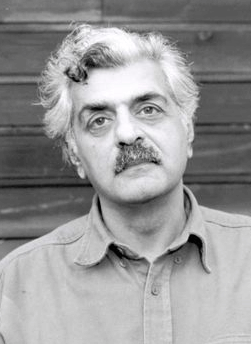
Tariq Ali on the recent killings in Kashmir

Tariq Ali in the London Review of Books:

ScreenHunter_03 Jul. 20 11.27 A Kashmiri lawyer rang me last week in an agitated state. Had I heard about the latest tragedies in Kashmir? I had not. He was stunned. So was I when he told me in detail what had been taking place there over the last three weeks. As far as I could see, none of the British daily papers or TV news bulletins had covered the story; after I met him I rescued two emails from Kashmir informing me of the horrors from my spam box. I was truly shamed. The next day I scoured the press again. Nothing. The only story in the Guardian from the paper’s Delhi correspondent – a full half-page – was headlined: ‘Model’s death brings new claims of dark side to India’s fashion industry’. Accompanying the story was a fetching photograph of the ill-fated woman. The deaths of (at that point) 11 young men between the ages of 15 and 27, shot by Indian security forces in Kashmir, weren’t mentioned. Later I discovered that a short report had appeared in the New York Times on 28 June and one the day after in the Guardian; there has been no substantial follow-up. When it comes to reporting crimes committed by states considered friendly to the West, atrocity fatigue rapidly kicks in. A few facts have begun to percolate through, but they are likely to be read in Europe and the US as just another example of Muslims causing trouble, with the Indian security forces merely doing their duty, if in a high-handed fashion. The failure to report on the deaths in Kashmir contrasts strangely with the overheated coverage of even the most minor unrest in Tibet, leave alone Tehran.

On 11 June this year, the Indian paramilitaries known as the Central Reserve Police Force fired tear-gas canisters at demonstrators, who were themselves protesting about earlier killings. One of the canisters hit 17-year-old Tufail Ahmad Mattoo on the head. It blew out his brains. After a photograph was published in the Kashmiri press, thousands defied the police and joined his funeral procession the next day, chanting angry slogans and pledging revenge. The photograph was ignored by the mainstream Indian press and the country’s celebrity-trivia-obsessed TV channels. As I write, the Kashmiri capital, Srinagar, and several other towns are under strict military curfew.

More here. [Thanks to Yousaf Hyat.]

Herbie Hancock’s secret of great musicianship: Do your math and science homework!

Reed Johnson in the Los Angeles Times:

ScreenHunter_01 Jul. 20 10.40 Hancock has placed his mark on modern music like few other performers.

Now he's got a new gig as creative jazz chair of the Los Angeles Philharmonic. In that capacity, he'll be responsible for programming jazz concerts at the Walt Disney Concert Hall and the Hollywood Bowl, bringing in guest artists and possibly commissioning new pieces.

So what are some keys to the professional success and longevity of Hancock, who turned 70 in April and seems as occupied as ever?

Well, one of them is: Study your math and science. As a self-described “techie,” Hancock says his lifelong embrace of electronic experimentation has helped him stay on top as well as take advantage of evolving musical developments.

Here's part of what he had to say on the subject during a recent interview at his Westside home:

“I've always been interested in science. I used to take watches apart and clocks apart, and there's little screws, and a little this and that, and I found out if I dropped one of them, that thing ain't gonna work. When I was a kid, I put things back together and they never worked anyway! But just, like, going into those details, it's kind of a scientist's thing. And I have that kind of [mind], it's part of my personality.”

“I'm one of the people who helped push it in the beginning. It was easier for me because I was an engineering major in college for two years. So when synthesizers came in, they used terminology I knew.”

More here.