
Enjoying the content on 3QD? Help keep us going by donating now.
Category: Recommended Reading
John Forté (1975 – 2026) Rapper and Fugees Member
Enjoying the content on 3QD? Help keep us going by donating now.
Performance of mamas: Isabella Rossellini
Enjoying the content on 3QD? Help keep us going by donating now.
The Story of the First Human to Receive Neuralink Implants: “This Technology Has Brought My Life Back”
From VOI:
 JAKARTA – Amid the excitement of the World Governments Summit (WGS) 2026 in Dubai, United Arab Emirates (UAE), a forum usually filled with majestic speeches, technological futurism and discussions of world leaders, there was a guest whose presence was the most silent, but his message was the most resounding. Nolan is the first human to receive a Neuralink brain implant, a breakthrough that has only been present in science fiction books. And in the forum held on February 3-5, Nolan brought a simple sentence: “This technology has brought my life back.” Nolan still remembers the day he was told he would be the first subject in human history to undergo a Neuralink implant. There were no tears, no long pauses like in a movie scene. There was urgency.
“Everything happened very quickly. All we think about is logistics: what to prepare, how to get there. But in my heart, I think about the possibilities. I think it will be fun, and I want to help people,” he said on the sidelines of the WGS 2026 event, as quoted Friday (6/2). The decision was not an easy one for someone living with quadriplegia, a condition that left him paralyzed from the neck down after an accident years ago. But for Nolan, the courage came from one thing: the belief that his life could still be of benefit.
More here.
Enjoying the content on 3QD? Help keep us going by donating now.
Chuck Negron (1942 – 2026) Singer/Songwriter
Enjoying the content on 3QD? Help keep us going by donating now.
Sunday Poem
my dream about being white
—re: Black History Month in the U.S.
hey music and
me
only white,
hair a flutter of
fall leaves
circling my perfect
line of a nose,
no lips,
no behind, hey
white me
and I’m wearing
white history
but there’s no future
in those clothes
so i take them off and
wake up
dancing.
Enjoying the content on 3QD? Help keep us going by donating now.
Friday, February 6, 2026
Paul Bloom: Is there a God-shaped hole?
Paul Bloom at Small Potatoes:
 We are born with a yearning for the spiritual and transcendent, and the difficult truths about life that we learn about as we grow older—such as the inevitability of death and the existence of terrible injustices—further push us towards faith. Without religion, or something close enough to religion, we are unhappy and unsatisfied. Blaise Pascal was wise when he said that secular pursuits can’t quench our thirst—“the infinite abyss can only be filled by an infinite and immutable object, that is to say, only by God Himself.” As it’s sometimes put, there is a God-shaped hole that we all need to fill.
I know a lot of people who believe all this. But I’m becoming increasingly confident that all of the above sentences are false.
There was always reason to be skeptical. For one thing, the idea of inborn spiritual yearning never made much evolutionary sense.
More here.
Enjoying the content on 3QD? Help keep us going by donating now.
Seeing Silence: The Paintings of Helene Schjerfbeck
Enjoying the content on 3QD? Help keep us going by donating now.
Why did SpaceX just apply to launch 1 million satellites?
Jonathan O’Callaghan in New Scientist:
 We are only a month into 2026, yet it’s already clear what one of the major space stories of the year is going to be: mega-constellations, and the ongoing attempts to launch thousands of satellites into Earth’s orbit.
The latest development is that SpaceX has asked the US Federal Communications Commission (FCC) for permission to launch 1 million orbital data centre satellites. The request is unprecedented. The previous largest filing with the FCC, also by SpaceX, was for 42,000 Starlink satellites in 2019.
“This is beyond what’s been proposed by any constellation,” says Victoria Samson at the Secure World Foundation in the US.
SpaceX already operates the largest fleet of satellites in orbit, the Starlink internet constellation, which makes up about 9500 of the 14,500 satellites in orbit – but the fleet represents just 1 per cent of SpaceX’s planned orbital data centre satellites. Those Starlink satellites alone are already making conditions in orbit hazardous, with SpaceX having to dodge 300,000 collisions in 2025.
More here.
Enjoying the content on 3QD? Help keep us going by donating now.
Mao’s Mango
Christin Bohnke at JSTOR Daily:
 In August 1968, a visiting foreign minister from Pakistan, Mian Arshad Hussain, gave Mao a box of mangoes as a gift during a state visit. Presenting mangoes has a long tradition in Pakistan, but in China, the fruit was virtually unknown. Mao passed the box to workers occupying the Tsinghua campus in Beijing, who were attempting to control the Red Guards stationed there. The scholar of Chinese visual culture Alfreda Murck writes that the mangoes carried an implicit message: from now on, the workers, not the Red Guards, would be in charge of education and the transformation of China in Mao’s image.
According to Murck, even Mao could not have anticipated the consequences of his gift. Because the mangoes came from the supreme leader, they were transformed, in the eyes of the workers, from a simple fruit into an object endowed with attributes of the divine. William H. Hinton, the author of Fanshen, compiled eyewitness accounts of workers who reported staying up all night, touching the mangoes, and marveling at their new station as protégés of the Chairman. Using the momentum, the official party cadres concocted a propaganda campaign surrounding the mangoes, workers, and Mao, and in doing so, according to the political scientist Richard Baum, effectively signed “the death warrant of the Red Guards.”
more here.
Enjoying the content on 3QD? Help keep us going by donating now.
“Koo-ba-koo Phail Gayi Baat” by Parveen Shakir, sung by Danyal Raza
Enjoying the content on 3QD? Help keep us going by donating now.
Reading Infinite Jest Now
Hermione Hoby at The New Yorker:
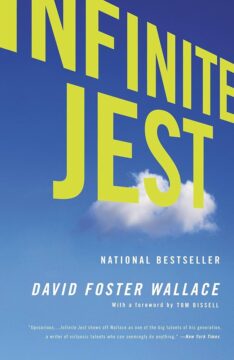 David Foster Wallace’s “Infinite Jest,” a book whose notorious bigness comprises both physical size and reputational heft, turns thirty in February. The occasion is a moment to ask how a novel that mourns addiction and venerates humility and patience became a glib cultural punch line—a byword for literary arrogance, a totem of masculine pretentiousness, a red flag if spotted on the shelves of a prospective partner, and reading matter routinely subjected to the word “performative” in its most damning sense. At a thousand and seventy-nine pages, “Infinite Jest” has become a one-liner.
Last year, an article in the Guardian explored the risks of so-called performative reading under the title “Is it OK to read Infinite Jest in public?” For the Guardian writer, the question was a rare refutation of Betteridge’s law, the journalistic adage stating that any headline ending in a question mark can be answered with a no. Here the answer was a nervous and tentative yes. Mostly, though, the piece drew on and perpetuated the archetype of the noxious “Infinite Jest” bro which has solidified in the quick-drying cement of social media. In 2020, the “Jest” bro hit the big screen in Emerald Fennell’s heavy-handed “Promising Young Woman,” in which a D.F.W. fanboy tells Carey Mulligan’s character that she has to read “Consider the Lobster,” one of the author’s essay collections.
more here.
Enjoying the content on 3QD? Help keep us going by donating now.
Reflections on Getting a College Education in Prison
Thomas E. Miles at The Hedgehog Review:
 Why bother? What’s the point? These are questions that inevitably arise in conversations about college programs in prisons. But these questions make certain assumptions about education in general and higher education in prisons specifically. What is it, exactly, that is not worth it, according to skeptics and naysayers, about college education in prison? Ought we not to consider just what the point of education is in the first place? My position as a prisoner has given me the opportunity to contemplate the question and arrive at some insight into it.
Sometime around 2017, I applied to the Bennington College Prison Education Initiative (PEI) at Great Meadow Correctional Facility in Comstock, New York.
More here.
Enjoying the content on 3QD? Help keep us going by donating now.
Humanity’s Last Exam Stumps Top AI Models—and That’s a Good Thing
Shelly Fan in Singularity Hub:
 How do you translate a Roman inscription found on a tombstone? How many pairs of tendons are supported by one bone in hummingbirds? Here is a chemical reaction that requires three steps: What are they? Based on the latest research on Tiberian pronunciation, identify all syllables ending in a consonant sound from this Hebrew text.
These are just a few example questions from the latest attempt to measure the capability of large language models. These algorithms power ChatGPT and Gemini. They’re getting “smarter” in specific domains—math, biology, medicine, programming—and developing a sort of common sense. Like the dreaded standardized tests we endured in school, researchers have long relied on benchmarks to track AI performance. But as cutting-edge algorithms now regularly score over 90 percent on such tests, older benchmarks are increasingly becoming obsolete.
More here.
Enjoying the content on 3QD? Help keep us going by donating now.
Friday Poem
Dream Father
I seem to have a dream about my father roughly once a year.
Most of the time he acts pretty much like when he was alive,
Stands off to one side and maintains a running commentary,
Sucking in smoke as he laughs, then exhaling it as he speaks.
It is hard for me to gauge his attitude toward life and death.
At times he seems to ask, How can I be dead if we are here?
But that may be more of a waking thought about the dream.
My dreaming self is wiser than to have that kind of thought.
My dream self is with him already and wants that to persist.
There is a certain white ribbed sweater he wore all the time.
He is always wearing it in these dreams, I only just realized,
A cheap sweater from the huge department store at the mall.
It started to pill as soon as he got it but looked good on him.
There we stand, in a field, or in the corner at a strange party.
He knows about life and feels for me that I’m still here in it,
But I wouldn’t say he’s bitter, or that he regrets his own run.
Honestly, these conversations only ever last about a minute.
We never say goodbye or tie things off, but, then, we didn’t.
by John Jeremiah Sullivan
from The Yale Review 9/8/25
Enjoying the content on 3QD? Help keep us going by donating now.
Thursday, February 5, 2026
Kerry James Marshall: In Conversation
Enjoying the content on 3QD? Help keep us going by donating now.
The changing (and surprising) geography of diabetes
Hannah Ritchie at By the Numbers:
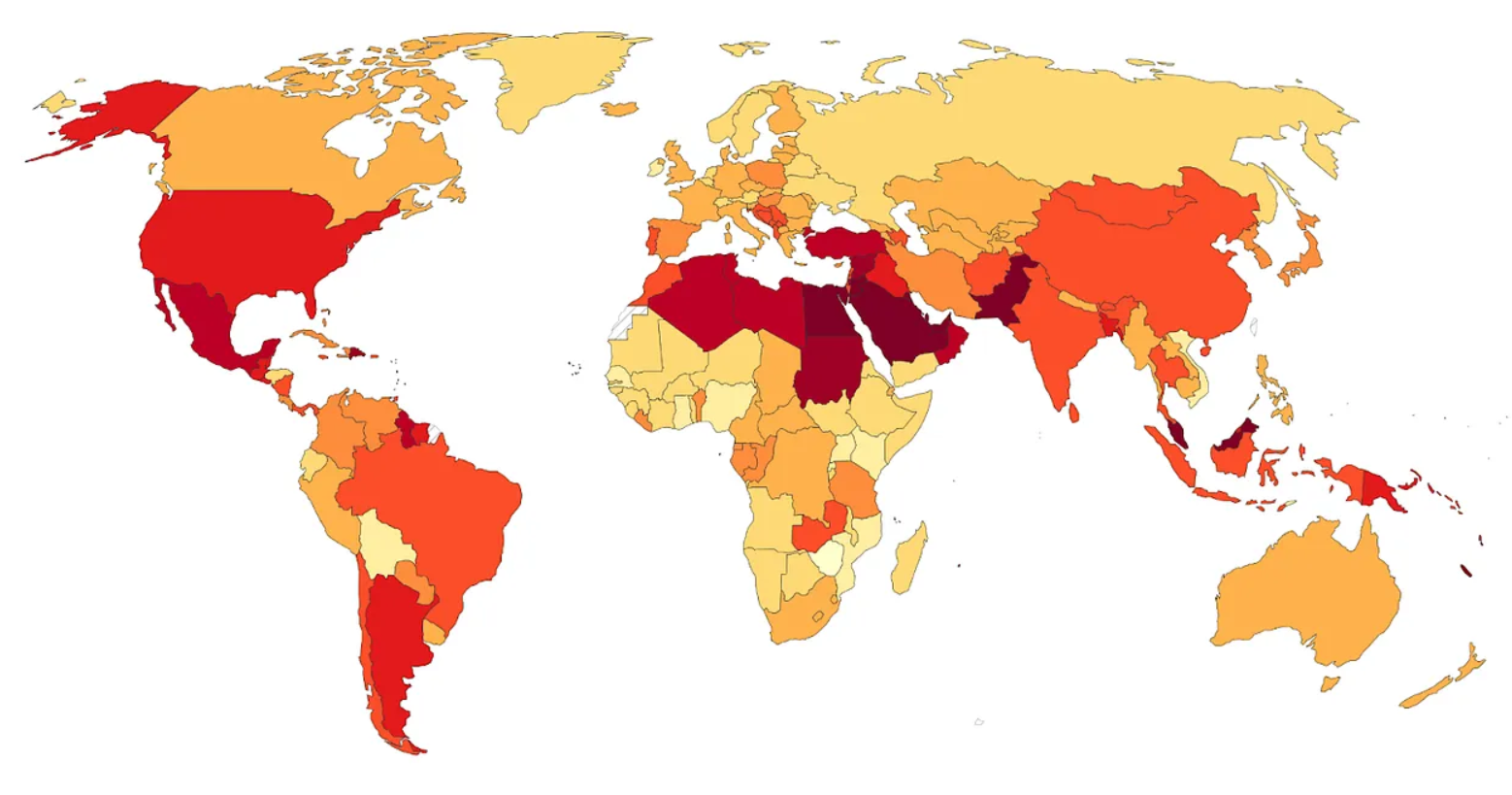 Which country has the highest rates of diabetes? Many people would guess the United States. Perhaps Canada or Australia? Mexico? The United Kingdom?
According to the International Diabetes Federation, it’s Pakistan.
Take a look at the map below, which plots the prevalence of diabetes among 20 to 79-year-olds.
Now, this data is what we call “age-standardised”. The risk of diabetes, like many diseases, increases with age. So if we were to map the raw (or crude) rates of diabetes, it would strongly reflect how old populations are.
To understand changes in prevalence and risk beyond aging, we use age-standardised metrics that hold the age structure of the population constant over time and across countries. It imagines that the age distribution of every country is the same.
More here.
Enjoying the content on 3QD? Help keep us going by donating now.
Jesus in the Junk Shop
Stephen Westich at The Hedgehog Review:
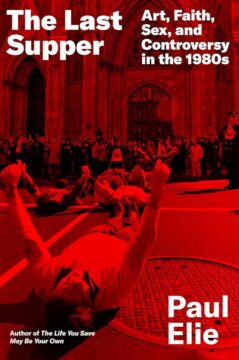 Investigating the crypto-religious is Elie’s venture in this book. Readers of Elie’s first two books, The Life You Save May Be Your Own and Reinventing Bach, will be familiar with his interest in complicating the boundary between secular and sacred with close readings of literary and musical works through the lens of their makers’ spiritual struggles and developments. One way he expands on these ideas in The Last Supper is by foregrounding the visual arts in his analysis. But a second, more central expansion comes from his concept of the crypto-religious. He borrows the term from the Polish poet Czesław Miłosz, who wrote to Thomas Merton that “I have always been crypto-religious and in a conflict with the political aspect of Polish Catholicism.” For Miłosz, this meant concealing his religious inclinations within his homeland’s Communist regime and alluding to early Christians hiding in Roman crypts. Elie expands the phrase to cover much more: “Crypto-religious art is work that incorporates religious words and images and motifs but expresses something other than conventional belief. It’s work that raises the question of what the person who made it believes, so that the question of what it means to believe is crucial to the work’s effect: as you see it, hear it, read it, listen to it, you wind up reflecting on your own beliefs.”
more here.
Enjoying the content on 3QD? Help keep us going by donating now.
How The Fridge Destroyed One of the World’s Largest Monopolies
Enjoying the content on 3QD? Help keep us going by donating now.
An Infinite Sadness
Rachel Gerry at the LARB:
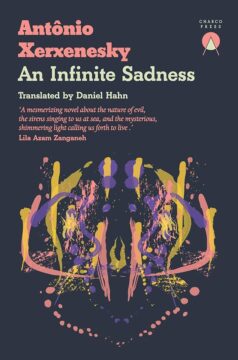 In the genre of sanatorium literature, An Infinite Sadness stands apart. It doesn’t have much of the fellow feeling that defines Thomas Mann’s classic The Magic Mountain (1924), in which Hans Castorp, bowled over by love and intellectual companionship, struggles to leave the Berghof hospital. In Christa Wolf’s August (2012), the protagonist reflects on the affecting compassion of a fellow resident in a TB clinic, while in Ken Kesey’s One Flew over the Cuckoo’s Nest (1962), the bonds among the patients form the basis of their resistance to institutional authority. Alphonse Daudet, while seeking relief from spinal pain in a thermal spa, wrote that “the patients, in all their weirdness and diversity, draw comfort from the demonstration that their respective illnesses all have something in common.” Stories set in sanatoriums tend to show their characters slowly settling into their new homes, the world slipping away, time taking on different proportions. Separated from the imperatives of productivity, the sanatorium is an imaginative space in which the future is null and progress uncertain. As sickness becomes the rule instead of the exception, the patient begins to exist authentically, in a reality defined by a community of fellow sufferers.
more here.
Enjoying the content on 3QD? Help keep us going by donating now.