
Hermione Hoby at The New Yorker:
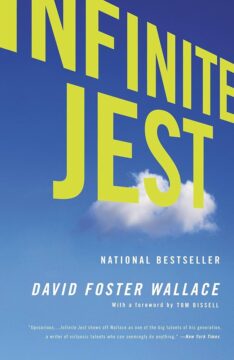 David Foster Wallace’s “Infinite Jest,” a book whose notorious bigness comprises both physical size and reputational heft, turns thirty in February. The occasion is a moment to ask how a novel that mourns addiction and venerates humility and patience became a glib cultural punch line—a byword for literary arrogance, a totem of masculine pretentiousness, a red flag if spotted on the shelves of a prospective partner, and reading matter routinely subjected to the word “performative” in its most damning sense. At a thousand and seventy-nine pages, “Infinite Jest” has become a one-liner.
Last year, an article in the Guardian explored the risks of so-called performative reading under the title “Is it OK to read Infinite Jest in public?” For the Guardian writer, the question was a rare refutation of Betteridge’s law, the journalistic adage stating that any headline ending in a question mark can be answered with a no. Here the answer was a nervous and tentative yes. Mostly, though, the piece drew on and perpetuated the archetype of the noxious “Infinite Jest” bro which has solidified in the quick-drying cement of social media. In 2020, the “Jest” bro hit the big screen in Emerald Fennell’s heavy-handed “Promising Young Woman,” in which a D.F.W. fanboy tells Carey Mulligan’s character that she has to read “Consider the Lobster,” one of the author’s essay collections.
more here.
Enjoying the content on 3QD? Help keep us going by donating now.