The Hunt for the Prehistoric Roots of Cancer

From Discover Magazine:

CanWhen you search the archives for the first known case of human cancer you come across the story of a prehistoric hominid called Kanam Man. The only remains that have been found of this relative of Homo sapiens is a petrified jawbone, and inside the curve of the tooth line is a large lump that many scientists believe to be osteosarcoma, a cancer of the bone. The Kanam jaw, discovered in Kenya in 1932 by Louis Leakey, was my portal into the world of paleopathology and, in particular, the obscure sub discipline of paleo-oncology — the search for the ancient roots of cancer. I tell the story in chapter 3 of The Cancer Chronicles, which is excerpted in the current issue of Discover.

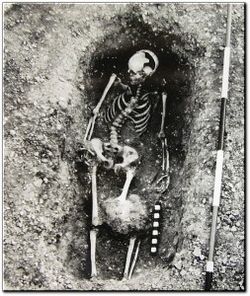
In the piece, “The Long Shadow,” I also write about Egyptian and Peruvian mummies and early medieval skeletons — an accumulating body of evidence that cancer has been with us all along. There was an ancient Scythian king whose skeleton, retrieved from a royal burial chamber, was eaten by what appears to be metastatic prostate cancer, and an Egyptian woman whose face was all but destroyed by nasopharyngeal carcinoma. Visually the most striking example may be an enormous tumor the size of a basketball growing on the femur of an early medieval Saxon man. Finding cancer in the distant past shouldn’t be surprising. All of us multi-celled creatures — the metazoans — are the result of an evolutionary compromise. Each individual cell is granted enough power and autonomy to ensure the robustness of life, yet it must work in accordance with its neighbors. When this delicate balance is upset, the cell reproduces like mad, dividing and dividing, and a tumor begins to grow and evolve like an aggressive new species in the ecosystem of the body.

More here.

Tuesday, June 25, 2013

a nineteenth-century Anglo-German bourgeois

Marx

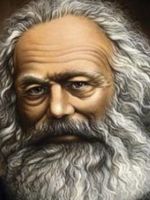
Karl Marx, writes Jonathan Sperber in this splendid new biography, was “a true and loyal friend, but a vehement and hateful enemy”. To be in his small circle was to feel part of something historic, but also to be exposed to constant critical scrutiny. Once he feared for his political reputation, Marx let no politesse hold him back. One close colleague, Karl Liebknecht, remembered him as “the most accessible of men … cheerful and amiable in personal relations”. It was as well, perhaps, that Liebknecht remained unaware of his sniping remarks about him in private letters. Marx’s closest friendship was with Friedrich Engels, a man many found to be extremely off-putting in person: strongheaded, rather vain and arrogant. It may be that his buddy relationship with Engels licensed Marx to ditch responsible leadership and blow off steam, and their mutual correspondence is certainly full of unedifying abuse of almost everyone they knew. But it is Marx’s ability to inspire loyalty and awed respect that comes through most clearly from the recollections of those who knew him.

more from at the Dublin Review of Books here.

the carbon story

1371673916carbondemocracygraphic

In 2005, the rate of production of oil in countries outside the United States hit a plateau, above which it has not been able to move.18 Even to stay on that plateau, as we know, new oil fields must be brought into production each year to compensate for the decline in production from existing fields. The rate of decline, a production-weighted average of the rate of increase or decline in oil produced from all the world’s major fields, is difficult to estimate. In June 2012, the Geopolitics of Energy project at the Belfer Center for Science and International Affairs at Harvard University, a project funded by BP and other energy companies, published a wildly optimistic forecast of low decline rates and hence increasing supplies, which news media around the world reported with enthusiasm. Scholars in the UK quickly showed that the forecast was based upon misreading the available data and an elementary and embarrassing, but less widely reported, arithmetical mistake.19 Facing an annual decline rate of 4 or even 4.5 percent, the world must discover and bring online the equivalent of a new Saudi Arabia—or one could equally say, a new United States, complete with shale boom—every four years, or perhaps every three, in order merely to maintain current rates of production.

more from Timothy Mitchell at Dissent here.

the unbearable

Castle_1-071113_jpg_230x1417_q85

This year marks the fiftieth anniversary of the suicide of the poet Sylvia Plath (1932–1963), and as one might expect given the sensational details of her short and appalling life, both her US and UK publishers are celebrating the occasion with a kind of vulpine festivity. Faber has just issued an “anniversary” edition of The Bell Jar (1963)—the harrowing autobiographical novel Plath had just published at the time of her death—and has been marketing it, distastefully enough, as “chick lit” avant la lettre. A clutch of new biographies (including the two reviewed here) are likewise among the morbid tie-ins. “Sylvia Plath may be the most fascinating literary figure of the twentieth century”—so the publisher’s copy for one of them gushes. “Even now, fifty years after her death, writers, students, and critics alike are enthralled by the details of her 1963 suicide and her volatile relationship with Ted Hughes.” Such ambulance-chasing fans no doubt also dote on Frida Kahlo’s near-fatal impaling by the tram rail. Yet however unsavory, the ongoing interest in Plath’s story—Otto the bogeyman “Daddy” and smother-mother Aurelia; the precocity and self-destructiveness; the breakdowns and electroshocks; Cambridge and poetry and the tumultuous marriage to Hughes; the mental illness and scarifying death (she gassed herself one bitter London winter morning, her two small children asleep in the next room)—may reflect something rather more than mere readerly voyeurism.

more from Terry Castle at the NYRB here.

Of Harmony and Regret

Our own Morgan Meis in The Smart Set:

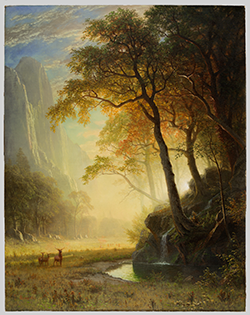
ID_IC_MEIS_BIERS_AP_001The elk are looking right at us. There are three of them down there at the bottom left-hand side of the painting (and the hazy forms of more elk further off, in the distance of the meadow). A stream curves around a copse of trees to the left of the elk. The sheer cliff of a mountain rises above. The sun is glowing in its setting just beyond the trees. It is a moment of intense beauty at Hetch Hetchy Canyon.

The painting “Hetch Hetchy Canyon” was created by Albert Bierstadt in 1875. Bierstadt was once the most famous painter in America. Along with Thomas Cole and Frederic Edwin Church, he’s a central figure in the Hudson River School of painting. These painters favored landscapes. They captured American nature in its grandiosity. Bierstadt’s “Hetch Hetchy Canyon” records a scene in a remote area near Yosemite in California.

The painting now lives in Massachusetts, at the Mount Holyoke College Art Museum. It was also recently on display as the centerpiece of an exhibit called “Albert Bierstadt and the Legacy of Concern.” Bierstadt’s painting was the first painting ever purchased by the museum, inaugurating its collection. On the face of it, the painting is a strange choice to inaugurate the collection of a museum in Massachusetts. What does a remote canyon way out west have to do with Massachusetts?

The answer is Emerson. In 1875, Ralph Waldo Emerson was still alive. He was living out his final years in Concord, Massachusetts. Emerson had spent his whole life sending the imaginations of American artists out into nature. He’d done it with his famous essay, Nature, written in 1836, and furthered his cause with the stream of essays and lectures that flowed from his pen in the years following.

More here.

The Bias within the Bias

Samuel McNerney in Scientific American:

800px-Finger_trap_toysRecall this pivotal scene from the 1997 movie, Men in Black. James Edwards (Will Smith, or Agent J) arrives at the headquarters of MiB – a secret agency that protects Earth from extraterrestrial threats – to compete with “the best of the best” for a position. Edwards, a confident and cocky NYPD officer, completes various tests including a simulation where he shoots an ostensibly innocent schoolgirl. When asked why, Edwards explains that compared to the freakish aliens, the girl posed the biggest threat. He passes the test: potentially dangerous aliens are always disguised as real humans. Agent K (Tommy Lee Jones) offers him a position at MiB and the remaining candidates’ memories are erased. They return to normal life without ever realizing that the aliens were a ruse – a device for Agent K to detect how sagacious the candidates really were.

This wily test of intelligence and mindfulness is defined by two characteristics. The first is that most people fail it; the second is a subtle trick intentionally implemented to catch careless thinking (the schoolgirl for example). Narratives in literature and film that incorporate this test go something like this: scores have tried and failed because they overlooked the trick – even though they confidently believed they did not – until one day a hero catches it and passes the test (Edwards).

More here.

On Writing With Others

John Kaag in the New York Times:

0624DRAFTlahan-blog427Sometimes I need some guarantee that another human being will actually read this little thing I’m spending far too much of my life creating. The silent covenant that I make with myself before writing anything — namely that I promise not to destroy it in the end — is simply not enough to prevent self-sabotage. On these occasions, the loneliness of being a professional philosopher is more intolerable than usual. This is why I frequently write with others.

I become a co-author because I can’t stand writing by myself.

Margaret Atwood has said, “Perhaps I write for no one. Perhaps for the same person children are writing for, when they scrawl their names in the snow.” Perhaps she’s just wrong about this. Many children may scrawl their names in snow — and in sand, on dirty windows, bathroom stalls and old desks — with the secret hope that someone will take note. At least some of these children go on to become academics whose feverish scrawling belies the fear that all of it will go unacknowledged. If they go into the humanities, as I did, this fear may never go away.

If I’m really honest, I’ll acknowledge that it’s this fear that drove me to do the unthinkable, at least for a philosopher. It drove me to write with others.

More here.

The Social Life of Memory

From Harvard Magazine:

MemoryLeading a healthy social life depends on the ability to predict the behavior of others accurately. Most people expect a loud, aggressive bully to be cruel, and a passive, quiet loner to shy away from confrontation. More often than not, that’s correct. Yet exactly how the brain predicts such behavior has long been unclear.

Now research by Kenan professor of psychology Daniel Schacter and several coauthors, published in the March issue of the journal Cerebral Cortex, suggests that the brain, when making behavioral predictions, uses the part devoted to memory. During the past decade, Schacter says, a revolution has occurred in the field of memory science: researchers have shown that memory is responsible for much more than the simple recall of facts or the sensation of reliving events from the past. “Memory is not just a readout,” he explains. “It is a tool that’s used by the brain to bring past experience to bear when thinking about future situations.” In fact, Schacter continues, memory and imagination involve virtually identical mental processes; both rely on a specific system known as the “default network,” previously thought to be activated only when recalling the past. This discovery led to a rich vein of research, he reports. For instance, the link between memory and imagination could explain why those with memory problems, such as amnesiacs or the elderly, often struggle to envision the future.

More here.

Plants perform molecular maths

From Nature:

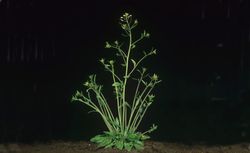
PlantAs if making food from light were not impressive enough, it may be time to add another advanced skill to the botanical repertoire: the ability to perform — at least at the molecular level — arithmetic division. Computer-generated models published in the journal eLife illustrate how plants might use molecular mathematics to regulate the rate at which they devour starch reserves to provide energy throughout the night, when energy from the Sun is off the menu1. If so, the authors say, it would be the first example of arithmetic division in biology. But it may not be the only one: many animals go through periods of fasting — during hibernations or migrations, for example — and must carefully ration internal energy stores in order to survive. Understanding how arithmetic division could occur at the molecular level might also be useful for the young field of synthetic biology, in which genetic engineers seek standardized methods of tinkering with molecular pathways to create new biological devices. Plants make the starch reserves they produce during the day last almost precisely until dawn. Researchers once thought that plants break down starch at a fixed rate during the night. But then they observed that the diminutive weed Arabidopsis thaliana, a plant favoured for laboratory work, could recalculate that rate on the fly when subjected to an unusually early or late night2.

To Alison Smith and Martin Howard of the John Innes Centre in Norwich, UK, and their colleagues, this suggested that a more sophisticated molecular calculation was at work. The team hypothesized the existence of two molecules: one, S, that tells the plant how much starch remains, and another, T, that informs it about the time left until dawn. The researchers built mathematical models to show that, in principle, the interactions of such molecules could indeed drive the rate of starch breakdown such that it reflected a continuous computation of the division of the amount of remaining starch by the amount of time until dawn. For example, the models predicted that plants would adjust the rate of starch breakdown if the night were interrupted by a period of light. During that period of light, the plants could again produce starch. When the lights went out again, the rate of starch breakdown should adjust to that increase in stored starch, the models predicted — a result that the researchers confirmed in Arabidopsis plants. The team then trawled the literature looking for Arabidopsis mutants with known handicaps at different steps along the starch-degradation pathway. These showed that the models were compatible with the behaviour of these mutants, which result in a higher than usual amount of starch remaining at the end of the night.

More here.

Tuesday Poem

The Factory

These were her father’s last words: “I have a dread of chaos in my heart.”
Or, “I have a dread of the chaos in my heart.” The two others present–
her mother, her brother—and she later cannot agree. It was perhaps

a critique of the cryptic vehicles of concealment—symmetry and white noise,
city blocks and hinterlands—she thinks now, as she watches her son watch
a praying mantis watch a caterpillar. The caterpillar is famously playing

dead. Suddenly she wonders if her father is watching her
watching her son watching the praying mantis watching the caterpillar
playing dead. Windows within windows within something window-shaped.
“Kilroy was here” means he’s not anymore—a kind of geometry nobody
cannot configure. She imagines her father working, somewhere, in a factory
that churns out checkerboards, one after another, black and red,

ordinate and abscissa, drawing the axis between obsess and abyss.
Confess and confuse: there is a blind spot in her blind spot in the shape of
a heart in chaos, or chaos in a heart, red on black, or vice versa.
.

by Jessica Goodfellow
from Thrush Poetry Journal, March 2010

Monday, June 24, 2013

You Are an Abstraction: Mistakes of Metaphysical Individualism

by Stephen T. Asma

Stick-familyHow can we fix all those lunatics on the other side of the planet? This seemingly fresh and pressing question is actually one of the oldest. All cultures have relished their barbaric “other.” Asking how we can civilize the foreign hordes is undoubtedly the wrong question, but it seems downright irresistible. Even liberal Western “doves” have magic-bullet theories that try to get at the heart of social violence and pathology.

Steven Pinker expresses a well-worn normative suggestion when he says that the world should move away from tribal or group thinking and feeling, and embrace the “rights tradition” of individualism. He argues, in The Better Angels of Our Nature, that violence recedes as individualism rises. The rest of the world could profit from the recognition, Pinker argues, that we are individuals, and individuals are the ones that “really count” (they actually feel the pleasure and pain). “Groups,” he says, “are a kind of abstraction.”[1]

I'm going to disagree here and argue, somewhat counter-intuitively, that Pinker is the abstraction. I am the abstraction. You, gentle reader, are the abstraction.

The independent individual is a hero to WEIRD cultures (Western, Educated Industrialized, Rich and Democratic), and it serves as the starting place for both pessimistic and romantic theories of the social contract. Whether you're a Hobbesian who thinks the selfish ego must be constrained by the community, or a Rousseauian who laments such constraint (or even a Rawlsian), you still start from a metaphysic of individualism. But what if the individual is actually an ecological, developmental, and political construct?

The primacy of the individual is what philosopher R. G. Collingwood (1889-1943) might call an “absolute presupposition” –an assumed principle that governs certain inquiries and ways of thinking. In fact, digging down to these deep presuppositions was the preferred way, according to Collingwood, to do metaphysics (without getting hung-up on ontology). So, in the spirit of Collingwood's metaphysics, let me suggest an alternative, wherein the collective group is primordial and the individual is derivative.

Read more »

Sunday, June 23, 2013

The Strange Case of Barrett Brown

Amid the outrage over the NSA's spying program, the jailing of journalist Barrett Brown points to a deeper and very troubling problem.

Peter Ludlow in The Nation:

ScreenHunter_224 Jun. 23 17.37In early 2010, journalist and satirist Barrett Brown was working on a book on political pundits, when the hacktivist collective Anonymous caught his attention. He soon began writing about its activities and potential. In a defense of the group’s anti-censorship operations in Australia published on February 10, Brown declared, “I am now certain that this phenomenon is among the most important and under-reported social developments to have occurred in decades, and that the development in question promises to threaten the institution of the nation-state and perhaps even someday replace it as the world’s most fundamental and relevant method of human organization.”

By then, Brown was already considered by his fans to be the Hunter S. Thompson of his generation. In point of fact he wasn’t like Hunter S. Thompson, but was more of a throwback—a sharp-witted, irreverent journalist and satirist in the mold of Ambrose Bierce or Dorothy Parker. His acid tongue was on display in his co-authored 2007 book, Flock of Dodos: Behind Modern Creationism, Intelligent Design and the Easter Bunny, in which he declared: “This will not be a polite book. Politeness is wasted on the dishonest, who will always take advantage of any well-intended concession.”

But it wasn’t Brown’s acid tongue so much as his love of minutiae (and ability to organize and explain minutiae) that would ultimately land him in trouble. Abandoning his book on pundits in favor of a book on Anonymous, he could not have known that delving into the territory of hackers and leaks would ultimately lead to his facing the prospect of spending the rest of his life in prison. In light of the bombshell revelations published by Glenn Greenwald and Barton Gellman about government and corporate spying, Brown’s case is a good—and underreported—reminder of the considerable risk faced by reporters who report on leaks.

More here.

Fermilab names Nigel Lockyer as new director

Nicola Jones in Nature:

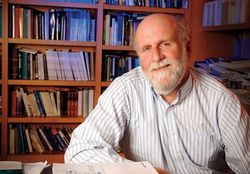
Nigel-Lockyer-lowres-204x300Fermilab’s major project, the Tevatron, shut down in 2011. Is the lab past its glory days?

Absolutely not. There’s half a dozen really interesting questions where Fermilab can play a really interesting role. We’re looking to have a flagship programme where we can ‘own the podium’, as they said in Canada during the Olympics.

What will that flagship be?

This is determined by the international landscape. Europe is really focusing on the Large Hadron Collider (LHC). They say if you want to study neutrinos, talk to the US or Japan. So what Fermilab is pursuing is the Long Baseline Neutrino Experiment (LBNE). I personally find the science there very inviting. One issue is charge parity violation, looking to see if neutrinos are different from anti-neutrinos. This could broach completely new ground. The second goal is to look at proton decay, which gets into Grand Unified Theory questions. The third thing is people are very interested in detecting neutrinos from supernovae.

What the US government has given a bit of a green light to is a detector on the surface that I would argue is too small. I’d like to make it twice as big and put it a kilometer underground. The challenge is to work with European and Japanese colleagues to see if we can do that.

More here.

Wine-tasting: it’s junk science

Experiments have shown that people can't tell plonk from grand cru. Now one US winemaker claims that even experts can't judge wine accurately. What's the science behind the taste?

David Derbyshire in The Guardian:

Woman-tasting-red-wine-009Every year Robert Hodgson selects the finest wines from his small California winery and puts them into competitions around the state.

And in most years, the results are surprisingly inconsistent: some whites rated as gold medallists in one contest do badly in another. Reds adored by some panels are dismissed by others. Over the decades Hodgson, a softly spoken retired oceanographer, became curious. Judging wines is by its nature subjective, but the awards appeared to be handed out at random.

So drawing on his background in statistics, Hodgson approached the organisers of the California State Fair wine competition, the oldest contest of its kind in North America, and proposed an experiment for their annual June tasting sessions.

Each panel of four judges would be presented with their usual “flight” of samples to sniff, sip and slurp. But some wines would be presented to the panel three times, poured from the same bottle each time. The results would be compiled and analysed to see whether wine testing really is scientific.

The first experiment took place in 2005. The last was in Sacramento earlier this month. Hodgson's findings have stunned the wine industry. Over the years he has shown again and again that even trained, professional palates are terrible at judging wine.

More here.

Gorgeous Microscopy and Visual Journalism

From Scientific American:

Over at AudioVision, a project of Southern California Public Radio, Mae Ryan and others bring us the best in visual journalism. Mae contacted me about last month’s feature on David Scharf, electron microscoper extraordinaire. His images are simply stunning, and I had to share. AudioVision is not a science-specific project, so I’m especially thrilled to see science imagery there. I wish more news outlets would incorporate science into their everyday stories. It seems as if science news is always shoved into the corner by major media outlets, and the assumption becomes that science news has to be pursued all by itself, which means people have to take initiative to find it (by visiting Scientific American blogs for instance!), but it doesn’t often find its way to the average viewer who isn’t actively looking for it. Unless it’s coverage of a new study that shows chocolate is healthy and you can eat as much as you want, it stays within the science circle.

Picture: Various allergens by David Scharf.

More here.