The forgotten story of the Flushing Remonstrance

Flushing-Remonstrance-ComicWei Zhu at Immanent Frame:

Known today for their pacifist and quietist ways, Quakers had an altogether different reputation in the seventeenth century: belligerent and boisterous rabble-rousers. Fueled by evangelical zeal, and asserting radical ideas for the time, the Quakers were aggressive proselytizers. As a result, they faced violent persecution in England and, to a lesser extent, in the Netherlands, where many migrated. News of their beliefs (e.g. equality for women, refusal to swear oaths, etc.) and their tactics (e.g. preaching loudly and publicly, disrupting worship services, etc.) reached the colonies before the Quakers did. Connecticut, in fact, banned Quakers in October 1656—prior to any Quakers having ever reached the colony. Other English colonies followed suit (Massachusetts would be particularly harsh on the Quakers), with the sole exception of Rhode Island—though Roger Williams, its founder, spent much of his later life debating Quakers and being frustrated with their refusal to adhere to the “sober rules of civility and humanity.” Quaker missionaries arrived in New Netherland in 1657. Following the sentencing of one of their number, Robert Hodgson, for public preaching, Peter Stuyvesant passed a law that penalized anyone who housed a Quaker, and at the same time incentivized locals to become informants of Quaker activities. The law had gone into effect by December 1657, when local men John Tilton and Henry Townsend were convicted under it.

more here.

How Do Hitmen Operate?

Ryan Jacobs in Pacific Standard:

HitmenA group of researchers at the Center for Applied Criminology at Birmingham City University in the U.K. has recently analyzed newspaper articles, court records, and a series of “off-the-record” interviews with informants “who have, or who had, direct knowledge of contract killings” in order to construct what they term a “typology” of British hitmen. For the record, these social scientists “define a hitman as a person who accepts an order to kill another human being from someone who is not publicly acknowledged as a legitimate authority regarding ‘just killing’.” The results of their detailed search of British cases that matched this description in the period between 1974 and 2013 only turned up 27 contracted hits or attempted hits “committed by a total of 36 hitmen” (there was only a single “hitwoman”), but the researchers used the sample to tease out the details and profiles of typical killers-for-hire.

The main thrust of the paper, which will be published in the Howard Journal of Criminal Justice, is that hitmen do not operate with the drama, professionalism, or glamour that mob films and spy novels afford them. In actuality, the majority of killers select jejune settings for their crimes, have occasionally bumbling performances, and are often hired by contractors with lame motivations.

Read the rest here. (h/t Digg)

Wednesday Poem

Snow Angel Haiku

Wrapped in layers
Of gortex and angora,
Carving snow angels.

First snowflakes fallen,
Her tongue searches crystalline
Darkness for their kiss.

Coltrane softly wails
Desperate to tell his tale,
Long winters release,

Fire in the black
Hearth smolders pink orange flame
Wet boots slowly dry.

We read books entwined
Faux fur throw lulls us to sleep
Snow angels whisper

Songs delicate like
Lace, dynastic porcelain
Painted with flower blossoms.

Mindful transgression
Liquid time measured in flakes
Unique as thumbprints.

We float over wind-
Swept beaches littered with shells,
Sand Pipers skim waves.

Morning arises,
Fresh snow lights the sky with dew.
Hope eternally.
.

by Eric J. Weiner

Acid bath offers easy path to stem cells

David Cyranoski in Nature:

CellIn 2006, Japanese researchers reported1 a technique for creating cells that have the embryonic ability to turn into almost any cell type in the mammalian body — the now-famous induced pluripotent stem (iPS) cells. In papers published this week in Nature2, 3, another Japanese team says that it has come up with a surprisingly simple method — exposure to stress, including a low pH — that can make cells that are even more malleable than iPS cells, and do it faster and more efficiently. “It’s amazing. I would have never thought external stress could have this effect,” says Yoshiki Sasai, a stem-cell researcher at the RIKEN Center for Developmental Biology in Kobe, Japan, and a co-author of the latest studies. It took Haruko Obokata, a young stem-cell biologist at the same centre, five years to develop the method and persuade Sasai and others that it works. “Everyone said it was an artefact — there were some really hard days,” says Obokata.

Obokata says that the idea that stressing cells might make them pluripotent came to her when she was culturing cells and noticed that some, after being squeezed through a capillary tube, would shrink to a size similar to that of stem cells. She decided to try applying different kinds of stress, including heat, starvation and a high-calcium environment. Three stressors — a bacterial toxin that perforates the cell membrane, exposure to low pH and physical squeezing — were each able to coax the cells to show markers of pluripotency. But to earn the name pluripotent, the cells had to show that they could turn into all cell types — demonstrated by injecting fluorescently tagged cells into a mouse embryo. If the introduced cells are pluripotent, the glowing cells show up in every tissue of the resultant mouse. This test proved tricky and required a change in strategy. Hundreds of mice made with help from mouse-cloning pioneer Teruhiko Wakayama at the University of Yamanashi, Japan, were only faintly fluorescent. Wakayama, who had initially thought that the project would probably be a “huge effort in vain”, suggested stressing fully differentiated cells from newborn mice instead of those from adult mice. This worked to produce a fully green mouse embryo.

More here.

Tuesday, January 28, 2014

Mr Big Bucks and the Mamelodi Sundowns

Sean Jacobs at Roads & Kingdoms

MamelodiMost black South Africans, however, were not scandalized by Mandela’s one-time celebration of violent struggle or his communist leanings, or by Winnie’s complicated, but flawed, legacy, which was formed in a more compromising, violent outside. As Stephen Smith rightly concluded in the London Review of Books recently: “If any one person can stand in for the country, it’s surely Winnie, half ‘mother of the nation’ and half township gangsta, deeply ambiguous, scarred and disfigured by the struggle.” Most South Africans get this full, complicated understanding of their recent history.

Zola Mahobe is another such complicated figure, part gangster, part hero. Mahobe, a legendary soccer club owner in South Africa during the 1980s, died nine days after Mandela. While his death quite rightly did not receive the same attention that Mandela’s did, his life was shaped by many of the same forces. For some, Mahobe was a symptom of what was wrong with South African professional soccer. Others viewed him (and still do) as a brilliant entrepreneur, a sort of Apartheid-era Robin Hood, and a visionary that would help reshape the dimensions of South African soccer.

Read the rest here.

the black church after mlk

1389021688eddielongAnthea Butler at Dissent:

After the heyday of the freedom movement passed in the 1970s, two contrasting paths gradually emerged in black churches: one stayed true to the message of social justice while the other turned to an emphasis on individual morality and a gospel of prosperity. Most rising religious leaders took the latter approach. In the 1990s T.D. Jakes—whom Time dubbed “America’s Preacher”—organized “Women Thou Art Loosed” conferences that promoted spiritual and sexual health. These gatherings, which attracted audiences of over 10,000 women, combined spiritual counseling, group therapy, and personal confession. In a dramatic style, Jakes spoke to women about the abuse they had suffered, and they let their emotions flow. The sermons were just the cornerstone of a thriving business, which included teaching materials, a book, and a movie. Jakes used the message of respectability and prosperity to build a massive support group for women, who are the majority in most black churches. While Jakes said little about politics, other ministers employed talk of moral uplift to advance their views about social issues—in particular, their opposition to same-sex marriage.

more here.

pynchon as serious moral fiction

17208457Cassandra Nelson at First Things:

Don’t be fooled by the slapstick comedy and the silly names, the labyrinthine plots that careen around and veer maddeningly toward irresolution and paranoia, the playful gags and the abundant nods to pop culture—or to stoner culture, for that matter. Thomas Pynchon writes serious ­moral fiction.

Although his name has become a byword for postmodernism and impenetrable prose, Bleeding Edgemakes clearer than ever before what has been true since the publication of V. half a century ago: Pynchon is a writer with a profound, unwavering moral vision and an abiding commitment to realism. Not the realism of a Balzac or a Howells, of course, but the kind employed by Dostoevsky and Flannery O’Connor, the kind that forgoes verisimilitude in favor of the fantastic and the grotesque in order to make a point about the nature of reality—what is real and enduring, and what isn’t.

“Tanks are mortal, pears eternal,” was Milan Kundera’s memorable formulation in The Book of Laughter and Forgetting, and this eloquent phrase pretty well captures Pynchon’s take on the subject, too. Perennial champion of the animate over the inanimate, tireless advocate of love, not war, he begins and ends Bleeding Edge with the simultaneous bursting into bloom of “what looks like every Callery Pear tree on the Upper West Side,” as Ziggy and Otis, two brothers on the cusp of adolescence, head to school.

more here.

apocalyptic america

ID_PI_GOLBE_APOCO_AP_001Stefany Anne Golberg at The Smart Set:

Judgment Day is upon us, the radio evangelist proclaimed a few years ago, setting May 21, 2011 as the date. All across America, billboards became Camping advertisements for Apocalypse. “Cry mightily unto GOD for HIS Mercy” was one suggestion, “Joy to the World” claimed another. All across the nation, there were Americans who laughed, and those who readied themselves. Camping’s believers stopped paying their credit cards, quit their jobs, said farewell to friends. Some spent their life’s savings in preparation for the End — some spent it on the Rapture campaign itself.

When Judgment Day did not come, Camping tried to assuage believers. “Please forgive me, America!” a new billboard read. “I was terribly wrong about … May 21, 2011. There is forgiveness in those who trust in Jesus Christ.” Then he said that he had gotten the timing wrong and that the End would, in fact, happen in October. But October passed the same as ever and then Harold Camping had a stroke. By that time, accounts of thousands who had mistakenly given up their Earthly existence came pouring through the news. “Yet though we were wrong,” wrote Camping in a letter to his Family Radio Family, “God is still using the May 21 warning in a very mighty way.” Look at the millions and billions of people who heard the message of Christ’s imminent return, Harold Camping wrote. And he would still come, Camping assured us.

more here.

Tuesday Poem

Turn Turn Turn
Music by Pete Seeger, 1919-2014
(Adapted from Ecclesiastes)
Speaker 4

To everything (turn, turn, turn)
There is a season (turn, turn, turn)
And a time to every purpose under heaven

A time to be born, a time to die
A time to plant, a time to reap
A time to kill, a time to heal
A time to laugh, a time to weep

To everything (turn, turn, turn)
There is a season (turn, turn, turn)
And a time to every purpose, under heaven

A time to build up, a time to break down
A time to dance, a time to mourn
A time to cast away stones, a time to gather stones together

To everything (turn, turn, turn)
There is a season (turn, turn, turn)
And a time to every purpose, under Heaven

A time of love, a time of hate
A time of war, a time of peace
A time you may embrace, a time to refrain from embracing

To everything (turn, turn, turn)
There is a season (turn, turn, turn)
And a time to every purpose, under Heaven

A time to gain, a time to lose
A time to rend, a time to sew
A time for love, a time for hate
A time for peace, I swear it's not too late

Pete Seeger died yesterday

.

the maddening brilliance of germaine greer

Philip Hoare in The Telegraph:

Germaine-greer_2800077bOn the shores of New South Wales, a coast along which, even now, one could imagine James Cook sailing past on the Endeavourof a civilisation on the edge of utter wilderness. growth forest into what would eventually become lavatory paper.

In many ways, Greer’s book is a middle-aged escape act. Put her in the open country, and she feels happy: “Only in suburbia do I begin to feel frantic and hopeless, suddenly back where I was in my teens, imprisoned, heartsick, revolted by the endless roofscape, waiting for life to begin.” She’d rather end her life in the wastes: “Better a swift agony in the desert than my mother’s long twilight in a seaside nursing home.” After much searching of Australia’s wild corners, Greer finally finds her utopia in the shape of Cave Creek, 60 hectares of rainforest on the Gold Coast of Queensland boasting a remarkably high degree of biodiversity – and a chequered history of logging and intrusive agriculture. It is that new world conflict that powers White Beech’s story: one of invasive species – botanical, animal and human. After all, its author has declared it her intention never to call Australia home until Aboriginal sovereignty is recognised. Indeed, Greer’s first act, having bought Cave Creek, is to try to find its traditional owners – the Aboriginal people whose deep-time culture cuts through Western occupation. And yet Greer’s own bloody-minded, can-do attitude, it seems to me, is an essentially Australian characteristic. The rest of this wonderfully idiosyncratic book is taken up with the documentation of Greer’s “Cave Creek Rainforest Rehabilitation Scheme”, designated by plastic signs around the property instructing all comers that anyone taking anything out of it will be subject to prosecution (or, worse still, the vocal ire of its owner).

More here.

The Older Mind May Just Be a Fuller Mind

Benedict Carey in The New York Times:

MIND-articleInlinePeople of a certain age (and we know who we are) don’t spend much leisure time reviewing the research into cognitive performance and aging. The story is grim, for one thing: Memory’s speed and accuracy begin to slip around age 25 and keep on slipping. The story is familiar, too, for anyone who is over 50 and, having finally learned to live fully in the moment, discovers it’s a senior moment. The finding that the brain slows with age is one of the strongest in all of psychology.

Over the years, some scientists have questioned this dotage curve. But these challenges have had an ornery-old-person slant: that the tests were biased toward the young, for example. Or that older people have learned not to care about clearly trivial things, like memory tests. Or that an older mind must organize information differently from one attached to some 22-year-old who records his every Ultimate Frisbee move on Instagram. Now comes a new kind of challenge to the evidence of a cognitive decline, from a decidedly digital quarter: data mining, based on theories of information processing. In a paper published in Topics in Cognitive Science, a team of linguistic researchers from the University of Tübingen in Germany used advanced learning models to search enormous databases of words and phrases. Since educated older people generally know more words than younger people, simply by virtue of having been around longer, the experiment simulates what an older brain has to do to retrieve a word. And when the researchers incorporated that difference into the models, the aging “deficits” largely disappeared. “What shocked me, to be honest, is that for the first half of the time we were doing this project, I totally bought into the idea of age-related cognitive decline in healthy adults,” the lead author, Michael Ramscar, said by email. But the simulations, he added, “fit so well to human data that it slowly forced me to entertain this idea that I didn’t need to invoke decline at all.”

More here.

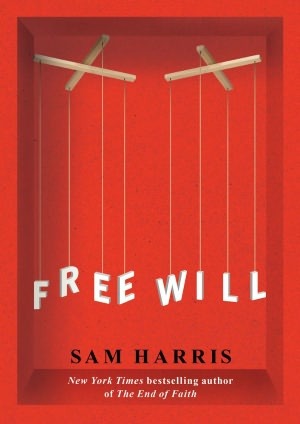
Dan Dennett tutors Sam Harris on Free Will

A review of Sam Harris's Free Will by Daniel C. Dennett at Naturalism.org:

13259270[Sam Harris] is not alone among scientists in coming to the conclusion that the ancient idea of free will is not just confused but also a major obstacle to social reform. His brief essay is, however, the most sustained attempt to develop this theme, which can also be found in remarks and essays by such heavyweight scientists as the 2 neuroscientists Wolf Singer and Chris Frith, the psychologists Steven Pinker and
Paul Bloom, the physicists Stephen Hawking and Albert Einstein, and the evolutionary biologists Jerry Coyne and (when he’s not thinking carefully) Richard Dawkins.

The book is, thus, valuable as a compact and compelling expression of an opinion widely shared by eminent scientists these days. It is also valuable, as I will show, as a veritable museum of mistakes, none of them new and all of them seductive—alluring enough to lull the critical faculties of this host of brilliant thinkers who do not make a profession of thinking about free will. And, to be sure, these mistakes have also been made, sometimes for centuries, by philosophers themselves. But I think we have made some progress in philosophy of late, and Harris and others need to do their homework if they want to engage with the best
thought on the topic.

More here.

Stephen Hawking: ‘There are no black holes’

Zeeya Merali in Nature:

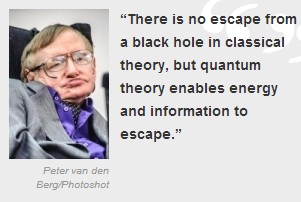
ScreenHunter_473 Jan. 28 10.36Most physicists foolhardy enough to write a paper claiming that “there are no black holes” — at least not in the sense we usually imagine — would probably be dismissed as cranks. But when the call to redefine these cosmic crunchers comes from Stephen Hawking, it’s worth taking notice. In a paper posted online, the physicist, based at the University of Cambridge, UK, and one of the creators of modern black-hole theory, does away with the notion of an event horizon, the invisible boundary thought to shroud every black hole, beyond which nothing, not even light, can escape.

In its stead, Hawking’s radical proposal is a much more benign “apparent horizon”, which only temporarily holds matter and energy prisoner before eventually releasing them, albeit in a more garbled form.

“There is no escape from a black hole in classical theory,” Hawking told Nature. Quantum theory, however, “enables energy and information to escape from a black hole”. A full explanation of the process, the physicist admits, would require a theory that successfully merges gravity with the other fundamental forces of nature. But that is a goal that has eluded physicists for nearly a century. “The correct treatment,” Hawking says, “remains a mystery.”

Hawking posted his paper on the arXiv preprint server on 22 January1. He titled it, whimsically, 'Information preservation and weather forecasting for black holes', and it has yet to pass peer review. The paper was based on a talk he gave via Skype at a meeting at the Kavli Institute for Theoretical Physics in Santa Barbara, California, in August 2013 (watch video of the talk).

More here.

Dedh Ishqiya and Urdu in India Today

Shoaib Daniyal in NY NewsYaps:

Dedh-IshqiyaIn a riotously funny scene from recently released comic thriller Dedh Ishqiya, Jaan Mohammad (played by Vijay Raaz) aggressively threatens a very drunk Khalujaan (Naseeruddin Shah) to leave town so that he can win the hand of the beautiful Begum Para (Madhuri Dixit). In a twist typical of the film, fist fights and gun brandishing suddenly give way to poetry, as Khalujaan picks up the word “wādā” (promise) used by Jaan and starts taunting him using asher. A gangster by profession and somewhat removed from the world of poetry, Jaan retorts as best he can by racking his brains and coming up with the only sher he knows on “wādā. This change of playing field from violence to poetry, though, can only end badly for Jaan. His verse induces derisive laughter from Khalujaan who then points out that Jaan’s original sher spoke of “bādā” (wine) and not “wādā” at all. Jaan just confused the two rhyming words.

It is credit to the competence of director Abhishek Chaubey that the Bombay heater I was in found the wordplay funny and laughed along with Khalu, in spite of the fact that very few would have been able to point out Jaan’s mistake themselves. Anupama Chopra, movie critic for the Hindustan Times, though, might have empathised more with Jaan and his struggles with High Urdu. While generally praising the film, she did end her review with one small regret: “I also struggled with the Urdu,” she said.“It was melodious but I wish I understood more of it.”

This frank admission, and the fact that Dedh Ishqiya is the only Bollywood film I’ve ever seen with English subtitles, contains within it some stark irony for an industry which, it could be said, was born into Urdu.

More here.

Monday, January 27, 2014

Sunday, January 26, 2014

Blindspots and A Democratic Euromaidan: On The Protests in the Ukraine

UkraineGirl

First, Volodymyr Ishchenko in Eurozine:

[T]he open letter signed by established academics, many of whom are mainly politically progressive, ignores the extent of far-right involvement in the Ukrainian protests. One of the major forces at Euromaidan is the far-right xenophobic party “Svoboda” (“Freedom”). They are dominant among the volunteering guards of the protest camp and are the vanguard of the most radical street actions, such as the occupation of the administrative buildings in central Kyiv. Before 2004, “Svoboda” was known as the Social-National Party of Ukraine and used the Nazi “Wolfsangel” symbol. The party leader Oleh Tiahnybok is still known for his anti-Semitic speech. Even after re-branding, Svoboda has been seeking cooperation with neo-Nazi and neo-fascist European parties such as the NDP in Germany and Forza nuova in Italy. Its rank-and-file militants are frequently involved in street violence and hate crimes against migrants and political opponents.

At Euromaidan, particularly, far-right attackers assaulted a left-wing student group attempting to bring social-economic and gender equality issues to the protest. Several days later, a far-right mob beat and seriously injured two trade union activists, accusing them of being “communists”. Slogans previously connected with far-right subculture, such as “Glory to Ukraine! Glory to the heroes!”, “Glory to the nation! Death to enemies!”, “Ukraine above all!” (an adaptation of Deutschland über alles) have now become mainstream among the protestors.

More here. Volodymyr Kulyk responds:

In his blinding opposition to both nationalism and capitalism, Ishchenko lumps together two very different matters: the role of rightwing radicals in Euromaidan and the role of these protests in Ukraine's choice of future. He is right that the radical nationalists do not share the protests' original goal of bringing Ukraine closer to the European Union and harm the democratic movement with their divisive slogans and their attacks on ideological opponents within the movement. However, he is wrong in arguing that such slogans and attacks invalidate the protests' value as a manifestation of the democratic and European aspirations of the Ukrainian people.

Although radical nationalists such as the Svoboda (Freedom) party and the less well-known organization called Rightwing Sector do not by any means constitute the majority of protesters, they are indeed rather prominent due to their vocal and visually striking behaviour.

More here. Also see this piece by Alex Motyl.

The Left in India has lost touch with the instincts and knowledges on which it has traditionally based its theoretical and practical positions

Akeel Bilgrami in The Indian Express:

Belief-mIn the United States, where I am domiciled, very little that makes for fundamental change in people’s lives gets onto the agenda of what is on offer in electoral politics. The two parties in the political arena merely represent competing “power elites”, to use a term of C. Wright Mills, and any basic opposition to this consensus of elite (mostly corporate) power has always come not from policies creatively formulated in the corridors of power by elected leaders, but from movements on the street which have occasionally forced elected leaders to make important changes — such as the labour movements of the 1930s or the civil rights and women’s movements of a few decades later. India, by contrast, has the distinct advantage of having a multiparty political system and so, even if there is a consensus among two of the major parties, there are others which may present alternatives outside the consensus, so long as the people are cognitively prepared to see the merit in the alternatives and their minds are not entirely shaped by the ideologies and ways of thinking underlying the consensus itself.

That brings us to the second question. The outcome of the 2004 elections in India is a telling example of what is at issue here. It is known that in the months prior to that election, pundits in the print and televised media were cheerleading for the utterly illusory claims of an emergent India under the policies that the government had been pursuing. Yet the government was defeated. In a sense, then, the mass of our people were saved by a combination of their illiteracy (the illusion of “India Shining” afflicted only the literate metropolitan classes who were cognitively fed by the media) and their knowledge of the causes of their own impoverished conditions, thereby revealing that everyday political knowledge and media literacy are by no means the same thing.

More here.

Open Letter from Ukrainian Writer Yuri Andrukhovych

From New Eastern Europe:

Andruchovych_yuriDear Friends,

These days I receive from you lots of inquiries to describe the current situation in Kyiv and overall in Ukraine, express my opinion on what is happening and formulate my vision of at least the nearest future. Since I am simply physically unable to respond separately to each of your publications with an extended analytical essay, I have decided to prepare this brief statement which each of you can use in accordance with your needs. The most important things I must tell you are as follows.

During the less than four years of its rule, Viktor Yanukovych’s regime has brought the country and the society to the utter limit of tensions. Even worse, it has boxed itself into a no-exit situation where it must hold on to power forever – by any means necessary. Otherwise it would have to face criminal justice in its full severity. The scale of what has been stolen and usurped exceeds all imagination of what human avarice is capable.

The only answer this regime has been proposing in the face of peaceful protests, now in their third month, is violence, violence that escalates and is “hybrid” in its nature: special forces’ attacks at the Maidan are combined with individual harassment and persecution of opposition activists and ordinary participants in protest actions (surveillance, beatings, the torching of cars and houses, storming of residences, searches, arrests, rubber-stamp court proceedings). The key word here is intimidation. And since it is ineffective, and people are protesting on an increasingly massive scale, the powers-that-be make these repressive actions even harsher.

More here.