
Category: Recommended Reading
Is There Something About Islam?

Kenan Malik in Eurozine (image source: Shutterstock):
Every year I give a lecture to a group of theology students – would-be Anglican priests, as it happens – on “Why I am an atheist”. Part of the talk is about values. And every year I get the same response: that without God, one can simply pick and choose about which values one accepts and which one doesn't.
My response is to say: “Yes, that's true. But it is true also of believers.” I point out to my students that in the Bible, Leviticus sanctifies slavery. It tells us that adulterers “shall be put to death”. According to Exodus, “thou shalt not suffer a witch to live”. And so on. Few modern day Christians would accept these norms. Others they would. In other words, they pick and choose.
So do Muslims. Jihadi literalists, so-called “bridge builders” like Tariq Ramadan (“bridge-builder”, I know, is a meaningless phrase, and there are many other phrases that one could, and should, use to describe Ramadan) and liberals like Irshad Manji all read the same Qur'an. And each reads it differently, finding in it different views about women's rights, homosexuality, apostasy, free speech and so on. Each picks and chooses the values that they consider to be Islamic.
I'm making this point because it's one not just for believers to think about, but for humanists and atheists too. There is a tendency for humanists and atheists to read religions, and Islam in particular, as literally as fundamentalists do; to ignore the fact that what believers do is interpret the same text a hundred different ways. Different religions clearly have different theologies, different beliefs, different values. Islam is different from Christianity is different from Buddhism. What is important, however, is not simply what a particular Holy Book, or sacred texts, say, but how people interpret those texts.
The relationship between religion, interpretation, identity and politics can be complex. We can see this if we look at Myanmar and Sri Lanka where Buddhists – whom many people, not least humanists and atheists, take to be symbols of peace and harmony – are organizing vicious pogroms against Muslims, pogroms led by monks who justify the violence using religious texts. Few would insist that there is something inherent in Buddhism that has led to the violence. Rather, most people would recognize that the anti-Muslim violence has its roots in the political struggles that have engulfed the two nations.
More here.
How Plagues Really Work
Wendy Orent in Aeon (Photo by Stefano Rellandini/Reuters):
It was the great Australian virologist Frank Macfarlane Burnet who argued that the deadliest diseases were those newly introduced into the human species. It seemed to make sense: the parasite that kills its host is a dead parasite since, without the host, the germ has no way to survive and spread. According to this argument, new germs that erupt into our species will be potential triggers for pandemics, while germs that have a long history in a host species will have evolved to be relatively benign.
Many health experts take the notion further, contending that any coming plague will come from human intrusion into the natural world. One risk, they suggest, comes when hungry people in Africa and elsewhere forge deep into forests and jungles to hunt ‘bushmeat’ – rodents, rabbits, monkeys, apes – with exposure to dangerous pathogens the unhappy result. Those pathogens move silently among wild animals, but can also explode with terrifying ferocity among people when humans venture where they shouldn’t. According to the same line of thought, another proposed risk would result when birds spread a new pandemic strain to chickens in factory farms and, ultimately, to us.
But there’s something in these scenarios that’s not entirely logical. There is nothing new in the intimate contact between animals and people. Our hominid ancestors lived on wildlife before we ever evolved into Homo sapiens: that’s why anthropologists call them hunter-gatherers, a term that still applies to some modern peoples, including bushmeat hunters in West Africa. After domesticating animals, we lived close beside them, keeping cows, pigs and chickens in farmyards and even within households for thousands of years. Pandemics arise out of more than mere contact between human beings and animals: from an evolutionary point of view, there is a missing step between animal pathogen and human pandemic that’s been almost completely overlooked in these terrifying but entirely speculative ideas.
According to the evolutionary epidemiologist Paul W Ewald of the University of Louisville, the most dangerous infectious diseases are almost always not animal diseases freshly broken into the human species, but diseases adapted to humanity over time: smallpox, malaria, tuberculosis, leprosy, typhus, yellow fever, polio. In order to adapt to the human species, a germ needs to cycle among people – from person to person to person.
More here.
Ferguson and the Modern Debtor’s Prison

Alex Tabarrok in Marginal Revolution:
A new report from Arch City Defenders, a non-profit legal defense organization, shows that the Ferguson municipal courts are a stunning example of these problems:
Ferguson is a city located in northern St. Louis County with 21,203 residents living in 8,192 households. The majority (67%) of residents are African-American…22% of residents live below the poverty level.
…Despite Ferguson’s relative poverty, fines and court fees comprise the second largest source of revenue for the city, a total of $2,635,400. In 2013, the Ferguson Municipal Court disposed of 24,532 warrants and 12,018 cases, or about 3 warrants and 1.5 cases per household.
You don’t get $321 in fines and fees and 3 warrants per household from an about-average crime rate. You get numbers like this from bullshit arrests for jaywalking and constant “low level harassment involving traffic stops, court appearances, high fines, and the threat of jail for failure to pay.”
If you have money, for example, you can easily get a speeding ticket converted to a non-moving violation. But if you don’t have money it’s often the start of a downward spiral that is hard to pull out of:
For a simple speeding ticket, an attorney is paid $50-$100, the municipality is paid $150-$200 in fines and court costs, and the defendant avoids points on his or her license as well as a possible increase in insurance costs. For simple cases, neither the attorney nor the defendant must appear in court.
However, if you do not have the ability to hire an attorney or pay fines, you do not get the benefit of the amendment, you are assessed points, your license risks suspension and you still owe the municipality money you cannot afford….If you cannot pay the amount in full, you must appear in court on that night to explain why. If you miss court, a warrant will likely be issued for your arrest.
More here.
On Level Five
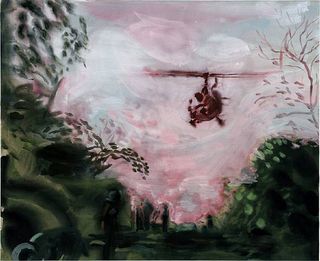
Whitney Mallet in n+1 (image by Mari Eastman):
Around the time video games were to coming to define the memory of Operation Desert Storm, Chris Marker made a movie about a video game that depicted a forgotten battle of a well-remembered war. The heroine in Marker’s 1997 film Level Five is working on a Macintosh, writing a game to reconstruct the Battle of Okinawa,at the tail end of World War II. The Battle of Okinawa was dizzying in its loss of human life, but in the West today, hardly anyone knows it happened. In Level Five, Marker’s subject is as much the conflict as our technologies of remembering it. The focus might be predictable from the experimental filmmaker, who is best-known for his meditations on memory in La Jetée and Sans Soleil—though Level Five is structured more like the latter, an essay film that challenges easy categorization as either fiction or non-fiction. Nearly two decades after the film was made and two years after Marker’s death, Level Five is having its first theatrical release at a moment when wars are not just being remembered in digital arenas, but are increasingly being fought in them too.
In Level Five’s fictional frame, Laura, played by Catherine Belkhodja, is making a video game to tell the true story of the U.S. Army’s invasion into the Japanese island and of the subsequent mass suicide that claimed a huge portion of civilian life. Together with the casualties of war, 150,000 men, women, and children died in the battle, roughly a third of the island’s entire population. Before killing themselves, many of them killed loved ones who were too weak to take their own lives. The tragedy meant husbands killed wives. Parents killed children. Sons killed mothers. Marker’s film includes docu-style interviews and verité footage, sandwiched within the game-writer protagonist Laura’s monologues. The juxtaposition suggests that shared histories are impossible to parse from subjective, lived experience. Laura has chatroom run-ins; survivors describe the violence they witnessed in unforgettable and specific detail.
More here.
Misquoting Muhammad: The Challenge and Choices of Interpreting the Prophet’s Legacy
Mona Siddiqui in The Independent:

Brown's inspiration for the book comes from the New Testament scholar Bart Ehrman's bestselling Misquoting Jesus, a work which looks at the accidental or intentional textual variations of the Bible. Brown explains that his own focus is more on the challenges of interpreting the Prophet's legacy rather than “unveiling Islamic origins”. He explores the rich interpretative history of Islam and how the faithful continue to be challenged. Much of what Brown is really exploring is the status of the sayings or traditions of the Prophet – hadiths. These were compiled in their thousands and form the basis of much of Islamic dogmatic, legal and theological thinking from the earliest times. They are second only to the Koran as a source of authority. But how many of them are reliable, and why do Muslims continue to be guided by them when so many are disputed even rejected by scholars? The book tries to get to the bottom of these debates.
More here.
A Unified Theory: connections between these two worlds of art and technology
James Gleick in The New York Times:
Vikram Chandra is a wonderful novelist and apparently knows his way around an algorithm, too. His new book is an unexpected tour de force, different from anything he has done before. It has the oddly off-putting title “Geek Sublime,” which disguises its ambition: to look deeply, and with great subtlety, into the connections and tensions between the worlds — the cultures — of technology and art. The book becomes an exquisite meditation on aesthetics, and meanwhile it is also part memoir, the story of a young man finding his way from India to the West and back, and from literature to programming and back.
More here.
Friday, August 22, 2014
What Indian soldiers in the First World War wrote home about
To commemorate the centenary of India’s service in the First World War, the British historian David Omissi collected the letters of Indian soldiers away from home in Indian Voices of the Great War, published this year by Penguin. These eloquent letters offer a poignant glimpse into the lives of these Indian soldiers, whom history forgot.
David Omissi in The Caravan:
A wounded Sikh to his father
[Gurmukhi]
Brighton Hospital
18th January 1915
Tell my mother not to go wandering madly because her son, my brother, is dead. To be born and to die is God’s order. Some day we must die, sooner or later, and if I die here, who will remember me? It is a fine thing to die far from home. A saint said this, and, as he was a good man, it must be true.
Ram Prasad (Brahmin) to Manik Chand (c/o Sikander Ali, Bamba Debi Bazar, Marwari Water Tank, Bombay)
[Hindi]
Kitchener’s Indian Hospital, Brighton
2nd September 1915
And send me fourteen or fifteen tolas of charas [hashish], and understand that you must send it so that no one may know. First fill a round tin box full of pickles and then in the middle of that put a smaller round box carefully closed, so that no trace of the pickles can enter. And send a letter to me four days before you send the parcel off. [Letter withheld]
Ser Gul (Pathan, 129th Baluchis) to Barber Machu Khan (57th Rifles, serving at the front)
[Urdu]
Indian Hospital, Rouen
13th September 1915
I have no need of anything, but I have a great longing for a flute to play. What can I do? I have no flute. Can you get me one from somewhere? If you can, please do, and send it to me. Take this much trouble for me. For I have a great desire to play upon the flute, since great dejection is fallen upon me. You must, you simply must, get one from somewhere. I have no need of anything else. But this you must manage as soon as you can.
More here.
Birds Lost Their Sweet Tooth, Hummingbirds Got Theirs Back
Ed Yong in Not Exactly Rocket Science:

They aren’t alone. Maude Baldwin from Harvard University and Yasuka Toda from the University of Tokyo looked at the genomes of 10 different birds, from falcons to finches and ducks to doves. None of them had T1R2. Alligators do, and they’re some of the closest living relatives of birds. So at some point, as birds evolved from small dinosaurs, they lost their sweet tooth.
What about hummingbirds?
Hummingbirds feed largely on nectar, the sweet liquid that flowers produce. They love the stuff and the sweeter the better; they’ll actually reject flowers whose nectar isn’t sweet enough. They lack the T1R2 gene, but they can clearly taste sugar.
Baldwin and Toda have now discovered their workaround: they repurposed two other taste genes that are normally responsible for detecting savoury tastes. On a hummingbird’s tongue, these savoury sensors are sugar sensors too.
More here.
Can the Crowd Solve Medical Mysteries?
Carrie Arnold at PBS:

Jared Heyman knows the Loops’ frustration all too well. Several years ago, his younger sister was debilitated by an illness that no one could diagnose. Two years, nearly unspeakable agony, and half a million dollars in tests later, his sister finally got a diagnosis and treatment. “I knew there had to be a better way,” he says.
So Heyman set out to create that better way and started CrowdMed in 2013. The site allows patients to submit their cases to the site to be solved by a cadre of medical detectives from around the world. Heyman’s background in economics and the decade he spent as the head of a startup had given him an appreciation for the wisdom of crowds, which states that a large group of people tends to be smarter and more accurate than any single expert. What tricky diagnoses needed, Heyman realized, was a crowd of people doing their best to solve medical mysteries. Which is exactly what CrowdMed provides. He tested the concept by submitting his sister’s symptoms. Within three days, the site’s medical detectives had correctly identified her condition.
In the year since it began, CrowdMed has soared in popularity, with users in 21 countries around the world. Investors have also flocked to the project, including actor Patrick Dempsey (aka “Dr. McDreamy” on the television show Grey’s Anatomy), who recently pledged $1 million. The site’s promise, however, is tempered by concern from bioethicists and physicians alike, who worry about everything from privacy to medical errors.
More here.
Hashim Khan, Patriarch of a Squash Dynasty, Is Dead
William Yardley in the New York Times:
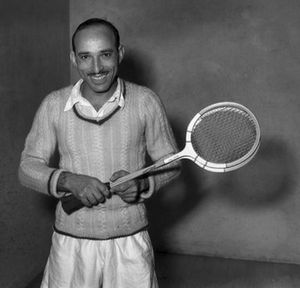
His death was confirmed by his son Mohammad.
Pakistan was not yet an independent nation when Khan began working as a ball boy at a British officers’ club near Peshawar where his father, Abdullah, was the head steward. When he was not fetching balls hit over walls — courts used to be roofless — young Hashim watched game after game.
When the officers cleared the courts, he went out to practice, barefoot. Sometimes he traded his lunch for lessons. The hard work eventually got him a job teaching squash at the club and led to the belated break that made him a star.
He was in his 30s and a national champion in his homeland when a player he regularly defeated, Abdul Bari of Bombay, made it to the final of squash’s British Open. Khan had not played internationally, but Bari’s success prompted Khan’s supporters to raise money to send him to the tournament in 1951. There were concerns that he was too old, but with Pakistan having just become independent from India, it was a matter of national pride.
He was at least 36 — and possibly several years older — when he played for the first time in the Open, squash’s most celebrated tournament. Khan made an impressive debut, vanquishing an array of international stars on his way to the final, where he defeated the man presumed to be world’s best player, the four-time champion Mahmoud Karim of Egypt, 9-5, 9-0, 9-0.
Khan won the Open for six straight years. In 1956, he defeated his cousin Roshan in the final. Roshan was 26 at the time. Khan was in his 40s.
The next year, he lost to Roshan in the final. Although it was a defeat for Khan, it enhanced his family’s fame.
More here. [Thanks to Farrukh Azfar.]
Mapping the Mind: An Interview with Eric Kandel
Was the Human Brain Unleashed?
Courtney Humphries in Harvard Magazine:
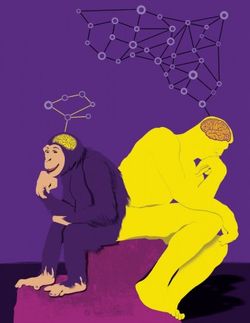
Randy Buckner, professor of psychology and of neuroscience, and his former student Fenna Krienen, Ph.D. ’13, have proposed a hypothesis to explain how the evolution of a large cortex may have enabled the distinct cognitive skills that humans display. The key is not just size but organization. As the human brain swelled, they argue, the cells in newly evolved areas were increasingly freed from constraints that patterned the simpler connections in other areas, and thus able to connect to each other in more complex ways that enabled new kinds of thinking.
More here.
Do gut bacteria control your mind?
From KurzweilAI:
How your gut microbiome may control you
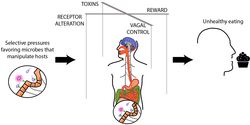
- The diverse community of microbes, collectively known as the gut microbiome, influence human eating behavior and dietary choices to favor consumption of the particular nutrients they grow best on, rather than simply passively living off whatever nutrients we choose to send their way.
- Some bacterial species prefer fat, and others sugar, for instance. They vie with each other for food and to retain a niche within their ecosystem — your digestive tract — and they also often have different aims than you do when it comes to your own actions.
- Bacteria may influence your decisions by releasing signaling molecules into your gut. Because the gut is linked to the immune system, the endocrine system, and the nervous system, those signals could influence your physiologic and behavioral responses — and health.
- Bacteria may be acting through the vagus nerve, which connects 100 million nerve cells from the digestive tract to the base of the brain, changing taste receptors, producing toxins to make you feel bad, and releasing chemical rewards to make you feel good.
- Certain strains of bacteria increase anxious behavior (in mice).
- Some strains of bacteria cause stomach cancer and perhaps other cancers.
More here.
Friday Poem
Begane Grond
Our lift talks to me, as I go up
or down, in a gentle, protective tone.
“We are here,” she says “you may go”.
She tells me the floor we have reached,
always lets me know where I am.
But whenever I descend to go out
into these streets I do not belong to,
“Begane grond” she intones, in a voice
which sounds to me slightly concerned,
“Here,” I think she says, “here’s the world,
open the door, go. And do not fret,
everyone here is as foreign as you are.
No one belongs. Not anywhere.”
by Roni Margulies
from Poetry International
translated by Roni Margulies
Thursday, August 21, 2014
Why the Ukraine Crisis Is the West’s Fault
John J. Mearsheimer in Foreign Affairs:
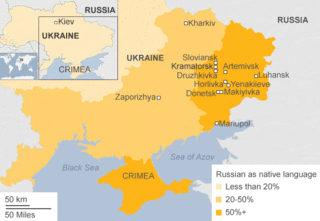
But this account is wrong: the United States and its European allies share most of the responsibility for the crisis. The taproot of the trouble is NATO enlargement, the central element of a larger strategy to move Ukraine out of Russia’s orbit and integrate it into the West. At the same time, the EU’s expansion eastward and the West’s backing of the pro-democracy movement in Ukraine — beginning with the Orange Revolution in 2004 — were critical elements, too. Since the mid-1990s, Russian leaders have adamantly opposed NATO enlargement, and in recent years, they have made it clear that they would not stand by while their strategically important neighbor turned into a Western bastion. For Putin, the illegal overthrow of Ukraine’s democratically elected and pro-Russian president — which he rightly labeled a “coup” — was the final straw. He responded by taking Crimea, a peninsula he feared would host a NATO naval base, and working to destabilize Ukraine until it abandoned its efforts to join the West.
Putin’s pushback should have come as no surprise. After all, the West had been moving into Russia’s backyard and threatening its core strategic interests, a point Putin made emphatically and repeatedly. Elites in the United States and Europe have been blindsided by events only because they subscribe to a flawed view of international politics. They tend to believe that the logic of realism holds little relevance in the twenty-first century and that Europe can be kept whole and free on the basis of such liberal principles as the rule of law, economic interdependence, and democracy.
More here.
The Strange & Curious Tale of the Last True Hermit
For nearly thirty years, a phantom haunted the woods of Central Maine. Unseen and unknown, he lived in secret, creeping into homes in the dead of night and surviving on what he could steal. To the spooked locals, he became a legend—or maybe a myth. They wondered how he could possibly be real. Until one day last year, the hermit came out of the forest.
Michael Finkel in GQ:

Candy! Always good. Ten rolls of Smarties, stuffed in a pocket. Then, into his backpack, a bag of marshmallows, two tubs of ground coffee, some Humpty Dumpty potato chips. Burgers and bacon were in the locked freezer. On a previous raid at Pine Tree, he'd stolen a key to the walk-in, and now he used it to open the stainless-steel door. The key was attached to a plastic four-leaf-clover key chain, with one of the leaves partially broken off. A three-and-a-half-leaf clover.
He could've used a little more luck. Newly installed in the Pine Tree kitchen, hidden behind the ice machine, was a military-grade motion detector. The device remained silent in the kitchen but sounded an alarm in the home of Sergeant Terry Hughes, a game warden who'd become obsessed with catching the thief. Hughes lived a mile away. He raced to the camp in his pickup truck and sprinted to the rear of the dining hall. He peeked in a window.
More here. [Thanks to Bill Hooker.]
Where academic philosophy went wrong
Charlie Huenemann in his blog Huenemanniac:

Each academic discipline became a guild or union, where membership is tightly controlled and guild members insist on their indispensability to the general curriculum. New disciplines created their own means of controlling membership and making cases for their newfound indispensability.
As unions generally lost power and new models of management were developed in the last third of the 20th century, the university also experienced a shift in authority from the faculty to the administration. In the names of efficiency and accountability, administrators deployed numerous measures for evaluating faculty “productivity”; and the nature of these measures encouraged faculty to entrench themselves more firmly in their respective guilds.
In the case of philosophy, this meant (1) more attention devoted to narrow problem-solving activity rather then efforts to deepen philosophical wonder; (2) increasingly narrow specialization and less general knowledge of the discipline itself and its history; (3) less engagement with anyone outside the professional guild; and (4) development of various cants and shibboleths to patrol membership in the guild.
More here.
Syria in Revolt: Understanding the Unthinkable War
Sadik J. Al-Azm in the Boston Review:

I was surprised by the revolution, but I should not have been. Daily experiences and recurrent observations foretold a crisis that many Syrians tried hard to deny. And deny we did. Let me explain.
After the violent suppression of the Damascus Spring in 2001–2002 and again after the assassination of former Lebanese Prime Minister Rafiq Hariri in Beirut in 2005, which led to the humiliating withdrawal of Assad’s troops from Lebanon, angst spread throughout Syria. I was working in Damascus, where the trepidation was especially pronounced. The country, it seemed, was teetering on the edge of an abyss.
But life flowed routinely on the surface. Talking about the situation publicly was out of the question. Even hinting at it was dangerous. When someone did speak up, others quickly changed the subject. A conspiracy of silence was the order of the day.
This period marked a palpable deterioration in relations among Syrians. Sectarian lines hardened, undermining long-standing friendships, harmony among colleagues, and the daily interactions of citizens. Even our way of joking changed.
More here.
A brash tech entrepreneur thinks he can reinvent higher education by stripping it down to its essence, eliminating lectures and tenure along with football games, ivy-covered buildings, and research libraries. What if he’s right?
Graeme Wood in The Atlantic:

Those future students will pay about $28,000 a year, including room and board, a $30,000 savings over the sticker price of many of the schools—the Ivies, plus other hyperselective colleges like Pomona and Williams—with which Minerva hopes to compete. (Most American students at these colleges do not pay full price, of course; Minerva will offer financial aid and target middle-class students whose bills at the other schools would still be tens of thousands of dollars more per year.) If Minerva grows to 2,500 students a class, that would mean an annual revenue of up to $280 million. A partnership with the Keck Graduate Institute in Claremont, California, allowed Minerva to fast-track its accreditation, and its advisory board has included Larry Summers, the former U.S. Treasury secretary and Harvard president, and Bob Kerrey, the former Democratic senator from Nebraska, who also served as the president of the New School, in New York City.
Nelson’s long-term goal for Minerva is to radically remake one of the most sclerotic sectors of the U.S. economy, one so shielded from the need for improvement that its biggest innovation in the past 30 years has been to double its costs and hire more administrators at higher salaries.
More here.