Love Letters Between Christopher Isherwood and Don Bachardy

31SUBGIARDINA-master675Henry Giardina at The New York Times:

In 1956, Christopher Isherwood wrote from Cheshire, England, to his partner, the artist Don Bachardy. It is the first entry in a 14-year correspondence: a brief, eccentric document that mentions, in a short space, Alexander Korda’s memorial service, incest between two cats and Courbet’s “Diligence in the Snow.”

“I think about you all the time,” he writes in closing, “and about times I might have been kinder and more understanding, and I make many resolutions for the future — some of which I hope I’ll keep.”

Their relationship began on Valentine’s Day of 1953 and was in an important sense defined by its many periods of separation. The world of the letters lived inside the broader, coded world of midcentury homosexuality. Within it, Isherwood and Bachardy were able to express themselves through a more personal kind of code, in what would become the prolonged metaphor of the Animals.

more here.

a history of civilisation that peers into a post-human future

Ab06ff1e-c4d6-4678-8981-e7c1d97af4d5John Gray at The Financial Times:

Already a bestseller in Hebrew, Sapiens mounts a fundamental challenge to the predominant contemporary view of humans and their place in the world. “Liberal humanism,” Harari points out, “is built on monotheist foundations.” Take away the soul and the privileged place in the world accorded to humans by a creator-god, and it becomes difficult to explain why humans are so special. The task becomes harder if we perform a thought-experiment based on the facts of human origins. We’ve grown used to thinking of ourselves as the only species of humans. But for most of its history Homo sapiens shared the planet with several humanoid species – the Neanderthals being only the best known. “The earth of a hundred millennia ago was walked by at least six different species of man”, writes Harari. Suppose some or all of these species had survived alongside ourselves up to the present. What would become of the cherished sense that we are set apart from the rest of the natural world by having some peculiar transcendent value? Human uniqueness, Harari concludes, is a myth spawned by an accident of evolution.

For most people today, history is a tale of human advance fuelled by increasing brainpower. For Harari, this is just another myth. There is no evidence that human beings have become more intelligent over time, and most of history’s largest changes have not involved an improvement in the quality of life. The agricultural revolution is touted as a great advance; but “for the average person, the disadvantages probably outweighed the advantages”. For most human beings, the shift to farming was not a choice but a trap.

more here.

Juggling Worlds

Pico Iyer in The New York Times:

Bone“I don’t summon anything up,” protests Holly Sykes, the down-to-earth protagonist of “The Bone Clocks,” David Mitchell’s latest head-spinning flight into other dimensions. “Voices just . . . nab me.” She’s trying to explain to a skeptical, curmudgeonly English writer how she occasionally falls out of time and sees what’s going to happen next. Embarrassed about her gift — she’s just a regular daughter of the owner of the Captain Marlow pub in Gravesend, Kent — and reluctant to credit such way-out ideas as precognition, she goes on, “Oh, Christ, I can’t avoid the terminology, however crappy it sounds: I was channeling some sentience that was lingering in the fabric of that place.”

There you have it: a perfectly matter-of-fact, unvarnished evocation of how regular folks speak, married to a take-no-prisoners fascination with all that we can’t explain. Coming from a writer himself famous for his gift for channeling voices (not least of pub-owners’ daughters) and for his preternatural talent for seeing things, in the world, above it and all around it, the admission gives off a flash of unexpected self-revelation. (One recalls how the last novel Hilary Mantel published before her uncannily mediumistic “Wolf Hall” was about a woman full of demons who contacts the other world for a living.) “The Bone Clocks” — a perfect title for a novelist who’s always close to the soil and orbiting the heavens in the same breath — is a typically maximalist many-storied construction: In one of its manifold secret corners, it sounds as if a sublimely original writer is wondering how much “writing’s a pathology” (as one of his characters puts it) and whether it’s possible to conjure up time-traveling characters and scenes from the distant past and future, yet not believe in magic.

More here.

Name-to-Know: Régime des Fleurs

Lauren Sherman in The Wall Street Journal:

AliaTHE SELF-TAUGHT NOSES behind new perfume line Régime des Fleurs refer to themselves as “lifetime fragrance geeks.” Ex-fashion stylist Ezra Woods, 30, was born into a family of florists, and Alia Raza, 36, formerly a filmmaker and video artist, often found herself inspired by perfume while dreaming up concepts for her work. The longtime friends both had a habit of obsessively researching perfumes and raw materials. About a year ago, they finally decided it was time to make their own. This spring, they introduced a range of six unique, beautifully bottled fragrances with highly romantic descriptions. Turquoise, for instance, a fruity floral, is said to evoke “a teenage Marie Antoinette gone abroad to India.”

…Still, Mr. Woods and Ms. Raza are in the midst of developing a more “conventional, scalable” secondary collection, which will bring them closer—but not too close—to the mass market. “We're really interested in other product categories, different types of personal care, apparel, home—even edible products,” said Mr. Woods. “We love the idea of making everything floral,” added Ms. Raza. “Why is there not jasmine chewing gum, and why don't I have gardenia toothpaste?”

More here. (Disclosure: Alia Raza is our niece)

Friday, August 29, 2014

The pathos of Stefan Zweig and his overdue revival

Adam Kirsch in The New Republic:

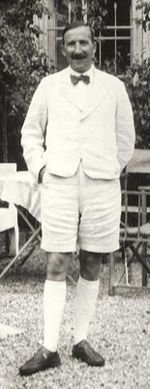
ScreenHunter_778 Aug. 29 16.36The careers of Stefan Zweig and Walter Benjamin offer a contrast so perfect as to become almost a parable. The two writers were contemporaries—Benjamin was born in 1892, Zweig in 1881—and both operated in the same German literary ecosystem, though Benjamin was from Berlin and Zweig from Vienna. Both reached their height of productivity and reputation during the Weimar Republic, and as Jews both were forbidden from publishing in Germany once Hitler took power. And both ended darkly as suicides: Benjamin took his life in 1940 while trying to flee from France to Spain, and Zweig died a year and a half later in Brazil, where he sought refuge after unhappy sojourns in England and America.

Yet the similarities end with their biographies. As writers, they could not have been more different, and their literary destinies were exact opposites. Zweig flourished during his lifetime, enjoying huge sales of his psychologically charged novels and his popular historical biographies. Born with a fortune—his father was a textile manufacturer in Bohemia—he earned another fortune through his books, carrying into literature the bourgeois discipline and regularity that he inherited from his businessman ancestors.

More here.

The return of radical empiricism

Massimo Pigliucci in Scientia Salon:

Recently, here at Scientia Salon I published three essays — two by Robert Nola [2] and one by Coel Hellier [3] — that epitomize radical empiricism, more so in Hellier’s than in Nola’s case, I might add. Interestingly, Nola is a philosopher and Hellier a scientist, and indeed it is known by now that “scientism” — which is the attitude that results from radical empiricism — is being championed by a number of scientists (e.g., Lawrence Krauss [4], Neil deGrasse Tyson [5]) and philosophers (James Ladyman and Don Ross [6], Alex Rosenberg [7]).

Clearly, I find myself puzzled and bewildered by this state of affairs. As someone who has practiced science for a quarter century and then has gone back to graduate school to switch to philosophy full time I have a rather unusual background that, I think, makes me appreciate where radical empiricists come from, and yet which also precludes me from buying into their simplistic worldview.

In the remainder of this essay, then, I will try to do the following:

    1. Sketch out what I see are the logical moves attempted by radical empiricists;
    2. Show why they don’t work;
    3. Explain why this is more than an academic debate, and certainly more than “just semantics.”

More here.

Friends of Israel

Connie Bruck in The New Yorker:

ScreenHunter_777 Aug. 29 16.27On July 23rd, officials of the American Israel Public Affairs Committee—the powerful lobbying group known as AIPAC—gathered in a conference room at the Capitol for a closed meeting with a dozen Democratic senators. The agenda of the meeting, which was attended by other Jewish leaders as well, was the war in the Gaza Strip. In the century-long conflict between the Israelis and the Palestinians, the previous two weeks had been particularly harrowing. In Israeli towns and cities, families heard sirens warning of incoming rockets and raced to shelters. In Gaza, there were scenes of utter devastation, with hundreds of Palestinian children dead from bombing and mortar fire. The Israeli government claimed that it had taken extraordinary measures to minimize civilian casualties, but the United Nations was launching an inquiry into possible war crimes. Even before the fighting escalated, the United States, Israel’s closest ally, had made little secret of its frustration with the government of Prime Minister Benjamin Netanyahu. “How will it have peace if it is unwilling to delineate a border, end the occupation, and allow for Palestinian sovereignty, security, and dignity?” Philip Gordon, the White House coördinator for the Middle East, said in early July. “It cannot maintain military control of another people indefinitely. Doing so is not only wrong but a recipe for resentment and recurring instability.” Although the Administration repeatedly reaffirmed its support for Israel, it was clearly uncomfortable with the scale of Israel’s aggression. AIPAC did not share this unease; it endorsed a Senate resolution in support of Israel’s “right to defend its citizens,” which had seventy-nine co-sponsors and passed without a word of dissent.

More here.

from church bells to dumbbells

HD_P_193_1_v_16_1746_finalKatherine Hunt at Cabinet Magazine:

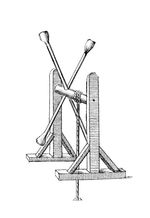
In an article in the Spectator in July 1711, the eponymous character Mr. Spectator—as written by Joseph Addison, one of the magazine’s founders—described his exercise routine. When in town, and therefore not able to go out riding, “I exercise myself an Hour every Morning upon a dumb Bell that is placed in a Corner of my Room, and pleases me the more because it does every thing I require of it in the most profound Silence.”1 We know dumbbells now as handy at-home pieces of gym equipment—free weights that have been around, in some form, at least since ancient Greek athletes used halteres to increase the length of their long jumps. But the dumbbell that Mr. Spectator refers to, and from which the heavy gym weights borrow their name, is something different. An illustration of a similar piece of equipment, published in the Gentleman’s Magazine in 1746, shows a wooden contraption in which two crossed bars with weights on the ends are mounted on an axle, around which is wound a length of rope. This mechanism would be elevated within a room, or placed in a garret, with the rope hanging down for a person standing below to pull. It mimics the apparatus used for ringing church bells, with the bell itself replaced by two weighted bars—it’s these that resemble the dumbbells of today.

more here.

Women’s Shadow in the American Western

1408626858126Thirza Wakefield at Granta:

‘You want to talk about the vanishing wilderness?’ These are the opening words of John Boorman’s Deliverance (1972), spoken by Burt Reynolds’ character Lewis, the only self-declared outdoorsman among four Atlanta men headed for a canoeing trip along the fictional Cahulawassee River. The expedition is Lewis’s idea and, driving into backcountry by way of the opening credits, he’s hard-pressed to persuade the party of the urgency and importance of their trip. This is the last chance they’ll have to ride the river: the government plans to flood the valley to make way for a reservoir – more recreation for ‘your smug little suburb’, Lewis calls it. Where they’re going is frontier territory: ‘just about the last wild, untamed, unpolluted, un-fucked-up river in the South.’

Director of photography Vilmos Zsigmond’s wooded American wild is a voluptuous green, backlit by an acid sun. Zsigmond desaturated the film’s Technicolor, dredging the photography of reds, blues and yellows, effecting a backwoods that vibrates with fecundity, a cannibalizing flora that eats at the edges of the frame.

more here.

john Williams’ “Augustus”

Mendelsohn_2-081414_jpg_250x1401_q85Daniel Mendelsohn at The New York Review of Books:

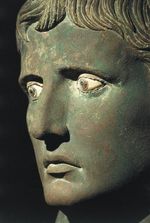
How to write about such a figure? In Augustus, the question is slyly put in the mouth of the emperor’s real-life biographer Nicolaus. “Do you see what I mean,” the confounded scholar writes after a meeting with Augustus, whose notorious prudence he cannot reconcile with an equally notorious penchant for gambling. “There is so much that is not said. I almost believe that the form has not been devised that will let me say what I need to say.”

This is an in-joke on Williams’s part: the form Nicolaus dreams of—which is of course the one Williams ended up using—is the epistolary novel, a genre that wasn’t invented until fifteen centuries after Augustus. And yet its roots go right back to his reign. The Roman poet Ovid—also a character in Augustus, providing gossipy updates on the doings of the imperial court—composed a work called Heroides(“Heroines”), a sequence of verse epistles by mythical women to their lovers.

The epistolary form, so long associated with romantic subjects, is in fact ideally suited to Williams’s quasi-biographical project.

more here.

Friday Poem

The Clothes Shrine

In the early days to find
Light white muslin blouses
On a see-through nylon lone
Drip-drying in the bathroom
Or a nylon slip in the shine
of its own electricity-
As if St, Brigid once more
Had rigged up a ray of sun
Like the one she'd stung on air
To dry her own cloak on
(Hard-pressed Brigid, so
Unstoppably on the go)-
The damp and slump and unfair
Drag of the workday
Made light of and got through
As usual, brilliantly

by Seamus Heaney
from Electric Light
Farra, Straus and Giroux, 2001

Gratitude for help among adult friends and siblings

Anna Rotkirch in Evolutionary Psychology:

Gratitude-rainbowspiral1-300x300Although gratitude is a key prosocial emotion reinforcing reciprocal altruism, it has been largely ignored in the empirical literature. We examined feelings of gratitude and the importance of reciprocity in same-sex peer relations. Participants were 772 individuals (189 men; mean age = 28.80) who completed an online survey using a vignette design. We investigated (i) differences in reported gratitude and the importance of reciprocity among same-sex siblings and same-sex friends, and (ii) how relationship closeness moderates these associations. Based on the theory of kin altruism, we expect that people would feel more grateful towards friends than towards their siblings, and that lack of gratitude or failure to pay back a loan would bother more with friends than with siblings, irrespective of emotional closeness. Results showed that levels of gratitude and expectations of reciprocity were higher towards friends compared to siblings. This was the case also after controlling for emotional closeness. Being close generally made participants feel more grateful and expect lower displays of gratitude in the other. Closeness was also strongly associated with emotional gratitude among siblings compared to friends. We conclude that feelings and displays of gratitude have a special role in friendships. Although a close sibling may elicit as much gratitude as a friend does, even a very close friend is not exempt from the logic of reciprocity in the same way that a sibling is.

More here.

Etching the Neural Landscape

Greg Dunn in American Scientist:

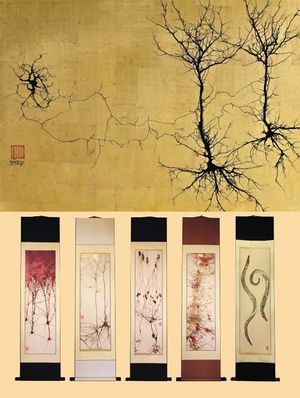
NeralBoth art and science arise from our root desires to describe our experience of reality. From this starting point, the artistic and scientific paths diverge. Science describes external reality, about which we share a consensus. Art captures our internal, subjective realities. But the two sides do not always stand apart. My own work can best be described as science/art, not simply because I paint that which scientists study but because I draw evenly from artistic and scientific approaches to capture the essence of the neurons that carry sensations and produce thought.

My artistic career began during my tenure as a graduate student in neuroscience at the University of Pennsylvania. As I came to learn, molecular research can be an existential exercise in that you must rely on machines and chemical reagents to “see” your experiments. Painting provided me a welcome respite from lab frustrations because it gave me a sense of control. When painting, I can experiment and immediately see the result, judge it against my intentions, and iterate as necessary. I can convey my thoughts to the world without having to worry about grants, contaminated compounds, the politics of publishing, or an unexpected flood in the mouse room threatening to wash away my study subjects.

More here.

Thursday, August 28, 2014

From the archives of Playboy: Frank Sinatra

Joe Hyams in Playboy in 1963:

Playboy: All right, let’s start with the most basic question there is: Are you a religious man? Do you believe in God?

Sinatra1Sinatra: Well, that’ll do for openers. I think I can sum up my religious feelings in a couple of paragraphs. First: I believe in you and me. I’m like Albert Schweitzer and Bertrand Russell and Albert Einstein in that I have a respect for life—in any form. I believe in nature, in the birds, the sea, the sky, in everything I can see or that there is real evidence for. If these things are what you mean by God, then I believe in God. But I don’t believe in a personal God to whom I look for comfort or for a natural on the next roll of the dice. I’m not unmindful of man’s seeming need for faith; I’m for anything that gets you through the night, be it prayer, tranquilizers or a bottle of Jack Daniel’s. But to me religion is a deeply personal thing in which man and God go it alone together, without the witch doctor in the middle. The witch doctor tries to convince us that we have to ask God for help, to spell out to him what we need, even to bribe him with prayer or cash on the line. Well, I believe that God knows what each of us wants and needs. It’s not necessary for us to make it to church on Sunday to reach Him. You can find Him anyplace. And if that sounds heretical, my source is pretty good: Matthew, Five to Seven, The Sermon on the Mount.

Playboy: You haven’t found any answers for yourself in organized religion?

Sinatra: There are things about organized religion which I resent. Christ is revered as the Prince of Peace, but more blood has been shed in His name than any other figure in history. You show me one step forward in the name of religion and I’ll show you a hundred retrogressions.

More here. [Thanks to Sam Harris.]

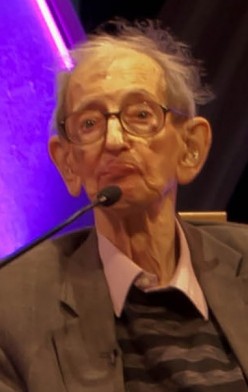
The Bourgeois Eric Hobsbawm

David A. Bell in The National Interest:

ScreenHunter_777 Aug. 28 18.20In a famous exchange in 1994, Michael Ignatieff asked Eric Hobsbawm whether the vast human costs inflicted by Stalin on the Soviet Union could possibly be justified. Hobsbawm replied, “Probably not. . . . because it turns out that the Soviet Union was not the beginning of the world revolution. Had it been, I’m not sure.” Do you mean, Ignatieff pressed him, that “had the radiant tomorrow actually been created, the loss of fifteen, twenty million people might have been justified?” Hobsbawm answered, “Yes.”

Two years after Hobsbawm’s death at the age of ninety-five, his lifelong, unapologetic Communism remains for many the most important thing about him. To his critics on the right, it discredits him, pure and simple. On the left, even some commentators who took more admirable stances on Communist tyrannies treat his steadfast commitment to the USSR as, to quote Perry Anderson, “evidence of an exceptional integrity and strength of character.” They refer with something approaching reverence to the justification he formulated in his 2002 autobiography, Interesting Times: “Emotionally, as one converted as a teenager in the Berlin of 1932, I belonged to the generation tied by an almost unbreakable umbilical cord to hope of the world revolution, and of its original home, the October Revolution.”

But in what ways did Hobsbawm’s politics really shape the voluminous writings that made him one of the most famous historians of the past century?

More here.

Seven of Italy’s top scientists were convicted of manslaughter following a catastrophic quake. Has the country criminalized science?

David Wolman in Medium:

ScreenHunter_776 Aug. 28 18.16During the winter and early spring of 2009, Selvaggi and other seismologists at Italy’s National Institute of Geophysics and Volcanology had been monitoring numerous tremors around L’Aquila. The sequence of small quakes over a short period of time, known as a “seismic swarm,” is distinct from the aftershocks that follow a big quake.

And in places like L’Aquila, they are not necessarily abnormal. Local media repeatedly relayed that generic message to the public. Regional government officials insisted there was no need to fret, despite chronically unenforced building codes. The Civil Protection Department for Abruzzo, the region where L’Aquila is located, even issued a press release flatly proclaiming there would be no big earthquake.

But the people of L’Aquila were understandably concerned. Over the centuries, the city had been devastated by several major quakes: One in 1703 killed 10,000 people, and a magnitude 7.0 quake in 1915 killed 30,000. This history has given rise to a culture of caution. When the ground seems especially temperamental, many residents — like their parents and grandparents before them — grab blankets and cigarettes and head outside to mill about in a piazza or a nearby park. Others sleep in their cars. Better not to be in an ancient building that hasn’t been seismically reinforced.

More here.

You Almost Certainly Have Mites On Your Face

Ed Yong in Not Exactly Rocket Science:

Demodex-follicularumThink of all the adults you know. Think of your parents and grandparents. Think of the teachers you had at school, your doctors and dentists, the people who collect your rubbish, and the actors you see on TV. All of these people probably have little mites crawling, eating, sleeping, and having sex on their faces.

There are more than 48,000 species of mites. As far as we know, exactly two of those live on human faces. While their relatives mostly look like lozenges on spindly legs, face-mites are more like wall plugs—long cones with stubby legs at one end. They don’t look like much, and most of us have never looked at one at all. But these weird creatures are almost certainly the animals we spend the most time with.

They live in our hair follicles, buried head-down, eating the oils we secrete, hooking up with each other near the surface, and occasionally crawling about the skin at night. They do this on my face. They probably do it on yours. A group of scientists led by Megan Thoemmes and Rob Dunn at North Carolina State University found that every adult in a small American sample had face-mites on their faces—something that was long suspected but never confirmed. If you want to find humanity’s best friend, ignore dogs; instead, swab a pore and grab a microscope.

More here.

virginia woolf, writing, and painting

517d7ba0-285c-11e4_1089269hRuth Scurr at the Times Literary Supplement:

Critical to the development of Woolf’s writing was the freedom of the Hogarth Press, which she and Leonard began in 1917 after buying a hand-press for £19 5s 6d on Farringdon Street. Woolf’s first two novels, The Voyage Out (1915), and Night and Day (1919), were published by her half-brother Gerald Duckworth’s company. The editions look sombre and conventional, a world away from Jacob’s Room(1922), which the Hogarth Press produced with a bright, bold cover designed by Vanessa Bell. Spalding describes this novel with almost no plot and a central character defined by his absence as “sprightly word painting”. After reading Woolf’s story “The Mark on the Wall”, which formed half of the Hogarth Press’s first publication Two Stories (1917), Roger Fry told her, “You’re the only one now Henry James has gone who uses language as a medium of art, who makes the very texture of the words have a meaning and a quality really almost apart from what you are talking about”.

In 1918, the Hogarth Press was asked to consider Ulysses for publication. The Woolfs explained the technical impossibility: “at our rate of progress a book of 300 pages would take at least two years to produce . . . . We very much regret this as it is our aim to produce writing of merit which the ordinary publisher refuses”. Joyce’s novel was eventually published by Shakespeare and Company, Paris, in 1922. Seeing a first edition of Ulysses alongside a selection of Hogarth Press books – Katherine Mansfield’s Prelude (1917), Hope Mirrlees’s Paris (1920), T. S. Eliot’s The Waste Land (1923) – brings the press’s physical limitations and unbounded literary ambition into sharp focus.

more here.