The Most Futuristic Predictions That Came True In 2014

George Dvorsky in io9:

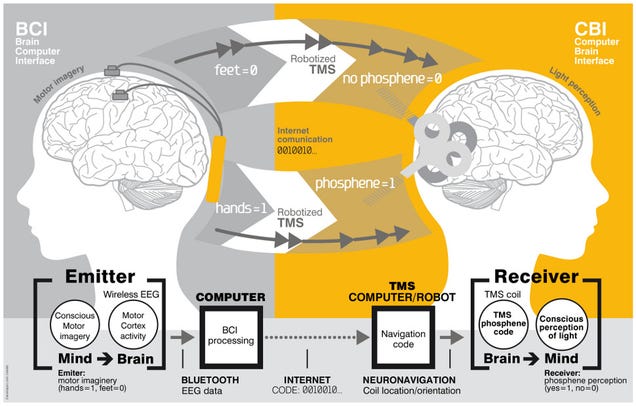
Technologically-assisted telepathy was successfully demonstrated in humans

For the first time ever, two humans exchanged thoughts via mind-to-mind communication.

The Most Futuristic Predictions That Came True In 2014

Remarkably, the system is completely non-invasive. By using internet-linked electroencephalogram (EEG) and robot-assisted image-guided transcranial magnetic stimulation (TMS) technologies, an international team of researchers were able to get two subjects — one in India and one in France — to mentally transmit the words “hola” and “ciao.” It's an important proof of concept for furthering the development of tech-enabled telepathy.Image: Carles Grau et al/Plos.

And in a similar breakthrough, a different team developed a system that allowed a human subject to control the movements of another person. The University of Washington researchers showcased the technology by having participants collaborate on a computer game where a “sender” sent mental instructions to a “receiver” to control their hand movements.

More here.

On “The New Republic”

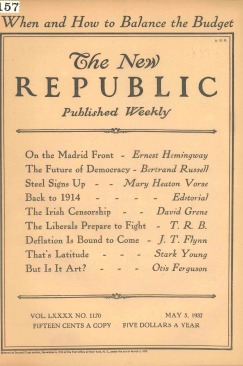
The-new-republic-243x366

David A. Bell in the LA Review of Books:

The old TNR did not end with a financial whimper, but a massive and unnecessary bang, courtesy of the new owner (and reported on in copious detail by former staffer Ryan Lizza, now working for The New Yorker). But even if a quiet slide into bankruptcy had precipitated TNR’s fall, the event would have posed the same questions: What did it really represent in American life? What future, if any, remains for institutions like it? To what extent can individual publications retain even their identity, to say nothing of their influence, in an age of social media?

To start answering these questions, a little history is in order.

Magazines like TNR are, fundamentally, creations of the 18th century. It was then that the basic format appeared: weekly or monthly periodicals that published various mixtures of news reports and analysis, opinion columns, book reviews, and the occasional poetry or fiction (not to mention, in a pre-phonograph age, sheet music). The Tatler and The Spectator, founded in Britain early in the century, quickly found imitators across the continent and then in the Americas. The point was to instruct and persuade, but to do so in an engaging, indeed entertaining manner: the essays were short enough to read in a single sitting, and full of witty anecdotes. Not coincidentally, it was in one of these magazines, the Berlinische Monatsschrift (Berlin Monthly) that the philosopher Immanuel Kant published his great 1784 essay “What Is Enlightenment,” in which he associated human progress with the ability of the public to make free use of its reason — i.e., for its members to argue rationally with each other. (The same issue included, among other things, articles on Jewish education, on a machine that supposedly spoke and played chess, and on a Berlin astrologer.) Kant understood that in a society where few people had the learning and leisure to engage in advanced philosophical discussions, printed periodicals were the level at which the public use of reason would mostly take place.

In TNR’s first issue, published in the fall of 1914, the magazine embraced this tradition, pledging itself to a version of Kant’s ideal.

More here.

Cleanse your body with the alkaline diet

Victoria Lambert in The Telegraph:

Natasha-Corrett_3148735bFive years ago, Natasha Corrett was overtired, overworked and unhappy with her weight. And when her back seized up in a stress-related spasm the day before her 26th birthday, she sought acupuncture treatment in a desperate effort to ‘‘un-knot’’ her in time for her party. What the gourmet cook didn’t expect was advice on food which would revolutionise her diet, lose two and a half stone “without noticing” – and find relief from the symptoms of polycystic ovary syndrome that had dogged her for years. It was while she was having the needles inserted that the therapist told her about the benefits of an alkaline diet: one which avoids “acid forming foods” such as dairy, meat, sugar and coffee and replaces them with plant foods and wholegrains.

Now 31, Natasha is in radiant health and her series of best selling Honestly Healthy cook books, based on the principles of alkaline eating, have a big celebrity following – one fan is Victoria Beckham. The latest book, Honestly Healthy Cleanse, is launched this week and contains 100 meticulously tested new recipes that combine her alkaline diet principles with four “cleansing plans” to kick start a new eating regime. Each detox is tailored to individual needs: the six-day slimdown cleanse, for example, suggests a menu of raw salads with soups and smoothies, to inspire those New Year weight loss plans; while for those in search of something more ambitious, the 30-day lifechanging cleanse is, she promises, a stepping stone to a new, healthier life. ‘’Once you’ve achieved the first 30 days, there will be no turning back,’’ shepromises, ‘’you will make definite lifestyle changes for the better as you’ll feel so energised and full of life.’’

More here.

A One-Way Trip to Mars? Many Would Sign Up

Natalie Angier in The New York Times:

Curiosity-rover-28-months-on-mars-1418070845861-master495When Seth Shostak, an astronomer who scans the cosmos for signs of extraterrestrial intelligence, asks middle school students how many of them want to go to Mars, all hands shoot up. When he asks how many would rather design robots that go to Mars, most hands drop back to their desks. And when he asks general audiences how many would go to Mars even if it meant dying a few weeks after arriving, he invariably finds volunteers in the crowd. “I kid you not,” said Dr. Shostak, the director of the Center for SETI Research. “People are willing to risk everything just to see Mars, to walk on the surface of our little ruddy buddy.” His experience accords with what many say is a distinct surge in public enthusiasm for space travel generally, and a manned mission to Mars in particular. Or make that a human mission: Women, too, are wholly on board. “I would totally love to go to Mars,” said Pamela A. Melroy, a former NASA astronaut who piloted two space shuttle missions and commanded a third.

More here. (Note: Do look at the amazing pictures in the accompanying interactive feature)

Teju Cole in Conversation with Aleksandar Hemon

Cole-01

Over at Bomb magazine (photo by Teju Cole):

Aleksandr Hemon I’ve always found the insistent distinction between fiction and nonfiction in Anglo-American writing very annoying, indeed troubling. For one thing, it implies that nonfiction is all the stuff outside of fiction, or the other way around, the yin and yang of writing. Another problem: it marks a text in terms of its relation to “truth,” a category that is presumably self-evident and therefore stable. But narration cannot contain stable truth, because it unfolds, and it does so before the narrator in one way, and before the listener/reader in another way. Narration is creation of truth, which is to say that truth does not precede it.

In Bosnian, there are no words that are equivalent to “fiction” and “nonfiction,” or that convey the distinction between them. This is not to say that there is no truth or falsehood. Rather, the stress is on storytelling. The closest translation of nonfiction would really be “true stories.”

You declare Every Day Is for the Thief a work of fiction. Why?

Teju Cole I made a sideways move from art history into writing, and I think this, in part, is why I also find the stern distinction between fiction and nonfiction odd. It’s not at all a natural way of splitting up narrated experience, just as we don’t go around the museum looking for fictional or nonfictional paintings. Painters know that everything is a combination of what’s observed, what’s imagined, what’s overheard, and what’s been done before. Is Monet a nonfiction painter and Ingres a fiction painter? It’s the least illuminating thing we could ask about their works. Some lean more heavily on what’s seen, some more on what’s imagined, but all draw on various sources.

Writers know this too, but I think they knew it a lot better before the market took such a hold. Would Miguel de Cervantes have considered himself a writer of fiction? Would François Rabelais? Would Robert Burton consider his activity (let’s telescope the eras here) essentially dissimilar to Rabelais’s? They all pretty much understood themselves to be spinning narratives out of whatever was at hand. And let’s not even get into Daniel Defoe, who played devious games with the emerging genres.

More here.

Monday, December 29, 2015

Sunday, December 28, 2014

Kazuo Ishiguro: how I wrote The Remains of the Day in four weeks

Kazuo Ishiguro in The Guardian:

ScreenHunter_933 Dec. 29 00.23Many people have to work long hours. When it comes to the writing of novels, however, the consensus seems to be that after four hours or so of continuous writing, diminishing returns set in. I’d always more or less gone along with this view, but as the summer of 1987 approached I became convinced a drastic approach was needed. Lorna, my wife, agreed.

Until that point, since giving up the day job five years earlier, I’d managed reasonably well to maintain a steady rhythm of work and productivity. But my first flurry of public success following my second novel had brought with it many distractions. Potentially career-enhancing proposals, dinner and party invitations, alluring foreign trips and mountains of mail had all but put an end to my “proper” work. I’d written an opening chapter to a new novel the previous summer, but now, almost a year later, I was no further forward.

So Lorna and I came up with a plan. I would, for a four-week period, ruthlessly clear my diary and go on what we somewhat mysteriously called a “Crash”. During the Crash, I would do nothing but write from 9am to 10.30pm, Monday through Saturday. I’d get one hour off for lunch and two for dinner. I’d not see, let alone answer, any mail, and would not go near the phone. No one would come to the house. Lorna, despite her own busy schedule, would for this period do my share of the cooking and housework. In this way, so we hoped, I’d not only complete more work quantitively, but reach a mental state in which my fictional world was more real to me than the actual one.

More here.

What We Talk about When We Talk about Holes

Evelyn Lamb in Scientific American:

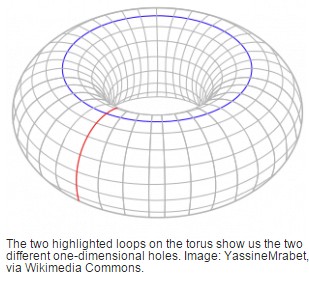
ScreenHunter_932 Dec. 28 19.54For Halloween, I wrote about a very scary topic: higher homotopy groups.Homotopy is an idea in topology, the field of math concerned with properties of shapes that stay the same no matter how you squish or stretch them, as long as you don’t tear them or glue things together. Both homotopy groups and the somewhat related homology groups are different ways to describe the topology of shapes using algebra. In my post, I said that homology detects “holes” of different dimensions. But, as one commenter asked, what do I mean by holes of different dimensions?

Good question! I deliberately used “hole” as a wiggle word because there isn’t a real mathematical definition of hole. But here’s my short answer that is also the reason I’m not an algebraic topologist. If you can put it on a necklace, it has a one-dimensional hole. If you can fill it with toothpaste, it has a two-dimensional hole. For holes of higher dimensions, you’re on your own.

That answer isn’t very satisfying. Is there a better way to describe holes? I talked with some of my topologist friends and discovered two things: topologists don’t all agree on what a hole is, and it’s fun and interesting to think about different interpretations of a word whose mathematical definition isn’t completely settled. I think my larger conclusion, in the spirit of the season, is that holes are like Santa Claus: the true meaning is in your heart. So let’s look into our hearts and think about what holes are.

More here.

Rebecca Solnit: The Age of Capitalism is over

Rebecca Solnit in Salon:

Shutterstock_66271057-620x412It was the most thrilling bureaucratic document I’ve ever seen for just one reason: it was dated the 21st day of the month of Thermidor in the Year Six. Written in sepia ink on heavy paper, it recorded an ordinary land auction in France in what we would call the late summer of 1798. But the extraordinary date signaled that it was created when the French Revolution was still the overarching reality of everyday life and such fundamentals as the distribution of power and the nature of government had been reborn in astonishing ways. The new calendar that renamed 1792 as Year One had, after all, been created to start society all over again.

In that little junk shop on a quiet street in San Francisco, I held a relic from one of the great upheavals of the last millennium. It made me think of a remarkable statement the great feminist fantasy writer Ursula K. Le Guin had made only a few weeks earlier. In the course of a speech she gave while accepting a book award she noted, “We live in capitalism. Its power seems inescapable. So did the divine right of kings. Any human power can be resisted and changed by human beings.”

That document I held was written only a few years after the French had gotten over the idea that the divine right of kings was an inescapable reality. The revolutionaries had executed their king for his crimes and were then trying out other forms of government. It’s popular to say that the experiment failed, but that’s too narrow an interpretation. France never again regressed to an absolutist monarchy and its experiments inspired other liberatory movements around the world (while terrifying monarchs and aristocrats everywhere).

Americans are skilled at that combination of complacency and despair that assumes things cannot change and that we, the people, do not have the power to change them. Yet you have to be abysmally ignorant of history, as well as of current events, not to see that our country and our world have always been changing, are in the midst of great and terrible changes, and are occasionally changed through the power of the popular will and idealistic movements. As it happens, the planet’s changing climate now demands that we summon up the energy to leave behind the Age of Fossil Fuel (and maybe with it some portion of the Age of Capitalism as well).

More here.

How the invasion of Panama birthed the quagmire in Iraq

Greg Grandin in Salon:

NoriegaOperation Just Cause was carried out unilaterally, sanctioned neither by the United Nations nor the Organization of American States (OAS). In addition, the invasion was the first post-Cold War military operation justified in the name of democracy — “militant democracy,” as George Will approvingly called what the Pentagon would unilaterally install in Panama.

The campaign to capture Noriega, however, didn’t start with such grand ambitions. For years, as Saddam Hussein had been Washington’s man in Iraq, so Noriega was a CIA asset and Washington ally in Panama. He was a key player in the shadowy network of anti-communists, tyrants, and drug runners that made up what would become Iran-Contra. That, in case you’ve forgotten, was a conspiracy involving President Ronald Reagan’s National Security Council to sell high-tech missiles to the Ayatollahs in Iran and then divert their payments to support anti-communist rebels in Nicaragua in order to destabilize the Sandinista government there. Noriega’s usefulness to Washington came to an end in 1986, after journalist Seymour Hersh published an investigation in the New York Times linking him to drug trafficking. It turned out that the Panamanian autocrat had been working both sides. He was “our man,” but apparently was also passing on intelligence about us to Cuba.

Still, when George H.W. Bush was inaugurated president in January 1989, Panama was not high on his foreign policy agenda. Referring to the process by which Noriega, in less than a year, would become America’s most wanted autocrat, Bush’s National Security Advisor Brent Scowcroft said: “I can’t really describe the course of events that led us this way… Noriega, was he running drugs and stuff? Sure, but so were a lot of other people. Was he thumbing his nose at the United States? Yeah, yeah.”

Read the full article here.

The truth about free will: Does it actually exist? Daniel Dennett explains

David Edmunds and Nigel Warburton in Salon:

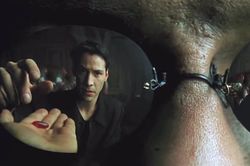
Matrix_pills2David Edmonds: One way to exercise my freedom would be to act unpredictably, perhaps not to have a typical introduction to a “Philosophy Bites” interview, or to cut it abruptly short mid-sentence. That’s the view of the famous philosopher and cognitive scientist, Daniel Dennett. He also believes that humans can have free will, even if the world is determinist, in other words, governed by causal laws, and he…

Nigel Warburton: The topic we’re focusing on is “Free Will Worth Wanting.” That seems a strange way in to free will. Usually, the free will debate is over whether we have free will, not whether we want it, or whether it’s worth wanting. How did you come at it from this point of view?

Daniel Dennett: I came to realize that many of the issues that philosophers love to talk about in the free will debates were irrelevant to anything important. There’s a bait-and-switch that goes on. I don’t think any topic is more anxiety provoking, or more genuinely interesting to everyday people, than free will But then philosophers replace the interesting issues with technical, metaphysical issues. Who cares? We can define lots of varieties of free will that you can’t have, or that are inconsistent with determinism. But so what? The question is, ‘Should you regret, or would you regret not having free will?’ Yes. Are there many senses of free will? Yes. Philosophers have tended to concentrate on varieties that are perhaps more tractable by their methods, but they’re not important.

More here.

Anxiety nation: why are so many of us so ill at ease?

Sophie Mcbain in New Statesman:

AnxietyFor a condition that affects so many of us, there is very little agreement about what anxiety actually is. Is it a physiological condition, best treated with medication, or psychological – the product of repressed trauma, as a Freudian might suggest? Is it a cultural construct, a reaction to today’s anomic society, or a more fundamental spiritual and philosophical reflection of what it means to be human? For most sufferers, the most pressing concern is whether drugs work, and if therapy is a good idea. Our modern, medical definition of anxiety could be traced back to 1980 and the publication of the third edition of the Diagnostic and Statistical Manual (DSM-III), the doctor’s and psychiatrist’s bible for identifying mental illness. The authors of DSM-III suggested that, according to their new criteria, between 2 and 4 per cent of the population would have an anxiety disorder. But three decades on, the America’s State of Mind Report showed that one in every six people in the United States suffers from anxiety.

The most recent nationwide survey, which took place in 2007, found that three million people in the UK have an anxiety disorder. About 7 per cent of UK adults are on antidepressants (often prescribed for anxiety, too) and one in seven will take benzodiazepines such as Xanax in any one year. Mental health charities warn that our anxiety levels are creeping even higher; they often blame our “switched-on” modern culture for this, or the financial crisis and the long recession that followed it. And yet, it is difficult to quantify whether it is our feelings of anxiety that have changed, or whether it’s just our perception of those feelings that is different: are we increasingly viewing ordinary human emotions as marks of mental illness?

More here.

Saturday, December 27, 2014

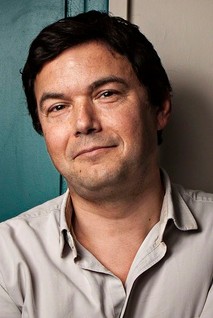
‘We need permanent revolution’: how Thomas Piketty became 2014’s most influential thinker

Owen Jones in The Guardian:

ScreenHunter_931 Dec. 27 22.08For a man with the unlikely description of “rock-star economist”, there is nothing rock’n’roll about Thomas Piketty’s cramped, book-lined office in a nondescript Parisian office block. By his feet are scattered various foreign translations of his publishing sensation, Capital in the Twenty-First Century: Greek, German, Japanese, and so on. There are 20 foreign editions already published, he tells me with evident pride, and another 37 to come. It must be rather surreal, I suggest: one doesn’t normally expect a French economist to become a global superstar. “Is there something particular with being French, or economists in general?” he jokes in a thick Parisian accent, effecting a faux wounded Gallic pride.

Piketty’s book is surely the most influential published by an economist in a generation, infuriating the right as much as it delighted an intellectually starved left. Using a mass of data, the book sought to expose why modern capitalism is an engine of exploding inequality: the rate of return on capital exceeds the rate at which the economy grows, he argues, and wealth is becoming ever more concentrated at the top of society.

More explosively, he proposes a global wealth tax as a check on this process, even though he has conceded this is “utopian”. He has been feted by political leaders across the western world – Ed Miliband among them – and beyond. I ask the boyish 43-year-old if his life has been thrown upside down. “Not so much. Sure, it was much more successful than I could expect – it was a gradual process, I had time to get accustomed … it’s not like a huge shock from complete anonymity to complete stardom. I’m still a little star!”

More here.

American Racial Boundaries Are Quite Distinct (For Now)

Razib Khan in The Unz Review:

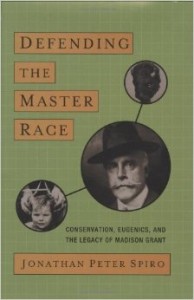
41AFhg61TZL._SY344_BO1204203200_-194x300Geneticists are people of their time. I’m rather sure that if Charles Davenport had written a book with the title Race Crossing in Jamaica today it would end with a far different moral, because the dominant Zeitgeist in regards to racial admixture in the United States is far different nearly 100 years on. In my post below where I review interesting aspects of the new study from researchers in David Reich’s lab and 23andMe, The Genetic Ancestry of African Americans, Latinos, and European Americans across the United States, I didn’t cover the variation in admixture in black and white Americans too much in detail. Partly that’s because this study only improved the bigger picture on the margins, and with finer geographic grain (though these were interesting obviously). We knew that the vast majority of white Americans who are not Hispanic do not have detectable non-European ancestry. It has also long been reported and verified that a substantial minority of the total ancestry of black Americans is of European origin, with a small Native American fraction as well. Additionally, this non-African ancestry in black Americans varies by geography as well as individual to individual a great deal.

So I have to take issue when The New York Times posts articles with headlines such as White? Black? A Murky Distinction Grows Still Murkier. What genetics is showing is that in fact white Americans are shockingly European to an incredibly high degree for a population with roots on this continent for 400 years. If we removed all the history that we take for granted we’d be amazed that the indigenous peoples had so little demographic impact, and, that the larger numbers of people of partial African ancestry did not move into the general “white” population. This is in fact the case across much of Latin America, where many self-identified whites,blanco, have African and indigenous ancestry. But we do know the reasons for why North America was unique, a combination of a smaller indigenous population which underwent a mass die off, and folk migrations on a huge scale previously unimaginable in human history. Whole villages in Poland and Norway, not just working age males, decamped for the New World.

More here.