
Category: Recommended Reading
Teaching Iguala

Thomas Rath in Berfrois:
On 26 September, the municipal police of Iguala, Guerrero, shot dead three trainee teachers from Ayotzinapa. One body later turned up with the eyes gouged and skin flayed. Later, the police kidnapped 43 other students and, reportedly, handed them over to a gang of narcos (drug-traffickers) who executed the students before incinerating their bodies and throwing what remained into a river. This crime disgusted Mexico, and national and international protests soon mushroomed. The events in Iguala have made me, like many people, alternately sad, angry and – once protests began – oddly hopeful. As a historian I’ve also been fascinated to see interpretations of the event slowly emerge, and think about the different versions of Mexico’s recent past underpinning them.
The events certainly undermine the florid boosterism of the Peña Nieto administration. President Peña Nieto is a member of the Partido Revolucionario Institucional (PRI), which ruled Mexico through a careful blend of co-option and violence from 1929-2000. The PRI finally lost a presidential election in 2000, but was then voted back to power in 2012. The president portrayed himself as an economic modernizer unlocking Mexico’s latent potential with sweeping market-driven reforms, dumped the militarized rhetoric of his predecessor Enrique Calderón, and downplayed levels of violence.
Much of the international press lapped this stuff up. In The Economist, Peña Nieto claimed it was “Mexico’s moment“. The cover of Time magazine announced that Peña Nieto had “changed the narrative“, a weird, but appropriately vapid headline. All of this sounds pretty hollow now; perhaps it always did in Mexico, at least outside of Los Pinos, gated communities or, say, Monterrey’s hi-tech business parks. What good are 44 free-trade agreements or renewed oil production if your loved ones rot in one of the hundreds (probably thousands) of mass graves perforating the country?
But the stakes are larger than one administration’s rhetoric. The Iguala scandal has engulfed the entire political class: Iguala’s mayor, suspected of ordering the killings, is a member of the nominally left-wing opposition party; the disastrous war against narcos was launched in 2006 by the right-wing Partido Acción Nacional (PAN), in which at least 100,000 have been killed or disappeared. These are levels of violence comparable to those in Iraq over the same period. It has also raised larger questions about where Mexico has been in the last few decades and where it’s going.
More here.
A Very Kautsky Christmas
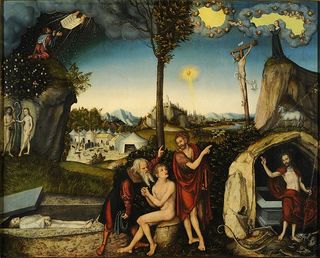
Loren Balhorn in Jacobin (image Lucas Cranach, The Law and the Gospel. 1529):
Reading Karl Kautsky at the tail end of 2014 is a peculiar undertaking. For starters, there is the burning question of “who actually reads Kautsky?”
Vilified by the Bolsheviks and their descendants for, in their eyes,betraying the Marxist principles his writings had done so much to popularize, yet still too Marxist for comfort in the rightward-moving Social Democratic Party of Weimar Germany, the “Pope of Marxism” has largely been consigned (along with Georgi Plekhanov, Bruno Bauer, and others) to the pile of seemingly-important authors one should at least have read about, but is not obligated to actually read.
Once we move beyond this first peculiarity, we are confronted with the second: namely, that a lot of what Kautsky writes is quite good. Sure, his work is riddled with over-simplifications and teleological projections that hold little water a century after the fact. But to reduce his Marxism to these shortcomings alone is to ignore one of the most important socialists of the twentieth century.
Kautsky’s most significant contribution — namely, systematizing classical Marxist theory into a series of easily understandable, digestible works fit for mass consumption — brought socialist theory and politics into the hearts and minds of millions of European workers at the turn of the last century. Kautsky was considered a “Pope” not due to unassailable ecclesiastic authority or backroom intrigues within the upper ranks of the SPD, but rather because he represented one of the main authorities on Marxist theory in an age where the spirit of revolution was sweeping up the German working classes like never before (and never since).
He sat at the pinnacle of an expanding workers’ movement, whose promises of inevitable socialist transformation seemed plausible and within reach. He wrote for an audience of millions of eager, attentive militants, and no doubt felt a sense of responsibility to use his authority to imbue the spirit of class consciousness in his readers.
This spirit runs through Communism in Central Europe at the Time of the Reformation, in which Kautsky traces the revolutionary egalitarian impulses of subaltern Protestant currents in the Middle Ages, identifying both an “egalitarian communism” of the poor and downtrodden masses, as well as an intellectualized “Utopian communism” of the educated upper classes.
More here.
The story of Germany
There is no single German story. Political centralisation came early to Britain and France; Germany, by contrast, assumed something like its modern form less than 150 years ago. Prior to this, it was a hodgepodge of little kingdoms, principalities and dukedoms, for many centuries owing a loose allegiance to the ramshackle Holy Roman Empire. German history, according to Neil MacGregor, director of the British Museum, is “a composite of different, sometimes conflicting, local narratives . . . inevitably, enrichingly and confusingly fragmented”.
The existence of such multiple narratives explains much about the behaviour of modern Germany: its instinctive federalism and commitment to European integration, its readiness to compromise combined with a stubborn insistence on fiscal discipline, its deep-rooted pacifism and, above all, its unwillingness to lead. Nationalism came late to Germany, and led to the disaster of the 1930s. It is a lesson the nation has learnt more bitterly than any other. In three recent books that reflect on how Germany’s past is shaping its future — MacGregor’s Germany: Memories of a Nation, Stephen Green’s Reluctant Meisterand Hans Kundnani’s The Paradox of German Power — this fragmentation and belated nationhood provide the backdrop.
more here.
Bringing bribery out into the open
Nabila Rahhal in Citiscope (via Digg):

The Smart car was covered with images of a driver’s license, diploma, utility meter and a gavel, and embossed in Arabic, Dek kenet el balad (“The city’s store where everything is for sale”). The drivers would park the car in front of government administration offices, to shine a light on the corruption that greases almost every government transaction here.
The Kabseh car (it means “surprise visit”) was the work of a new NGO here called Sakker el Dekkene (“close the store”). Their goal was not just to shame bureaucrats. It was also to collect data. Sakker el Dekkene has launched a smartphone app, website and telephone hotline for citizens to report when they’ve needed to pay a bribe in order to conduct government business. People exiting the government offices stopped at Kabseh to report 920 bribes, including some they’d paid just moments before.
Sakker el Dekkene’s crowd-sourced platforms give Lebanese their first means of quantifying a scourge that is all around them. Citizens report the city where their bribe took place, which government office was responsible and the amount of the bribe. While the data are far from comprehensive and hard to verify — most users opt to remain anonymous — the reports paint a grim picture. In six months, nearly 1,550 reports have been filed, with the total value of bribes paid adding up to 2.1 billion Lebanese Lira ($1.4 million U. S.).
Read the rest here.
Porochista Khakpour’s audacious coming-of-age novel
Hermione Hoby in The Guardian:

Khakpour’s imagination is similarly ambitious in its scope. The narrative is not Silber’s, or even Asiya’s, but belongs to the young man who fascinates them both – Zal, the last and 19th child of Khanoom, a demented woman living in a small village in Iran. Zal’s mother is so horrified by her son’s paleness, by this “sickly yellow-white thing in her arms”, that she calls him “White Demon” and locks him in a cage in her aviary. There he grows up (if his stunted early life can be described thus) eating bugs and birdseed and mimicking the shrieks and squawks of the canaries that surround him. As the novel’s preface indicates, this is a reimagining of one of the most famous tales in theShahnameh, the epic Persian poem in which an albino child’s parents are so horrified by his whiteness that they abandon him on a mountaintop, where he’s raised by a huge mythical bird.
More here.
Why Homer Matters
Bryan Doerries in The New York Times:

…Nicolson contends that the epic poems reflect “the violence and sense of strangeness of about 1800 B.C. recollected in the tranquillity of about 1300 B.C.,” though not captured in writing until roughly 700 B.C. And so he believes that whoever wrote the poems down belonged to “a culture emerging from a dark age, looking to a future but also looking back to a past, filled with nostalgia for the years of integrity, simplicity, nobility and straightforwardness.” It is difficult to assess Nicolson’s theory, which is based on a conjecture that the “Iliad” describes a pre-palatial warrior culture that seems to align well with the “world of the gold-encrusted kings buried in the shaft graves at Mycenae,” now dated to the 17th and 16th centuries B.C. But as a thought exercise, it is often gripping and, at times, electrifying. According to Nicolson, “Epic, which was invented after memory and before history, occupies a third space in the human desire to connect the present to the past: It is the attempt to extend the qualities of memory over the reach of time.” The purpose of epic “is to make the distant past as immediate to us as our own lives, to make the great stories of long ago beautiful and painful now.”
More here.
Sunday Poem
To Live in the Bordlerlands
To live in the Borderlands means you
are neither hispana india negra espanola
ni gabacha, eres mestiza, mulata, half-breed
caught in the crossfire between camps
while carrying all five races on your back
not knowing which side to turn to, run from;
To live in the Borderlands means knowing
that the india in you, betrayed for 500 years,
is no longer speaking to you,
that mexicanas call you rajetas,
that denying the Anglo inside you
is as bad as having denied the Indian or Black;
Cuando vives en la frontera
people walk through you, the wind steals your voice,
you're a burra, buey, scapegoat,
forerunner of a new race,
half and half – both woman and man, neither –
a new gender;
To live in the Borderlands means to
put chile in the borscht,
eat whole wheat tortillas,
speak tex-mex with a brooklyn accent;
be stopped by la migra at the border checkpoints;
Living in the Borderlands means you fight hard to
resist the gold elixir beckoning from the bottle,
the pull of the gun barrel,
the rope crushing the hollow of your throat;
In the Borderlands
you are the battleground
where enemies are kin to each other;
you are at home, a stranger,
the border disputes have been settled
the volley of shots have shattered the truce
you are wounded, lost in action
dead, fighting back;
To live in the Borderlands means
the mill with the razor white teeth wants to shred off
your olive-red skin, crush out the kernel, your heart
pound you pinch you roll you out
smelling like white bread but dead;
To survive the Borderlands
you must live sin fronteras
be a crossroads.
by Gloria Evangelina Anzaldua
from Borderlands -The New Mestiza
Aunt Lute Books, San Francisco, CA
Friday, December 26, 2014
Antonio Muñoz Molina: Narrative Across Time

The handy metaphor for time is a river: the swollen rapid that hurls us forward, or the placid current that rolls along, barely noticed until we find ourselves deposited far downstream. The comparison serves a few purposes. It captures our sense of time as continuous. It assures us of the present’s connection to both past and future, and therefore of our current selves’ connection to the people we have been and the people we will become. Above all, the metaphor confers a teleology upon time, makes a narrative of it. And narrative, of course, implies logic.
By virtue of his vocation, the Spanish author Antonio Muñoz Molina relies on narrative. But in the latest of his novels to appear in English, In the Night of Time(beautifully translated by Edith Grossman), Muñoz Molina is interested not in time’s flow but in its rupture.[1] In the Night of Time fixates on time not as an organizing principle, but rather as a partition that cordons off one period of a life from another with cruel suddenness.
more here.
our era of SOCIAL ACCELERATION

FOR MORE THAN TWO CENTURIES, time has been felt to be passing more and more quickly. Scholars tell us that since the twin revolutions of the 18th century — industrial and political — a general sense of time speeding up has been recorded with regularity in documents of all kinds. Political and technical progress somehow meant that people were always losing ground, unable to keep up, out of breath. Rousseau spoke in Émile of the encroachingtourbillon social irresistibly overtaking everything, and the enduring popularity of Waldenno doubt owes something to its condemnation of the way we squander rather than savor our time. Marx’s bourgeoisie, of course, “cannot exist without constantly revolutionizing the means of production,” and toward the end of the century, Nietzsche diagnosed the malady of the modern age in “the madly thoughtless shattering and dismantling of all foundations, their dissolution into a continual evolving that flows ceaselessly away, the tireless unspinning and historicizing of all there has ever been by modern man, the great cross-spider at the node of the cosmic web” — lines that come from the aptly titled Untimely Meditations.
So, naturally, reformers and revolutionaries sought to show how a better future would deliver us from relentless acceleration. In the hands of socialists, utopia became depicted not as beyond time — Thomas More’s was intended to be a timeless idea, not a prediction — but as something located in the definite future.
more here.
Jean-Luc Godard’s 3D film Adieu au langage

There’s no doubt that Adieu au langage, like many of Godard’s previous films, has the potential to feel “baffling”, “incoherent”, “irritating and often incomprehensible”, as some critics have suggested. American film theorist David Bordwell remarks about Godard’s work in general: “The brute fact is that these movies are, moment by moment, awfully opaque.” Borrowing from Proust, one could say that Adieu au langage is a film that resists the viewer’s gaze. It offers images “which the eye cannot penetrate”.
A simple way to understand this experience would be through the title of the film. Could Godard be suggesting, in his idiosyncratic style, that we must bid farewell to language as a means of communication? After all, it is nowadays a rather common observation: the world has become incommensurable to the various means of expression we have at our disposal. The words we could use to account for the ongoing mutations are failing us. In one of his previous films, Éloge de l’amour (2001), Godard has one of the characters reciting a line from Jean Cocteau’s diary: “Too many changes are in the air that still lack a means of expression” (1988:299; my translation). In Adieu au langage, a similar idea is conveyed by a quote from a book by Alain Badiou:
What is happening to us in the early years of the century – something that would appear not to have any clear name in any accepted language? (2012: 1)
more here.
The Royal Commoner
By Ullekh NP in Open The Magazine:

Her father Nandeshwar Singh, now 59, lives with her mother and a few relatives on what now remains of the estate in Bargoria. “There are not more than five people who live in that home where I grew up and the family doesn’t even own a bicycle now,” Kumud Singh says ruefully, with a tinge of wounded pride. Singh never went to school because even in the 80s the family had a sheltered existence and it wasn’t considered wise for girls of the dynasty to sit alongside other children, that too in a school founded by her ancestors. Instead, she was given private tuition at home and was educated to the level of the 10th standard exams. “I am currently pursuing my 11th through the Indira Gandhi National Open University (IGNOU) programme,” she says, as her two children, Tesu Trishna (like her, Kumud’s daughter is also named after a flower) and Bhusit, run past playfully.
Kumud Singh is not exactly a good conversationalist, but is aggressive and direct in her interactions on Facebook where she has begun to play a pivotal role in a discourse meant to resurrect what she terms as “the good deeds” of her family that many, including local historians, claim are not acknowledged and recorded. In the process, she has also reinvented herself from a homemaker to the editor of what is arguably the first weekly news portal in the Maithili language, Esamaad.com.
Read the rest here.
Why American Jews Eat Chinese Food on Christmas
Adam Chandler in The Atlantic:

If you look at the two other main ethnic cuisines in America, which are Italian and Mexican, both of those combine milk and meat to a significant extent. Chinese food allowed Jews to eat foreign cuisines in a safe way.
And so, for Jews, the chop suey palaces and dumpling parlors of the Lower East Side and Chinatown gave the illusion of religious accordance, even if there was still treif galore in the form of pork and shellfish. Nevertheless, it’s more than a curiosity that a narrow culinary phenomenon that started over a century ago managed to grow into a national ritual that is both specifically American and characteristically Jewish.
More here.
Joan Rivers is Hilarious on Johnny Carson’s Tonight Show
Friday Poem
Bow City
First abandoned was the telegraph.
(The railway had found a straighter course).
The silos emptied. The bank foreclosed itself.
The last live bullet soothed the last lame horse.
When the saloon snuck out, so did its drunk,
followed by his shadow constable
who faded like a red serge into fable.
Even the cemetery, somehow, shrunk.
No one noticed the cartographer
paint over them a gloss of sand. One day
the silence spooked the magpies from their perch.
Time, in geese’s arrows, flew away,
and the town’s two founders disappeared together,
as they’d come: the whorehouse and the church.
.
by Michael Lavers
from 32 Poems, Fall/Winter 2013
This Is Not a Vermeer™
Can anyone own a masterpiece? In part one in this series about artistic authenticity, five very dissimilar people share a common desire: To own a Vermeer.
Rex Sorgatz in Medium:
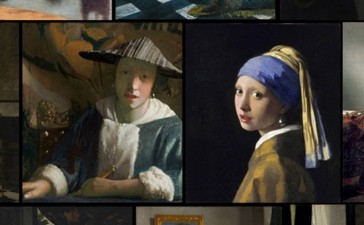
I knew this would not be easy. Johannes Vermeer, that seventeenth-century Dutch “master of light,” produced only 35 known paintings, which today are among the most valuable objects in the world. Art historians reserve a certain adjective for precisely these types of cultish obsessions, which are not beyond value, but rather are, as they say, priceless — that is, without price, simply because the marketplace has not publicly accessed numerative value.
For most of the last century, no one really had any idea what a Vermeer was worth. Most of what we call modern art — Dali’s droopy clocks, Warhol’s soupy cans, Pollock’s drippy drips, Rothko’s blurry blobs — didn’t even existthe last time a Vermeer met an auction gavel.
Nonetheless, if you decided to buy all 35 Vermeers in the world, you would need billions of dollars.
More here.
David Attenborough’s rendition of “What a Wonderful World”
EATING DINNER WITH MARTIN SCORSESE
Stephen Smith in Esquire:

This is the way you dreamed it would go down, of course. The sit-down: the milk-fed veal, the carmine carafes, the rubber of post-prandial card games abruptly abandoned. The diminutive figure of the maestro bristles across the table from you. As he reacts to the sound of voices from the darkened doorway, a tremor of unease transmits itself through Scorsese’s people, his crew.
The director himself reaches for his piece. You watch in astonishment as the garlanded Hollywood insider fingers the barrel of his… inhaler.
It’s nighttime in New York City, and Scorsese has called a meeting at a favorite low-key joint a block or two from his home. But instead of the spaghetti house straight out of the old country, this is a chintzy suite in a boutique hotel, with its surprising lacunae: the pelmets concealing foxed wainscoting, the MDF boxing and panelling that shuts away eyesore cables.
The filmmaker, 72, is briefly between pictures, the gab and hustle for his most recent outing The Wolf of Wall Street (2013) is behind him, and he is generously putting aside some time after standing me up on a previous date.
More here.
Thursday, December 25, 2014
George Clooney’s Downton Abbey Skit Is Better Than Anything on TV This Week
June Thomas in Slate:

It’s lovely to see the familiar Downton characters once again, but it’s especially fun to learn that everyone is aware of the show’s tendency toward repetition. In the first part of the sketch, a declaration of family happiness is followed—as it always seems to be on the show—by bad news. A telegram arrives with word that Lord Grantham (Hugh Bonneville) has managed to lose the family fortune. “Not again!” says his wife, Cora—and everyone who has ever watched Downton Abbey. The sketch then morphs into a version of It’s a Wonderful Life, with Joanna Lumley (Patsy Stone on Absolutely Fabulous) as an angel, showing Lord G. how terrible life would’ve been if he had never been born. (If you’re wondering why Jeremy Piven shows up as retail pioneer Harry Selfridge, it’s because, like Downton, Mr. Selfridge airs on ITV in Britain.
More here.
a christmas memory
From DelancyPlace:
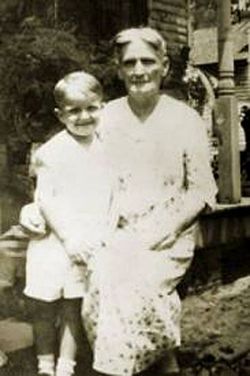
“The black stove, stoked with coal and firewood, glows like a lighted pumpkin. Eggbeaters whirl, spoons spin round in bowls of butter and sugar, vanilla sweetens the air, ginger spices it; melting, nose-tingling odors saturate the kitchen, suffuse the house, drift out to the world on puffs of chimney smoke. In four days our work is done. Thirty-one cakes, dampened with whiskey, bask on window sills and shelves. “Friends. Not necessarily neighbor friends: indeed, the larger share are intended for persons we've met maybe once, perhaps not at all. People who've struck our fancy. Like President Roosevelt.
More here.