Tuesday Poem

Invisible Waiter

Maitreya Bodhisattva, raising a bite of rare steak to his mouth, said,
“Even we sometimes get hungry.
Mere peace of mind doesn’t satisfy the flesh,
though, on the contrary, the sense of fullness at times does lead to peace of mind.”

“Each of us is aware that we should avoid eating unbalanced meals.
Our calling requires nothing but the capital of soul and body.
The American way of taking nutritional pills, however,
is severely prohibited by Buddha.”

Maitreya Bodhisattva, using knife and fork quite adeptly,
talked on and on with the accent of Pure Land Buddhism.
“I had a very hard time learning European table manners.
Anyway we had to master all at once
in a three-night training session
what Europeans had developed over hundreds of years.”

“Of course even we are not perfect.
Like you, we have our troubles.
There are some anorexic ascetics and some depressive goddesses of mercy.”
A Bodhisattva I met the other day in a Laundromat has insomnia,
so at night he seems to read by reading lamp
Romance of the Three Kingdoms.
He said he hadn’t slept for an entire month
and had now read 3,000 pages.

“And a nirvana incarnation I know well
who seems to be categorized by the present administration
as ‘a bed-ridden old man’
was high-handedly removed
to a special old folks’ home in Shibuya.
I saw him for the first time ever crying, ‘No! No!’”

It was already late at night.
All the waiters had gone home.
All that remained was people’s sighs,
like the laughter of the Cheshire cat.

In front of Maitreya Bodhisattva now fallen silent,
I put a non-existent cigarette in my mouth. Just then,
a transparent waiter appeared
and gently lighted it for me.
.

by Inuo Taguchi
from Armadillogic
publisher: Shichosha, Tokyo, 2002
translation: William I. Elliott and Kazuo Kawamura

Original Japanese

Discontent and Its Civilizations – Pakistan’s place in the world

Sukhdev Sandhu in The Guardian:

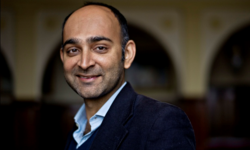
MohsinIn 2010, Mohsin Hamid was asked by Granta to contribute to a piece entitled “How to write about Pakistan”. Other poets or novelists might have railed against accounts littered with mullahs, military generals, secret agencies and American drones. Hamid, characteristically droll, drew up a list of 10 commandments of which the first three were: “Must have mangoes”; “Must have maids who serve mangoes”; “Maids must have affairs with man servants who should occasionally steal mangoes.” In Discontent and Its Civilizations, a collection pulling together essays and reviews from the past 15 years, he talks about the way in which Pakistan “plays a recurring role as villain in the horror sub-industry within the news business”. In his eyes, the nation in which he grew up, and to which he returned in 2009 after lengthy stints living in cities on both sides of the Atlantic, is less diabolical; he loves the “out-of-character Pakistan, Pakistan without its makeup and plastic fangs, a working actor with worn-out shoes, a close family, and a hearty laugh”.

…In one essay, Hamid says he’s in “self-exile from the United States”. His reflections on that country are pointed. Discussing “the Great American Novel”, he observes that “‘the’ is needlessly exclusionary, and ‘American’ is unfortunately parochial. The whole, capitalised, seems to speak to a deep and abiding insecurity, perhaps a colonial legacy.” Rather too many pieces – on fatherhood, ebooks, Obama’s election – feel dated or too short. Then again, as he proved in The Reluctant Fundamentalist, brevity has its virtues. Writing about Antonio Tabucchi’s Pereira Maintains, he claims: “Novels are like affairs, and small novels are affairs with less history, affairs that involved just a few glances across a dinner table or a single ride together, unspeaking, on a train, and therefore affairs still electric with potential, still heart-quickening, even after the passage of all these years.” It’s a lovely notion and Discontent and Its Civilizations has just enough others to make it worth spending time with.

More here.

Cancer’s Random Assault

Denise Grady in The New York Times:

CancerIt may sound flippant to say that many cases of cancer are caused by bad luck, but that is what two scientists suggested in an article published last week in the journal Science. The bad luck comes in the form of random genetic mistakes, or mutations, that happen when healthy cells divide. Random mutations may account for two-thirds of the risk of getting many types of cancer, leaving the usual suspects — heredity and environmental factors — to account for only one-third, say the authors, Cristian Tomasetti and Dr. Bert Vogelstein, of Johns Hopkins University School of Medicine. “We do think this is a fundamental mechanism, and this is the first time there’s been a measure of it,” said Dr. Tomasetti, an applied mathematician. Though the researchers suspected that chance had a role, they were surprised at how big it turned out to be. “This was definitely beyond my expectations,” Dr. Tomasetti said. “It’s about double what I would have thought.” The finding may be good news to some people, bad news to others, he added. Smoking greatly increases the risk of lung cancer, but for other cancers, the causes are not clear. And yet many patients wonder if they did something to bring the disease on themselves, or if they could have done something to prevent it. “For the average cancer patient, I think this is good news,” Dr. Tomasetti said. “Knowing that over all, a lot of it is just bad luck, I think in a sense it’s comforting.”

Among people who do not have cancer, Dr. Tomasetti said he expected there to be two camps. “There are those who would like to control every single thing happening in their lives, and for those, this may be very scary,” he said. “ ‘There is a big component of cancer I can just do nothing about.’ “For the other part of the population, it’s actually good news. ‘I’m happy. I can of course do all I know that’s important to not increase my risk of cancer, like a good diet, exercise, avoiding smoking, but on the other side, I don’t want to stress out about every single thing or every action I take in my life, or everything I touch or eat.’ ”

More here.

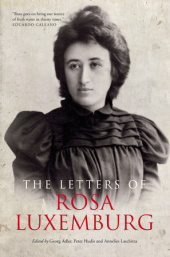
History and Heartbreak: The Letters of Rosa Luxemburg

9781781681077

Vivian Gornick in The Nation:

There she was: a girl, a Jew, a cripple—possessed of an electrifying intelligence, a defensively arrogant tongue and an unaccountable passion for social justice, which, in her teens, led her to the illegal socialist organizations then abounding among university students in Warsaw. In the city’s radical underground, she opened her mouth to speak and found that thought and feeling came swiftly together through an eloquence that stirred those who agreed with her, and overwhelmed those who did not. The experience was exhilarating; more than exhilarating, it was clarifying; it centered her, told her who she was.

At 18—already on the Warsaw police blotter—Rosa was sent to Zurich to study, and never went home again. Although she was registered at the university as a student in natural sciences, it was at the German socialist club—with its library, reading room and lecture hall—that she got her education. There, in the autumn of 1890, she met Leo Jogiches, a Lithuanian Jew three years her elder and already a student revolutionary of local reputation. A self-styled hero of Russian radical literature, Leo was brooding, angry, remote, enamored of Bakunin’s famous definition of the revolutionary as a man who “has no interests of his own, no cause of his own, no feelings, no habits, no belongings, he does not even have a name. Everything in him is absorbed by a single, exclusive interest, a single thought, a single passion—the revolution.” Rosa was enraptured. Leo, in turn, was aroused by her adoration. They became lovers in 1891; but, from the start, theirs was a misalliance.

From earliest youth, Rosa had looked upon radical politics as a means of living life fully. She wanted everything: marriage and children, books and music, walks on a summer evening and the revolution. Personal happiness and the struggle for social justice, she said, shouldn’t be mutually exclusive. If people gave up sex and art while making the revolution, they’d produce a world more heartless than the one they were setting out to replace. Leo, on the other hand, withdrawn and depressed—he hated daylight, sociability and his own sexual need—told her this was nonsense; all that mattered was the Cause. Yet Rosa’s longing for intimacy with him did not abate.

More here.

Monday, January 5, 2015

Sunday, January 4, 2015

The Art World’s Patron Satan

Christopher Glazek in the New York Times Magazine:

ScreenHunter_918 Jan. 04 22.40Since 2007, [Stefan] Simchowitz has sponsored and promoted roughly two dozen young artists. In addition to arranging sales for their work, Simchowitz often provides them with a studio, purchases their materials, covers their rent and subsidizes their living expenses. Perhaps most consequentially, he also posts photos of them and their work on his influential Instagram account, thereby creating what he calls “heat” and “velocity” for the artists he supports, who have included market darlings like the Colombian Oscar Murillo, the Japanese-American Parker Ito and the Brazilian Christian Rosa, all under the age of 35. But Simchowitz’s methods call down the opprobrium of art-world stalwarts, who are contemptuous of his taste, suspicious of his motives and fearful of his network’s potential to subvert the intricate hierarchies that have regulated art for centuries.

Reputations in the art world are forged over many years across countless fairs, openings, reviews and dinners. Although laypeople may look at a $30 million Richter and compare it to splatters from a second grader, Richter’s prices are determined not by chance but by the elaborate academic, journalistic and institutional infrastructure the art world has built to mete out prizes and anoint the next generation of cultural torchbearers. The collector class has traditionally come from the very top of the wealth spectrum and has included people looking to trade money for social prestige by participating in the art world’s stately rituals. Over the last few years, though, a new class of speculators has emerged with crasser objectives: They are less interested in flying to Basel to attend a dinner than in riding the economic wave that has caused the market for emerging contemporary art to surge in the past decade.

More here.

The search for truth in a graveyard for boys

Ben Montgomery in Miami Herald:

BC-LOST-BONES-PART1-TBT_01The pressure on Kimmerle, 40, was intense. The associate professor of forensic anthropology was scorned by some academics, watched by Panhandle lawmakers. County officials complained about the bad publicity. The local newspaper publisher called her work “this greed motivated waste of money.” Some locals even wanted her arrested.

In town, she noticed the sideways glances. Her colleague swore somebody was following her. They didn’t know whom they could trust.

Kimmerle knew the risks. What if she didn’t find anything? What if it was a waste of money?

They started with shovels, then trowels. The first hole they’d dug was empty, nothing but Jackson County clay. But, now, on the third day of digging, a graduate student got Kimmerle’s attention. Her eyes were wide.

“Want to come take a look?”

Kimmerle descended into the open grave.

The months to come would bring protests and press conferences, more threats and a massive search for a second cemetery. Kimmerle would come close to breaking. She’d find more bodies than anybody expected. She’d find an empty casket. She’d find a hundred more questions.

Now, though, in early September 2013, at the bottom of the grave, she brushed away the earth.

There in the dirt was a perfect set of baby teeth.

Read more here.

Obama May Not Be the President Progressives Hoped For, But He’s Still Getting Lots Done

Steven Rosenfeld in AlterNet:

Barack_obama_cornel_westWhat a difference six years makes! When Barack Obama was elected president in 2008, people were literally dancing in the streets—as was the case in Philadelphia. Today, as Obama appears to be finding new muscles to flex in office, a great many of his earliest enthusiasts, who have been disappointed for years, are wondering if the candidate they believed in is coming to life. “High office shouldn’t be about putting points on the electoral scoreboard, it should be about changing the country for the better,” wrote economist Paul Krugman in Rolling Stone,in a high-profile piece reconsidering and defending Obama's presidency. “Has Obama done that? Do his achievements look likely to endure? The answer to both questions is yes.” Krugman’s judgment came before Obama announced sweeping executive actions on immigration, protecting from deportation 40 percent of undocumented immigrants and single-handedly overturning five decades of anti-Cuba policy. Other positive assessments have ensued, causing speculation about a new and more powerful Obama.Obama seized the agenda, saw his initiative dominating the front pages and television news discussions and sent Republicans in Congress scrambling,” wrote the Washington Post’s Paul Waldman, about the Cuba initiative. “This could well be the template for much of the next two years.”

While many pundits are focusing on the future, a more pressing question arises. Have progressives been missing the boat on Obama’s accomplishments in office?

More here.

New Caliphate, Old Caliphate

Conor Meleady in HistoryToday:

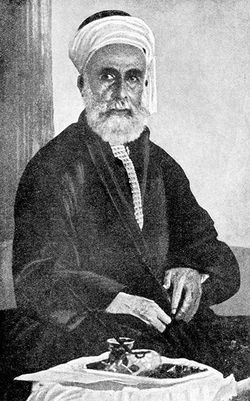
CaliphWhen the organisation known as Islamic State in Iraq and Syria (ISIS) announced at the end of June 2014 that it was seeking to restore the Islamic caliphate, with its leader, Abu Bakr al-Baghdadi, as caliph, it set off a wave of debate both among jihadists and western analysts. The debate concerned the legitimacy of al-Baghdadi’s claim and the likelihood of ISIS securing the support of the Islamic world for its project. Some analysts declared it to be the first time since Mustafa Kemal Atatürk’s abolition of the Ottoman Empire in March 1924 that any group or individual had been bold enough to make such a claim. In fact, just days after Atatürk’s action, the Hashimite Sharif Husayn of Mecca, King of the Hijaz, proclaimed himself caliph, inititating a controversy similar to that which al-Baghdadi’s declaration provoked. It was a controversy in which the officials charged with formulating Britain’s postwar policy in the Near East were deeply implicated.

Husayn’s claim was a decade in the making. Since the late 19th century, Arab intellectuals in Syria and Egypt had sought to reform the Ottoman Empire through a top-down process of Arabisation, with the Sharif of Mecca touted as a possible caliph. In the context of deteriorating Ottoman-British relations, these ideas were encouraged by orientalists such as Wilfrid Blunt, author of the anti-Ottoman tract, The Future of Islam, in which he argued that the revival of the Arabs was a historical inevitability in which Britain must play its part.

More here.

Sunday Poem

I See You Dancing, Father
.
No sooner downstairs after the night’s rest

In the middle of the kitchen floor.

And as you danced
You whistled.
You made your own music
Always in tune with yourself.

Well, nearly always, anyway.
You’re buried now
In Lislaughtin Abbey
And whenever I think of you

I go back beyond the old man
Mind and body broken
To find the unbroken man.
It is the moment before the dance begins,

Your lips are enjoying themselves
Whistling an air.
Whatever happens or cannot happen
In the time I have to spare
I see you dancing, father.
.

by Brendan Kennelly
from A Time for Voices, Selected Poems 1960-1990
publisher: Bloodaxe, Newcastle upon Tyne, 1990

Formulating Science in Terms of Possible and Impossible Tasks

Marletto_0

A Conversation with Chiara Marletto over at Edge.org:

I’ve been thinking about constructor theory a lot in the past few years. Constructor theory is this theory that David Deutsch proposed—a proposal for a new fundamental theory to formulate science in a completely different way from the prevailing conception of fundamental physics. It has the potential to change the way we formulate science because it’s a new mode of explanation.

When you think about physics, you usually describe things in terms of initial conditions and laws of motion; so what you say is, for example, where a comet goes given that it started in a certain place and time. In constructor theory, what you say is what transformations are possible, what are impossible, and why. The idea is that you can formulate the whole of fundamental physics this way; so, not only do you say where the comet goes, you say where it can go. This incorporates a lot more than what it is possible to incorporate now in fundamental physics.

David and I have been working on this together for the past three years, and we’ve been applying it to many different problems. So far, the two completed parts of our trying out constructor theory to see whether it can solve problems are: a fundamental theory of information within physics1; and the constructor theory of life2, which applies this new theory of information to a fundamental problem that's at the boundary between physics and biology, and has to do with how certain features of living things, such as the ability to self-reproduce very accurately, are compatible with the laws of physics as we know them.

In these two cases, you can see how switching to this new mode of explanation allows one to change the perspective and address the problems in a much more effective way. These are two examples where switching to this new mode of explanation makes all the difference.

Take information, for example. Information is something we use in our everyday speaking; also we use it in physics a lot. For instance, we assume that information has certain properties, e.g. that it can be copied from one physical system to another. So far, we did not have a fundamental theory telling us what are the regularities in nature that allow the existence of information in this sense. But whenever we talk about information we refer to those regularities. We assume, for example, that the laws of physics allow copy processes. In constructor theory you can express these regularities, and this is what our theory does. Our way of incorporating information in fundamental physics is by formulating what are these regularities in nature that allow the existence of information.

More here.

Blaming Parents, and Other Neoliberal Pastimes

5091248839_8f49a6049a_z-400x225

Emmett Rensin and David Shor in the Baffler (Indeed/Photo by Nico Paix):

The State of California believes the following things to be true: first, that reading to children will make them smarter. Second, that parents ordinarily disinclined for reasons of time or temperament from this activity may be won over by means of thirty-second radio spots. These are strange beliefs, but they are not uncommon.

Too Small to Fail, a nonprofit nominally led by Hillary Clinton, believes the same. Among the organization’s many laudable efforts to improve early childhood health and education is a less laudable (but no less costly) attempt to use advertisements to convince poor parents to read to their children. This, the group claims, will bolster kids’ intelligence, and thereby their tests scores, and thereby their futures. Chicago has a similar program. Their slogan: “Take time to be a dad.”

These efforts will fail. Not because PSAs and chipper radio spots won’t conjure quality reading time in the schedules of parents rushing from a 5 p.m. quitting time to the start of a 6 p.m. second shift (although they won’t, of course), but because reading to children, even young children, will not necessarily make them smarter.

It isn’t that reading to children doesn’t have its benefits. Improved socialization and greater empathy skills are among the upsides of childhood reading. If you are a parent with the luxury of time, reading to your kids will help produce better people. It just won’t produce smarter ones.

Chicago and Clinton and California didn’t invent these misconceptions. There is a wealth of data purportedly showing that reading to young children will increase their intelligence and test scores. The trouble is these studies do not actually demonstrate a link between the act of reading and an increase in childhood intelligence; rather, they demonstrate a link between the kinds of children whose parents read to them and the kinds of children (largely the same children) who wind up doing well on tests.

There’s another correlation that goes unmentioned: the parents who read to their children tend to be wealthier and smarter than the parents who don’t (PDF). And so the tail wags the dog; similarly, we notice how many athletes were encouraged to play sports as children, but fail to note how tall and strong their parents are and what nice sports equipment they’ve got locked in the garage.

If we restrict ourselves instead to studies that properly adjust for parental characteristics—that is, how smart, well-educated, and test-capable they were—the impact of reading to children disappears.

More here.

Don’t Write Off ET Quite Yet

Unknown

Caleb Scharf in Nautilus (photo by Kim Steele/Getty):

Here’s a riddle. We’ve never seen any, and we don’t know if they exist, but we think about them, debate them, and shout at each other about them. What are they?

Aliens, of course.

A while ago I wrote a piece for Nautilus on what might happen to us after learning about the existence of extraterrestrial life—whether microbes on Mars or technological civilizations around other stars—and asked if there might be inherent, unexpected, dangers in acquiring this information. Could infectious alien memes run riot, disrupting societies? Might intelligent life decide to shield itself from such knowledge? It was a whimsical, quizzical thought experiment, exploring the real science of our hunt for life in the cosmos, and the possibility—even if remote—that there could be unexpected perils for intelligently curious life anywhere.

Simple enough. But as comments to the piece began to pile up—many in my inbox—I found myself on the receiving end of a barrage of opinion. There was outrage at the suggestion that there might ever be circumstances to drive us (or any intelligent species) to close our astronomical and scientific eyes to avoid picking up dangerous alien data. At the other extreme, and I do mean extreme, there was outrage that we were already being kept in the dark about aliens by our governments. And across the board was a world-weary sense of our seemingly boundless capacity to screw things up, big universe or not.

Phew.

The possibility of life somewhere else in the cosmos isn’t just scientifically fascinating, it’s a unique mental playground for our hopes, fears, and fantasies. It can also be, as I’ve learned, an inkblot test; a reflection of our inner thoughts, emotions, and—to be honest—hang-ups.

More here.

Saturday, January 3, 2015

Male Nerds Think They’re Victims Because They Have No Clue What Female Nerds Go Through

Bigbangtheory

Laurie Penny in The New Republic:

A few people have forwarded me MIT professor Scott Aaronson’s post about nerd trauma and male privilege (link here). It's part of a larger discussion about sexism in STEM subjects, and its essence is simple. Aaronson's position on feminism is supportive, but he can’t get entirely behind it because of his experiences growing up, which he details with painful honesty. He describes how mathematics was an escape, for him, from the misery of growing up in a culture of toxic masculinity and extreme isolation—a misery which drove him to depression, anxiety and suicidal thoughts. The key quote is this:

Much as I try to understand other people’s perspectives, the first reference to my 'male privilege'—my privilege!—is approximately where I get off the train, because it’s so alien to my actual lived experience … I suspect the thought that being a nerdy male might not make me 'privileged'—that it might even have put me into one of society’s least privileged classes—is completely alien to your way of seeing things. I spent my formative years—basically, from the age of 12 until my mid-20s—feeling not 'entitled', not 'privileged', but terrified.

I know them feels, Scott.

As a child and a teenager, I was shy, and nerdy, and had crippling anxiety. I was very clever and desperate for a boyfriend or, failing that, a fuck. I would have done anything for one of the boys I fancied to see me not as a sad little boffin freak but as a desirable creature, just for a second. I hated myself and had suicidal thoughts. I was extremely lonely, and felt ugly and unloveable. Eventually I developed severe anorexia and nearly died.

Like Aaronson, I was terrified of making my desires known—to anyone. I was not aware of any of my (substantial) privilege for one second—I was in hell, for goodness' sake, and 14 to boot. Unlike Aaronson, I was also female, so when I tried to pull myself out of that hell into a life of the mind, I found sexism standing in my way. I am still punished every day by men who believe that I do not deserve my work as a writer and scholar. Some escape it's turned out to be.

More here.

A Static Form of Remembrance

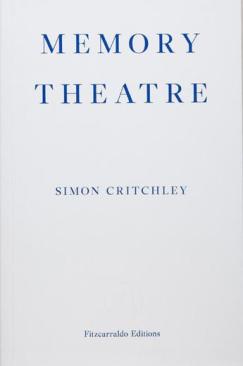
Memory-Theater-243x366

Daniel Fraser reviews Simon Chritchley's Memory Theatre, in The LA Review of Books:

THIS YEAR’S NOBEL PRIZE for Medicine was awarded to three scientists whose neuroscientific work provided conclusive evidence for the interwoven relationship between the concepts of memory and space in the human brain. John O’Keefe, May-Britt Moser, and Edvard I. Moser discovered cells referred to as “place” and “grid” cells, which together form a coordinate system used in the construction of mental maps and their memorization. These two cell types work together with neurons dubbed “time cells” that represent the flow of time in specific memories; together they reveal a structure of memory that is not only integrated with space but is in flux and repeatedly reconstituted.

Philosophical discourse is no stranger to the symbiotic relationship between memory and space. One of its most interesting conceptualizations of this relationship is the memory theatre: a physical space conceived in the mind in which knowledge might be stored in order for it to be recalled more easily. This spatial idea of memory has found expression throughout the history of philosophy, originating with the Greek Simonides: he supposedly could identify the remains of the guests of a party he attended after the roof collapsed and mangled them by remembering where each of them had been sitting.

From this fittingly macabre and humorous example comes Simon Critchley’s first novel, Memory Theatre: a postmodern, virulently metafictional blend of essay, autobiography, apocalyptic revelation and historical examination. The book centers on a university professor (a philosopher named Simon Critchley who shares an academic career and bibliography with his real-life counterpart) who receives a set of boxes, each labeled with a sign of the zodiac, containing the papers of a recently deceased colleague and friend (the French philosopher Michel Haar). In one of the boxes he discovers a set of memory maps that precisely chart the lives, publications, and deaths of a number of philosophical figures, including several who are still alive: one of them belonging to “Simon Critchley” himself.

More here.

The Fantastic Mr. Hobbes

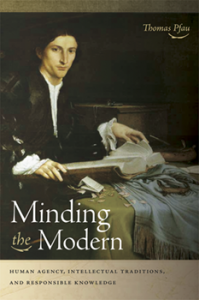
Minding-the-Modern-199x300

Thomas Pfau in The Immanent Frame:

Some readers of Minding the Modern have been surprised to find my account so firmly critical of Thomas Hobbes on will and personhood. Now, it is both incidental and inevitable that my reading challenges recent attempts to claim Hobbes as a precursor of modern liberalism and individualism. Long before me, of course, a wide and diverse array of thinkers (Hannah Arendt, Alasdair MacIntyre, Charles Taylor, John Milbank, Louis Dupré, Michael Oakeshott) had probed the conceptual weakness of modern Liberalism, particularly its propensity to expire in an omnipresent state, putatively enlightened and benevolent as it orders and controls individual and social life at every level. If my reading of Hobbes casts doubt on some of modern Liberalism’s cherished axioms and aspirations, this only points to a certain lack of discernment among those who would identify Hobbes as a heroic precursor of an enlightened, secular, and liberal politics, of whose lasting benefits they remain unshakably persuaded. That said, political theory is not a principal concern of Minding the Modern, whereas putting analytic pressure on modern philosophy’s assumptions about human agency, rationality, and volition very much is.

It is presumably because Hobbes’s assumptions here have been assimilated by a fair number of twentieth-century political philosophers that some readers of Minding the Modern have homed in on this part of my narrative with such neuralgic intensity and exculpatory zeal. The dominant strategy here is to blunt my critical account of Hobbes on personhood with references to the supposedly unique situation and constraints within which he developed his theory of human agency and political community. Thus Mark Alznauer insists that “Hobbes’ theory of agency is an answer to problems that emerged in the seventeenth century, … [and] this is a new question.” Only by subscribing to a radically particularist, nominalist view of history can one suppose that a theory of agency can, let alone should, be tailored to its putatively unique historical circumstances. For my part, I very much doubt that human nature abruptly changed in the year 1651 any more than “on or about December 1910,” as Virginia Woolf so breezily proposed.

More here.