
Category: Recommended Reading
Carl Sagan, Stephen Hawking and Arthur C. Clarke – God, The Universe and Everything Else (1988)
1920’s – What The Future Will Look Like
THE SCIENCE OF SETTING GOALS
Nadia Goodman in TED Ideas:

But what if this year really could be different?
There’s a science to setting goals. The problem is that it often stays in the ivory tower or gets muddled with misinformation. We called up Kelly McGonigal (TED Talk: How to make stress your friend), a psychologist at Stanford University, and asked her about the best way to set and accomplish a goal, scientifically speaking. Below, she shares four research-backed tips to help you craft and carry out successful goals.
Choose a goal that matters, not just an easy win.
Our brains are wired to love rewards, so we often set simple goals that make it easy to check off boxes. Did you go to the gym today? Check. Did you write in your journal? Check. “It feels really good to set a goal,” says McGonigal. “People often set them just for the burst of optimism they get when they vow to make a change.” But if that’s all our New Year’s resolutions are about, no wonder we end up abandoning them so quickly.
More here.
The Best of LensCulture in 2014
Selected by the Editors of Lensculture:

If this photography doesn't inspire you, please go out and make some of your own! We would love to see what you are doing with this amazing visual language of photography. Really.
Cheers!
More here.
White People Problems: A Critical Response to William Deresiewicz’s “Excellent Sheep”
Douglas Greenberg in the Los Angeles Review of Books:
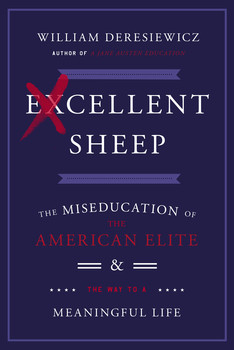
Deresiewicz is definitely upset, and he is also making shit up. He is upset with Columbia and Yale, from which he holds degrees, but he is also upset with Harvard, Princeton, Stanford, and an ill-defined group of other private universities. His widely reviewed Excellent Sheep: The Miseducation of the American Elite has something unpleasant to say not only about these institutions but about everyone associated with them: the students, their parents, the faculty, the administrators, the donors, the alumni. Many of these criticisms of elite private higher education have some merit. Yet the tone of the book is so egocentric and intemperate and the framing of the issues is so narrow and sensationalistic that it might not merit a review in the Los Angeles Review of Books if it had not already received so much attention in the national press. Somehow this book has captured the entire national conversation about higher education, although it is mainly concerned with a subset of a small and atypical group of private research universities whose importance can be easily exaggerated, particularly by people who work for, graduated from, or pay tuition to them — or hope someday to do any of the three…
Like it or not, if you don’t go to a college on Deresiewicz’s murky and shifting list of elite institutions, you are a loser. Of course, you are also pathetic if you go to one of the elites since you will be condemned to a soulless life making nothing but money at Bain or Goldman Sachs. It actually seems that for Deresiewicz, if you go to college anywhere at all, you will wind up either a heartless winner or a pathetic loser. In fact, if you have the audacity even to suggest that “you can get an equally good education at Fresno State as at Stanford […] or at Linfield College as at Swarthmore,” you are indulging in a “species of willful anti-elitism.” This is Deresiewicz’s gloss on Sophie Tucker (“I’ve been rich and I’ve been poor. Rich is better.”): “I’ve been to Fresno State and I’ve been to Stanford. Stanford is better.”
Read the full article here.
Magna Carta: the things you didn’t know
Dan Jones in The Telegraph:
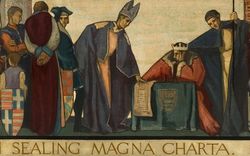
But what exactly is Magna Carta? Why was it granted? Does it really speak to the principles of democracy, liberty and human rights with which it is so often associated? And what is the purpose of the charter – if it has one – today? All of these questions are of critical importance as we celebrate eight centuries of Magna Carta, and look towards a ninth.Magna Carta was a failed peace treaty. It was produced during a civil war between John and a coalition of his barons, known by various titles, including The Army of God and The Northerners.
More here.
Wednesday, December 31, 2015
Meet the anti-Dr. Oz: Ben Goldacre
Julia Belluz in Vox:

Over the years, Goldacre has taken on everyone from sloppy journalists to pharmaceutical executives, vitamin proprietors, and disingenuous academics. He has illuminated the evidence, and lack thereof, behind detox footbaths, homeopathy, and ear candling. And, with every debunking, he has left behind lessons in the scientific method, epidemiology, and evidence-based medicine. His writing has changed policy and informed the public at a time when few in the media stand up for science in health.
Now, you can catch up on his fun fights with bad science in his new collected works, I think you'll find it's a bit more complicated than that. He calls the tome a “statistics toilet book,” which is basically true. Here, we talked to Goldacre about the changing discourse on science in the public, where the biggest abuses of science are happening today, and what he hopes to see change in the future.
More here. [Thanks to John Ballard.]
The financial consequences of saying ‘Black,’ vs. ‘African American’
Joe Pinsker in The Atlantic:

A century’s worth of calculated name changes are a testament to the fact that naming any group is a politically freighted exercise. A 2001 study catalogued all the ways in which the term “Black” carried connotations that were more negative than those of “African American.” This is troubling on the level of an individual’s decision making, and these labels are also institutionalized: Only last month, the US Army finally stopped permitting use of the term “Negro” in its official documents, and the American Psychological Association currently says “African American” and “Black” can be used interchangeably in academic writing.
But if it was known that “Black” people were viewed differently from “African Americans,” researchers, until now, hadn’t identified what that gap in perception was derived from. A study, to be published next month in the Journal of Experimental Social Psychology, found that “Black” people are viewed more negatively than “African Americans” because of a perceived difference in socioeconomic status. As a result, “Black” people are thought of as less competent and as having colder personalities.
Read the rest here.
1920s New Year’s Eve in Warsaw: Ain’t She Sweet
Pieter Coecke van Aelst and Renaissance Tapestry
Everyone who was anyone in the sixteenth-century art world liked Pieter Coecke van Aelst. The skilled artisans who wove tapestries and crafted stained-glass windows eagerly used his designs. The greatest patrons paid happily through the nose for the immense tapestries, eight or nine to a series, in which Coecke and those who executed his designs told biblical and classical stories, put the cardinal vices on parade, or celebrated the victories of great men. Monarchs who hated one another—for example, those bitter lifelong enemies King Francis I of France and the Holy Roman Emperor Charles V—were as one in their desire to cover their walls with Coecke’s work, even if they had to wait years to see one of his subtle, elegant designs translated into solid, colorful cloth.
Until the Metropolitan Museum put on its current, magnificent exhibition of Coecke’s work, however, his name was not a household word, even in those households that discuss Renaissance art. “Grand Design” is the third in a great series of shows that have restored tapestry to its proper place in our historical panorama of Renaissance and Baroque art. Deeply learned and dazzlingly accessible, these exhibitions—the first two organized by, and the third inspired by the scholarship of, Thomas Campbell, now the museum’s director—have taught or reminded us to see the tapestry as a central form of Renaissance art.
more here.
An Intellectual History of the French Revolution

Anyone looking for a neat explanation of the French revolutionary terror faces the problem of choice. Since the collapse of Jacobin rule after Robespierre’s execution in Thermidor Year II, debate has raged over how an event that began with the promise of liberty and fraternity degenerated so rapidly into fifteen months of mass imprisonment and death. During 1793 and 1794 around three hundred thousand people were jailed, many of them dying from disease and neglect, a further seventeen thousand were guillotined or shot and a quarter of a million killed in civil wars, of which the Vendée was by far the most deadly. After Thermidor the revolution’s opponents argued that terror on such a scale was inherent in the entire revolutionary project from the outset, part of a “genetic code” of violence and intolerance deeply embedded in the revolutionary gene. The revolution’s supporters, on the other hand, defended terror as the product of difficult circumstances, a regrettable but necessary expedient to combat the threats posed to the republic by civil war and military invasion.
Each side, in other words, blamed the other back then and have continued to do so ever since, taking up entrenched positions that have dominated historians’ and the public’s attitudes for over two hundred years. Along the way new avenues of interpretation have widened the argument, bringing on board issues such as social conflict and food shortage, the importance of Enlightenment thought, changes in sensibility, the influence of personality and even the serendipity of sheer accident.
more here.
Best books of 2014
Arifa Akbar in The Independent:

Curmudgeons hailed the death of the novel (Will Self), or the demise of the long novel (Tim Parks), but the following pages prove them most emphatically wrong. Some of the best reads this year weighed in at more than 500 pages, though 2014 was also the year of the short story, with Margaret Atwood and Hilary Mantel, among other novelists, turning their hand to the short-form. Long-percolating debuts eclipsed fare from some of the most seasoned authors (Ian McEwan's middling 'The Children Act'; Martin Amis's bewildering Holocaust “comedy”, 'The Zone of Interest'). So, Nathan Filer's Costa triumph was followed by Eimear McBride's Bailey's prize success.
More here.
2014 in science
From Nature:

Human origins decoded
Considering that they have been dead for around 30,000 years, Neanderthals had a hell of a year. Their DNA survives in non-African human genomes, thanks to ancient interbreeding, and two teams this year catalogued humans’ Neanderthal heritage. Scientists learnt more about the sexual encounters between Homo neanderthalensis and early humans after analysing the two oldest Homo sapiens genomes on record — from men who lived in southwest Siberia 45,000 years ago and in western Russia more than 36,000 years ago, respectively. The DNA revealed hitherto-unknown human groups and more precise dates for when H. sapiens coupled with Neanderthals, which probably occurred in the Middle East between 50,000 and 60,000 years ago. Radiocarbon dating of dozens of archaeological sites in Europe, meanwhile, showed that humans and Neanderthals coexisted there for much longer than was once thought — up to several thousand years in some places. Genomes old and new charted the emergence of agriculture. Contemporary Europeans carry DNA inherited from light-skinned, brown-eyed farmers who migrated from the Middle East beginning 7,000–8,000 years ago, in addition to more-ancient ancestry. The achievements of these early farmers — domestication of crops such as wheat and barley — are also being understood through genome sequencing. In July, a consortium reported a draft copy of the gargantuan wheat genome, which contains 124,000 genes and 17 billion nucleotides. Another group released the genomes of 3,000 rice varieties.
More here.
Wednesday Poem
Brand New Ancients

See – all that we have here is all that we’ve always had.
We have jealousy
and tenderness and curses and gifts.
But the plight of a people who have forgotten their myths
and imagine that somehow now is all that there is
is a sorry plight,
all isolation and worry –
but the life in your veins
it is godly, heroic.
You were born for greatness;
believe it. Know it.
Take it from the tears of the poets.
There’s always been heroes
and there’s always been villains
and the stakes may have changed
but really there’s no difference.
There’s always been greed and heartbreak and ambition
and bravery and love and trespass and contrition –
we’re the same beings that began, still living
in all of our fury and foulness and friction,
everyday odysseys, dreams and decisions . . .
The stories are there if you listen.
The stories are here,
the stories are you,
and your fear
and your hope
is as old
as the language of smoke,
the language of blood,
the language of
languishing love.
The Gods are all here.
Because the gods are in us.
The gods are in the betting shops
the gods are in the caff
the gods are smoking fags out the back
the gods are in the office blocks
the gods are at their desks
the gods are sick of always giving more and getting less
the gods are at the rave –
two pills deep into dancing –
the gods are in the alleyway laughing…
.
by Kate Tempest
from Brand New Ancients
publisher: Picador, London, 2013
Tuesday, December 30, 2015
In transition to independent living, the ‘dignity of risk’ for the mentally ill
Stephanie McCrummen in the Washington Post:
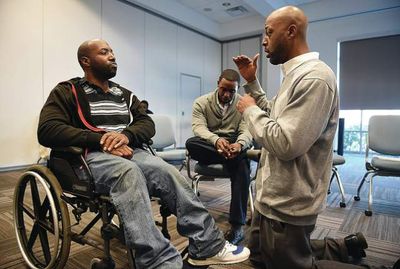
He rolled his wheelchair into the kitchen and poured himself another coffee. Day by day, he was trying to let go of all that had come before now — years of psychiatric hospitalizations, sleeping on streets, hearing voices, seeing “ghosts,” shelters, a suicide attempt and, most recently, an adult home where, for the first time, he thought he might have found stability.
Thirty-three years old, he was now trying the next step, to live on his own.
He looked around his new two-bedroom apartment in suburban Charlotte, all blank white walls and empty except for a blue couch, a bed, two side tables and a TV with no cable. He poured another cup of coffee.
“Oh, man,” he sighed.
What he had learned in his first 25 days: He didn’t know if this was going to work out.
But what he also knew: Here was his chance. This bare-bones place, the result of decades of lawsuits, legislation and a 1999 Supreme Court ruling, known as the Olmstead decision, that found it discriminatory for states to segregate people with serious mental illnesses in psychiatric institutions if they were willing and able to live more independently in the community.
Read the full article here.
The Genius and Faith of Faraday and Maxwell
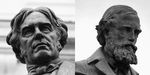
The religious commitments of the great scientists of history are today often dismissed as mere idiosyncrasies. Their beliefs are considered regrettable if understandable blemishes, the incidental flaws of great minds who helped advance civilization out of primitivism yet could not fully escape it. After all, is not science supposed to aspire to an understanding of the universe that is independent of the beliefs and opinions of scientists, whether religious, political, social, or aesthetic?
Yet, science does not exist in a vacuum, and studies in the sociology, history, and philosophy of science often emphasize how scientists’ broader beliefs and practices influence their work, and thus the way that science develops. Some scholars even argue (if not entirely convincingly) that scientists’ beliefs influence science’s settled content.
The strict separation we commonly observe between a researcher’s scientific ideas and his or her “personal beliefs” is a modern, and even recent, norm. From antiquity through the Scientific Revolution, science was viewed as a form of philosophy, and many of the thinkers we have retroactively dubbed “scientists” freely intermingled their speculation about the natural world with theological, philosophical, and mathematical writings, often expending a great deal of their scholarly time and energy on religious study. Kepler’s seventeenth-century laws of planetary motion, for example, seem to his modern readers like needles of scientific inspiration buried in a haystack of theological speculation. Newton and Boyle likewise intermingled physics and philosophical theology without apparent hesitation.
more here.
Benjamin Britten’s The Turn of the Screw

So many things must be done right for an opera to turn out well that it’s amazing any of them succeed at all. The composer has to be a good musician, of course, but he must also be in sympathy with the librettist and, if there is a separate source author, with that writer as well. Once their initial job is done, the creation then gets handed over to a whole other set of people who can mess it up: the director, the set, costume, and lighting designers, the conductor, the orchestra members, and of course the singers. In most operas, these onstage performers need to be able to act as well as sing; it also helps if they look right for their parts. The list of potential pitfalls goes on and on—the acoustics of the hall, the size and nature of the audience, the comfort or discomfort of the seats. It’s endless, and daunting.
Before last summer, I had never even heard of Opera Holland Park, so I was admittedly taking a risk in attending their production of The Turn of the Screw during my short London stay. But I was curious to see this Britten opera, which had thus far evaded me—plus word-of-mouth on the production was good, and ticket prices were reasonable, especially compared to Covent Garden or Glyndebourne.
more here.
Joseph O’Neill and the New Cosmopolitan Novel
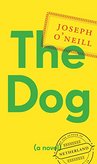
During the late 1990s, we saw the rise of a new literary subject: the postcolonial immigrant. In the metro-poles of the North Atlantic—in London and New York, Paris and Toronto—the protagonist emerged: a parvenu, an outsider with a sturdy work ethic, a grocer or taxi driver seeking to make it in his or her new home. There were geographical variations—the Dominicans of Junot Díaz’s Drown, the East Indians of Jhumpa Lahiri’s Interpreter of Maladies, the Soviet Jews of Gary Shteyngart’s The Russian Debutante’s Handbook, and the African refugees of Chimamanda Ngozi Adichie’s Americanah—but central to these narratives was the direction of movement. The postcolonial subject moved from the outside in, from the former colony to the metropole, from beyond to the imperial center. Gatsby-like, he or she often tested the outer limits of the American dream—that still-regnant myth about capitalist self-making. The narrative arc was that of the arriviste: a story not only of assimilation and the arduous passage toward citizenship but also of accumulation and the trials of “making it.”
Today, however, we have something of a body double floating around, a doppelgänger novel. While the parvenu novel was a study of citizenship, of the ways in which former colonial subjects found success in the imperial capital, we now see a new kind of migration: that of the cosmopolitan, the emigrant, the exile pushed out into the world, spreading away from the imperial center, roots from a tree.
more here.
Have Human Rights Treaties Failed?
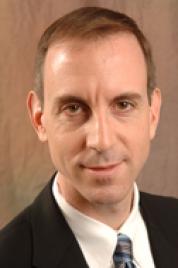

Kenneth Roth, executive director of Human Rights Watch, and Eric Posner, author of “The Twilight of Human Rights Law”, debate the issue in the NYT. Posner:
Age-old blights like child labor, the subjugation of women,
Many people argue that the solution to these problems is to strengthen human rights law. They argue that we need more treaties, with stricter obligations and better-funded, more powerful international institutions. But my view is the opposite. Human rights law is too ambitious — even utopian — and too ambiguous: it overwhelms states with obligations they can’t possibly keep and provides no method for evaluating whether governments act reasonably or not. The law doesn’t do much; we should face that fact and move on. This doesn’t mean that we shouldn’t care when governments abuse their citizens. But more focused and pragmatic interventions, including relying heavily on foreign aid for economic development, rather than coercion or shaming, is the better way to go.
Roth:
Human rights treaties help to explain why these abuses are wrong. They may not always provide definitive answers — any text requires interpretation — but they codify a widely endorsed set of principles from which the conversation can begin.
Would we really be better off, as Eric implies, if each discussion of governmental behavior started from scratch — if, rather than debating what constituted a violation of, say, the right to a fair trial, we had to begin by discussing whether people should be given fair trials?
More here.