A Gaza Artist Creates 100 Square Feet of Beauty, and She’s Not Budging

Jodi Rudoren in The New Yor Times:

DEIR AL-BALAH, Gaza Strip

GAZA2-articleLargeNIDAA BADWAN’S room is less than 100 square feet, lit by a single window and a bare bulb. She has slathered one wall with aquamarine paint and covered another in a patchwork of colored egg cartons. There is a medium-size mirror, an antique sewing machine and iron, two easels, a large yellow ladder and a gas canister on which she boils water to make a sweet cappuccino drink from a packet. Alienated by Gaza’s restrictive religiosity and constant conflict with Israel, Ms. Badwan, 27, has hardly left the room for more than a year. Within its walls she has created her own world, and a striking set of self-portraits that are at once classical and cutting-edge. “I wait for the light,” said Ms. Badwan, who sometimes takes a week or even a month to construct photographs that look like paintings. “Everything is beautiful, but only in my room, not in Gaza. I’m ready to die in this room unless I find a better place.

The project is called “100 Days of Solitude” in homage to Gabriel García Márquez’s landmark novel, though Ms. Badwan’s isolation has been much longer. Its 14 self-portraits, all about 40 by 22 inches, are on display at an East Jerusalem art gallery, whose director, Alia Rayyan, said they evoked the Dutch masters of the 16th and 17th centuries with modern splashes, made more meaningful against the unseen backdrop of chaos outside. That may be a stretch, but the images are undeniably compelling. Here is Ms. Badwan lying on her tummy in jean overalls and a wool hat, bare ankles crossed, staring at a laptop. There she is on a tire swing hung from that yellow ladder, buttoning a man’s shirt with a look of defiant pride. Wiping tears as she peels an onion. Threading a needle to sew a quilt. Gulping from a tin cup. Tapping an old typewriter, meditating, applying lipstick.

More here.

Friday, February 27, 2015

Jean-Luc Godard: still brooding on the end of cinema

Hoberman_brotheranotherplanet_ba_imgJ. Hoberman at The Nation:

What to make of the Godardian mind? You might say that, as prolific as he is, Godard suffers from the attention-deficit disorder of genius, a condition Bob Dylan evoked repeatedly in his mid-’60s work, as when he wailed, “I need a dump truck, baby, to unload my head.” There are more ideas about more things in any five minutes of Godard’s latest opus, Goodbye to Language, than in the year’s five next most intelligent movies combined.

Largely devoted to startling stereoscopic effects, alternating sections labeled “Nature” and “Metaphor,” ultimately devolving to the quandary of a youngish couple, apparently played by two sets of actors, about whether to have a baby or get a dog, Goodbye to Language is neither a narrative film, nor a film essay, nor even a documentary, but an almost indescribable mélange of gorgeous images, slapstick interactions, unanswerable questions and strident assertions, including the playful observation, opening the movie, that “Those lacking imagination take refuge in reality.” Godard is surely referring to himself. No filmmaker has ever been more interested in the fiction of the real—or crankier.

Peppered with questions during his Concordia talks, Godard routinely shoots from the hip. The most opinionated of cinephiles, as well as a former critic, he has no difficulty articulating his preferences.

more here.

virgil thomson: writing about music

TompkinsWeb1Jeff Tompkins at The Brooklyn Rail:

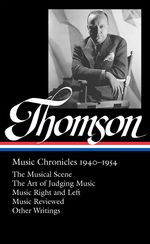
The first pages of the Library of America’s new collection make it clear that when Virgil Thomson was named head music critic of the New York Herald Tribune in the fall of 1940, he came in spoiling for a fight. At that time, New York’s staid musical establishment was still in thrall to the 19th century and the Austro-German tradition, whereas Thomson was not only an ardent Francophile—he lived in Paris from 1925 to 1940, fleeing one step ahead of the Nazis in June of that year—but a composer of avant-garde tendencies whose opera Four Saints in Three Actsboasted a libretto by Gertrude Stein.

His opening salvos aimed at fat targets: Brahms’s music, Thomson informed his readers, is “timid and over-respectful of the past,” devotion to it “the mark of a quite definite musical conservatism”; Sibelius was “vulgar, self-indulgent, and provincial beyond all description”; the violinist Jascha Heifetz produced “silk-underwear music”; and the playing of the New York Philharmonic (in Thomson’s inaugural review, no less) was “dull and brutal.”

The Library of America volume,Music Chronicles 1940–1954, restores to print four collections of Thomson’s criticism from the years indicated, along with a miscellany of previously uncollected pieces.

more here.

Why the Dismal Science Needs a Richer Moral Anthropology

51N54NCKS9LChristina McRorie at Hedgehog Review:

It’s tempting to conclude that Piketty understands and delivers what the public wants from economics: a return to classical political economy. More than a few reviews of his work make this exact claim; he’s been hailed as the Smith, Mill, or Marx the twenty-first century has been waiting for.

If only it were true. Or, to be fair, completely true. Piketty’s work is certainly a welcome step in the right direction, but it doesn’t make him the new Adam Smith. Empirical attention to the sweep of history was not the only thing that enabled the grand theorists of classical political economy to make sense of market life for their readers. The other half of what made political economy—the forerunner of economics—so compelling was its ability to take on “big questions” by connecting economic matters with moral and philosophical concerns, often by way of what might be called moral anthropology.

For those longing for a revival of political economy in the tradition of Smith, even Piketty’s remarkable turn to richer data doesn’t fully satisfy their hunger for a fully worked out exploration of the connection between economics and larger philosophical and moral questions. These questions are about more than mere markets and politics; they pertain directly to the moral dimensions of economic life.

Because early economists such as Smith (1723–90) were also moral philosophers, they took up such questions naturally. They assumed that theories of justice and normative reflections on society were inseparable from their theories about pricing, the distribution of resources, and national wealth. They assumed that their field could advance only if all such concerns were part of a seamless whole.

more here.

Ending the Creditor’s Paradise

5026088471_e8990458fc_z

Mark Blyth in Jacobin:

As I sat in my office at Brown University on December 16, 2014, an email popped into my inbox with the title “Herzlichen Glückwunsch – Sie sind der 1. Preisträger des Hans-Matthöfer-Preises für wirtschaftspublizistik.” This was the award given by the Friedrich Ebert Stiftung (FES), the research foundation closest to the German Social Democratic Party (SPD), and the Hans-Matthöfer Stiftung for the best economics publication in German in 2014. I was, to say the least, surprised.

My 2013 Oxford University Press book, Austerity: The History of a Dangerous Idea, had recently been translated into German by the publishing arm of the FES. Indeed, I had been there a month earlier, in Berlin, to do a book launch, which was very well attended. Since then the book has been reviewed, positively, in the German press, with Suddeutsche Zeitung giving it a rather glowing review. Something odd was going on.

Clearly, despite the impression we get in the US, there was movement away from the “austerity is the only way” approach to thinking about the eurozone crisis in Berlin, at least among the social democrats — but how much movement?

Consider that during the negotiations to form the current coalition with German Chancellor Angela Merkel’s Christian Democratic Union, the SPD could have made an issue out of how the policies designed to heal Europe were causing great harm, a fact acknowledged even by the International Monetary Fund by 2012. But they chose not to do so.

True, as German (and French) politicians know only too well, there are no votes in talking about Europe, only costs, so not speaking up is locally rational. But not speaking up when such inappropriate policies are being applied to Germany’s European partners is collectively disastrous. Indeed, what is so tragic in this crisis is how the center-left throughout Europe have not just accepted, but in many cases actively supported, policies that have done nothing but hurt their supposed core constituencies.

So I was awarded the prize at a ceremony in Berlin for “thinking differently” about economics. Martin Schultz, the head of the European Parliament, gave the introduction. Peter Bofinger, the voice of macroeconomic reason on the German equivalent to the US Council of Economic Advisors, gave a speech praising the book. I had ten minutes to say something useful at the end of the event. But what should I say that would be of use to the six hundred social democrats gathered in the room?

More here.

Friday Poem

Unfinished Book
.

The Achaeans have been pinned against their hollow ships
all winter. Not because this is how the epic unfolds,
but because this is where I left off, tired of the clashing of swords,
the clamor of armor, the spilling of black blood,
tired of the myriad of forgettable Greek names and
their fathers’ places of birth.

Maybe later this month, after I’ve read The Elements of Style
and my daily horoscope for the second time, the Achaeans will once again
raise themselves from the dirt, released from their paused state,
and drive back onto the plain of Scamander to rescue a reluctant wife.

Or maybe this summer, when beach reading gives way
to more heroic struggles, Achilles will quit
his stubborn stance and rejoin the reckless battle;
but nothing will happen until I pick up that book and silently
recite the words, turn the pages, and continue the struggle.
I, Eric, son of Brent of Salt Lake.
.

by Eric Parker
from Anderbo.com

Displaced Personhood: A Pakistani-British writer chronicles his odyssey through the war on terror

Jake Lamar in Bookforum:

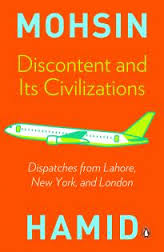
ImagesOne could say, with no snark intended, that back in the year 2000, twenty-nine-year-old Mohsin Hamid was the ultimate bourgeois bohemian. He had just published a well-received first novel. He lived on lovely Cornelia Street, in a corner of the West Village once inhabited by artists and writers but, by the dawn of the twenty-first century, affordable mainly to investment bankers and management consultants. As it happened, this debut novelist was also a management consultant. And in a deal of sugar-shock sweetness, his employer, McKinsey & Company—famous for overworking its bright young climbers—allowed this graduate of Princeton and Harvard Law three months off per year to write fiction. This guy, as Frank Sinatra might have crooned, had the world on a string, the string around his finger. But even back then, before the twin towers came tumbling down, Hamid felt the sting of Islamophobia in New York City. In “International Relations,” one of the many superb pieces in his first collection of essays, Discontent and Its Civilizations, Hamid describes how he was made to squirm every time he went to the Italian consulate in Manhattan to receive official clearance to visit his then-girlfriend in her European homeland. Hamid’s passport “runs suspiciously backward, the right-hand cover its front, and above the curved swords of its Urdu lettering . . . reads, ‘Islamic Republic of Pakistan.’ Words to make a visa officer tremble.”

For Hamid, life in the Big Apple would turn sour fast. As he writes in another essay: “The 9/11 attacks placed great strain on the hyphen bridging that identity called Muslim-American. As a man not known for frequenting mosques, and not possessing a US passport, I should not have felt it. But I did, deeply. It seemed two halves of myself were suddenly at war.” He arranged to have McKinsey transfer him, indefinitely, to London. All was well there, at least for a while: “Like many Bush-era self-exiles from the United States, I found that London combined much of what first attracted me to New York with a freedom America seemed to have lost in the paranoid years after 9/11.” In London, Hamid met the love of his life: “She and I had been born on the same street in Lahore.” He quit McKinsey. He published his mesmerizing second novel, The Reluctant Fundamentalist, which became an internationally acclaimed best seller. Marching with a million other people in Hyde Park to protest the 2003 invasion of Iraq, Hamid thought: “I am one of them. I am a Londoner.”

More here.

Thursday, February 26, 2015

Why companies are rewarding shareholders instead of investing in the real economy

Imrs

Lydia DePillis in The Washington Post's Wonkblog (via Doug Henwood) (image Jewel Samad/AFP/Getty Images):

In the past several years, profits have been increasingly paid back out to shareholders, rather than invested in hiring more people and paying them better. And lately, companies have even been borrowing money to make those shareholder payouts, because with interest rates so low, it’s a relatively cheap way to push stock prices higher.

That’s according to a new paper from the Roosevelt Institute, a left-leaning think tank that's launching a project exploring how the financialization of the economy has unlinked corporates from the well-being of regular people.

“The health of the financial system might matter less for the real economy than it once did,” writes J.W. Mason, an assistant professor of economics at John Jay College who wrote the paper, “because finance is no longer an instrument for getting money into productive businesses, but for getting money out of them.”

If it holds up, that has some pretty serious implications for how the Federal Reserve should go about tending the “real economy” in the future.

Here’s the data at the center of the report: In the 1960s, 40 percent of earnings and borrowing used to go into investment. In the 1980s, that figure fell to less than 10 percent, and hasn’t risen since. Instead of investment, borrowing is now closely correlated with shareholder payouts, which have nearly doubled as a share of corporate assets since the 1980s.

So what happened in the 1980s? The “shareholder revolution,” starting with a wave of hostile takeovers, propelled a shift in American corporate governance. Investors began demanding more control over the firm’s cash flow. Rather than plowing profits back into expansion and employee welfare, managers would pay them out in the form of dividends.

The years since the recession have given firms even more of an incentive to dispense cash rather than invest in growth: The Fed’s policy of keeping interest rates low has made credit cheap, and with weak consumer demand, high-yield investment opportunities have been scarce. So instead, companies have been borrowing in order to buy back stock, which boosts their share price and keeps investors happy — but doesn’t give anything back to the world of job listings and salary freezes, where most of us still exist.

More here.

French hip-hop

Jesse McCarthy in The Point:

ScreenHunter_1031 Feb. 26 19.47In 1988 no one in France took the hip-hop movement seriously. It was the rec-room era. JoeyStarr and Kool Shen were just two kids from Seine-Saint-Denis, the 93rd ward, a neglected tract of housing projects on the northern outskirts of Paris. One black, the other white, they shared a love and talent for breakdancing and got together practicing moves in bleak lots and house parties. They started crews and listened to Doug E. Fresh, Masta Ace, Grandmaster Flash and Marley Marl. DJs played the breaks looped over jazzy horn riffs, cats sported Kangol hats and Cosby sweaters, and they tagged the walls of the city with their calling card: NTM, an acronym for Nique Ta Mère (Fuck Your Mother). There were no labels, no official concerts or shows, and the only airplay was after midnight on Radio Nova, a station dedicated to underground and avant-garde music, created and directed by French countercultural hero Jean-François Bizot.

I was at a house party in a spacious bourgeois apartment somewhere in the 16th arrondissement when I first heard DJ Cut Killer’s track “La Haine,” better known by its infamous refrain “Nique la police” (Fuck the police). I hadn’t yet seen the film La Haine (1995), which made the song famous, and which remains arguably the most important French film of the 1990s. I was at a boum, slang for a teenage house party and a tradition of Parisian coming of age that involves a great deal of slow dancing and emotional espionage. Sophie Marceau immortalized it as a mesmerizing ingénue in the greatest French teen romance ever produced, La Boum (1980). But I wasn’t dancing with Sophie Marceau.

More here.

Parasitic Wasps Infected with Mind-Controlling Viruses

Carl Zimmer in his excellent blog, The Loom:

Parasite-NG-cover-550-206x300In November, National Geographic put a ladybug and a wasp on its cover. They made for a sinister pair. The wasp, a species called Dinocampus coccinellae, lays an egg inside the ladybug Coleomegilla maculata. After the egg hatches, the wasp larva develops inside the ladybug, feeding on its internal juices. When the wasp ready to develop into an adult, it crawls out of its still-living host and weaves a cocoon around itself.

As I wrote in the article that accompanied that photograph, the ladybug then does something remarkable: it becomes a bodyguard. It hunches over the wasp and defends it against predators and other species of parasitic wasps that would try to lay their eggs inside the cocoon. Only after the adult wasp emerges from its cocoon does the bodyguard ladybug move again. It either recovers, or dies from the damage of growing another creature inside of it.

How parasites turn their hosts into zombie slaves is a tough question for scientists to answer. In some cases, researchers have found evidence suggesting that the parasites release brain-controlling chemicals. But the wasp uses another strategy: there’s a parasite within this parasite.

More here.

Cold Remains in Greenland

Edward Rackley in Warscapes:

ScreenHunter_1030 Feb. 26 19.30Urban development in the High Arctic can be a drab affair. Buildings are inelegant steel boxes fit for lunar colonies, clustered against withering winds and inhumanly low temperatures—”post-industrial morgue” might be the cynic’s take. Walking the dusty gravel of Kangerlussuaq, a town of 512 inhabitants in western Greenland, I stopped before the improbable “King Kong Bar.” In simple green letters on peeling white plywood, the sign hung above a cave-like entrance carved directly into the steel shell of a faded red shipping container.

That so remote and hardscrabble a place was a cast-off artifact of an obscure but busy political and literary lineage was unknown to me as I wandered the town. I connected these remarkable threads much later, on the heels of a brief but intoxicating immersion in Greenland’s fjords, icecap, and rolling verdant hills. Groundbreaking Arctic exploration and the high-stakes military gamesmanship of Cold War geopolitics—parallel dimensions of recent Greenlandic history— coexisted but rarely intersected during much of the twentieth century. Now as I walked this ghostlike town these two paths collided before me, offering a very different angle on the famous “eighth continent.”

More here.

john aubrey and the art of literary biography

3bc4bfc2-bce9-11e4_1131715hStuart Kelly at the Times Literary Supplement:

It is a curious phenomenon that while fictional narratives of lives have constantly, even aggressively, sought new forms in which the idea of how lived life might be conveyed and understood in prose, literary biography has been stuck, for the most part, with Maria in The Sound Of Music: “Let’s start at the very beginning / A very good place to start”. Even she had to try something more innovative fairly quickly after that. Chronological tied shoelaces aside, there are few biographies that interrogate certain questions which writers of fiction and writers of philosophy have had to confront: is the self a discontinuous phenomenon? Since memory is always reconstructive, what value do we give to any recorded memory, either by the subject or another? – Ulric Neisser’s “Snapshots or Benchmarks?” made this an issue over three decades ago. Likewise, many of the clichés of the Creative Writing Industry – what is your character’s motivation? what’s their backstory? what are they struggling against? – miss the point by a country mile. Fictional characters are held to far lower ethical and philosophical ideals than we shambling actualities.

It is against this background that Ruth Scurr’s extraordinary John Aubrey: My own life shines so brightly. As an experiment in the art of biography, it illuminates both its subject, himself a biographer, and the unquestioned presumptions behind biography itself. Antiquarian, astrologer, scientist, toponymist, playwright, folklorist, educational theorist, hint-keeper, snapper-up of unconsidered trifles, assiduous collector, Aubrey is a figure of frustrating brilliance.

more here.

The man behind Willie Nelson

08b282bed88832c9197a25b1ea22b623_XLJoe Nick Patoski at The Oxford American:

Paul English was talking about breaking someone’s legs, cheerily using the threat as a means to get to the punch line of a story. The four men listening to him in the back of the touring bus hung on every word—because it was Paul, because it was very difficult deciphering his nasal mumble filtered through a twang, and because whatever he said was likely to be true.

“I told Lana we could do something,” Paul was saying. “We could break his legs. We have to do something to him. We cain’t go and leave him walking. We’d of done that to him. That’s nothing.”

He was discussing the shoot-out at Ridgetop back in 1970, just outside of Nashville, when Willie Nelson and Paul English defended a house full of family against Willie’s daughter’s husband and his gun-toting brothers, one of many larger-than-life incidents that have been burnished into legend over the course of the career of Paul English’s boss and best friend, Willie Nelson. In this particular story, Willie’s daughter Lana’s husband, Steve, had hit her, prompting Willie to go over to their house and slap Steve, pissing off Steve so much that he and his brothers drove over to Willie’s house and started shooting. The altercation ended with Paul firing .380-grain bullets from his M1 rifle into the bumper of Steve’s car to “get him to go on, goodbye.”

more here.

A newly discovered trove of unknown fairy tales

9780143107422_large_The_Turnip_Princess_and_Other_Newly_Discovered_Fairy_TalesMichael Dirda at The Washington Post:

In 2012, in the municipal archive of Regensburg, Germany, scholar Erika Eichenseer discovered 30 boxes containing more than 500 hitherto unknown fairy tales. A high-ranking civil servant named Franz Xaver von Schönwerth (1810-1886) had spent much of his spare time collecting the oral and traditional stories of Bavaria. This unexpected find rocked the fairy-tale establishment.

Maria Tatar, chair of the program in folklore and mythology at Harvard, explains why in the introduction to her English translation of “The Turnip Princess and Other Newly Discovered Fairy Tales.” Schönwerth’s narratives, she tells us, exhibited “a compositional fierceness and energy rarely seen in stories gathered by the Brothers Grimm or Charles Perrault, collectors who gave us relatively tame versions of ‘Little Red Riding Hood,’ ‘Snow White,’ ‘Cinderella,’ and ‘Rapunzel.’ Schönwerth gives us a harsher reality.” While the Grimms polished their transcriptions to an almost Gallic brilliance, Schönwerth preserved more fully the rough vigor and even crudeness of the oral originals.

more here.

A history of the world in funny puns

From The Telegraph:

Socrates_3180934kFor many of us, it's a punderful life (pun: a joke exploiting the different possible meanings of a word or the fact that there are words which sound alike but have different meanings) and to mark the UK Pun championships, we present a history of the world in puns.

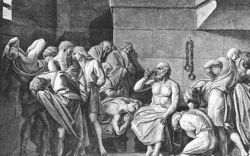
It didn't end too well for SOCRATES,the man credited as one of the founders of Western philosophy. The Greek philosopher was sentenced to death in the form of drinking a hemlock-based liquid (above, an engraving by French painter Jacques-Louis David, 1748-1825) when he was 71.

Who was Socrates' worst student? Mediocrities

Who was Socrates' busiest student? The one with a lot on his Plato

What do you call a fliratatious philosopher: A Socratease

What relative did Socrates need after his trial? An Aunty dote

More here.

Junk the phrase ‘human capital’

Unknown

Branko Milanovic in Al Jazeera America (image Meriel Jane Waissman, Getty Images):

Among many services both great and small that Thomas Piketty’s “Capital in the 21st Century” has rendered to economics is his skeptical view of the terminology of human capital. That coinage was one of the biggest mistakes in economic nomenclature in the last 50 years. It was ideologically motivated and has contributed to conceptual confusion.

Since Adam Smith, economists have known that there is a difference between more and less skilled labor. Under skill, we include education (measured by years of formal schooling), experience (measured by the years one has worked) and, less precisely definable, knowledge. Whether using Marxian or neoclassical economic theory, people with greater skills are supposed to be paid more because they produce greater value.

It is this combination of education, experience and knowledge that economists Jacob Mincer and Gary Becker decided in the early 1960s to term “human capital.” There is nothing new in the phrase nor anything harmful as such. We can call a more skilled person a person with greater human capital or use any other term, as long as we know and agree on what we mean. Calling it “human capital” appears a mere terminological quirk: We could just as well say that a more skilled person has greater “skilz” or whatever we decide to call it.

So if the name that we give to more skilled labor, whether “human capital” or “skilz,” does not matter, why is “human capital” such a disastrous turn of phrase? There are two reasons. First, it obfuscates the crucial difference between labor and capital by terminologically conflating the two. Labor now seems to be just a subspecies of capital. Second and more important, it leads to a perception — and sometimes to the argument used by insufficiently careful economists — that all individuals, whether owners of real capital or not, are basically capitalists. Even if you have human capital and I have financial capital, we are fundamentally the same. Entirely lost is the key distinction that for you to get an income from your human capital, you have to work. For me to get an income from my financial capital, I do not.

More here. A follow-up can be found here.

Wednesday, February 25, 2015

Elegies in the letters of Elizabeth Bishop and Robert Lowell

Typewriter-BethanPhillipsAustin Allen at Poetry Magazine:

One January evening 50 years ago, Elizabeth Bishop wrote from Rio to her beloved friend and fellow poet Robert Lowell. Into their usual mix of personal and literary tidbits—an upcoming trip to Ouro Prêto, the premiere of an Edward Albee play, the completion of a jigsaw puzzle (“took four evenings!”)—she dropped a solemn note:

I am sure you feel very badly about Eliot; and I’m very sorry, too. [I won]der why on earth he was still in London at this time of year? And [the] picture I saw of him at the time he received that medal showed him [loo]king very sick, I thought. Poor Valerie.

The unfortunate Londoner, of course, was T.S. Eliot, who had died of emphysema three days before.

Humble as this squib is, it conjures up a wealth of biographical context: the assumption of shared mourning for their famous acquaintance, whose death was being reported worldwide; the common reference point of “that medal” (the Presidential Medal of Freedom, an extraordinary honor for a poet); the intimacy implied in the clucking over Eliot’s choice of winter residence—and yet the difference in formality accorded “Valerie” and her husband “Eliot,” who was 38 years older and already a legend.

more here.