
by Brooks Riley
Category: Recommended Reading
Sunday, March 1, 2015
Steven Pinker Explains Why #TheDress Looked White, Not Blue
Steven Pinker in Forbes:
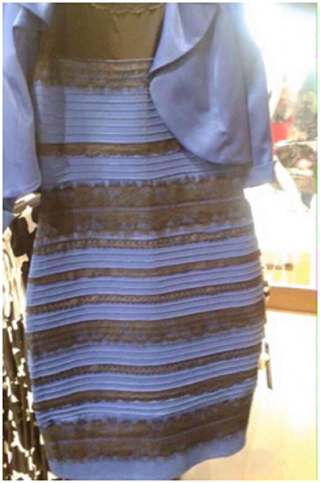
She was not the only one freaking out — the puzzle has ricocheted around the internet and set off hundreds of comments and speculations, including judgments by a number of celebrities. Within minutes a dozen students in my introductory psychology course emailed me, asking for an explanation. I had to catch a plane, and at the airport bar overheard the barmaid and several patrons debating the dress. Here’s my best guess as to what’s going on.
The puzzle has nothing to do with what philosophers call the inverted-spectrum paradox (Is my red the same as your red?), which pertains to cases in which peopleagree—at least overtly—about the color they are seeing.
Nor does it have anything to do with rods and cones. The viewing conditions for the image are all well into the brightness range of the cones. The rods aren’t seeing the image at all.
And the two different percepts don’t seem to depend on the color settings of their monitor. According to the internet reports, two people can look at the same screen and still see the colors differently.
What it has to do with is lightness constancy and color constancy.
More here.
Mites hide in your bed and breed on your face. They’re smaller than the period at the end of this sentence.
Rob Dunn in National Geographic:

Currently two species of face mites are known; at least one of them appear to be present on all adult humans. My bet was that even a modest sampling of adults would turn up more species of these mites, ones that are totally new to science.
Biologists often make bets; they call them predictions to sound fancier. My bet was based on an understanding of the tendencies of evolution and of humans. Evolution tends to engender its greatest richness in small forms. Humans, on the other hand, tend to ignore small things. Aquatic mites, for example, live in most lakes, ponds, and even puddles, often in densities of hundreds or thousands per cubic meter. They can even be found in drinking water, yet few people have ever heard of aquatic mites, including, until recently, me. And I study tiny things for a living.
More here.
Lure of the Caliphate
Malise Ruthven in the New York Review of Books:

But the challenge of defeating the Islamic State is a huge one. The group is formidably armed, having captured large quantities and varieties of weaponry from Syrian and Iraqi forces. Its senior commanders include former officers of Saddam Hussein’s Baathist regime in Iraq, a battle-hardened Chechen Islamist and former Georgian army sergeant, and veterans of the conflict in Libya. Above all, it has been able to attract unprecedented numbers of young recruits from the West itself—not least by drawing on apocalyptic currents in Islamic culture and thought in which the region of Greater Syria, known as Bilad al-Sham, is given paramount importance.
According to Europol, some five-thousand European nationals—mainly from the wealthier countries of northern Europe—have now joined the group, with around one thousand each from Britain and France. Among them are hundreds of young men and women still in their teens. Meanwhile, the caliphate’s tentacles now stretch from Afghanistan, to Yemen and to Libya, with Sunni affiliates and tribal groups making their allegiance (baya) to Abu Bakr al-Baghdadi, the self-styled caliph of ISIS.
More here.
Clark Terry (1920 – 2015)
Marvin David Levy (1932 – 2015)
leonard nemoy (1931 – 2015)
Steven Pinker on ‘Literally,’ Emojis, and Other Trends That Aren’t Destroying English
Scott Porch in The Atlantic:

Steven Pinker: Not really. Clearly, there’s overlap and some people write in a more conversational style than others, but it is striking how a transcript of a talk given extemporaneously does not read well on the printed page. I first noticed this when I was a teenager and read the Watergate transcripts—the conversations among Nixon and advisors like Haldeman and Ehrlichman and Mitchell. A number of people at the time who had never seen conversations transcribed were astonished at how difficult they were to interpret.
Porch: What do you think about the flagrant misuse of the word “literally”? Does it literally make your head explode?
Pinker: [Laughs.] It’s understandable why people do it. We are always in search of superlatives, of ways of impressing upon our hearer that something that happened is noteworthy or even extraordinary. And the words we use to signal that eventually lose their meaning.
Porch: Like “awesome.”
Pinker: “Awesome” is a recent example. In the UK, “brilliant” is used for the most banal observations. Before that, words like “terrific,” meaning inspiring terror, “wonderful,” inspiring wonder, “fabulous,” worthy of fable. We see the fossils of dead superlatives that our ancestors overused the way we overuse “awesome.” “Literally” is a victim of a similar type of inflation. The figurative use doesn’t mean the language is deteriorating. Hyperbole has probably been around as long as language has been around.
More here.
Sunday Poem
Some Love Poems
1
There you go
this morning
with frost
in your parka
down London Road
I’d know your walk
anywhere
But I’m not there
I’m in this dumb room
with your blond hair
& all the beautiful lines
on your very special face
2
In your doorway
I’ll stay
the light kisses
I’ll place
& there are diamonds
on your eyelids
I’ll stay here
in your doorway
& when we kiss
we both look so young
Zen and the art of stroke recovery
Max Liu in The Independent:
For the past three years, he'd been feeling depressed: his marriage was in trouble, his father died and he stopped working. Two decades of listening to patients' harrowing stories have taken their toll and Roland's own psychiatrist, Wayne, diagnoses him with post-traumatic stress disorder. Roland describes the patients who haunt him – from the woman who was sexually abused in childhood to the young murderer – and recalls his apprentice years treating prisoners: “The small world of the prison had expanded in my mind, while the world outside had become small.” This reminded me of my time reporting on trials and inquests when detailed accounts of violence and misery would lodge themselves in my mind daily. Readers whose work exposes them to trauma, even in indirect ways, will value Roland's perspectives on this.
More here.
The happiness conspiracy: against optimism and the cult of positive thinking
Bryan Appleyard in New Statesman:
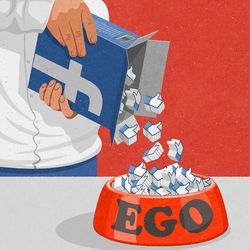
That this has got dangerously out of hand is obvious to the most intelligent. The Nobel Prizewinner Daniel Kahneman (the author of the bestseller Thinking, Fast and Slow) and his collaborator Dan Lovallo point out that optimism undermines executive decisions. They show that forecasts based solely on internal company attitudes are often wildly overoptimistic and suggest that companies should instead adopt “reference class forecasting”, where the performance of outsiders in similar situations is taken into account, and at once pessimism intrudes. There is also the Icarus paradox, identified by the economist Danny Miller, which is all about the way extreme success in business is often followed by abject failure, precisely because of the overoptimism fomented by the good times.
More here.
Saturday, February 28, 2015
How Leonard Nimoy (RIP) grew to love Spock as much as we did
Andrew Collins in The Guardian:
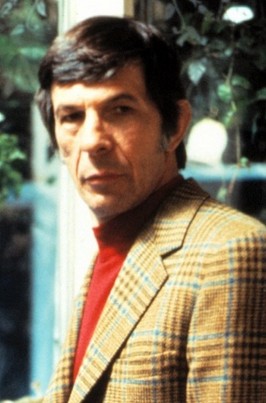
As played by Leonard Nimoy, a Boston-raised polymath of Ukrainian parentage who eventually learned to embrace the pixie-eared half-Vulcan who made him an international icon, the starship Enterprise’s science officer was our appointment to view in those glory years when those of us too young to see science fiction at the cinema snaffled it up on TV. It was Mr – never Doctor – Spock who kept his head while all around were losing theirs, whether to a sexy female alien like fallible farmboy Captain Kirk, or amid some engine-room catastrophe like Scotty. (I seem to remember my mum having at least one baby book by the famous American paediatrician and Olympic rowing medallist Doctor Spock, who empowered mothers with his 1946 book Baby and Child Care. He was not Spock.)
Although the thespian and the half-Vulcan were two different people, to us they were one and the same. We assumed Nimoy to be as calmly logical and emotionally repressed as Spock. Nimoy’s relationship with his alter-ego was encapsulated by the titles of his two autobiographies, I Am Not Spock, published in 1975, and I Am Spock, 20 years later. But Nimoy was Spock; he even invented the famous Vulcan “neck-pinch” as a fighting technique suitable for a vegetarian, which Spock was. And the Vulcan salute (do it now), which he adapted from a blessing sign used bykohanim priests. The actor admitted that Spock’s personality had influenced his own in real life. Nimoy is in Spock’s green blood and Spock is in Nimoy’s red equivalent.
More here.
From computational complexity to quantum mechanics
Michael Segal in Nautilus:
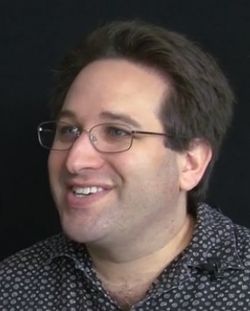
Completing his undergraduate studies at age 18, and earning tenure at MIT at age 31, Aaronson has certainly made study a central part of his own life. But it’s not just computer science that draws his interest. His book, Quantum Computing Since Democritus, touches on consciousness, free will, and time travel. A recent discussion on his blog about gender roles in science has drawn 609 comments as of this writing. And he does not shy away from public debate, having become one of the most persistent critics of claims made by startup D-Wave Systems that they are selling operational quantum computers. Why not just turn a blind eye and let those claims slide? “This is just not who I am,” says Aaronson.
More here.
People are animals, too
The human brain is special. Just not that special. To understand animal minds, and our own place in the living world, we should remove ourselves from centre stage.
Peter Aldhous in Mosaic:
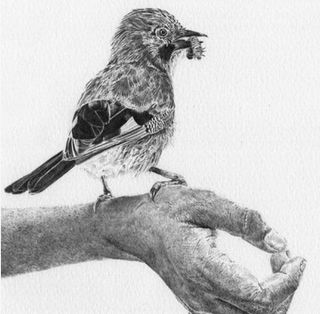
Central to Wise’s arguments in Tommy’s case, and similar suits his organisation has filed on behalf of other captive chimpanzees, is the assertion that apes are highly intelligent and self-aware beings with complex emotional lives. “The uncontroverted facts demonstrate that chimpanzees possess the autonomy and self-determination that are supreme common law values,” Wise told the five judges hearing the case.
It is a bold legal move – and so far unsuccessful. The court in Albany, like a lower court before it, rejected the idea that Tommy has legal rights of personhood. But Wise intends to fight on, taking Tommy’s case to the state’s ultimate arbiter, the New York Court of Appeals.
Events elsewhere in New York State stand in stark contrast to its courts’ willingness to consider the legal implications of the science of animal cognition. In March 2014, the Rip Van Winkle Rod and Gun Club in Palenville, a hamlet of some 1,000 people on the Hudson River, held the fourth instalment of an annual festival that makes a competitive sport out of shooting down creatures that – judged by objective measures of their mental abilities – are arguably just as deserving of personhood as Tommy.
More here.
Right Brained, Wrong Brained: How Caltech Neuroscience Became a Buzzfeed Quiz
Jason G. Goldman in Los Angeles Magazine:
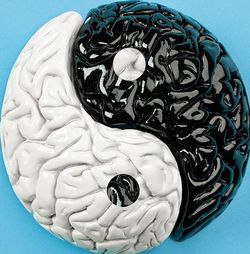
Angelenos are always looking for new target areas for self-improvement, but there’s an inherent flaw in treating the two sides of the brain as if they’re biceps. Cognitive development doesn’t work that way. As the neuroscientist whose research helped define split-brain theory in humans will tell you, you’re limiting your potential by trying to fit something as complicated as the brain into two tidy categories.
“There’s a folk psychology that says people have two skills—they’re more verbal or more visual, more artistic or more analytical,” says Michael S. Gazzaniga, director of the SAGE Center for the Study of the Mind at the University of California, Santa Barbara. “But the simple dynamics of ‘the left brain does this, the right brain does that’ are way overdone.”
More here.
This 3.5-Minute Music Video Was Shot In 5 Seconds
What I Mean by Mexico

14.
Birds everywhere. Fish everywhere. And when we came near the ocean we began to encounter fishermen of clearly African descent. Their village, with its two aspects, the tourist side facing the ocean and a great expanse of beach, the fishing side facing the lagoon, looked like a little paradise. One had to remember that, if its isolation had been an advantage for its founder members, peons of the lowest class of the society of the day, it must also—as was the whole coast—have been plagued with disease and other forms of daily risk. The fishing (crocodiles apart) might have been the easiest thing about it. As it is, today the village is painted with propaganda about public health, explaining the risks and symptoms of tuberculosis, influenza and so forth.
15.
The houses are often painted in bright colors, combinations that can probably be traced to the availability of individual pigments at the time of painting. But sometimes a color plan is evident: an imposing bright green facade with a yellow trim, or a yellow facade with magenta stripes. One small inn showed boldly in bright green at the base and different hues of blue on an upper story, but set off by contrasting panels of chocolate and hazelnut. Gardens, where they existed, pushed in the direction of a riot of reds. A Catholic church, with no priest or weekly service, used mainly for weddings and baptisms, was painted in the colour known to Benjamin Moore as Bermuda teal. And in this pleasant environment, women with hair combed out in Afrostyle, but men—obeying the current international fashion—tending towards the faux-hawk.
more here.
MEMORY THEATRE BY SIMON CRITCHLEY
An English philosopher called Simon Critchley moves from Essex to New York after becoming disillusioned with the state of British academia. On returning to Essex to clear out his office he finds five boxes, each marked with a zodiac sign from Capricorn to Gemini (the Taurus box is missing), containing the unpublished notebooks and manuscripts of the great, recently deceased, Michel Haar.
Among the boxes is a text called “Le théâtre de mémoir selon G.W.F Hegel,” “an entirely original interpretation of Hegel’s monumental 1807 Phenomenology of Spirit.” Haar’s interpretation of Hegel is informed by a reading of British art historian Francis Yates’s The Art of Memory, a book tracing mnemonic systems from antiquity to the early modern period; in particular by her account of the Renaissance philosopher Giulio Camillo’s theatre of memory, a theoretical structure that “hold[s] the sum of knowledge in a way that would permit total recall.”
Having lost a great deal of his memory in an industrial accident, Critchley finds the idea of the memory theatre at once quaint and irresistible. Later he opens the fifth box—marked Pisces; his astrological sign—and finds a series of astrological projections. “They weren’t so much birth charts as death charts, necronautical rather than genethlialogical. Their purpose was to plot the major events in a philosopher’s life and then to use those events to explain their demise.” One of them, produced 18 years before Haar’s death, predicts that death to the minute. “Knowing his fate, he had simply lost the will to live. He arrived dead just on time.”
more here.
‘The Buried Giant’, by Kazuo Ishiguro

Kazuo Ishiguro’s first novel for a decade is, on one level, a complete surprise. It’s set in England in the Dark Ages no less, perhaps in the fifth or early sixth century, a period about which little certain is known. The Romans have left Britain and the Saxons have arrived, built settlements, and fought wars of conquest and survival. The people Ishiguro calls “Britons” have been forced into an uneasy accommodation with the settlers, and ogres and pixies roam a bleak, damp landscape.
Ishiguro has set novels in a parallel dystopian England in which child clones are being reared for organ donation in ignorance of their ultimate fate (Never Let Me Go, 2005), and in an imaginary central European city in which a concert pianist finds himself lost in a kind of surrealist nightmare of coincidence, farce and mistaken identity (The Unconsoled, 1995). He is no realist. But I never expected to encounter a she-dragon in his fiction or, for that matter, the wizard Merlin, from Arthurian legend.
Yet for all its flights of fantasy and supernatural happenings — a mist has settled over the land forcing people into a condition of forgetfulness, or so they believe — The Buried Giant is absolutely characteristic, moving and unsettling, in the way of all Ishiguro’s fiction.
more here.
Sojourner Truth Speech of 1851, “Ain’t I a Woman”
On April 28, six NWHM Board Members and Advisors attended the dedication of the Sojourner Truth bust in Emancipation Hall of the new Capitol Visitor Center. She becomes only the 10th statue of a woman to stand in the U. S. Capitol building, out of 211 statues. The Hall was filled with excitement and pride. Secretary of State Hillary Clinton noted that the event was long past due, Speaker Nancy Pelosi acknowledged standing on the shoulders of the women who came before and Michelle Obama said that as a descendant of slaves, Sojourner Truth must be pleased to see her standing there as first lady. House Minority Leader John Boehner, Senate Minority Leader Mitch McConnell and Senate Majority Leader Harry Reid spoke in honor of the dedication – good speeches but not near so impassioned as the women’s. The female speakers understood the indebtedness that they owed Truth. They had a vested interest and it showed.
One of the highlights was Cicely Tyson’s reenactment of Truth’s famous “Ain’t I a Woman?” speech. It brought the house down. She made the words – and Truth – come alive.
More here. (Note: This is our last post in honor of Black History Month. Please take 4 minutes to listen to this speech)