Wittgenstein, Schoolteacher

Spencer Robins in The Paris Review:
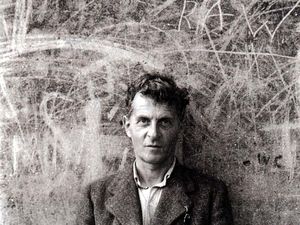
3-ludwig-wittgenstein-1-dreizehnBy the time he decided to teach, Wittgenstein was well on his way to being considered the greatest philosopher alive. First at Cambridge, then as an engineer and soldier, Wittgenstein had finished his Tractatus Logico-Philosophicus, at once an austere work of analytic philosophy and—for some readers, Wittgenstein apparently included—an almost mystical experience. In it, he claimed charmingly and not without reason to have solved all the problems of philosophy. This was because of the book’s famous “picture theory of meaning,” which held that language is meaningful because, and only because, of its ability to depict possible arrangements of objects in the world. Any meaningful statement can be analyzed as such a depiction. This leads to the book’s most famous conclusion: that if a statement does not depict a possible arrangement of objects, it doesn’t mean anything at all. Ethics, religion, the nature of the world beyond objects … most statements of traditional philosophy, Wittgenstein contended, are therefore nonsense. And so, having destroyed a thousand-year tradition, Wittgenstein did the reasonable thing—he dropped the mic and found a real job teaching kids to spell.

At this time in his life—around 1919, when he turned thirty—Wittgenstein wanted badly to transform himself. Convinced he was a moral failure, he took extreme steps to change his circumstances, divesting himself of his enormous family fortune (which he dispersed among his siblings, making sure he could never legally access it again); leaving the palatial family home he’d grown up in (it was literally called the “Palais Wittgenstein”); and looking for the kind of hard and honest work he hoped would distract him from his despair and allow him to do something of value. In choosing teaching he was influenced by a romantic idea of what it would be like to work with peasants—an idea he’d gotten from reading Tolstoy. His family was perplexed by his decisions. His sister Hermine told him that applying his genius to teaching children was like using a “precision instrument” to open crates.

Read the rest here.
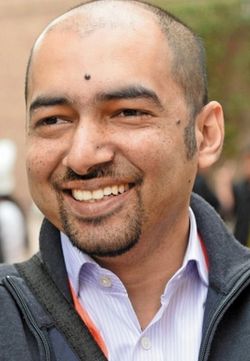
K. Anis Ahmed’s stringent tales of life in the sprawling capital of Bangladesh

André Naffis-Sahely in The Nation:

ScreenHunter_1052 Mar. 06 14.16In his dotage, Henry Kissinger has come to resemble Emperor Palpatine from Star Wars. After his five decades of insidious influence on US foreign policy, his face has crumpled into a ripple of wrinkles, but the eyes retain their wily luster. When he enters a room, he does so briskly, and his somber suits barely contain his contempt for those who repeat the accusations that have been gaining traction since the end of the Cold War—that during his tenure as secretary of state in the 1970s, Kissinger abetted, and sometimes incited, mass murder on three continents. The man’s dark aura is magnified by his raspy, Teutonic timbre, which habitually turns the scores of journalists sent to interview him into deferential scribes cowering at the pharaoh’s feet.

As was the case with Palpatine, Kissinger’s overconfidence may well turn out to be his weakness. Since 2001, judges in several countries have called for him to testify about his involvement in the Pinochet dictatorship in Chile, and activists have demanded his indictment for his role in some of the bloodiest chapters of Vietnamese history, to name only a few of the countries where he wreaked havoc. His travel schedule regularly inspires activists to protest his public appearances. For the moment, however, Kissinger remains a highly coveted pundit—passing judgment on the Ukrainian and Middle Eastern crises in some of the world’s most prestigious newspapers—and dinners are still held in his honor. Public anger, it seems, only invigorates Kissinger, and he is as unassailable now as when he haunted the White House with Tricky Dick.

More here.

John Maynard Keynes: art dealer, impresario, don, speculator, wit

Tim Bouverie in The Telegraph:

Keynes_2_3221146bAt first glance, a biography of Keynes which largely ignores the economics might seem like a biography of Mozart which skips over the music. But as Richard Davenport-Hines argues in his sprightly Life, or Lives, Keynes was a man so interesting, diverse and important that he is able to command attention beyond the field with which his name is indelibly associated. As his fellow Bloomsbury set member Leonard Woolf wrote, Keynes was “a don, a civil servant, a speculator, a businessman, a journalist, a writer, a farmer, a picture dealer, a statesman, a theatrical manager, a book collector, and half a dozen other things”. “Economist” is notable by its absence, as it is also from the seven thematic chapter headings of this book. For Davenport-Hines, this is entirely deliberate. As Keynes wrote, “the worst of economics is that it really is a technical and complicated subject”, unsuited to a general readership. But for Davenport-Hines there is also a more profound reason, which becomes apparent through this highly enjoyable series of portraits: Keynes’s economics were not created out of a theoretical or mathematical firmament but were the product of his wider life.

Born into the middle-class intelligentsia, Keynes was by birth, by education and inclination, a Liberal. A King’s Scholar at Eton, he went on to King’s College Cambridge where he was a member of the semi-secret debating club, The Apostles. There, members discussed philosophy and took it in turns to read papers from the hearth rug. It was here that Keynes developed that “unparalleled power of lucid exposition” (Austin Robinson) which was to enable him to become one of the great “persuaders” of his age.

More here.

Vote for a nominee for the 3QD Politics & Social Science Prize 2015

Browse the nominees in the list below and then go to the bottom of the post to vote.

Alphabetical list of nominated blog names followed by the blog post title:

(Please report any problems with links in the comments section below.)

For prize details, click here.

  1. 3 Quarks Daily: Delhi: the City of Rape?
  2. 3 Quarks Daily: Free-Floating Anxiety, Teens, and Security Theatre
  3. 3 Quarks Daily: My Grandmother's Democratic Party (Part 2)
  4. 3 Quarks Daily: Notes Of A Grand Juror
  5. 3 Quarks Daily: Somewhere in Europe
  6. 3 Quarks Daily: The Evil That Republicans Do
  7. 3 Quarks Daily: The Undocumented Journey North, Through Mexico
  8. Abandoned Footnotes: The Saudi Monarchy as a Family Firm
  9. At War: Signs of an Afghan Crisis, There on Election Day in June
  10. Brown Pundits: Blasphemy, blasphemy laws, Pakistan, Charlie Hebdo…
  11. Hong Wrong: The Power of the Powerless: Hong Kong’s Last Stand
  12. Huffington Post: You Can't Understand ISIS If You Don't Know the History of Wahhabism in Saudi Arabia
  13. Jezebel: The Cops Don't Care About Violent Online Threats. What Do We Do Now?
  14. Justin Erik Halldór Smith: Abandoning Ukraine
  15. Los Angeles Review of Books: The Limits of Muslim Liberalism
  16. Notes From Pakistan: The predominance of clergy in Pakistan
  17. Opinionator: Privacy and the Pool of Information
  18. Pacific Policy: Timor Leste's survival is an example for all nations
  19. Pandaemonium: Assimilation vs. Multiculturism
  20. Peril: Modi in Oz: Turning Water into Mines
  21. Proof I Never Want To Be President: It's Not a Competition
  22. Religious Left Law: The Highlander Folk School: A Civil Rights Movement Halfway House
  23. Scientia Salon: Why not Cynicism?
  24. The Philosopher's Beard: The Robot Economy and the Crisis of Capitalism: Why We Need Universal Basic Income
  25. U.S. Intellectual History: How the CIA Bought Juan Rulfo Some Land in the Country
  26. U.S. Intellectual History: Liberty Man: The Studliness of Exodus
  27. U.S. Intellectual History: The Culture Wars Are Dead, Long Live the Culture Wars!
  28. U.S. Intellectual History: The Mediterranean and the Mediterranean World in the Age of Charlton Heston
  29. Warscapes: Cold Remains in Greenland

If you are new to 3 Quarks Daily, we welcome you and invite you to look around the site after you vote. Learn more about who we are and what we do here, and do check out the full site here. Bookmark us and come back regularly, or sign up for the RSS feed. If you have a blog or website, and like what you see here, we would very much appreciate being mentioned there or added to your blogroll. Please don't forget!

Voting ends on March 11th at 11:59 pm NYC time.

Results of the voting round (the top twenty most-voted-for posts) will be posted on the main page on March 12th. The finalists will be announced on March 13th and winners of the contest will be announced on March 23rd, 2015.

PLEASE BE AWARE: We have multiple ways of detecting fraud such as multiple votes being cast by the same person. We will disqualify anyone attempting to cheat.

Now click here to vote.

Thank you.

Friday Poem

Li Ho

Li Ho of the province of Honan
(not to be confused with the god Li Po
of Kansu or Szechuan
who made twenty thousand verses)
Li Ho, whose mother said,
“my son daily vomits up his heart”
mounts his horse and rides
to where a temple lies as lace among foliage.
His youth is bargained
for some poems in his saddlebag—
his beard is gray. Leaning
against the flank of his horse he considers
the flight of birds
but his hands are heavy. (Take this cup,
he thinks, fill it, I want to drink again.)
Deep in his throat, but perhaps it is a bird,
he hears a child cry.

by Jim Harrison
from Selected and New Poems
Delacorte Press, 1965

Celebration of scientific art

Chris Woolston in Nature:

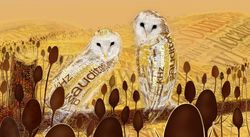
WEB_owlImages of painted pterosaurs, ceramic diatoms and quilts depicting neurons have flooded scientists’ Twitter feeds, after the writers of Symbiartic, Scientific American’s art blog launched ‘SciArt Week’ this week. Researchers and artists have been posting a flurry of artwork highlighting the beautiful side of science, using the hashtag #sciart. Malcolm Campbell, a plant scientist at the University of Toronto, Scarborough, Canada, was one of the first researchers to announce SciArt week on Twitter. “Art captures the imagination in a way that science alone cannot,” he says. “It’s a wonderful way to make science more tangible to the public.”

The week began with a post on the Symbiartic blog calling for followers to tweet out at least three pieces of scientific art — including paintings, cartoons, medical illustrations and rough sketches — each day. Glendon Mellow, the Toronto-based artist and Symbiartic blogger who first conceived SciArt Week, says he was originally hoping for about 1,600 #sciart tweets per day, but was surprised to see nearly 5,000 on 2 March alone. One of his motivations, he says, was to expose artists to a wider audience of potential buyers. “We want people who love science to become aware of how easily they can reach out to artists.” The deluge of images has spanned just about every field of science. Adam Summers, a fish biologist at the University of Washington, Seattle, shared his striking photograph of a leopard shark embryo with blue-stained cartilage.

Picture: Words frequently found in research papers about barn owls were used to create this image.

More here.

cosmopolitan istanbul: then and now

D4681728-2e81-498a-8817-210ed9c2621bBernd Brunner at Lapham's Quarterly:

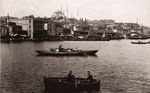
In 1850, when Gustave Flaubert visited Istanbul, or Constantinople, as it was still called, he wrote of discovering a fantastic “human anthill,” which he expected to become “the capital of the world”: “You know that feeling of being crushed and overwhelmed that one has on a first visit to Paris: here you are penetrated by that feeling, elbowing so many unknown men, from Persian and Indian, to the American and Englishman, so many separate individualities which, in their frightening total, humble your own.” Herman Melville, who spent six days in Constantinople in December 1856, found the city labyrinthine and often got lost. “Came home through the vast suburbs of Galata,” he noted in his journal. “Great crowds of all nations…coins of all nations circulate—Placards in four or five languages (Turkish, French, Greek, Armenian)…You feel you are among the nations…Great curse that of Babel; not being able to talk to a fellow being.”

Mark Twain came to Constantinople a decade later to see what he characterized as “an eternal circus”: “People were thicker than bees in those narrow streets, and the men were dressed in all the outrageous, outlandish, idolatrous, extravagant, thunder-and-lightning costumes that ever a tailor with the delirium tremens and seven devils could conceive of.” Constantinople, at the intersection of Europe, Asia, and the Middle East, with its unusual human mosaic, was a place that welcomed nearly everyone.

more here.

on the good badness of westerns

Lone_Ranger_and_Tonto_1956John Crutchfield at berfrois:

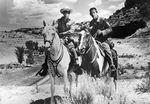
The Lone Ranger, by any adult standard, is a terrible show. In fact, it is of a terribleness scarcely to be believed. The dialogue is composed in a language no man ever spoke, nor should he attempt to. The sentences have all the pliability of driftwood, but none of the interesting shapes and textures. The voice-over during the overture is a prodigy of expository compression (“He was a fabulous individual!”). The characters are of a piece with the language: everybody is One Thing, and come hell or high water, They Do Not Change. If you have the misfortune to be a bad guy, you might as well enjoy it while you can, because the narrative will grant you no hope of reform. If you’re a good guy, say adios to anything that might help you resemble an actual human being: a moment of doubt or weakness, a capacity for actual emotions, a troubled conscience—not a chance. You won’t even be granted a little good old-fashioned blood-lust, for as the first episode makes clear, you will “Shoot to wound, not to kill. For killing is wrong.” Suffice it to say that the acting, directing, costume and set-design, editing, sound engineering—all are so hideously clunky that (you know where I’m going with this) they’re almost kind of good.

more here.

Thomas Merton and the Eternal Search

Elie-Merton-320Paul Elie at The New Yorker:

Here ends the book, but not the searching. Thomas Merton ended “The Seven Storey Mountain” with a little Latin to that effect: Sit finis libri, non finis quaerendi. Set tombstone-style in small caps, at once pompous and obscure, it runs against the spirit of the book, which is personal, casual, talky, and self-deprecating—the story of a conversion to Catholicism and a call to a Trappist monastery as the adventures of a young New York dangling man.

Here ends the book, but not the searching. Those words turned out to be as true as any Merton wrote before or after. “The Seven Storey Mountain” sold six hundred thousand copies in 1948 and 1949, and the book’s success forced Merton into the role of a cloistered celebrity, a spokesman for silence. Boxed in by this development and suddenly unstoppered as an author, Merton set himself to overcoming “the limitations that I created for myself with The Seven Storey Mountain” and “the artificial public image which this autobiography created.” There would be no sequel, but over the next twenty years he would scatter accounts of his further adventures across tens of thousands of pages: devotional books, poems, essays, letters, journals, aphorisms, and song lyrics—everything but fiction.

more here.

A philosopher plays Minecraft

Charlie Huenemann in Huenemanniac:

Minecraft-wolf_2757144I have killed three dogs in Minecraft. The way to get a dog is to find a wolf, and then feed bones to the wolf until red Valentine’s hearts blossom forth from the wolf, and then it is your dog. It will do its best to follow you wherever you go, and (like a real dog) it will invariably get in your way when you are trying to build something. Apart from that, they are just fun to have around, and they will even help you fight monsters. If they become too much of a nuisance, you can click on them and they will sit and wait patiently forever until you click on them again.

I drowned my first two dogs. The first time, I was building a bridge over a lake, but a bridge that left no space between it and the water. The dog did its best to follow me around, but it soon found itself trapped beneath the water’s surface by my bridge. Not being smart enough to swim out from under the bridge, it let out a single plaintiff yelp before dying and sinking. Exactly the same thing happened to my second dog, as it was this second episode that made this particular feature of dogs clear to me. I know now to make dogs sit if I’m building bridges. I’m not sure what happened to the third dog, but I think it fell into some lava. There was, again, the single yelp, followed by a sizzle. No more dog.

I felt bad each time, while of course fully realizing that only virtual entities were being killed. Surely some of the sorrow I felt was imported from the real world, where I am fond of dogs and do what I can to avoid drowning or burning them. I could not be said to have developed a meaningful relationship with my virtual dogs, but I was pleased to see them each time they caught up with me, and I was a little sad to realize they wouldn’t be getting in my way anymore. I think I was right to feel at least a little bit bad about killing them. But how can there be any place for emotional or even moral attachments to virtual characters? What could cause me to feel any kind of sympathy or concern for beings that don’t really exist?

More here.

Thursday, March 5, 2015

The East India Company: The original corporate raiders

William Dalrymple in The Guardian:

ScreenHunter_1051 Mar. 05 16.41One of the very first Indian words to enter the English language was the Hindustani slang for plunder: “loot”. According to the Oxford English Dictionary, this word was rarely heard outside the plains of north Indiauntil the late 18th century, when it suddenly became a common term across Britain. To understand how and why it took root and flourished in so distant a landscape, one need only visit Powis Castle.

The last hereditary Welsh prince, Owain Gruffydd ap Gwenwynwyn, built Powis castle as a craggy fort in the 13th century; the estate was his reward for abandoning Wales to the rule of the English monarchy. But its most spectacular treasures date from a much later period of English conquest and appropriation: Powis is simply awash with loot from India, room after room of imperial plunder, extracted by the East India Company in the 18th century.

There are more Mughal artefacts stacked in this private house in the Welsh countryside than are on display at any one place in India – even the National Museum in Delhi. The riches include hookahs of burnished gold inlaid with empurpled ebony; superbly inscribed spinels and jewelled daggers; gleaming rubies the colour of pigeon’s blood and scatterings of lizard-green emeralds. There are talwars set with yellow topaz, ornaments of jade and ivory; silken hangings, statues of Hindu gods and coats of elephant armour.

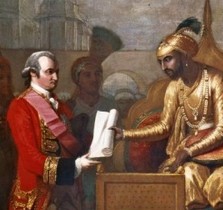
Such is the dazzle of these treasures that, as a visitor last summer, I nearly missed the huge framed canvas that explains how they came to be here.

More here.

A Major Surge in Atmospheric Warming Is Probably Coming in the Next Five Years

Nafeez Ahmed in Motherboard:

ScreenHunter_1050 Mar. 05 16.36Forget the so-called ‘pause’ in global warming—new research says we might be in for an era of deeply accelerated heating.

While the rate of atmospheric warming in recent years has, indeed, slowed due to various natural weather cycles—hence the skeptics’ droning on about “pauses”—global warming, as a whole, has not stopped. Far from it. It’s actually sped up, dramatically, as excess heat has absorbed into the oceans. We’ve only begun to realize the extent of this phenomenon in recent years, after scientists developed new technologies capable of measuring ocean temperatures with a depth and precision that was previously lacking.

In 2011, a paper in Geophysical Research Letters tallied up the total warming data from land, air, ice, and the oceans. In 2012, the lead author of that study, oceanographer John Church, updated his research. What Church found was shocking: in recent decades, climate change has been adding on average around 125 trillion Joules of heat energy to the oceans per second.

How to convey this extraordinary fact? His team came up with an analogy: it was roughly the same amount of energy that would be released by the detonation of two atomic bombs the size dropped on Hiroshima. In other words, these scientists found that anthropogenic climate is warming the oceans at a rate equivalent to around two Hiroshima bombs per second. But as new data came in, the situation has looked worse: over the last 17 years, the rate of warming has doubled to about four bombs per second. In 2013, the rate of warming tripled to become equivalent to 12 Hiroshima bombs every second.

More here.

A visit to Harvard’s Holden chapel, where William James once asked the question, “Is life worth living?”

John Kaag in Harper's:

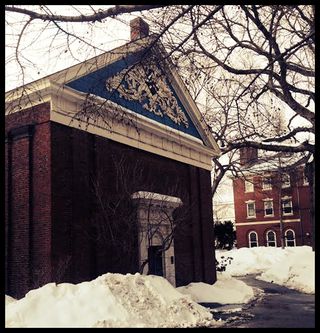
HarpersWeb-Postcard-Maybe-622pxHarvard University’s Holden Chapel always struck me as the proper home of a crypt-keeper: an appropriate place to die, or at least to remain dead. The forty-foot brick structure has no front windows. Above its entrance are four stone bucrania, bas-relief ox-skull sculptures of the sort that pagans once placed on their temples to keep away evil spirits. In 1895, when William James was asked to address a crowd of young Christian men at the Georgian chapel, it was already more than 150 years old, a fitting setting for the fifty-three-year-old philosopher to contemplate what he had come to believe was the profoundest of questions: “Is life worth living?”

For centuries, philosophers and religious thinkers, from Maimonides to John Locke, coolly articulated the belief that life, for any number of unassailable reasons, was worth living. In the thirteenth century, Aquinas argued that all things—be they amoebas or human beings—have a natural life cycle put into place by an intelligent designer. Far be it from any of God’s creatures to disrupt it. Kant’s argument, five hundred years later, was less theologically speculative. Rational beings, he said, have a duty not to destroy our own rational capacities. In Kant’s words, “Suicide is not abominable because God has forbidden it; on the contrary, God has forbidden it because it is abominable.”

James had pondered the abominable since at least his twenties.

More here.

Thursday Poem

In Which the Cartographer Explains Himself

You might say
my job is not
to lose myself exactly
but to imagine
what loss might feel like –
the sudden creeping pace,
the consultation with trees and blue
fences and whatever else
might prove a landmark.
My job is to imagine the widening
of the unfamiliar and also
the widening ache of it;
to anticipate the ironic
question: how did we find
ourselves here? My job is
to untangle the tangled,
to unworry the concerned,
to guide you out from cul-de-sacs
into which you may have wrongly turned.
.

by Kei Miller
from The Cartographer Tries to Map a Way to Zion
publisher: Carcanet, Manchester, 2014

My Karachi family’s shame

Rafia Zakaria in Salon:

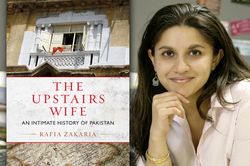
Rafia_zakariaIt was Aziza Apa who had passed the verdict on Uncle Sohail’s marriage, pulling all her clan on the side of her darling Sohail, whose wife had denied him not just the son he deserved but any progeny at all. “You are barren,” she had reminded Aunt Amina. “You should be thankful that he is a good enough man to still keep you at all.” Her words had echoed loud and deep; suddenly everyone in the community saw clearly that Uncle Sohail was the self-denying hero whose good-heartedness led him to keep a wife who could not fulfill her duty. Many had exacting broods of children, whose pressing needs grated on their lives; denouncing the barren woman elevated them, made their sacrifices of lost sleep and interrupted meals and mountains of soiled clothes a gift to be cherished.

In our house, on the sideboard of the formal dining room by the tray holding the car keys, invitations for weddings began to pile up as they did every winter. It was the season. There they lay, proof of the celebrations that continued unabated in the lives of others. Every day brought a few more: fat, festive envelopes promising feasts at hotels, or thin frugal ones threaded with gold lettering begging our respectable presence at smaller venues. Neither made it out of their resting places. Weddings—the days and weeks of rituals preceding them and the parties held after them—are the fairy-lit center of Karachi’s social life, events that mark for women points of respite from their otherwise secluded lives of cooking for the in-laws and yelling at children. They are where the prosperity of a cousin’s blooming business or the extra pounds on a sister-in-law can be witnessed, old scores settled and new gripes gobbled up between mouthfuls of grease and spice. That December many yearned for us to appear at one celebration or another so that, between compliments for the bride and congratulations for the groom, my mother or grandmother could be asked: “How is Amina . . . ? We heard her husband is marrying again and that she has returned to your house.” As they threw out the words, they could watch our faces, gauge in the glint of our eyes and the turn of our heads the extent of our embarrassment. With this measure, they could mark the boundary between their conformity and our scandal, the degree of our banishment, which defined, after all, their own belonging.

More here.

Genetically Speaking, You’re More Like Your Dad

Carl Engelking in Discover:

PaternalgenesYou may have inherited your mother’s eyes, but, genetically speaking, you use more DNA passed down from your father. That’s the conclusion of a new study on mice that researchers say likely applies to all mammals. We humans get one copy of each gene from mom and one from dad (ignoring those pesky sex chromosomes) – that hasn’t changed. The same is true for all mammals. But that doesn’t necessarily mean that mom and dad genes are equally active in creating who we are. Researchers now report that thousands of mouse genes show parent-specific effects, and that on balance, the scales are tipped in favor of dads. Studying whether this imbalance exists in humans could give scientists insights into the causes of inherited conditions like diabetes and heart disease.

…Scientists interbred three strains of these mice to create nine different types of offspring. When these mice reached adulthood, scientists measured the level of gene expression in a variety of bodily tissues. They then quantified how much gene expression was derived from the mother and the father for every single gene in the genome. Overall, they found that most genes showed parent-of-origin effects in their levels of expression, and that paternal genes consistently won out. For up to 60 percent of the mouse’s genes, the copy from dad was more active than the copy from mom. This imbalance resulted in mice babies whose brains were significantly more like dad’s, genetically speaking.

More here.

Doris Lessing, Clancy Sigal, and sexy Oedipal “nuttiness”

P11_Boddy_1133425hKasia Boddy at the Times Literary Supplement:

It’s not unusual for lovers to contest events and for the one who feels misrepresented to write back with gusto. Ted Hughes, for examples, used Birthday Letters to inform the world that there was something rather dubious about Sylvia Plath’s “long, perfect American legs”, never mind her “roundy” face. But perhaps because his break-up with Lessing was more mutual, and perhaps because he had originally come to Europe with the intention of having an affair with a European intellectual (in the footsteps of Nelson Algren seeking his own Simone de Beauvoir), Sigal is more genial and self-consciously satirical about the affair. He takes great pleasure in elaborating on the “wonderful, inventive, imaginative” culinary, rather than intellectual, skills of his once well-beloved (a juicy meat loaf makes several appearances) and his own reputation as “James Dean out of Brendan Behan” and being “terrific in bed”.

And yet the decades-old experience of being “stuck hot and steaming” into Lessing’s prose like “a still-struggling lobster” was not forgotten. Unlike Lessing, Rubenstein argues, Sigal seems never to have got the relationship “out of his system – or to exhaust its literary possibilities”. In his hands Saul Green becomes Jake Blue, then Paul Blue, then Gus Black and so on. For all its comic playfulness (“Stay out of my drawers – figuratively, I mean”, his alter ego scolds hers), the sense of betrayal is never far from the surface of Sigal’s prose.

more here.

notes on john carpenter’s ‘the thing’

Thing4-sizedDave Tompkins at Paris Review:

The Thing scampers across the Antarctic tundra in a dog suit. A Norwegian helicopter gives chase with bad aim and incendiaries. It’s in humanity’s best interest to kill the dog before it transforms into a “pissed-off cabbage” made of twelve dog tongues lined with thorny dog teeth. (Taking over the world requires imagination, psychedelic detailing, and a little hustle.) The dog, referred to by Thingsplainers as “Running dog-Thing,” is smart; it will go on to perform incredible feats. Like helping oatmeal cowboy Wilford Brimley build a spaceship. Like sticking Kurt Russell inside a fifth of J&B. Like replicating the frailty of the human mind in conditions of paranoia and subzero isolation. All of these, unbearable likenesses. Running dog-Thing has earned its customized bass lurk, composed by Ennio Morricone, which, in fairness to your ears and mine, could be an expensive John Carpenter imitation.

This opening sequence for Carpenter’s The Thing prompted cheers at BAM last month, as part of a retrospective of the horror director’s work. I whooped for my own dread, maybe rooting for the thirteen-year-old version of me who saw The Thing with my dad in 1982, after my parents’ divorce. I relished those early quiet moments at U.S. National Science Institute Outpost 31, before the dog exploded and everyone started side-eyeing each other’s ratty long johns.

more here.