Quran Fragments Perhaps as Old as Islam

Dan Bilefsky in The New York Times:
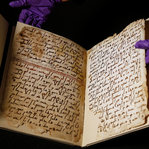
QURAN-mediumSquare149LONDON — The ancient manuscript, written on sheep or goat skin, sat for nearly a century at a university library, with scholars unaware of its significance. That is, until Alba Fedeli, a researcher at the University of Birmingham studying for her doctorate, became captivated by its calligraphy and noticed that two of its pages appeared misbound alongside pages of a similar Quranic manuscript from a later date. The scripts did not match. Prodded by her observations, the university sent the pages out for radiocarbon testing. On Wednesday, researchers at the University of Birmingham revealed the startling finding that the fragments appeared to be part of what could be the world’s oldest copy of the Quran, and researchers say it may have been transcribed by a contemporary of the Prophet Muhammad. “We were bowled over, startled indeed,” said David Thomas, a professor of Christianity and Islam at the University of Birmingham, after he and other researchers learned recently of the manuscript’s provenance.

The ancient pieces of manuscript, estimated to be at least 1,370 years old, offered a moment of unity, and insight, for the world’s 1.6 billion Muslims. Professor Thomas said it provided tantalizing clues to help settle a scholarly dispute about whether the holy text was actually written down at the time of the prophet, or compiled years later after being passed down by word of mouth. The discovery also offered a joyful moment for a faith that has struggled with internal divisions and external pressures. Muslims believe Muhammad received the revelations that form the Quran, the scripture of Islam, between 610 and 632, the year of his death. Professor Thomas said tests by the Oxford Radiocarbon Accelerator Unit indicated with a probability of more than 94 percent that the parchment dated from 568 to 645.

More here.
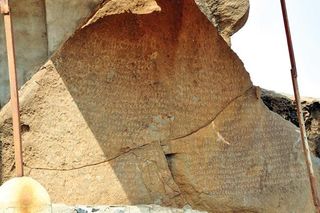
Upon This Rock: What the stone edicts of Ashoka tell us about India’s great Buddhist ruler

Upon-this-rock_photo-by-nayanjot-lahiri_the-caravan-magazine_july2015_01

Nayanjot Lahiri in Caravan:

THERE IS NOTHING ESPECIALLY STRIKING about the cluster of rocks which crowns the edge of a low hilly ridge near the village of Erragudi in the Andhra region. From a distance, the cluster appears unremarkable, while the ridge on which it sits is somewhat bare, rising out of a patchwork of cultivated fields and sparsely dotted with vegetation. The rocks on it stand a mere 30 metres or so above the plains.

Cascading down the rocks is a dramatic waterfall of words. More than a hundred lines in the ancient Brahmi script are imprinted across several of the boulders. Large portions of this scrawl are exceedingly clear, the characters boldly etched across the rock face. Some segments have deteriorated, while a few of the lines have been defaced by modern graffiti. Yet not even the English and Telugu scribbles of contemporary visitors can diminish the overwhelming impression of messages from antiquity created by the profusion of these ancient words. This copious transcription is part of a royal enunciation. The words and phrases that comprise it were composed by and inscribed at the instructions of Ashoka, the sorrowless one, the third emperor of the dynasty of the Mauryas, and ruler of a terrain that stretched, at one point, from Taxila in the north-west to Kalinga in the east.

Some 2,200 years ago, Ashoka made himself visible through the words that he caused to be inscribed at Erragudi, as well as at scores of other places across India and beyond. They represented an extraordinary democratic innovation—no ruler before him appears to have thought it necessary, or found the technology, to speak directly to his or her subjects. In keeping with Ashoka’s territorial ambitions, the scale of this project was truly imperial. The edicts were inscribed and installed across his lands, often in more than one language. A large and adept provincial administration helped carry his voice out to his subjects. They may even have reached those on the borders of the empire, an important consideration for a monarch who had undergone a religious conversion—one of the most famous in world history—and wished to reassure all people that the path of his dhamma was open to anyone who wished to follow its precepts with the right morals and true zeal. He transformed the way in which the state communicated with its people; in doing so, he hoped to transform the state itself.

More here.

Wednesday, July 22, 2015

The Hijackers

Download (6)

Hugh Roberts in The LRB:

Damascus was the seat of the Umayyad dynasty, established by a clan of the Prophet’s tribe to rule the first Islamic empire. Syria is where, in 1516, the absorption of the Arab world into the Ottoman Empire began, with the Ottoman victory in the battle of Marj Dabiq; where the nahda, the cultural renaissance of the Arab world, blossomed in the 19th century; where the unified Arab kingdom that the British promised the Hashemites, who led the 1916-18 Arab revolt against the Ottoman Empire, was to have its capital. It is where, in the aftermath of the Second World War, the most politically developed and socially radical version of the dream of Arab unity was conceived by the founders of the Arab Socialist Baath (‘resurrection’) Party. Syria is also the terminus of the Arab Spring.

The country today is in ruins: there are more than 200,000 dead, many thousands of them children, about four million refugees in Iraq, Jordan, Lebanon and Turkey, some seven million people internally displaced and many towns largely destroyed. The movement sparked by the Tunisian revolution has ended up consigning Egypt to a new phase of military dictatorship bleaker than any before and precipitating the descent into mayhem of Libya, Yemen and Syria. The most substantial beneficiary in the region of this turn of events practises the most zealously intolerant, retrograde, vindictively sectarian and brutal form of Islamist politics seen in our lifetimes. Islamic State – with its capital and organising centre in Raqqa in northern Syria – now exerts control over much of Syria and Iraq and is spreading its tentacles south to the Gulf states and west to North Africa. How is this dreadful turn of events to be understood?

Jean-Pierre Filiu, who teaches at Sciences Po in Paris after a career in France’s diplomatic corps which included tours of duty in Jordan, Syria and Tunisia, argues in his new book, From Deep State to Islamic State, that the Arab revolutions (as he calls them) have been foiled – Tunisia apart – by successful counter-revolutions organised by the ‘deep state’. In Syria – as in Egypt and Yemen – the deep state is the hard core of a regime that strongly resembles those of the Mamluks in Egypt and the Levant long ago. He holds the Syrian ‘Mamluks’ responsible not only for the devastation of their own country but also for the rise of Islamic State, with which, he suggests, they have been in cahoots. The ‘Mamluks’ are the main – indeed the only – villains in his story. His solution is to keep the revolutions going at all costs and get rid of the ‘Mamluks’ whatever it takes.

More here.

Gödel’s Second Incompleteness Theorem Explained in Words of One Syllable

Kurt_gödel

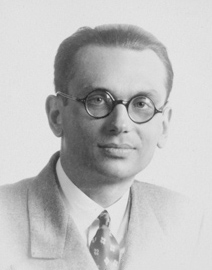
George Boolos in Mind (1994) [h/t: Dan Balis]:

First of all, when I say “proved”, what I will mean is “proved with the aid of the whole of math”. Now then: two plus two is four, as you well know. And, of course, it can be proved that two plus two is four (proved, that is, with the aid of the whole of math, as I said, though in the case of two plus two, of course we do not need the whole of math to prove that it is four). And, as may not be quite so clear, it can be proved that it can be proved that two plus two is four, as well. And it can be proved that it can be proved that it can be proved that two plus two is four. And so on. In fact, if a claim can be proved, then it can be proved that the claim can be proved. And that too can be proved.

Now, two plus two is not five. And it can be proved that two plus two is not five. And it can be proved that it can be proved that two plus two is not five, and so on.

Thus: it can be proved that two plus two is not five. Can it be proved as well that two plus two is five?

More here.

E.L. Doctorow’s Novels About American History Changed the Future of Fiction

Lede_doctorow

Jeet Heer in The New Republic:

E.L. Doctorow, who died yesterday, wrote historical novels that never ran the risk of being merely antiquarian. The past was never really dead for Doctorow, but always connected to present-day realities. Doctorow himself was more than a fiction writer. He was a bridge to an older America, one that shaped the modern world in ways that were often willfully forgotten.

In his 1991 book Postmodernism, the literary critic Fredric Jameson wrotethat “E. L. Doctorow is the epic poet of the disappearance of the American radical past, of the suppression of older traditions and moments of the American radical tradition: no one with left sympathies can read these splendid novels without a poignant distress that is an authentic way of confronting our own current political dilemmas in the present.”

A prime example of what Jameson had in mind was Doctorow’s The Book of Daniel (1971), about a 1960s student activist researching his parents, executed spies loosely based on Julius and Ethel Rosenberg. The Book of Daniel is much more polarizing than other Doctorow’s other novels—former editor of the New York Times Book Review Sam Tanenhausdismissed it as “kitsch” on twitter yesterday—but it is central to his development as a writer. It was in The Book of Daniel that Doctorow discovered his great theme, the return of the repressed, the way the political movements that were crushed by McCarthyism in the early cold war came to the fore in other guises in the 1960s.

Doctorow’s historical vision was enormous in scope and bookended by two wars: the Civil War and the Vietnam War. His prime interest was the America that ran from Abraham Lincoln to Harry Truman, the America that crushed the Confederacy but left the problem of slavery unresolved, the America of mass immigration and industrialization, of labor unions and robber barons.

More here.

Body Shaming Black Female Athletes Is Not Just About Race

Serena-williams2

Kareem Abdul-Jabbar in Time:

Serena Williams won her 21st Grand Slam title at Wimbledon this month. This marks the 17th time in a row that she has defeated Maria Sharapova. Yet Williams, who has earned more prize money than any female player in tennis history, is continually overshadowed by the woman whom she consistently beats. In 2013, Sharapova earned $29 million, $23 million of that from endorsements. That same year, Williams earned $20.5 million, only $12 million of that from endorsements. How’s that possible? Because endorsements don’t always reward the best athlete. They often reward the most presentable according to the Western cultural ideal of beauty.

I know, you think this article is about racism. It’s not.

Misty Copeland just became the first African-American woman to be named principal dancer at the American Ballet Theatre. But when she was 13, she was rejected from a ballet academy for having the wrong body type. As an ad featuring Ms. Copeland put it, summarizing the responses she received early in her career: “Dear candidate, Thank you for your application to our ballet academy. Unfortunately, you have not been accepted. You lack the right feet, Achilles tendons, turnout, torso length, and bust.” At 13? That criticism of her body being too muscular and “mature” has followed her throughout her career. “There are people who say that I don’t have the body to be a dancer, that my legs are too muscular, that I shouldn’t be wearing a tutu, that I don’t fit in,” Copeland said in response.

What do these two highly successful athletic women have in common? They seem to endure more body shaming than their white, less successful counterparts.

More here.

Yes, it’s possible to be queer and Muslim

Lamya H in Salon:

Queer_muslimI’m excited about this date, I really am.

It’s been a while since my last heartbreak, and my best friend has personally taken on the task of deciding for me that it’s time to move on. She has yelled at me to download Tinder, cheered me on as I cobble together a profile. Encouraged me to swipe right a few times, talk to women I match with. It’s taken a while, but I’m starting to get into it. And now I’m excited about this date.

She’s risen to the top of my tinder crushes, this date. The banter – an essential component of all my crushing – has been electric, and she’s smart and funny and gorgeous to boot.

We’re meeting for ice cream, and she’s a little late, my date. I scan the passing faces for resemblances to the photos she has up on Tinder, wanting to spot her before she does me. “Look for the hijab,” I’ve told her, a little anxious to reveal what’s under the hats and the helmets in my own pictures. “I’m hard to miss.” Her nonchalant response – neither fetishizing nor surprised – puts me at ease. I’m excited about this date.

Except.

Except we spot each other at the same time, exchange shy glances and quick hellos before ordering, sit down with our ice creams, and her second question to me is: “So. Tell me, Lamya. How are you queer and Muslim at the same time?”

Always, the except.

This happens often enough that I have a strategy. For basic white girls with no subtlety, for women at lesbian bars making small talk, for those who have taken no time to get to know me and are obviously not invested in my answers. For quick dismissals, for moving on.

More here.

Workers Aren’t Disappearing

Doug Henwood in Jacobin:

ScreenHunter_1269 Jul. 22 22.44Paul Mason has a breathless piecein the Guardian making grand New Economy claims that sound like recycled propaganda from the late 1990s — though he gives them a left spin: post-materiality is already liberating us. I wrote a book that was in large part about all that ideological froth, published in 2003, and so far I’ve been struck by the non-revival of that discourse despite a new tech bubble. Uber and Snapchat don’t excite the same utopian passions that the initial massification of the web did.

I’ll pass on refuting Mason’s article, because I already did that twelve years ago. But I do want to comment on one point that Mason makes — one that’s ubiquitous in a lot of economic commentary today: capitalists don’t need workers anymore. As he puts it:

Postcapitalism is possible because of three major changes information technology has brought about in the past 25 years. First, it has reduced the need for work, blurred the edges between work and free time and loosened the relationship between work and wages. The coming wave of automation, currently stalled because our social infrastructure cannot bear the consequences, will hugely diminish the amount of work needed — not just to subsist but to provide a decent life for all.

I can’t make sense of the “currently stalled because our social infrastructure cannot bear the consequences” — has capitalism ever skipped an innovation because of its social consequences? — but there’s no evidence that info tech is “hugely diminish[ing] the amount of work needed.” Sure, wages and benefits stink, but that’s about politics and class power, not because of the latest generation of Intel chips or something fresh out of the latest TechCrunch Disrupt.

More here.

To build a scientist

From Nature:

ScientistPhD programmes often lead to an increasing narrowness and specialization, which results in graduate students who are not sufficiently exposed to wider aspects of their subject and of related subjects. Looking outside the immediate interests of a thesis project can lead to real creative advances. One way to expand thinking is to ensure that students have access to a series of inspirational speakers who will cover a wide range of scientific topics, with at least some who are more removed from their PhD focus. At the Francis Crick Institute, we will cover a wide range of biomedicine with truly inspirational speakers, but also look at other areas of science, such as high-energy physics, dark matter and aspects of biology, such as evolution and ecology, that are more distant from biomedicine.

Another suggestion is for what I call 'master classes', after the model of players of musical instruments. In science master classes, a group of graduate students would be exposed to a true expert, an excellent practitioner who would talk about doing science. I don't mean discussing the details of experiments, but discussing the broader questions: how do you do a satisfactory experiment, how do you do rigorous work, what is the nature of knowledge and so on. The final suggestion is to broaden expectations. When students are three-quarters of the way through their graduate degree, they should be intensively mentored and urged to discuss their future careers.

More here.

Episodes in the Life of Bounce

Weiditz_Trachtenbuch_1529_finalCarlin Wing at Cabinet Magazine:

All cultures engage in some form of ball play. Ball games are a basic way for us to hone what computational neuroscientist Beau Cronin calls “the quotidian spatiotemporal genius of the human brain,” and over the past two hundred years, they have come to dominate the popular imagination, with huge swaths of airtime and large volumes of ink given over to the dramas of soccer, basketball, baseball, American football, tennis, golf, rugby, cricket—the list goes on.1 All ball sports are aleatoric structures organized, to greater or lesser degrees, around bounce. Aleatoric structures—structures of planned chance—produce a reliable kind of uncertainty. We don’t know who will win and who will lose, but we know that at the end of the day, there will be a winner and a loser. A ball introduces a second, more uncertain, kind of uncertainty into the fray. Its bounce dances along the edge of our predictive capacity, always almost but never fully under control. At least in the Anglophone world, this second kind of chance—the chance of the ball—seems to be especially important to our contemporary understanding of play.2 While other kinds of contests are raced, run, rowed, and swum; wrestled, fenced, fought, and boxed; timed, weighed, measured, and judged; ball games are played. And only an athlete who contends with balls (or pucks, or shuttlecocks, or other third objects) earns the title “player.” We become players in and through bounce.

more here.

Wednesday Poem

The Full Indian Rope Trick

There was no secret
murmured down through a long line
of elect; no dark fakir, no flutter
of notes from a pipe,
no proof, no footage of it –
but I did it,

Guildhall Square, noon,
in front of everyone.
There were walls, bells, passers-by;
a rope, thrown, caught by the sky
and me, young, up and away,
goodbye.

Goodbye, goodbye.
Thin air. First try.
A crowd hushed, squinting eyes
at a full sun. There
on the stones
the slack weight of a rope

coiled in a crate, a braid
eighteen summers long,
and me –
I’m long gone,
my one-off trick
unique, unequalled since.

And what would I tell them
given the chance?
It was painful; it took years.
I’m my own witness,
guardian of the fact
that I’m still here.
.

by Colette Bryce
from The Full Indian Rope Trick
publisher: Picador, London, 2004

Tuesday, July 21, 2015

The Story of My Nine Lives

Wes Marfield in The New Yorker:

Life No. 1

ScreenHunter_1268 Jul. 21 22.26The cool thing about being a cat is that you can just wander from house to house and folks will take you in, feed you, and love you, no questions asked. I’ve got Canterbury Street on lockdown, man—from the Hansens’, on the corner, with the oversized litter box they installed for me in their back yard (or “sandbox,” as they euphemistically call it), to the Griffins’ colonial, with my special “doggy” door to the screened-in porch. Look! What’s that in the driveway? Is Mrs. Griffin’s Audi leaking antifreeze or did she leave me a saucer of blue Gatorade? Only one way to find out!

More here.

Hackers Remotely Kill a Jeep on the Highway—With Me in It

Andy Greenberg in Wired:

ScreenHunter_1267 Jul. 21 22.15I was driving 70 mph on the edge of downtown St. Louis when the exploit began to take hold.

Though I hadn’t touched the dashboard, the vents in the Jeep Cherokee started blasting cold air at the maximum setting, chilling the sweat on my back through the in-seat climate control system. Next the radio switched to the local hip hop station and began blaring Skee-lo at full volume. I spun the control knob left and hit the power button, to no avail. Then the windshield wipers turned on, and wiper fluid blurred the glass.

As I tried to cope with all this, a picture of the two hackers performing these stunts appeared on the car’s digital display: Charlie Miller and Chris Valasek, wearing their trademark track suits. A nice touch, I thought.

The Jeep’s strange behavior wasn’t entirely unexpected. I’d come to St. Louis to be Miller and Valasek’s digital crash-test dummy, a willing subject on whom they could test the car-hacking research they’d been doing over the past year. The result of their work was a hacking technique—what the security industry calls a zero-day exploit—that can target Jeep Cherokees and give the attacker wireless control, via the Internet, to any of thousands of vehicles. Their code is an automaker’s nightmare: software that lets hackers send commands through the Jeep’s entertainment system to its dashboard functions, steering, brakes, and transmission, all from a laptop that may be across the country.

To better simulate the experience of driving a vehicle while it’s being hijacked by an invisible, virtual force, Miller and Valasek refused to tell me ahead of time what kinds of attacks they planned to launch from Miller’s laptop in his house 10 miles west.

More here.

Against Honeymoons

Charles Comey in The Point:

ScreenHunter_1266 Jul. 21 22.10The honeymoon as we know it, the postnuptial trip for two, hasn’t been around all that long. In the nineteenth century there was something called a “bridal tour,” where newlyweds would travel, sometimes accompanied by friends and family, to visit relatives who hadn’t been able to attend the wedding. The bridal tour made sense when a marriage was much more about social ties and the joining of two families than it is now: the pair journeyed not as tourists but as a tour. At the turn of the century couples began to adapt the bridal tour to make it a private pleasure trip instead. In Marriage, a History Stephanie Coontz talks about the transition from bridal tour to honeymoon as part of a larger revolution in the form of family life in general: the increasing interiority and privacy of the family unit, as well as marriage becoming obsessively all about the two individuals and their bond.

It’s easy to understand why, for the first half of the twentieth century, the honeymoon was so appealing. Until relatively recently a marriage came after courtship: after semi-public calls to an eligible girl, usually in her living room. The honeymoon provided some much needed one-on-one time. Naturally, in its privacy, this was also the time to cleave, carnally, finally, to one’s new spouse. In fact at first the honeymoon was a bit scandalous for this reason, because of the attention it drew to the bridal bed. But as the twentieth century softened in its attitude toward sexuality that turned around. To my grandparents’ generation, the thundering of Niagara Falls was a trope for newlywed sex, and going to Niagara was about giving in to an irresistible force of nature. (Thus the rhyming of “Viagra,” which is meant to draw on that association.)

More here.

Can Moral Disputes Be Resolved?

Alex Rosenberg in the New York Times:

13stoneWeb-blog480Moral disputes seem intractable — more intractable than other disputes. Take an example of a moral position that most of us would consider obvious: Honor killing is wrong. But honor killing has its supporters. Anyone who suggests that we can compromise with its supporters on the matter misunderstands the nature of this type of disagreement. It’s absolute. One party has to be right. Us. So why can’t we convince those who hold the opposite view?

With some exceptions, political disputes are not like this. When people disagree about politics, they often agree about ends, but disagree about means to attain them. Republicans and Democrats may differ on, say, health care policy, but share goals — a healthy American population. They differ on fiscal policy but agree on the goal of economic growth for the nation. Of course, this is often a matter of degree. Political disputes can have moral aspects, too. The two sides in the debate over abortion rights, for instance, clearly don’t agree on the ends. There is an ethical disagreement at the heart of this debate. It is safe to say that the more ethical a political dispute is, the more heated and intractable it is likely to become.

Honor killing is the execution of one’s own family member, often a woman, who is seen to have brought disgrace to the family. It is a practice most of us find absolutely wrong, no matter the goal — in this case, restoring dignity to the family. The fact that it is a practice long sanctioned in other cultures does not matter to us. Meanwhile, those who approve of or carry out honor killings reject our condemnation, and most likely see it as a moral lapse of ours.

What makes moral disagreements so intractable? Ethics shouldn’t be as hard as rocket science.

More here.

Bitcoin innovations will come from developing countries

Liat Clark in Wired:

ScreenHunter_1265 Jul. 21 21.59The most exciting innovations in digital currencies will come from developing countries, where financial infrastructure is not as strong, says MIT Media Lab director of digital currency, Brian Forde.

Speaking at WIRED Money 2015, Forde explained that the mainstream British and American public cannot quite grasp the gravity of the economic revolution we have at our fingertips, because in these countries an ATM is always a few hundred metres away and everyone accepts credit cards. In many places across the globe, though, the status quo is not quite so straightforward.

“Today, in 2015, I still can't use Paypal to send money to friends in Nicaragua,” says Forde, former senior adviser for mobile and data innovation at the White House. “But I can send them Bitcoin instantly.”

In Ukraine, during the three-month protest in Kiev's Independence Square in 2013-2014, activists managed to fund their activities by plastering QR codes on their signs, which led supporters of the cause to a Bitcoin address. 'They instantly had Bitcoin in their wallet they could use,” says Forde. He tells the story of a recent interlude with someone who works in social welfare for government, where he discovered the convoluted process of how they distribute physical cash. “25 percent of the population that receives this cash doesn't live near an ATM. Sometimes they have to put it in a canoe, and the insurance company that delivers the money will only allow a certain amount in each canoe. They spend more money on the delivery of cash than the cash that's delivered.”

More here.

IF SCENT HAS A HOTLINE TO MEMORY, IT SEEMS MUSIC HAS A HOTLINE TO EMOTION

From The Sync Project:

Music+and+Emotion+-+SyncProjectMusic has the power to stimulate strong emotions within us, to the extent that it is probably rare not to be somehow emotionally affected by music. We all know what emotions are and experience them daily. Most of us also listen to music in order to experience emotions. The specific mechanisms through which music evokes emotions is a rich field of research, with a great number of unanswered questions. Why does sound talk to our emotional brain? Why do we perceive emotional information in musical features? Why do we feel the urge to move when hearing music? Through increasing scientific understanding of the universal as well as the individual principles behind music-evoked emotions, we will be able to better understand the effects that music-listening can have and make better use of them in an informed manner.

Perhaps the primary reason for music listening is the power that music has in stirring our emotions. Music has been reported to evoke the full range of human emotion (1, 2): from sad, nostalgic, and tense, to happy, relaxed, calm, and joyous. Correspondingly, neuroimaging studies have shown that music can activate the brain areas typically associated with emotions (3): the deep brain structures that are part of the limbic system like the amygdala and the hippocampus as well as the pathways that transmit dopamine (for pleasure associated with music-listening). The relationship between music-listening and the dopaminergic pathway is also behind the “chills” that many people report experiencing during music-listening. Chills are physiological sensations, like the hairs getting raised on you arm, and the experience of “shivers down your spine” that accompany intense, peak emotional experiences.

However, we don’t always listen to music to be moved – sometimes people use music for other effects.

More here.

A new impulse – But for which Europe?

Balibar_ni_468wÉtienne Balibar at Eurozine:

The history of European construction is long enough to have traversed many distinct phases or stages, each tightly linked to the transformations of the “world-system”.[1] It is convenient to identify them by way of the correspondence between the successive extensions of the European system and the growing complexity of the institutions that ensure its integrity while managing the unstable equilibrium between national sovereignty and communal governance. There are, arguably, three stages: the first stage, from the European Coal and Steel Community (ECSC) to the aftermath of the 1968 events and the oil crisis (without forgetting Richard Nixon's shock assault against the Bretton Woods system);[2] the second stage, from the early 1970s to the fall of the Soviet Union and the German reunification in 1990; finally, the last stage, from the Eastward growth to the crisis generated by the bursting of the American speculative bubble in 2007 and, in Europe, the sovereign defaulting of Greece which was averted at the last moment under well-known circumstances in 2010.

Does the current moment signify the beginning of a new phase? I do think so, even if the tensions that we are observing are only the consequence of a forced entry into globalization, which has dominated the politics of the community for twenty years – or perhaps for this very reason: these national and social tensions have reached a rupture point. A period of uncertainty and of fluctuation has begun and with it the possibility of a new crossing, the terms of which are unpredictable.

more here.