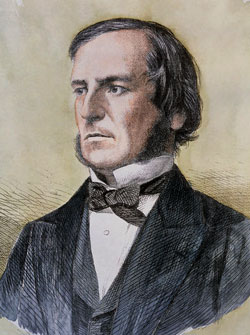
George Boole and the wonderful world of 0s and 1s

George_boole_color

Ems Lord in Plus Magazine:

The story of George Boole (1815-1864) is an extraordinary example of collaboration across the centuries. Boole's work provided the foundations for today's computers and mobile phones, yet he died many years before the first computers were invented. How did a mathematician who lived, and died, in the nineteenth century have such an impact on our twenty-first century technology? This is the tale of self-taught mathematician George Boole and the modern day engineers who recognised the power of his ideas.

Boole's early life

George Boole's early life did not mark him out as a ground-breaking mathematician. Born in Lincoln in 1815, he was the son of a local cobbler and would have been expected to work in the family shoe making business as he grew older. But his father's business collapsed and Boole became a local school teacher instead. By the age of 19, he was already a head teacher, spending his evenings and weekends exploring his mathematical ideas. His initial writings appeared in the Cambridge Mathematics Journal and his work soon attracted the attention of the Royal Society. In 1844 Boole was awarded the Royal Society's Royal Medal for his paper On a general method of analysis. His increased profile led to the offer of a professorship in mathematics. Boole left behind his Lincolnshire teaching career and headed off to Cork University to pursue his mathematics full-time, and make the break-through that still impacts on our lives today.

The breakthrough

During his time in Ireland, Boole focused on combining logical deduction with algebra. He argued that the logical approach taken by the ancient Greek philosopher Aristotle and his followers was insufficient for addressing certain types of problems. He focused on those problems where individual statements, or propositions, could either be described as true or false. Boole's work required the development of a new branch of algebra and its associated arithmetical rules.

To introduce Boole's ideas, consider these two propositions:

A = David Beckham is a footballer

B = Quidditch is an Olympic sport

We know that one of them is true and the other is false (I'll let you decide which is which!). But what about the statement A AND B: David Beckham is a footballer AND Quidditch is an Olympic sport? It's clearly false! For it to be true, we would need each of A and B to be true, which isn't the case. Therefore, the statement A AND B is false. If we assign the truth value 0 to a false statement and the value 1 to a true one, then we can write the AND connective as a kind of multiplication: AB stands for A AND B, and since one is true and the other false, we see that AB has the truth value 0 x 1 = 0.

More here.
Monday, November 9, 2015

Sunday, November 8, 2015

Behind ‘King Lear’: The History Revealed

Otoole_1-111915_jpg_600x694_q85

Fintan O’Toole in NY Review of Books:

Even by its own standards of extremity, King Lear ends on a note of extraordinary bleakness. The audience has just been through the most devastating scene in all of theater: Lear’s entrance with his dead daughter Cordelia in his arms and the words “Howl, howl, howl, howl!” coming from somewhere deep inside him. All is, as Kent puts it, “cheerless, dark, and deadly.”

Albany, the weak, widowed, and childless man who is all that remains of political authority, goes through the ritual end-of-play motions of rewarding the good and punishing the bad, but these motions are self-consciously perfunctory. When he says, “What comfort to this great decay may come/Shall be applied,” we know that the comfort will be small and cold. Albany promises to restore Lear to his abandoned kingship, but the old king utterly ignores the offer of power, and promptly dies.

Albany then tries to appoint Edgar and Kent as joint rulers, but Kent replies that he, too, intends to die shortly. No one, it seems, is willing to perform the necessary theatrical rites of closure, to present even the pretense that order has been restored. And so the only possible ending is the big one. Because the play cannot end, the world must end. In the original version that Shakespeare completed in 1606, the last lines are Albany’s:

The oldest have borne most. We that are young
Shall never see so much, nor live so long.

Why will the young not live to be old? Because the end of the world is coming. The bad news does not end there. This is not even the Christian apocalypse, in which the bad are damned to Hell and the good ascend into the eternal bliss of Heaven.

More here.

Translating Galeano

Eduardo_Galeano_en_1984

Mark Fried in Brick:

I began reading Eduardo Galeano when I arrived in Mexico for the first time—it was 1973—and met Cedric Belfrage, whose translation of Open Veins of Latin America had just been published. Open Veins was a treatise on history and political economy written like a novel about love or pirates. It thrilled me: here was the mysterious continent explained.

At the time, Eduardo was being persecuted in his native Uruguay for the crime of spreading dangerous ideas. By then, at thirty-three, he had also written a book of short stories and a novel but was better known for the editorial cartoons he had been publishing since the age of thirteen. In 1974 he fled to Buenos Aires and then, when military rule swept Argentina too, on to Spain, where he lived for eight years.

He credits the Uruguayan and Argentinean generals with giving him the time and perspective to step back from political agitation and return to literature. By a curious twist of fate, the result of his labours in exile, the marvellous trilogy Memory of Fire, became the translation sea in which I first swam.

Cedric Belfrage and I were working together on a Mexico City magazine, the year was 1980 or 1981. Cedric himself was a character out of a novel. He started as a publicist in England for the unknown Alfred Hitchcock, then in the 1920s covered Hollywood for Fleet Street, managed to survive marriage to a starlet who stabbed him in the bath, and was suddenly radicalized by the rise of Hitler.

He was nearly eighty and had begun translating the first volume of the trilogy when a stroke left him paralyzed on one side. Like most journalists, he had always typed with his two index fingers; now he was down to one. He appealed to me for help, and thus began my apprenticeship in literary translation. In his tiny office reeking of pipe smoke, Cedric would translate longhand on yellow legal pads, a barely legible scrawl. I would type for him, following the Spanish original at hand, and offer suggestions. Over the next four years, well oiled with frequent tequilas, he put out the first two volumes of Memory of Fire, and I learned a thing or two about translation.

More here.

‘Creating Art With Mathematics’

Pradeep Mutalik in Quanta Magazine:

Our Insights puzzle this month challenged Quanta readers to create pleasing symmetrical curves using mathematical expressions after solving a couple of problems, which were intended to help them divine the principles behind examples given by Frank Farris in his book Creating Symmetry: The Artful Mathematics of Wallpaper Patterns (Princeton University Press, 2015). As usual, our readers rose to the occasion, clearly explaining how the mathematics works to generate the symmetries, and then producing some breathtaking curves of their own.

Here are the questions and their solutions:

Question 1:

Look at the family of symmetrical curves below, one of which is featured in Farris’ book as a “mystery curve”:

[No Caption]

Each of these curves has an ordered pair of numbers associated with it, shown at the lower left of the curve. These two numbers determine the type of symmetry and complexity exhibited by the curve, and a simple mathematical relationship between the two numbers is required to generate the curve’s pleasant symmetry. In the second question below, we’ll give you the precise way these numbers are used to generate their curve. Without looking ahead, ponder these numbers and try to get an intuitive sense of how the curves change as the numbers do. Then look at curves A and B below and see if you can match them to the correct pairs of numbers, from the 10 choices given. Give your reasons for choosing your particular pairs and describe what you think the relationship is between the two numbers.

[No Caption]

Choices:

1. (5, –19) 2. (6, –19) 3. (7, –17) 4. (7, –12) 5. (7, –19)
6. (8, –20) 7. (8, –12) 8. (8, –13) 9. (8, –19) 10. (6, –24)

With careful observation it is not hard to establish a simple intuitive correlation between each curve and its pair of numbers, without any reference to the actual equations that generated them. From left to right, our example curves have sixfold, fivefold, fourfold and fourfold symmetry, while the first numbers associated with them are 7, 6, 5 and 5, respectively.

More here.

Finding Time

Rebecca Solnit in Orion Magazine:

SoundTHE FOUR HORSEMEN OF MY APOCALYPSE are called Efficiency, Convenience, Profitability, and Security, and in their names, crimes against poetry, pleasure, sociability, and the very largeness of the world are daily, hourly, constantly carried out. These marauding horsemen are deployed by technophiles, advertisers, and profiteers to assault the nameless pleasures and meanings that knit together our lives and expand our horizons. I’m listening to a man on the radio describe how great it is that there are websites where musicians who have never met or conversed or had any contact at all can lay down tracks together to make songs. While the experiment sounds interesting, the assumption sounds scary — that the complex personal, creative, and cultural collaborations of music-making could be unnecessary and you just need the digital conjunction of some skill sets. The speaker seems to believe that the sole goal is the production of songs, sundered from the production of social ties and social pleasure. But music has always been an occasion for people to get together — in rehearsals, nightclubs, parties, festivals, park band-shells, parades, and other social spaces. It is often the soundtrack to bodies in conjunction, whether marching or making love.

Ensemble music made in solitude is a very different thing; as a norm it signifies a loss. The loss is subtle and hard to describe, especially compared to the wonders of what can be uploaded, downloaded, and Googled, and the convenience and safety of never leaving your house or never meeting a stranger.

More here.

CHOOSING EMPATHY: A Conversation with Jamil Zaki

Jamil Zaki in Edge:

Zaki640I've been thinking an enormous amount about a puzzle concerning how empathy works. Before describing it, I should make sure that we're on the same page about what empathy is. To me, empathy is a useful umbrella term that captures at least three distinct but related processes through which one person responds to another person's emotions. Let's say that I run into you and you are highly distressed. A bunch of things might happen to me. One, I might “catch” your emotion and vicariously take on the same state that I see in you; that's what I would call experience sharing. Two, I might think about how you feel and why you feel the way you do. That type of explicit consideration of the world as someone else sees it is what I would call mentalizing. Three, I might develop concern for your state, and feel motivated to help you feel better; that is what people these days call compassion, also known as empathic concern. It often seems like these processes—sharing someone's emotions, thinking about their emotions, and wanting to improve their emotional state—should always go together, but they split apart in all sorts of interesting ways. For instance, people with psychopathy are often able to understand what you feel, but feel no concern for your emotions, and thus can leverage their understanding to manipulate and even harm you.

I spent several years early in my career thinking about these empathic processes and how they interact with each other, but in the last couple of years, I've zoomed out. I've stopped thinking as much about the “pieces” that make up empathy and started thinking about why and when people empathize in the first place. This is where the puzzle comes in, because there are two different narratives that you might hear about how empathy works. They're both compelling and very well supported, and they're pretty much entirely contradictory with each other, at least at first blush.

More here.

Sunday Poem

Kudzai

Kudzai,
when your first birthday passed
without a word
without a symbol
you kept quiet;
and when your second passed
without a present
without a party
you kept quiet.
But when your third birthday passed
you made your own car,
a mud car you drove around,
making your own world,
making your life with care
at the closed gate of privilege.
.

by Julius Chingono
from Flag of Rags
A joint publication by Quartz Press
and Hippogriff Press, Johannesburg

.

Saturday, November 7, 2015

Power to the people: a Syrian experiment in democracy

New World Summit–Rojava, Part I from New World Summit on Vimeo.

Carne Ross in the FT:

Perhaps the last place you would expect to find a thriving experiment in direct democracy is Syria. But something radical is happening, little noticed, in the eastern reaches of that fractured country, in the isolated region known to the Kurds as Rojava.

Just as remarkable, perhaps, is that the philosophy that inspired self-government here was originated by a little-known American political thinker and one-time “eco-activist” whose ideas found their way to Syria through a Kurdish leader imprisoned upon an island in the Sea of Marmara. It’s a story that bizarrely connects a war-torn Middle East with New York’s Lower East Side.

I visited Rojava last month while filming a documentary about the failings of the western model of democracy. The region covers a substantial “corner” of north-east Syria and has a population of approximately 3m, yet it is not easy to get to. The only passage is by small boat or a creaky pontoon bridge across the Tigris from Iraq.

Turkey has closed its borders with Rojava, preventing all movement from the north, including humanitarian supplies to Kurdish-controlled areas. To the south, in Iraq, the Kurdistan Regional Government does not make access easy; permits for journalists are not straightforward and, we were told, repeat visits are discouraged.

The isolation is not only physical. Turkey regards the Syrian Kurd YPG militia that is fighting the jihadi organisation Isis in Rojava as synonymous with the Kurdistan Workers’ party (PKK), a longstanding enemy inside Turkey. The YPG’s advance against Isis along Syria’s northern border has been halted by the declaration by Turkey of a so-called “safe zone” to the west of the Euphrates between the front line and the Kurdish-controlled canton of Afrin in the north-west. For the Kurds, the motive seems transparently clear: to prevent the formation of a contiguous area of Kurdish control along Turkey’s southern border.

The KRG, which collaborates with Turkey against the PKK, has also been reluctant to support the YPG, even though they share a common enemy in the shape of Isis.

More here.

Wouldn’t you like to know what’s going on in my mind?

Scarecrow-wizard-of-oz

John Preskill in Quantum Frontiers [via Sean Carroll]:

I suppose most theoretical physicists who (like me) are comfortably past the age of 60 worry about their susceptibility to “crazy-old-guy syndrome.” (Sorry for the sexism, but all the victims of this malady I know are guys.) It can be sad when a formerly great scientist falls far out of the mainstream and seems to be spouting nonsense.

Matthew Fisher is only 55, but reluctance to be seen as a crazy old guy might partially explain why he has kept pretty quiet about his passionate pursuit of neuroscience over the past three years. That changed two months ago when he posted a paper on the arXiv about Quantum Cognition.

Neuroscience has a very seductive pull, because it is at once very accessible and very inaccessible. While a theoretical physicist might think and write about a brane even without having or seeing a brane, everybody’s got a brain (some scarecrows excepted). On the other hand, while it’s not too hard to write down and study the equations that describe a brane, it is not at all easy to write down the equations for a brain, let alone solve them. The brain is fascinating because we know so little about it. And … how can anyone with a healthy appreciation for Gödel’s Theorem not be intrigued by the very idea of a brain that thinks about itself?

The idea that quantum effects could have an important role in brain function is not new, but is routinely dismissed as wildly implausible. Matthew Fisher begs to differ. And those who read his paper (as I hope many will) are bound to conclude: This old guy’s not so crazy. He may be onto something. At least he’s raising some very interesting questions.

More here.

How to Solve the Hardest Logic Puzzle Ever

7532_aeecc5a9c646444f00978ed43e747a96

Brian Gallagher in Nautilus:

The Hardest Logic Puzzle Ever goes like this:

Three gods A, B, and C are called, in some order, True, False, and Random. True always speaks truly, False always speaks falsely, but whether Random speaks truly or falsely is a completely random matter. Your task is to determine the identities of A, B, and C by asking three yes-no questions; each question must be put to exactly one god. The gods understand English, but will answer all questions in their own language, in which the words for “yes” and “no” are “da” and “ja,” in some order. You do not know which word means which.

Always up for a challenge, I sat down on my couch, pen and paper in hand, confident I could conquer the puzzle in two hours tops. It seemed to me that all I had to do was start by coming up with three questions at once and then work out their consequences. I asked A, for example, whether B was True; asked B whether A was True; and asked C whether he was True. Hours later, having asked the gods every yes and no question I could think of, I understood how the puzzle got its name. Clearly my questions weren’t compelling the gods to answer the way I wanted them to.

Frustrated, I went in search of enlightenment. The master atop the mountain turned out to be Boolos, who solved the puzzle in 1996. How he did it turns out to be one of the best lessons in logic and truth I have ever received. If you’d like to give the puzzle a try yourself, you can stop reading here. Good luck! If you succeed, you have my congrats. But if you don’t, come on back and you can go over Boolos’ solution with me below.

More here.

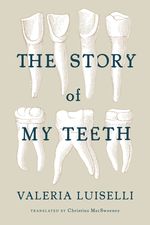
‘THE STORY OF MY TEETH’ BY VALERIA LUISELLI

Story-of-my-teethRosie Clarke at The Quarterly Conversation:

Humorous and heartbreaking, The Story of My Teeth is Luiselli’s follow-up to her award-winning debut, Faces in the Crowd. The author’s mastery of entrelacement was epitomized in that first book, which weaves together three plots into an intricate, and increasingly complex, braid of poignant narratives, where fact and fiction become indivisible (a refrain also common to this new work). Born in Mexico City in 1983, and currently based in New York City, Luiselli has lived in Costa Rica, South Africa, India, France, Spain, and South Korea. Despite such varied environments, two places in particular form a crucial part of her fiction: both Mexico and Manhattan play pivotal roles, often more like characters than settings. While Faces in the Crowd took us into the heart of Harlem, in The Story of My Teeth the nooks and crannies of the Distrito Federal are made tangible through Luiselli’s deftly descriptive prose, with the assistance of photographs documenting the real-life locations featured in the novel.

Written in instalments for the workers of the Jumex juice factory in Ecatepec, Mexico City,The Story of My Teeth recalls the heyday of serialized literature, when publishing chapters sequentially in magazines was a way of broadening readership to include those unable to afford books. In this case, each chapter was distributed among workers in the form of an egalitarian chapbook (with some so enamoured that a weekly reading group was formed, Luiselli subsequently receiving MP3 recordings of their meetings). In contrast to 19th-century serializations, modern technology allowed her to mold her written responses to include workers’ input. In this way, The Story of My Teeth is highly collaborative, and while Luiselli’s skill as storyteller is indisputable, the book’s rich sense of authenticity, locale, and character are surely in part due to numerous personal contributions, in addition to the many factual elements involved in what is otherwise an improbable tale.

more here.

on Michel Houellebecq’s ‘Submission’

1108-BKS-Knausgaard-LEAD-master675Karl Ove Knausgaard at The New York Times:

“Through all the years of my sad youth Huysmans remained a companion, a faithful friend; never once did I doubt him, never once was I tempted to drop him or take up another subject; then, one afternoon in June 2007, after waiting and putting it off as long as I could, even slightly longer than was allowed, I defended my dissertation, ‘Joris-Karl Huysmans: Out of the Tunnel,’ before the jury of the University of Paris IV-Sorbonne.”

So ran my first Houellebecq sentence, the beginning of the novel “Submission.” What kind of a sentence is it? It is not in any way spectacular, more distinctly literary, certainly not the opening of a blockbuster — and not just because it concerns a man whose youth was dismal and his relationship to what the vast majority of people would consider a highly obscure author of the 19th century, but also because the sentence in itself (at least as I read it in the Norwegian rendering, which I sense perhaps is closer in style to Houellebecq’s original than Lorin Stein’s graceful English translation) is anything but impressive, rather it is strikingly ordinary, sauntering in a way, slightly disharmonious and irregular in rhythm, untidy even, as if the author lacks full mastery of the language or is unused to writing.

What does this mean? It means that from the outset, the novel establishes a human presence, a particular individual, a rather faltering and yet sincere character about whom we already know something: His youth was unhappy and endured by the reading of novels, which became so important to him he felt compelled to study literature, in a sheltered environment in which he wished to remain for as long as possible, the environment in which literature is read and written about.

more here.

on ‘Augustine: Conversions and Confessions’, by Robin Lane Fox

Ae770a9d-8605-4b40-8465-ba199b650b76John Cornwell at the Financial Times:

Citing earlier Christian writers, Lane Fox quarrels at the outset with claims, controversial to this day, that Augustine “invented” original sin — the doctrine that the entire human race, with the exception of the Virgin Mary, inherited the sin of Adam and Eve and its consequences. His discussion of Augustine’s sexual exploits (“I was boiling over,” wrote Augustine, “because of my fornications”) goes beyond the standard commentaries to claim that “he has influenced our vocabulary for sexual desire ever since”. He refers to Augustine’s “flexibility” with the language of sex, and the dynamism of his metaphors. Where Augustine says that “the brambles of lust” were growing “beyond my head”, Lane Fox suggests that Augustine “actually did things, aged fifteen, and was as ‘wicked’ as possible”. In other words, his sexual sins, even at an early age, were no mere “impure thoughts”. Lane Fox is convinced, moreover, that Augustine probably indulged in same-sex liaisons as well as heterosexual ones.

With a dig at “pained modern liberal readers” who attempt to avoid the fact, he hammers home the significance of Augustine’s belief in predestination — that heaven awaits only those chosen by God, however hard the excluded try. He emphasises that Augustine was not claiming that he turned to God and thereby received God’s grace, but that God’s grace alone enabled him to turn in the first place. It is God who seeksus out.

more here.

Our Spoons Came from Woolworths: Barbara Comyns’s daring depiction of childbirth.

Emily Gould in The Paris Review:

SpoonsChildbirth, in literature, almost always takes place “offstage,” outside a book’s main action. Even contemporary novels, unless they are specifically about motherhood, birth babies in a sentence or two. What was Comyns up to, then, in devoting three chapters of this short book to Sophia’s labor and delivery? One possibility: the description of Sophia’s labor make the class and sex limbo that threatens her life inescapably clear: she is too middle-class to give birth, as poor people still mostly did in 1930, at home, but she is too poor to give birth, as richer women did, attended by competent doctors in a private hospital. Instead, she is treated brutally at the public hospital where a thoughtful friend of a friend has managed to get her admitted as a charity case. The fate that awaits her there is horrifying in part because its horror is so commonplace; millions of women shared it, and worse, still do. Even today birth is pathologized and shrouded in mystery in most of the developed world. Comyns, with her knack for defamiliarization that reveals the strangeness of the most familiar, was a perfect observer of the absurdity of the situation in which her narrator—and in which she—found herself. “Besides being very uncomfortable it made me feel dreadfully shamed and exposed. People would not dream of doing such a thing to an animal. I think the ideal way to have a baby would be in a dark, quiet room, all alone and not hurried.”

With these frank and detailed chapters, Comyns elevates what might have been a commonplace melodrama about a girl led astray into much more unusual sort of novel—especially for its time. The particulars of Sophia’s birth are outdated, but the feelings she describes—of shame, helplessness, and terror, wonder at her baby countered by fear for his life—are still far too common in life, yet still far too rare in literature.

More here.

The End of the Cold War

Duncan White in The Telegraph:

Gorbachev-largeOn May 28 1987, a skinny 19-year-old German took off from Helsinki in his Cessna and made for Moscow. Flying into Soviet airspace, Mathias Rust was tracked for a while by a MiG fighter, but carried on undaunted, flying low in a bid to avoid radar. Once over the Soviet capital, he used a map to find his way to Red Square, and took two low passes in an attempt to clear a space for a landing amid the gathering crowd before touching down on a neighbouring bridge. He chatted to the bemused Muscovites in awkward English; he said he wanted to “build an imaginary bridge” across the Iron Curtain. He asked if he might speak to Mikhail Gorbachev. The KGB had other ideas and locked him up.

Gorbachev, it turns out, was not even in Moscow, but at a meeting of Warsaw Pact leaders in East Berlin. When he was informed that an amateur aviator had penetrated what was supposed to be the most sophisticated air defence system in the world, he told the gathered leaders it constituted a grave humiliation for the Soviet Union. Inwardly, though, he was jubilant: Rust had given him leverage over the hardliners in the military who opposed his reforms. Eduard Shevardnadze, minister of foreign affairs and Gorbachev's partner in Perestroika, was so delighted that he celebrated by getting stuck into a bottle of brandy in his hotel room. The irony was that for all Rust's sentimental nonsense about imaginary peace bridges, his escapade did help to pave the way for major treaties on nuclear disarmament between the United States and the USSR. At a meeting of the Politburo on May 30, the defence minister Sergei Sokolov was forced to resign, and many sackings followed. It was a heavy blow to Gorbachev's opponents. Rust, meanwhile, spent two months in prison before being released in a diplomatic goodwill gesture.

More here.