
Category: Recommended Reading
Boygenius Is Driven by the Spirit of Solidarity
Carrie Battan at The New Yorker:
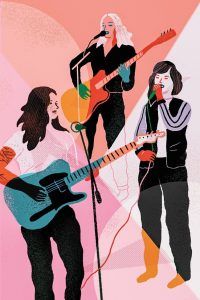 In 2016, the singer-songwriters Julien Baker, Lucy Dacus, and Phoebe Bridgers, who were all in their early twenties, were living parallel lives. They’d proved themselves to be careful and accomplished writers and performers, and had begun to attract attention from critics and labels alike. Each artist had crafted a distinct sound: Baker, a recovered opioid addict from Memphis, whose musical upbringing was in the Christian church, makes spare and swelling music that draws from the melodies and the ritualized melancholy of the emo world. Bridgers, a Los Angeles native who worshipped Elliott Smith and starred in an Apple commercial at the age of twenty-one, makes folksy, acoustic rock songs whose wispiness cleverly masks their morbid and searing lyrics. (One of her best songs, “Funeral,” details the experience of singing at the funeral of a boy who died of a heroin overdose.) Dacus has a deep, rich voice and makes more conventional rock songs, which she sings from a calm remove. But the three share indisputable similarities: they approach indie rock from a deliberate and plaintive perspective that skews more toward emo, folk, and blues than toward punk, and they write the kind of lyrics that warrant close reading. They are dutiful about guitar-rock songwriting without being explicitly reverential to a particular era.
more here.
How The World We Live in Already Happened in 1992
John Ganz at The Baffler:
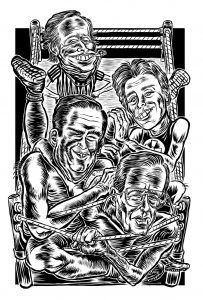 Who was the main enemy now? On the right, the answer increasingly was one another. In the 1980s, the conservative movement split into two warring factions—neoconservatives and paleo conservatives. The two sects fought over ideas, but also resources: comfortable think tank positions and administrative posts; grant money and the allegiance of the idle army of increasingly ideologically restive conservative activists who could scare up campaign contributions and votes.
The tribes huddled around their magazines, from whose pages they launched their slings and arrows. The capital of neoconland was Norman Podhoretz’s Commentary; major outposts were Tyrrell’s The American Spectator and Irving Kristol’s National Interest. Podhoretz and Kristol’s sons went into the family business. In the paleo mind, the Podhoretzes and Kristols were like two great feudal dynasties that would shower fellowship money on loyal retainers. The prominence of these two Jewish families in the conservative movement fed darker fantasies, too.
more here.
Philosophy of the Bedroom
Lisa Hilton at the TLS:
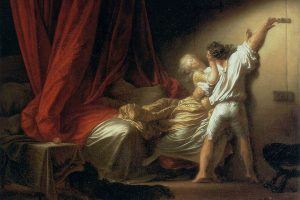 “Before the bedroom there was the room, before that almost nothing”, Perrot announces. She chooses to leapfrog over much medieval history and begin with a description of the king’s bedroom at Versailles under Louis XIV – an account for which she relies heavily on the memoirs of the duc de Saint-Simon, who spoke to the Sun King twice. Emmanuel Le Roy Ladurie is more thorough as an interpreter of the stultifying etiquette of the Versailles system, and Nancy Mitford much funnier; there is no fresh research or information in Perrot’s summary, which is at best indecisive as to the significance of the royal bedroom: “the king’s chamber guards its mysteries”. That said, we learn that Perrot intends to trace the origin of the desire for a “room of one’s own”, which mark of individualization is apparently less universal than it might appear. The Japanese had no notion of privacy, we are told, which might have come as news to the ukiyo-e artists of the seventeenth century; nonetheless, Perrot is broadly correct in her account of the evolution of private sleeping space as depending on the movement from curtained or boxed beds to separate chambers during the same period in Europe.
more here.
Enlightenment without end
John Gray in New Statesman:
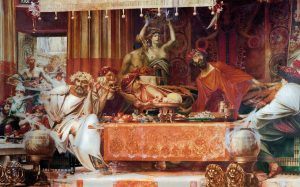 According to David Wootton, we are living in a world created by an intellectual revolution initiated by three thinkers in the 16th to 18th centuries. “My title is, Power, Pleasure and Profit, in that order, because power was conceptualised first, in the 16th century, by Niccolò Machiavelli; in the 17th century Hobbes radically revised the concepts of pleasure and happiness; and the way in which profit works in the economy was first adequately theorised in the 18th century by Adam Smith.” Before these thinkers, life had been based on the idea of a summum bonum – an all-encompassing goal of human life. Christianity identified it with salvation, Greco-Roman philosophy with a condition in which happiness and virtue were one and the same. For both, human life was complete when the supreme good was achieved.
But for those who live in the world made by Machiavelli, Hobbes and Smith, there is no supreme good. Rather than salvation or virtue they want power, pleasure and profit – and they want them all without measure, limitlessly. Partly this is because these are scarce and highly unstable goods, craved by competitors and exposed to the accidents of fortune, hard to acquire and easily lost. A deeper reason is that for these thinkers human fulfilment is something that is pursued, not achieved. Human desire is insatiable and satisfaction an imaginary condition. Hobbes summarised this bleak view pithily: “So that in the first place I put for a general inclination of all mankind a perpetual and restless desire of power after power, that ceaseth only in death.” As Wootton notes, Mick Jagger and Keith Richards voiced a similar view of the human condition in their song “(I Can’t Get No) Satisfaction”. Whether they knew it or not, the lyric captured the ruling world-view of modern times.
More here.
The Cat Who Could Predict Death
Siddhartha Mukherjee in Tonic:
 Of the many small humiliations heaped on a young oncologist in his final year of fellowship, perhaps this one carried the oddest bite: A 2-year-old black-and-white cat named Oscar was apparently better than most doctors at predicting when a terminally ill patient was about to die. The story appeared, astonishingly, in The New England Journal of Medicine in the summer of 2007. Adopted as a kitten by the medical staff, Oscar reigned over one floor of the Steere House nursing home in Rhode Island. When the cat would sniff the air, crane his neck and curl up next to a man or woman, it was a sure sign of impending demise. The doctors would call the families to come in for their last visit. Over the course of several years, the cat had curled up next to 50 patients. Every one of them died shortly thereafter. No one knows how the cat acquired his formidable death-sniffing skills. Perhaps Oscar’s nose learned to detect some unique whiff of death — chemicals released by dying cells, say. Perhaps there were other inscrutable signs. I didn’t quite believe it at first, but Oscar’s acumen was corroborated by other physicians who witnessed the prophetic cat in action. As the author of the article wrote: “No one dies on the third floor unless Oscar pays a visit and stays awhile.”
The story carried a particular resonance for me that summer, for I had been treating S., a 32-year-old plumber with esophageal cancer. He had responded well to chemotherapy and radiation, and we had surgically resected his esophagus, leaving no detectable trace of malignancy in his body. One afternoon, a few weeks after his treatment had been completed, I cautiously broached the topic of end-of-life care. We were going for a cure, of course, I told S., but there was always the small possibility of a relapse. He had a young wife and two children, and a mother who had brought him weekly to the chemo suite. Perhaps, I suggested, he might have a frank conversation with his family about his goals?
More here.
Thursday, November 8, 2018
In ‘Heavy,’ Kiese Laymon Recalls the Weight of Where He’s Been
Jennifer Szalai in the New York Times:
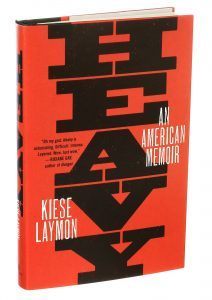 Kiese Laymon started his new memoir, “Heavy,” with every intention of writing what his mother would have wanted — something profoundly uplifting and profoundly dishonest, something that did “that old black work of pandering” to American myths and white people’s expectations. His mother, a professor of political science, taught him that you need to lie as a matter of course and, ultimately, to survive; honesty could get a black boy growing up in Jackson, Miss., not just hurt but killed. He wanted to do what she wanted. But then he didn’t.
“Heavy” is a gorgeous, gutting book that’s fueled by candor yet freighted with ambivalence. It’s full of devotion and betrayal, euphoria and anguish, tender embraces and rough abuse. Laymon addresses himself to his mother, a “you” who appears in these pages as a brilliant, overwhelmed woman starting her academic career while raising a son on her own. She gave her only child daily writing assignments — less, it seems, to encourage his sense of discovery and curiosity than to inculcate him with the “excellence, education and accountability” that were the “requirements” for keeping him safe.
More here.
Noam Chomsky Calls Trump and Republican Allies “Criminally Insane”
John Horgan in Scientific American:
 I don’t really have heroes, but if I did, Noam Chomsky would be at the top of my list. Who else has achieved such lofty scientific and moral standing? Linus Pauling, perhaps, and Einstein. Chomsky’s arguments about the roots of language, which he first set forth in the late 1950s, triggered a revolution in our modern understanding of the mind. Since the 1960s, when he protested the Vietnam War, Chomsky has also been a ferocious political critic, denouncing abuses of power wherever he sees them. Chomsky, who turns 90 on December 7, remains busy. He spent last month in Brazil speaking out against far-right politician Jair Bolsonaro, and he recently discussed the migrant caravan on the show “Democracy Now.” Chomsky, whom I first interviewed in 1990 (see my profile here), has had an enormous influence on my scientific and political views. His statement that we may always “learn more about human life and human personality from novels than from scientific psychology” could serve as an epigraph for my new book Mind-Body Problems (available for free here). Below he responds to my emailed questions with characteristic clarity and force. — John Horgan
Do you ever chill out?
Would rather skip personal matters.
Your ideas about language have evolved over the decades. In what ways, if any, have they remained the same?
Some of the earliest assumptions, then tentative and only partially formed, have proven quite robust, among them that the human language capacity is a species property in a double sense: virtually uniform among humans apart from serious pathology, and unique to humans in its essential properties.
More here.
Sean Carroll’s Mindscape Podcast: David Poeppel on Thought, Language, and How to Understand the Brain
Sean Carroll in Preposterous Universe:
 Language comes naturally to us, but is also deeply mysterious. On the one hand, it manifests as a collection of sounds or marks on paper. On the other hand, it also conveys meaning – words and sentences refer to states of affairs in the outside world, or to much more abstract concepts. How do words and meaning come together in the brain? David Poeppel is a leading neuroscientist who works in many areas, with a focus on the relationship between language and thought. We talk about cutting-edge ideas in the science and philosophy of language, and how researchers have just recently climbed out from under a nineteenth-century paradigm for understanding how all this works.
More here.
Past Masters of the Postmodern
Simon Blackburn in Inference Review:
 If anxiety about truth is very much in the air, it has been in the air for a very long time. Well before the advent of tweets and trolls, George Orwell expressed the fear that “the very concept of objective truth [was] fading out of the world.”1 Orwell’s anxieties were political. Truth was under attack by politicians and their propagandists. Our anxieties are cultural, the widespread sense that a number of philosophical theories have escaped the academic world, and, in the wild, are doing great harm. Writing in the otherwise staid European Molecular Biology Organization Report, Marcel Kuntz affirmed that “postmodernist thought is being used to attack the scientific worldview and undermine scientific truths; a disturbing trend that has gone unnoticed by a majority of scientists.”2
This view of postmodernism as an intellectual villain is very common.
Whatever postmodernism is in the arts, I am concerned with its philosophy of language, its view of truth. Familiar figures have, by now, become infamous: Jean Baudrillard, Jacques Derrida, Michel Foucault, Martin Heidegger, Frederic Jameson, Douglas Kellner, Jean-François Lyotard, and Richard Rorty. Philosophical postmodernists emphasized the possibility of different perspectives on things, or different interpretations of them. They denied the existence of unmediated or innocent observation, and were dubious about the distinction between facts and values, the analytic and the synthetic, the mind and the world. Skeptical about truth, and sensitive to shifts in culture, society, and history, they thought of words as tools, and believed that vocabularies survive because they enable us to cope, to meet our goals.
They mistrusted authority.
More here.
Jordan Peterson vs Susan Blackmore: Do we need God to make sense of life?
The Moment Sylvia Plath Found Her Genius
Craig Morgan Teicher at Literary Hub:
 In Plath we have a unique example of rapid, surging development of a poet’s art. In only seven years—from 1956, when the first poems in her Collected Poems were written, to 1963, the year of her death—Plath went from being an obviously talented and excruciatingly ambitious (as her journals attest) apprentice poet with lots of technique and intensity but few real subjects on which to train those powers, to the author of unprecedented works of genius. In Plath’s first book, The Colossus and Other Poems, the only book of poetry she published in her lifetime, we have an unusual opportunity to pinpoint the moments when her art surges forward in particular poems—we can actually watch her grow as an artist, see a little bit how the magic trick was done, and perhaps learn from it. Plath’s earlier poems have a lot to teach about how poets expand their capacities, how they “find” a voice by listening closely to their own minds, and how genius can be, if not made, then at least willfully courted.
more here.
Talking about Populism
Philip Manow at Eurozine:
 Disregarding the substance of populism and focusing exclusively on its exclusionary rhetoric may succeed in protecting the definition of populism from everyday polemic, however it also allows one to ignore the political issues, in other words what populists are actually saying and why. This, at least, is compatible with the prevailing view that populist positions are so obviously irrational that there is no point in bothering to discuss them anyway. However, this is nothing but the abjuration of the pluralist claim bandied about to characterise populism in the first place. In particular, it enables avoidance of basic questions of redistribution and scarcity, such as that of the losers of cosmopolitan humanitarianism: a question that the (German) middle class no longer likes to talk about, because it hardly comes into contact with them.
more here.
Tales of Sleep and Sleeplessness
Marina Benjamin at the TLS:
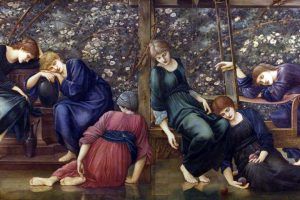 When Burne-Jones painted his Briar Rose cycle, grown women who had too much to say and to do were being forcibly put to bed. They were diagnosed as hysterics, depressives and neurasthenics, whose delicate nerves were no match for their mental gymnastics, and given a prescription of hardcore rest. Many of these women were insomniac. Some had eating disorders; others were suicidal. To a woman (almost) they balked at the societal restrictions that corralled them into being mothers and homemakers and disallowed anything else. Nervous conditions, sleeplessness, self-starvation (that is, disappearing before you are made to disappear), this was their protest.
The writer Charlotte Perkins Gilman described how at Silas Weir Mitchell’s Philadelphia clinic, in the spring of 1887, she was “put to bed and kept there”. Mitchell was the physician who devised the infamous rest cure, after working with soldiers who had emerged from the Civil War afflicted with “wounded nerves”.
more here.
How biologists are creating life-like cells from scratch
Kendall Powell in Nature:
 There were just eight ingredients: two proteins, three buffering agents, two types of fat molecule and some chemical energy. But that was enough to create a flotilla of bouncing, pulsating blobs — rudimentary cell-like structures with some of the machinery necessary to divide on their own. To biophysicist Petra Schwille, the dancing creations in her lab represent an important step towards building a synthetic cell from the bottom up, something she has been working towards for the past ten years, most recently at the Max Planck Institute of Biochemistry in Martinsried, Germany. “I have always been fascinated by this question, ‘What distinguishes life from non-living matter?’” she says. The challenge, according to Schwille, is to determine which components are needed to make a living system. In her perfect synthetic cell, she’d know every single factor that makes it tick.
Researchers have been trying to create artificial cells for more than 20 years — piecing together biomolecules in just the right context to approximate different aspects of life. Although there are many such aspects, they generally fall into three categories: compartmentalization, or the separation of biomolecules in space; metabolism, the biochemistry that sustains life; and informational control, the storage and management of cellular instructions. The pace of work has been accelerating, thanks in part to recent advances in microfluidic technologies, which allow scientists to coordinate the movements of minuscule cellular components. Research groups have already determined ways of sculpting cell-like blobs into desired shapes; of creating rudimentary versions of cellular metabolism; and of transplanting hand-crafted genomes into living cells. But bringing all these elements together remains a challenge.
More here.
Wednesday Poem
— “A friend of mine found this photograph in a shoe box in his Grandmother’s attic.
I wonder if those quotation marks imply what I think they do[;]
by the look on their faces, I would say they do.” — The Gaily Grind
Aunty Mary and Her “Friend” Ruth, 1910.
You wear the faded muslin—
did it begin yours or mine?
Everything we have is both.
Everything we are is both,
our faces shaped like sisters,
bodies like lovers. Our eyes
away from the camera as one.
This morning I brushed our hair in bed,
yours then mine, twisted the usual
Psyche knots onto our heads.
My mouth full of pins, you kissed
just the corner. For years
I turned my cheek, held your hands
to keep them from me but no more.
On the chair by the window,
room for only one, so I hold you
round your shoulders to balance us both.
The only difference between us:
yours is a smile that knows the sin
but not the penance and mine,
secret, hardly there.
Your fingers dust my chin,
the flashbulb goes.
by Sarah Sansolo
from Split This Rock
Wednesday, November 7, 2018
Thinking Clearly About Immigration
Kay Hymowitz in the New York Times:
 Global migration is triggering the sort of existential questions advanced nations haven’t had to bother with very much. Aside from lines on a map and a shared language, what makes Denmark Denmark, or Canada Canada? When does citizen-feeling for national culture and identity — not to mention budget concerns — veer into xenophobia? How much should a modern, secular nation tolerate the illiberal customs of newcomers from traditional cultures? As a “nation of immigrants,” one with a relatively modest welfare state, the United States should be safe from these prickly questions. After all, we have long been a hyphenated citizenry; our children are tutored — or are supposed to be — in E pluribus unum.
Yet here we are in the throes of a bitter war over immigration. Everyone knows who the enemy is, or thinks he does: One side points at ethnonationalist racists who cheer budget-busting walls, Muslim bans, caged children and deportations of hard-working parents whose only crime is wanting a better life. The other side sees self-deluded elitist hypocrites who condone criminal border-crossing and extravagant social spending as a way of supplying cheap labor to look after their children and clean their homes — while telling an ailing, law-abiding white working class that its time is up.
More here.
America Is No Longer Attracting The Top Minds In Physics
Ethan Siegel in Forbes:
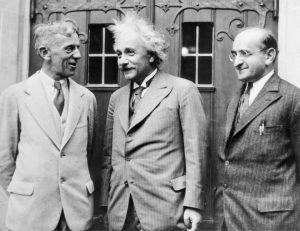 Throughout the 20th century and into the 21st, America emerged at the pre-eminent place to be for physics research in the world. Of the 209 people to ever win the Nobel Prize in Physics, a whopping 93 of them claimed United States citizenship: triple that of Germany, the next-closest country. This was reflected not only at the highest levels of prestige and accomplishment in research, but also in education.
The United States of America became the most desired place in the world to study physics at the highest levels. From fewer than 20 PhDs a year in 1900 to around 500 per year in the 1950s, we now award nearly 2,000 PhDs in physics every year. Moreover, since the 1990s, international students, representing some of the best and brightest talent the world has to offer, represent almost half of those degrees.
Yet, according to the American Physical Society, the past year has seen an alarming, unprecedented drop in the number of international applications to physics PhD programs in the United States. In an extremely large survey of 49 of the largest physics departments in the country, representing 41% of all enrolled physics graduate students in the United States, an overall decrease of almost 12% in the number of international applicants was observed from 2017 to 2018.
More here.
Yuval Noah Harari on Why Technology Favors Tyranny
Yuval Noah Harari in The Atlantic:
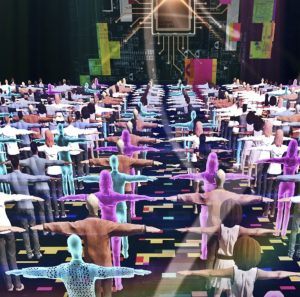 There is nothing inevitable about democracy. For all the success that democracies have had over the past century or more, they are blips in history. Monarchies, oligarchies, and other forms of authoritarian rule have been far more common modes of human governance.
The emergence of liberal democracies is associated with ideals of liberty and equality that may seem self-evident and irreversible. But these ideals are far more fragile than we believe. Their success in the 20th century depended on unique technological conditions that may prove ephemeral.
In the second decade of the 21st century, liberalism has begun to lose credibility. Questions about the ability of liberal democracy to provide for the middle class have grown louder; politics have grown more tribal; and in more and more countries, leaders are showing a penchant for demagoguery and autocracy. The causes of this political shift are complex, but they appear to be intertwined with current technological developments. The technology that favored democracy is changing, and as artificial intelligence develops, it might change further.
More here.