
Category: Recommended Reading
Ypres, a Century On
Jay Copp at Commonweal:
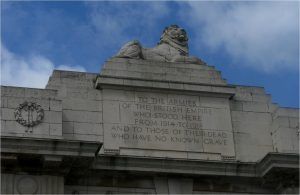 Ypres swarms with somber British tourists, who disembark from buses to walk its cobblestone paths, view its seemingly centuries-old shops, homes, and churches, and wander its 175 cemeteries, located outside town amid the famous poppy fields. The ancient architecture and ambience are an illusion. The entire town was destroyed in World War I. Not a single home or tree survived. Churchill argued that Ypres should not be rebuilt: “A more sacred place for the British race does not exist in the world,” he thundered. But the residents of Ypres who survived the war insisted on rebuilding.
Still, the Belgians have shown their gratitude. Every day is Veterans Day in Ypres. Every night since November 11, 1929 (except for the four years of German occupation during World War II) an elaborate ritual is repeated at eight o’clock: volunteer buglers sound out the Last Post at the Menin Gate, where Allied soldiers marched off to the front. The British endured the most casualties; some quarter million fell in or near Ypres.
more here.
The Odyssey of The Ballpoint Pen
B. Alexandra Szerlip at The Believer:
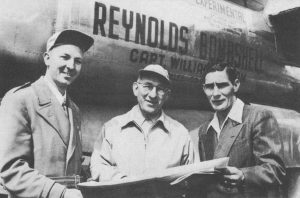 The odyssey, at times hilarious, of the ballpoint pen is a window into entrepreneurship and America’s consumer mentality at the start of the postwar (post WWII) period.
The first “ball tip” pen patent was filed back in 1888, the invention of Massachusetts leather tanner John Loud, who needed to mark hides, but it was never commercially exploited. Fifty years later, Hungarian journalist László Jozsef Biro—frustrated at always having to fill up fountain pens and clean up smudges—noticed that newspaper ink dried almost immediately, leaving the paper relatively smudge-free. But newsprint ink was too thick to flow through regular pen nibs (which often tore up the newsprint); he and his chemist brother, Georg, set to work making models. Their eureka moment came, the story goes, while watching boys playing street marbles; one marble, having rolled through a puddle, left a line behind it. The brothers devised a point fitted with a tiny ball bearing that, fed by a fine-coiled tube in the barrel, rolled (rather than poured) ink onto the page.
more here.
The Life of Saul Bellow
David Mikics at Literary Review:
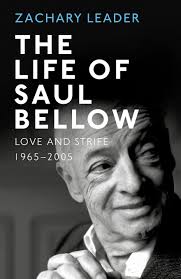 Saul Bellow had what one of his characters in Ravelstein calls ‘a gift for reading reality – the impulse to put your loving face to it and press your hands against it’. Bellow seems to outstrip other novelists in his unembarrassed wish to get as close as possible to the reality of people – their faces, clothes, bodies, speech, gestures. If Bellow’s love for his characters was often contentious and double-edged, well what is love if not the highest form of contention?
Bellow was a personality worthy of his own fictions, a lively, inspired troublemaker, as Zachary Leader shows in the second volume of his magisterial biography. He was ‘a great chain-yanker’ during arguments, his son Daniel said, adding, ‘He liked to dig a pit and cover it with branches so you’d come walking along, whistling away, and fall right in it. Then he would stand at the edge and watch you as you sort of thrashed around. He liked that.’
more here.
The Lies That Bind Us
Kwame Anthony Appiah in IAI:
“And now what will become of us without barbarians? / Those people were a kind of solution.”
—C. P. Cavafy, “Waiting for the Barbarians” (1898)
 Perhaps you know this poem? Constantine Cavafy was a writer whose every identity came with an asterisk, a quality he shared with Italo Svevo. Born two years after Svevo, he died only a few years after him. Cavafy was a Greek who never lived in Greece. A government clerk of Eastern Orthodox Christian upbringing in a tributary state of a Muslim empire that was under British occupation for most of his life, he spent his evenings on foot, looking for pagan gods in their incarnate, carnal versions. He was a poet who resisted publication, save for broadsheets he circulated among close friends; a man whose homeland was a neighborhood, and a dream. Much of his poetry is a map of Alexandria overlaid with a map of the classical world— modern Alexandria and ancient Athens— in the way that Leopold Bloom’s Dublin neighborhood underlies Odysseus’s Ithaca. No single sentence captures this Alexandrian genius better than E. M. Forster’s evocation of him as “a Greek gentleman in a straw hat, standing absolutely motionless at a slight angle to the universe.” 1 And I conjure Cavafy, here, at journey’s end, because I want to persuade you that he is representative precisely in all his seeming anomalousness.
Poems, like identities, never have just one interpretation. But in Cavafy’s “Waiting for the Barbarians” I see a reflection on the promise and the peril of identity. All day the anticipation and the anxiety build as the locals wait for the barbarians, who are coming to take over the city. The emperor in his crown, the consuls in their scarlet togas, the silent senate and the voiceless orators wait with the assembled masses to accept their arrival. And then, as evening falls, and they do not appear, what is left is only disappointment. We never see the barbarians. We never learn what they are actually like. But we do see the power of our imagination of the stranger. And, Cavafy hints, it’s possible that the mere prospect of their arrival could have saved us from ourselves.
More here.
The de-civilising process
Adrian Wooldridge in 1843:
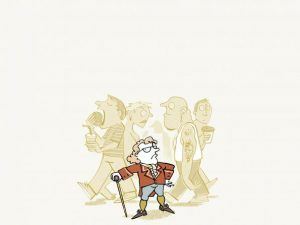 In his new book, “In Pursuit of Civility”, British historian Keith Thomas tells the story of the most benign developments of the past 500 years: the spread of civilised manners. In the 16th and 17th centuries many people behaved like barbarians. They delighted in public hangings and torture. They stank to high heaven. Samuel Pepys defecated in a chimney. Josiah Pullen, vice-principal of Magdalen Hall, Oxford, urinated while showing a lady around his college, “still holding the lady fast by the hand”. It took centuries of painstaking effort – sermons, etiquette manuals and stern lectures – to convert them into civilised human beings.
Reading Thomas’s book on a train recently I was gripped by a terrible realisation: everything our forebears worked so hard to achieve is now reversing. A process that took centuries has been undone in just a few decades. There is no better place to observe the collapse of manners than on mass transport. The most basic move in the civilising process was to make a distinction between the public and the private: persuading people to defecate in lavatories rather than chimneys and eat at regular times in designated places, not whenever or wherever the mood took them. Yet today city streets reek of urine and trains smell of fast food. I recently had the misfortune to sit next to a quivering man-mountain on a train who proceeded to slurp a Coke, demolish a Big Mac, munch fries and spill ketchup onto his beard while giggling at a film on his super-sized iPad. His only concession to the fact that he wasn’t in his own sitting room was to wear headphones.
More here.
Tuesday, November 6, 2018
Can the Republic Strike Back?
Andrew Sullivan in New York Magazine:
 Whatever else it will be, Tuesday will be a relief. We will finally find out where we are in the surreal dystopia of the last two years. We will see, in a tangible way, what America now is.
These years have been overwhelmed and saturated by a single figure with no political experience, who won almost 3 million fewer votes than his opponent, has had consistently lower approval numbers than any of his recent predecessors, and speaks and acts in ways no previous president ever has. He has cast a staggering spell over a hefty segment of the population, and he has earned the intense loathing of the rest. And for these very reasons, it has been tortuously hard to see what is in front of our noses.
Is this the new normal? Or has this been a detour into the freak zone, with a president accidentally elected, a major party temporarily hypnotized, but with a population still aware of something called reality? We’ve tried and tried these past two years to figure that out, and there are many layers of meaning here, but we haven’t had a clear test of anything. Polls are not elections. Only elections are elections. We are entering the human phase of the trials.
More here.
Dear young people, “Don’t Vote”
Please share with the young people you know!
Climate Change Is Already Damaging American Democracy
Vann R. Newkirk II in The Atlantic:

The damage from hurricane michael is still being cataloged. After the Category 4 storm made landfall in the Florida Panhandle two weeks ago, it ripped through parts of Florida and Georgia, killing dozens and destroying homes and vital infrastructure in rural communities. Residents don’t yet have a full account of the lives and property erased in the calamity, and even when they do, that accounting will only provide a rough estimate of what was lost. More difficult still will be dealing with the intangibles: the exhaustion and mental-health consequences, the frayed sense of security and safety, the missed school days, and the deepening vulnerability among people who faced the storm.
As the country deals with an onslaught of powerful hurricanes and other weather-related events, those intangibles have become more evident, and more and more important. Michael is—according to experts I spoke with—both a harbinger of a future climate and a representative of a class of disasters that in the past few years have exposed the vulnerabilities of local and national institutions. Those disasters have highlighted the role of inequality, civic instability, and poor planning in amplifying the effects of both extreme and mundane weather. The evidence seems to be mounting that not only will the developing climate regime, if sustained, expose the cracks in the American democratic project, but it will also widen them.
More here.
The Trump Legions: Despite their sudden rise, they didn’t come out of nowhere
Thomas B. Edsall in the New York Times:
 How could this man have been elected to the highest office in the land? And how can Trump not only remain in office but, for the moment at least, appear to stand a reasonable chance of being renominated and even re-elected?
To get some answers to these questions, I turned to a 2018 paper by Ronald Inglehart and two fellow political scientists at the University of Michigan, as well as to a new book by Marc Hetherington and Jonathan Weiler, who are political scientists at the University of North Carolina-Chapel Hill.
In “The Silent Revolution in Reverse: Trump and the Xenophobic Authoritarian Populist Parties,” Inglehart, Jon Miller and Logan Woods provide fresh insight on a subject to which Inglehart, at times writing withPippa Norris of Harvard, has devoted much of his career: the ongoing tension between materialist and post-materialist values and the political consequences of that tension.
More here.
Everything you wanted to know about the resolution of your TV (or monitor) screen
The History of The Personality Profile
Angela Chen at Lapham’s Quarterly:
 The two women who inflicted the Myers-Briggs Type Indicator on the world were less concerned with fighting evil than with optimizing daily life, according to Emre. There is Katharine, the Briggs in the equation. Unlike the men who worked in academic laboratories on both coasts, Katharine worked in “a cosmic laboratory of baby training”: her own home. She took meticulous notes on the training of her only child, Isabel (later the Myers of the MBTI), a girl who would read Pilgrim’s Progress by five despite rarely attending school. When one neighbor criticized her methods, Katharine, who wrote about child-rearing for magazines, included the neighbor’s daughter Mary in an article called “Ordinary Theodore and Stupid Mary.”
Isabel eventually left for Swarthmore to study political science, and Katharine fell into a deep depression. It was then that she came across Jung’s Psychological Types, and she would develop a lifelong obsession with the Swiss analyst, writing to and about him.
more here.
The Inexhaustible Desire to Keep Talking about Marx
Jonathan Wolff at the TLS:
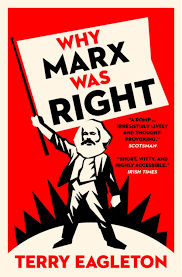 As Allen W. Wood observed in 1981, while it is easy to write an above-average book on Marx, it is hard to write a good one. The global outpouring of new volumes, editions and translations this year, the 200th anniversary of Marx’s birth, tests this claim to destruction. Too many books? Not for me. There can hardly be a subject so rich. Marx’s writings, when combined with Engels’s, will fill 114 hefty volumes. Only a tiny fraction was published in Marx’s lifetime, and of that, far too much was devoted to the ponderous demolition of now forgotten rivals. Some of the most interesting works, such as the 1844 Manuscripts, the German Ideology, and the Grundrisse, were only published decades after his death, sometimes in volumes coloured by ideological editorial decisions. Marx can be interpreted, reinterpreted, analysed, reduced, contextualized, medicalized, flattered, or diminished. He can be lauded for his vision, energy and influence, and condemned for exactly the same things. His vanity and catastrophic money management, but also his medical complaints (boils, liver) and family life of tortured devotion, constitute a tragicomic background to dry economic theory and sometimes petty political machinations. There are many Marxes, even more Marxisms, and therefore there is an unending potential for writing something new and original. But for thinking about Marx there is no time like the present.
more here.
In Prague
Sadakat Kadri at the LRB:
 Czechoslovakia would have been a hundred years old last Sunday, and Prague spent the weekend celebrating. I’ve been to better birthday parties. The gloomy weather didn’t help – it didn’t just rain on the parades, it poured – and the centennial narratives, never simple, were complicated further by the fact they were commemorating a state that dissolved itself in 1993.
Liberals, libertarians, conservatives and Islamophobes were out in force all weekend, and President Miloš Zeman isn’t the kind of leader who brings different sides together: his cantankerous state-of-the-nation address on Sunday night concluded by warning Czechs that there were ‘rabid and envious dwarfs’ in their midst.
The event I spent most time at was probably the smallest. Under leaden skies, as fighter jets roared invisibly overhead, about a hundred members of the Czech Republic’s Romani minority gathered beneath umbrellas outside Prague Castle. The slogan on their banners was as plaintive as they were angry. ‘We work like everybody else,’ it said.
more here.
Happy with a 20% chance of sadness
Matt Kaplan in The New York Times:
 In the winter of 1994, a young man in his early twenties named Tim was a patient in a London psychiatric hospital. Despite a happy and energetic demeanour, Tim had bipolar disorder and had recently attempted suicide. During his stay, he became close with a visiting US undergraduate psychology student called Matt. The two quickly bonded over their love of early-nineties hip-hop and, just before being discharged, Tim surprised his friend with a portrait that he had painted of him. Matt was deeply touched. But after returning to the United States with portrait in hand, he learned that Tim had ended his life by jumping off a bridge.
Matthew Nock now studies the psychology of self-harm at Harvard University in Cambridge, Massachusetts. Even though more than two decades have passed since his time with Tim, the portrait still hangs in his office as a constant reminder of the need to develop a way to predict when people are likely to try and kill themselves. There are plenty of known risk factors for suicide — heavy alcohol use, depression and being male among them — but none serve as tell-tale signs of imminent suicidal thoughts. Nock thinks that he is getting close to solving that. Since January 2016, he has been using wristbands and a phone application to study the behaviour of consenting patients who are at risk of suicide, at Massachusetts General Hospital in Boston. And he has been running a similar trial at the nearby Franciscan Children’s Hospital this year. So far, he says, although his results have not yet been published, the technology seems able to predict a day in advance, and with reasonable accuracy, when participants will report thinking of killing themselves.
More here.
Fascism then, Fascism now
A prescient 2005 article by Paul Bigioni in the Toronto Star:
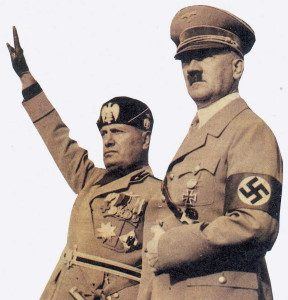 Observing political and economic discourse in North America since the 1970s leads to an inescapable conclusion: The vast bulk of legislative activity favours the interests of large commercial enterprises. Big business is very well off, and successive Canadian and U.S. governments, of whatever political stripe, have made this their primary objective for at least the past 25 years.
Digging deeper into 20th century history, one finds the exaltation of big business at the expense of the citizen was a central characteristic of government policy in Germany and Italy in the years before those countries were chewed to bits and spat out by fascism. Fascist dictatorships were borne to power in each of these countries by big business, and they served the interests of big business with remarkable ferocity.
These facts have been lost to the popular consciousness in North America. Fascism could therefore return to us, and we will not even recognize it. Indeed, Huey Long, one of America’s most brilliant and most corrupt politicians, was once asked if America would ever see fascism. “Yes,” he replied, “but we will call it anti-fascism.”
By exploring the disturbing parallels between our own time and the era of overt fascism, we can avoid the same hideous mistakes. At present, we live in a constitutional democracy. The tools necessary to protect us from fascism remain in the hands of the citizen. All the same, North America is on a fascist trajectory. We must recognize this threat for what it is, and we must change course.
More here.
Tuesday Poem
To the woman I saw today who wept in her car
Woman,
I get it.
We are strangers,
but I know the heart is a hive
and someone has knocked yours
from its high branch in your chest
and it lays cracked and splayed,
spilling honey all over
the ground floor of your gut
and the bees inside
that you’ve trained
over the days and years
to stay put, swarm
the terrain of your organs,
yes,
right here in traffic,
while we wait for the light to change.
I get it.
How this array of metal and plastic
tends to go womb room
once the door shuts,
and maybe you were singing
only moments before
you got the call,
or remembered that thing
you had tucked back and built
such sturdy scaffolding all around,
and now here it comes to knock
you adrift with only your steering
wheel to hold you up.
Or, maybe today
was just a tough day
and the sunlight
and warm weather
and blossoming limbs
and smiling pedestrians
waiting for their turn to cross
are much too much to take
when you think of all that’s left
to do, and here you are,
a reed stuck in the mud
of a rush hour intersection,
with so very many hours left to go.
Woman,
I know you.
I know how that thing
when left unattended
will show up as a typhoon
at your front door
demanding to be let in
or it will take
the whole damn house with it.
I know this place too.
I get it.
But because we are strangers,
because you did not see me see you,
my gaze has no more effect
than a phantom that stares at the living.
And yet, I want you to know that
today, in the hive of my heart,
there is room enough
for you.
by Bianca Lynne Spriggs
from Split This Rock
Monday, November 5, 2018
Noah’s Floods
by Paul Braterman
 By chance, I chose as holiday reading (awaiting my attention since student days) The Epic of Gilgamesh, a Penguin Classics bestseller, part of the great library of Ashur-bani-pal that was buried in the wreckage of Nineveh when that city was sacked by the Babylonians and their allies in 612 BCE. Gilgamesh is a surprisingly modern hero. As King, he accomplishes mighty deeds, including gaining access to the timber required for his building plans by overcoming the guardian of the forest. But this victory comes at a cost; his beloved friend Enkidu opens by hand the gate to the forest when he should have smashed his way in with his axe. This seemingly minor lapse, like Moses’ minor lapse in striking the rock when he should have spoken to it, proves fatal. Enkidu dies, and Gilgamesh, unable to accept this fact, sets out in search of the secret of immortality, only to learn that there is no such thing. He does bring back from his journey a youth-restoring herb, but at the last moment even this is stolen from him by a snake when he turns aside to bathe. In due course, he dies, mourned by his subjects and surrounded by a grieving family, but despite his many successes, what remains with us is his deep disappointment. He has not managed to accomplish what he set out to do.
 On his journey, Gilgamesh meets the one man who has achieved immortality, Utnapishtim, survivor of a flood remarkably similar, even in its details, to the Flood in the Bible. Reading of this sent me back to Genesis, and hence to two other books, The Bible [actually, just the Pentateuch] with Sources Revealed, by Friedman, and The Ark Before Noah, by Finkel. Friedman is Ann and Jay Davis Professor of Jewish Studies at the University of Georgia, while Finkel is curator of the British Museum’s collection of cuneiform tablets. Most of what follows derives from these two sources.
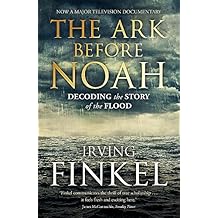 Comparing Hebrew with Cuneiform may seem like a suitable gentlemanly occupation for students of ancient literature, but of no practical importance. On the contrary, I maintain that what emerges is of major contemporary relevance.
As Lakatos pointed out, scientists will not abandon a position, despite difficulties, absurdities, and anomalies, until a more satisfactory one is offered. Why should the creationist be any different? He is led to embrace the absurdities of Young Earth “Flood Geology” because he regards the text of Genesis as the direct revealed word of God. If you want to change his mind, you must offer an alternative that is better on his terms, emotionally and spiritually. Such an alternative, I argue, is what emerges from textual and historical analysis. And in the Americas both North and South today, weaning the Evangelical voting bloc away from reality-denying simplicities is a matter of the greatest urgency. Read more »
On “Math with Bad Drawings” by Ben Orlin
by Jonathan Kujawa
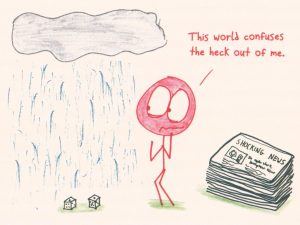
With the end of daylight savings time, the long, dark nights of winter slump over the land. It is the season for cold nights, warm blankets, and reading good books with a nice cup of tea (or a dram of scotch, if you prefer). Unless, of course, you live in Hawaii or the southern hemisphere, in which case you’ll have to content yourself with reading in a convenient hammock.
Popular math books are a sub-sub-sub-genre of nonfiction, found at a local bookstore in the Nonfiction-Science-Math-“Math? For fun? Really? Ok, if you say so.” section. Even within that narrow span of the bookshelf, you’ll find there are a wide variety of popular math books. Some ambitiously try to give you a sense of deep, modern topics of research like the geometric Langlands program or statistical mechanics. Although I suspect those mainly succeed in giving Hawking’s “A Brief History of Time” and Piketty’s “Capital” a run in the category of many sold but few actually read. Other authors lean towards biography. While interesting and enjoyable reads, they are not often about math, per se. I’m looking forward to someday getting to Siobhan Roberts’ well-reviewed biographies of Coxeter and Conway. Both sound great! But such books necessarily can only hint at the amazing math their subjects have done.
Perhaps unavoidably, too many popular math books end up missing the mark. Trying to talk math without the technicalities, the authors are left leaning on old standbys like the irrationality of √ 2, Hilbert’s Hotel and the marvels of infinity, and picture friendly topics like fractals. It’s a bit like eating a big bowl of oatmeal: a whole lot of familiar filling with the occasional pleasant surprise mixed in. Not that I’m throwing stones! My house here at 3QD is built from its share of tired metaphors, mathematical and otherwise. Every person who writes about math knows the truism: every equation you include cuts your readership in half. But talking about math without, you know, writing down any math is darn hard. It’s like writing about music or poetry in strict essay form. Read more »
A Young Person Investigating the End
by Lexi Lerner
 “They all go the same way. Look up, then down and to the left,” the EMT said. “Always.”
Why?
“I don’t know,” he said. “Well – I think they know. When they look up, they’re just… waiting.”
And the next part – why to the left? Because of the heart?
“I don’t know. Maybe something with blood pressure differences. Maybe something else. I really don’t know.”
I’m not living, I’m just killing time.[1]
It’s absurdly easy to take this life for granted. It’s so easy that I want to, so badly, all the time. The pitfall was built into its coding. So was the challenge: if I let life matter more, I choke.
What’s the worth of sitting in the grass, watching geese, or perhaps fireflies, for days or decades on end? Is it worthy of a lifetime? Where were the geese in my college classrooms? Where were the fireflies at my jobs? What’s the role of ambition? Ambition to do what?
We sat on a bench in Soho, watching a pickup kickball game.
“Is this fragile?” I asked her.
She looked through the chain link fence. The rubber ball sailed across the field; all heads followed its enormous arc. Both teams cheered heartily.
“Yes,” she said.
“Is it sacred?” I asked.
The bruised shadows of trees, the emperor sun behind them, the pigeons.
“Yes,” she said.
On a sun-spotted afternoon in a forest, I asked my dad if he missed his dad, who passed a few years ago.
Sometimes, it doesn’t really feel like he’s gone. More like, I haven’t seen him in a while, and we haven’t spoken in a while, but he’s just a phone call away. I find myself thinking, where’s Pa? Where is he? Read more »