
Category: Recommended Reading
Malcolm X, “Message to the Grassroots”
From BlackPast.Org:
On December 10, 1963, while still the leading spokesman for the Nation of Islam, Malcolm X gave a speech at a rally in Detroit, Michigan. That speech outlined his basic black nationalist philosophy and established him as a major critic of the civil rights movement. The speech appears below.
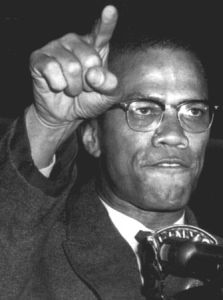 And during the few moments that we have left, we want to have just an off-the-cuff chat between you and me — us. We want to talk right down to earth in a language that everybody here can easily understand. We all agree tonight, all of the speakers have agreed, that America has a very serious problem. Not only does America have a very serious problem, but our people have a very serious problem. America’s problem is us. We’re her problem. The only reason she has a problem is she doesn’t want us here. And every time you look at yourself, be you black, brown, red, or yellow — a so-called Negro — you represent a person who poses such a serious problem for America because you’re not wanted. Once you face this as a fact, then you can start plotting a course that will make you appear intelligent, instead of unintelligent.
What you and I need to do is learn to forget our differences. When we come together, we don’t come together as Baptists or Methodists. You don’t catch hell ’cause you’re a Baptist, and you don’t catch hell ’cause you’re a Methodist. You don’t catch hell ’cause you’re a Methodist or Baptist. You don’t catch hell because you’re a Democrat or a Republican. You don’t catch hell because you’re a Mason or an Elk. And you sure don’t catch hell ’cause you’re an American; ’cause if you was an American, you wouldn’t catch no hell. You catch hell ’cause you’re a black man. You catch hell, all of us catch hell, for the same reason.
So we are all black people, so-called Negroes, second-class citizens, ex-slaves. You are nothing but a ex-slave. You don’t like to be told that. But what else are you? You are ex-slaves. You didn’t come here on the “Mayflower.” You came here on a slave ship — in chains, like a horse, or a cow, or a chicken. And you were brought here by the people who came here on the “Mayflower.” You were brought here by the so-called Pilgrims, or Founding Fathers. They were the ones who brought you here.
More here. (Note: Throughout February, we will publish at least one post dedicated to Black History Month)
Saturday, February 16, 2019
Computer programming once had much better gender balance than it does today. What went wrong?
Clive Thompson in the New York Times:
 As a teenager in Maryland in the 1950s, Mary Allen Wilkes had no plans to become a software pioneer — she dreamed of being a litigator. One day in junior high in 1950, though, her geography teacher surprised her with a comment: “Mary Allen, when you grow up, you should be a computer programmer!” Wilkes had no idea what a programmer was; she wasn’t even sure what a computer was. Relatively few Americans were. The first digital computers had been built barely a decade earlier at universities and in government labs.
By the time she was graduating from Wellesley College in 1959, she knew her legal ambitions were out of reach. Her mentors all told her the same thing: Don’t even bother applying to law school. “They said: ‘Don’t do it. You may not get in. Or if you get in, you may not get out. And if you get out, you won’t get a job,’ ” she recalls. If she lucked out and got hired, it wouldn’t be to argue cases in front of a judge. More likely, she would be a law librarian, a legal secretary, someone processing trusts and estates.
But Wilkes remembered her junior high school teacher’s suggestion. In college, she heard that computers were supposed to be the key to the future. She knew that the Massachusetts Institute of Technology had a few of them. So on the day of her graduation, she had her parents drive her over to M.I.T. and marched into the school’s employment office. “Do you have any jobs for computer programmers?” she asked. They did, and they hired her.
More here.
Hasan Minhaj on Saudi Arabia + Censorship In China
Saturday Poem
When Miguelito Should Have Been Sleeping
and his tías de México and his mother gathered around
the kitchen table, stories drifting toward his room
like cafecito vapor, he leaned against his door to listen.
When he first heard about how his orphaned grandmother
was her own godmother’s criada, how she would fall asleep
while scrubbing los pinche pisos—knees and knuckles
tired and raw from scratching against the cracked
clay floor—he imagined himself standing
next to his grandmother’s child-body: limp limbs, ragged-
heavy like a drenched mop’s clothed tentacles;
he imagined himself ordering the opening of the earth,
¡Ábrete! ¡Ábrete, trágatela ahora cuando está dormida! *
When he heard how his grandfather would shove a kicking
and screaming laughter into a plastic bag on those days
he left to work on foreign lands, but leave his daughters
without half a giggle because Miguelito’s grandfather
would need laughter more, he imagined himself
waiting for his grandfather’s hurried stride. He imagined
flinging himself toward the thick plastic, tearing it open
with a fork to let laughter bounce back into the bellies
of children because what are children without laughter?
When he learned how Fausto, the catechist, would lure children
into praying un “Padre nuestro” while their fathers were leaving
one by one, he wondered why his tías would say, Dios lo bendiga.**
But when he first heard about his mother clubbing
the neighbor’s stray pig to death when she was a child,
he wept, but not for the pig.
by Yaccaira Salvatierra
from Rattle Magazine #51, Spring 2016
*Open up! Open yourself, trap it now when you are asleep!
**God bless you
Photons reveal a weird effect called the quantum pigeonhole paradox
Emily Conover in Science News:
 In keeping with a mathematical concept known as the pigeonhole principle, roosting pigeons have to cram together if there are more pigeons than spots available, with some birds sharing holes. But photons, or quantum particles of light, can violate that rule, according to an experiment reported in the Jan. 29 Proceedings of the National Academy of Sciences.
The pigeonhole principle states that, if three pigeons are roosting in two holes, one hole must contain at least two birds. Though seemingly obvious, the idea helps define the fundamentals of what numbers are and what it means to count things. But in the quantum realm, scientists had predicted that three “pigeons” — technically, quantum particles — could squeeze into two holes without any one particle sharing a hole with another, in what’s known as the quantum pigeonhole effect (SN Online: 7/18/14).
The “quantum pigeonhole effect challenges our basic understanding…. So a clear experimental verification is highly needed,” study coauthors Chao-Yang Lu and Jian-Wei Pan, physicists at the University of Science and Technology of China in Hefei, wrote in an e-mail. “The quantum pigeonhole may have potential applications to find more complex and fundamental quantum effects.”
In the study, three photons took the place of the pigeons.
More here.
Bill and Melinda Gates: We didn’t see this coming
Bill and Melinda Gates in Gates Notes:
 How would you describe 2018?
Was it what you expected?
We’d probably say no. From especially devastating natural disasters on the one hand to record numbers of women campaigning for office on the other, 2018 felt to us like a series of surprises. The world looking backward from today is very different from what we pictured a couple years ago looking forward.
A benefit of surprises is that they’re often a prod to action. It can gnaw at people to realize that the realities of the world don’t match their expectations for it. Some surprises help people see that the status quo needs to change. Some surprises underscore that transformation is happening already.
More here.
Jane Fonda and Lily Tomlin: A hilarious celebration of lifelong female friendship
Becoming Unbecoming
Rafia Zakaria in The Baffler:
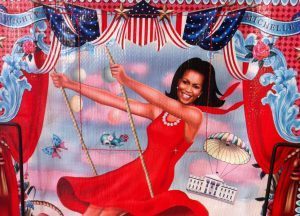 NOW THAT SHE IS NO LONGER presiding over the East Wing in the White House, Michelle Obama is grateful for the little things. One of them is toast, or rather toast she makes herself. As she recounts in her mega best-selling memoir, Becoming, nothing feels more liberating than tiptoeing to the kitchen of her own home and making toast, specifically cheese toast. It is a relief, she notes, to not have someone offer to make it for her, and a delight to walk to her back porch and eat it, alone and in shorts and with the Secret Service a hundred yards away. It is an endearing story, with its Oprah-endorsed (she told the story on Oprah’s “SuperSoul Conversations” podcast) appeal underscoring the everyone-loves-her charisma of the most admired woman in America. There is lots more of the same in Becoming; it is laden with curated-for-cuteness interludes. Indeed, sometimes you can almost hear the collective gasps of an invisible Oprah audience rise up from the page: they’re there when she tells of Barack staring at the ceiling one night in bed during their courtship and admitting he was thinking about “income inequality”; they cheer, too, when Michelle recounts how the couple was applauded by diners at a restaurant in New York when they went on a presidential date night; and they hem with smug approval when Michelle talks of laying down the law over family dinnertime at the East Wing regardless of what was going down at the West Wing.
There is nothing wrong about writing a book designed to please Oprah audiences; the office of First Lady has, over the decades, been a roost of soft-celebrity interlaced with doses of middle-class wifely virtue, the venue, so to speak, for a very American kind of royalty. Popularity is the job requirement, and the First Lady wins it by performing with convincing devotion the job of wife and mother that landed her there in the first place. Even Eleanor Roosevelt, arguably one of the most rebellious of First Ladies, had to bend to this demand in some way, obediently resigning from her position at the Democratic National Committee and promising not to air her political views in any future magazine articles. Wifely devotion and deliberate de-politicization appear to be de rigueur, then and now, so why should Michelle Obama deign to be any different?
Except that she is different. Becoming is (or at least intends to be) a story about evolution, of a woman transforming from what she was into what she is: America’s most recently recused first wife and mother-in-chief.
More here.
Adorno in America
Corey Robin at his own website:
 The history of the Frankfurt School in America is usually told as a story of one-way traffic. The question being: What did America get from the Frankfurt School? The answer usually offered: a lot! We got Marcuse, Neumann, Lowenthal, Fromm, and, for a time, Horkheimer and Adorno (who ultimately went back to Germany after the war)—the whole array of émigré culture that helped transform the United States from a provincial outpost of arts and letters into a polyglot Parnassus of the world.
The wonderfully counter-intuitive and heterodox question that animates Eric Oberle’s Theodor Adorno and the Century of Negative Identity is: what did the Frankfurt School get from America? To the extent that question has been asked, it has traditionally provoked a negative response. Not a lot. Adorno was notoriously unhappy in the US: the kitsch, the kitsch. And for those Frankfurters who may have found what they were looking for in the States, the suspicion has always been that they were somehow seduced and made less smart—less gloomy, less dialectical, less mandarin, less mitteleuropäisch—by their experience in the US. Witness Erich Fromm.
But Oberle refuses that argument. In a work of boundless ambition and comparable achievement, which combines close reading of familiar texts and synoptic intellectual histories that bring together unfamiliar texts, The Century of Negative Identity shows just how indebted the Frankfurt School, particularly Adorno and Horkheimer, was to its time in America.
More here.
The Geography of Rebels Trilogy by Maria Gabriela Llansol
Tara Cheesman at The Quarterly Conversation:
 Imagine if Don Mclean’s song American Pie was written about Christian mysticism instead of rock-n-roll. That’s my elevator pitch/description of the Portuguese writer, Maria Gabriela Llansol’s, English language debut: The Geography of Rebels Trilogy. Originally published as three separate books—The Book of Communities, The Remaining Life, and In the House of July and August—it has been painstakingly translated by Audrey Young and released by the Texas indie publisher Deep Vellum in a single volume.
Anyone coming to Llansol with any kind of “normal” expectations at all will likely be disappointed. Plot, logical structure, continuity, a sense of linear time and/or space— you won’t find any of that here. At least not in any form that is readily apparent. Instead, Llansol immerses her readers in a shared hallucinatory vision, seemingly fueled by religious hysteria and open to multiple interpretations.
more here.
James Baldwin, Restored
Hilton Als at The Paris Review:
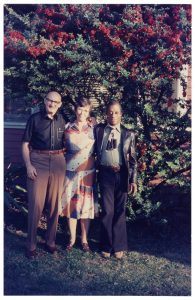 Skipping along those tones mentally and emotionally, we’ve left the world of biography, in fact, and we enter the universe of pure metaphor. Growing up and as an artist, Baldwin had a great interest in masks, specifically the masks of blackness and maleness, the various roles we appropriate or condemn the better to define ourselves. In one of his last pieces of writing, he talked about the various projections that Michael Jackson, for instance, had to withstand and survive if he did not internalize what America deemed ugly, which is to say his blackness and his maleness. In Anthony Barboza’s extraordinary image from 1980, we have Jackson’s real pre–Michael Jackson face, the face God made for him and he did not make for himself. His internal life disfigured his body and his face in order to find some approximation of it in front of the camera and in front of the world, and it’s such a gift to have Barboza’s portrait before those decisions were made, and to see his extraordinary vulnerability and the beauty of his real face.
more here.
Is Public Philosophy Good?
Agnes Callard at The Point:
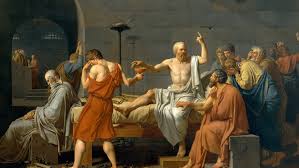 Here I put forward my own unabashedly partisan view of philosophy, cribbed from Plato’s cave: philosophy does not put sight into blind eyes; rather, it turns the soul around to face the light. A soul will not turn except under painful exposure to all the questions it forgot to ask, and it will quickly turn back again unless it is pressured to acknowledge the meaninglessness of a life in which it does not continue to ask them. Philosophy doesn’t jazz up the life you were living—it snatches that life out of your grip. It doesn’t make you feel smarter, it makes you feel stupider: doing philosophy, you discover you don’t even know the most basic things.
When Aristotle said that the intellectual life is one of serious leisure, I believe he was trying to avoid the Scylla of business and the Charybdis of pleasure. If philosophy offered helpful answers to the questions you were asking anyways, it wouldn’t be leisurely; if it added fun to the life you were living anyways, it wouldn’t be serious.
more here.
Dred Scott case, March 6, 1857
From Black History.com:
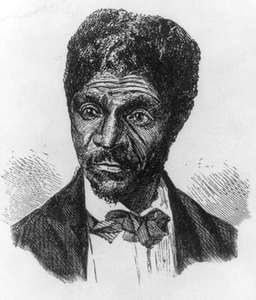 On March 6, 1857, the U.S. Supreme Court handed down its decision in Scott v. Sanford, delivering a resounding victory to southern supporters of slavery and arousing the ire of northern abolitionists. During the 1830s, the owner of a slave named Dred Scott had taken him from the slave state of Missouri to the Wisconsin territory and Illinois, where slavery was outlawed, according to the terms of the Missouri Compromise of 1820. Upon his return to Missouri, Scott sued for his freedom on the basis that his temporary removal to free soil had made him legally free. The case went to the Supreme Court, where Chief Justice Roger B. Taney and the majority eventually ruled that Scott was a slave and not a citizen, and thus had no legal rights to sue.
According to the Court, Congress had no constitutional power to deprive persons of their property rights when dealing with slaves in the territories. The verdict effectively declared the Missouri Compromise unconstitutional, ruling that all territories were open to slavery and could exclude it only when they became states. While much of the South rejoiced, seeing the verdict as a clear victory for the slave system, antislavery northerners were furious. One of the most prominent abolitionists, Frederick Douglass, was cautiously optimistic, however, wisely predicting that —This very attempt to blot out forever the hopes of an enslaved people may be one necessary link in the chain of events preparatory to the complete overthrow of the whole slave system.”
More here. (Note: Throughout February, we will publish at least one post dedicated to Black History Month)
Friday, February 15, 2019
A Suspense Novelist’s Trail of Deceptions
Ian Parker in The New Yorker:
 Dan Mallory, a book editor turned novelist, is tall, good-looking, and clever. His novel, “The Woman in the Window,” which was published under a lightly worn pseudonym, A. J. Finn, was the hit psychological thriller of the past year. Like “Gone Girl,” by Gillian Flynn (2012), and “The Girl on the Train,” by Paula Hawkins (2015), each of which has sold millions of copies, Mallory’s novel, published in January, 2018, features an unreliable first-person female narrator, an apparent murder, and a possible psychopath.
Mallory sold the novel in a two-book, two-million-dollar deal. He dedicated it to a man he has described as an ex-boyfriend, and secured a blurb from Stephen King: “One of those rare books that really is unputdownable.” Mallory was profiled in the Times, and the novel was reviewed in this magazine. A Washington Post critic contended that Mallory’s prose “caresses us.” The novel entered the Times best-seller list at No. 1—the first time in twelve years that a début novel had done so. A film adaptation, starring Amy Adams and Gary Oldman, was shot in New York last year. Mallory has said that his second novel is likely to appear in early 2020—coinciding, he hopes, with the Oscar ceremony at which the film of “The Woman in the Window” will be honored. Translation rights have been acquired in more than forty foreign markets.
More here.
The Proverbial Murder Mystery
Scott Alexander in Slate Star Codex:
 “We’re the United States’ only proverb laboratory. Our mission is to stress-test the nation’s proverbs. To provide rigorous backing for the good ones, and weed out the bad ones.”
“I’d never even heard of your organization before today, I have to admit. And now that I’m here…it’s huge! Who pays for all of this?”
“Everybody who uses proverbs,” said the Doctor, “which is to say, everybody. Consider: he who hesitates is lost. But also: look before you leap. Suppose you’re a business executive who spots a time-limited opportunity. What do you do? Hesitate? Or leap without looking? Eggheads devise all sorts of fancy rules about timing the market and relying on studies, but when push comes to shove most people are going to rely on the simple sayings they learned as a child. If you can keep your stock of proverbs more up-to-date than your competitor’s, that gives you a big business advantage.”
More here. [Thanks to Misha Lepetic.]
On Memory and Myth
Maia Cruz Palileo at Artforum:
 THIS SHOW’S TITLE comes from a letter that my grandmother wrote to me around ten years ago. I had just begun collecting stories from my family and had asked her to describe the house she lived in as a young girl in the Philippines. She drafted a long, detailed letter, filled with drawings. But she forgot to specify my apartment number on the address, so the letter was eventually returned to her. When she re-sent it, she added a note, lamenting, “All the while I thought you had received this.”
There was something about that phrase that really resonated with me. My work has so much to do with the oral history of my family and how stories construct a sense of our past and build a mythology. Growing up in Chicago, I’d hear so many tales about the Philippines from family members, but they always seemed a bit hazy and fragmented. My other grandmother, who never emigrated to the US, would reference bits and pieces of the past: “Your grandfather was in the war.” I was so interested in what their lives used to be like, but I could never get a full picture. I became curious about which stories don’t get told and what information doesn’t get passed on.
more here.
Iris Murdoch and The Power of Love
Anil Gomes at the TLS:
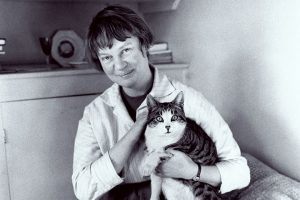 In contrast to her opponents, Murdoch stresses the reality of moral life. To acknowledge the reality of moral life is to recognize that the world contains such things as kindness, as foolishness, as mean-spiritedness. These are genuine features of reality, and someone who comes to know that some course of action would be foolish comes to know something about how things are in the world. This view is sometimes thought to be ruled out by a certain scientistic conception of the natural, one that restricts what exists to the things that feature in our best scientific theories. Such a view is too restricted, Murdoch thinks, to capture the reality of our lives – including our lives as moral agents. Goodness is sovereign, which is to say a real, if transcendent, aspect of the world.
Making sense of these ideas requires a metaphysics of morals, one that helps us to make peace with the existence of transcendent goodness. But if morality is to move us, we need not just a metaphysics of morals but also a moral psychology: an account of how we creatures, concrete as we are, are able to know about, and be guided by, the transcendent good.
more here.
How Tech Utopia Fostered Tyranny
Jon Askonas in The New Atlantis:
 The rumors spread like wildfire: Muslims were secretly lacing a Sri Lankan village’s food with sterilization drugs. Soon, a video circulated that appeared to show a Muslim shopkeeper admitting to drugging his customers — he had misunderstood the question that was angrily put to him. Then all hell broke loose. Over a several-day span, dozens of mosques and Muslim-owned shops and homes were burned down across multiple towns. In one home, a young journalist was trapped, and perished.
Mob violence is an old phenomenon, but the tools encouraging it, in this case, were not. As the New York Times reported in April, the rumors were spread via Facebook, whose newsfeed algorithm prioritized high-engagement content, especially videos. “Designed to maximize user time on site,” as the Times article describes, the newsfeed algorithm “promotes whatever wins the most attention. Posts that tap into negative, primal emotions like anger or fear, studies have found, produce the highest engagement, and so proliferate.” On Facebook in Sri Lanka, posts with incendiary rumors had among the highest engagement rates, and so were among the most highly promoted content on the platform. Similar cases of mob violence have taken place in India, Myanmar, Mexico, and elsewhere, with misinformation spread mainly through Facebook and the messaging tool WhatsApp.
More here.
AI: Better Language Models and Their Implications
Alec Radford, Jeff Wu, Dario Amodei,Daniela Amodei, Jack Clark, Miles Brundage & Ilya Sutskever in the blog of OpenAI:
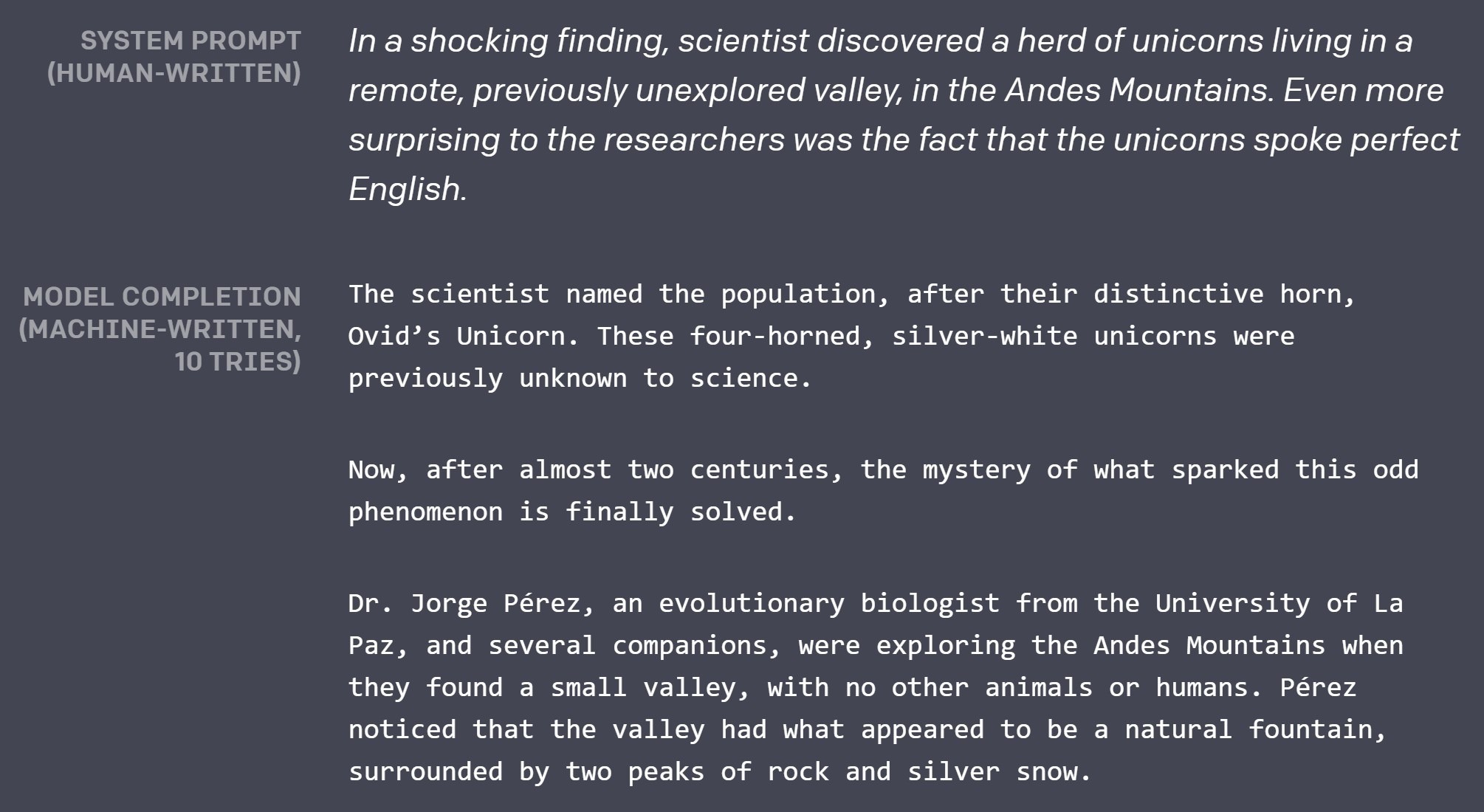
Our model, called GPT-2 (a successor to GPT), was trained simply to predict the next word in 40GB of Internet text. Due to our concerns about malicious applications of the technology, we are not releasing the trained model. As an experiment in responsible disclosure, we are instead releasing a much smaller model for researchers to experiment with, as well as a technical paper.
GPT-2 is a large transformer-based language model with 1.5 billion parameters, trained on a dataset[1] of 8 million web pages. GPT-2 is trained with a simple objective: predict the next word, given all of the previous words within some text. The diversity of the dataset causes this simple goal to contain naturally occurring demonstrations of many tasks across diverse domains. GPT-2 is a direct scale-up of GPT, with more than 10X the parameters and trained on more than 10X the amount of data.
GPT-2 displays a broad set of capabilities, including the ability to generate conditional synthetic text samples of unprecedented quality, where we prime the model with an input and have it generate a lengthy continuation.
More here.