The Sacred

by Maniza Naqvi

ScreenHunter_03 Oct. 01 19.54On a Saturday, in the crisp air and bright light of the highlands, hundreds of people, a flood of people —made their way to and from the market place, as has been done for centuries, carrying on their backs and shoulders, their precious babies and bundled loads of produce and goods. A miracle, this, how they had walked as far as forty kilometers up and down mountains for as long as five hours in one direction to reach the market with their livestock while carrying on their own backs and on the backs of their donkeys vessels of grains, honey, firewood, baskets, onions, potatoes, tomatoes, garlic, green chilies cauliflower, lettuce, live chickens, cabbage, Tef, Tej, sorghum, maize, wheat, rice, baskets and so on. In Lalibela, the sun drenched and bustling Saturday market right outside the walls of the dark, cool, quiet and largely empty inner sanctums of the stone churches reminded me of Jerusalem. The sacred it seems, all over the world must have a market. Or is it that commerce must have temples or that what is of value rings around itself the sacred?

ScreenHunter_04 Oct. 02 09.46In the market there are lemons for sale. And the guide picks one up and takes aim saying that over here if someone throws a lemon at you it’s a declaration of love. I can’t think of something clever so I say, “I bet they say that to all the older women who come through here”. He laughs, rubbing the back of his graying head, “Yes! See that motel there? It belongs to former guides who were helped by a lady tourist who was very happy with their services.” I pick up a lemon and do a mock throw at a kid who has been trailing alongside giggling and testing one liners on me in German, Italian and French.

ScreenHunter_05 Oct. 02 09.52My guide points out things that must be noted by me, “King Lalibela had divine intervention on his side, look what he accomplished, look how he carved this wall, that pillar, this step, that window, that cross and that detail of a divine eye watching over us.” My guide talks of King Lalibela as though he constructed the churches all by himself, single handedly. I point this out. Well that’s the folklore he says. “If there is anything divine,” I say, “Then surely it is the labor of the people who made these churches, no?” The guide agrees. I continue on “The rest is a King’s ego. Perhaps if rulers had focused on works that fed people instead of works that only nourished their own need for immortality then the centuries to follow would have been of plentiful crops. ScreenHunter_06 Oct. 02 09.52 Kings who build such things and the places like the Taj Mahal seem to condemn generations forward to misery. A King who made his people labor for 24 years on carving out these churches with their hands and tools made of stone must have done this at the cost of producing food and security. No wonder the neighboring warlords marched right into these valleys…everyone was busy cutting stone.” The guide leans against an embankment of stone watching me silently. I ask whether there are irrigation channels, water storage cisterns and wells in the area that date from the same time as the churches. “No”, replies the guide, “There was no need at that time because the land was plentiful with water and forests. Now the hills and valleys have neither and depend on the rain. The new road built in the valley recently destroyed the water sources. Besides, the King’s granaries were full. He provided his people food for work.”

Read more »

Poetry in Translation: Agha Shahid Ali and I do two couplets by Faiz Ahmed Faiz

by S. Abbas Raza

Once again, I present my own translation of two lovely couplets by Faiz Ahmed Faiz side by side with a translation of the same by the late Agha Shahid Ali. I do this not to criticize Shahid's translation in any way but actually to pay tribute to him as well as to Faiz and to show how very different translations can both, I hope, work. I have indulged in this sort of exercise before. You may see that previous effort here. This time, my translation is deliberately not as literal as it could be (although more so than Shahid's) and I have tried to retain the rhyme scheme and even, to some extent, the meter of the original Urdu. The original has no title, by the way (it just says “Couplets”), and Shahid and I have both made up our own. (My translation on the left; Shahid's on the right.)

006AS IF

Last night my heart recovered a lost memory of you,
As if a desolate place had impetuously bloomed,

As if a moist breeze had washed over a parched desert,
As if a man, suffering, had a sudden peace assumed.

And here is an informal Urdu transliteration as well as the original:

004ASHAAR

Raat yoon dil mein teree khoee hoee yaad aaee
Jaisay veeranay mein chupkay say bahaar aajaaey

Jaisay sehraaon mein hollay say chalay baad-e-naseem
Jaisay beemar ko bay-wajah qaraar aajaaey

I await suggestions for improvement from my Urdu-speaking (and other) readers!

Monday, September 24, 2012

The Legacy of Feudalism, or The American Dream: Lordships for All!

by Akim Reinhardt

Historian Wile E. Coyote and Road RunnerFrancis Jennings (1918-2000) didn’t take the fast track to academic fame. His first career was teaching high school English and Social Studies. After serving in World War II, he returned to the classroom and also became president of his union. Soon thereafter, he became a victim of the Red SCare; the House UnAmerican Activities Committee (HUAC) fingered him during its 1951 “investigation” of organized labor in Philadelphia.

Jennings became disgusted and quit. Despite having small children, he abandoned a safe, established career and began pursuing a Ph.D. in history at the University of Pennsylvania. It took more than a decade, but he finally earned his doctorate in 1965 at the age of 47.

It would take another decade for Jennings to establish himself in academia. He could not immediately translate his hard-won Ivy League pedigree into any prestigious appointments. Instead, he taught at little known schools like Moore College of Art and Cedar Crest College.

Jennings finally arrived on the scene in a way that could not be ignored in 1975 after publishing his first book at the age of 57. The very title was a shot across the bow of America’s received history: The Invasion of America.

The book defied many academic conventions, not to mention popular, mainstream history. It disputed the romantic notion of the European “discovery” of America, redefining it as an invasion and recasting North America’s hearty pioneers as the brutal agents of colonial conquest.

Jennings The Invasion of AmericaThe Invasion of America was a direct challenge not only to famous U.S. historians of yore such as Francis Parkman (1823-1893) and Frederick Jackson Turner (1861-1932), but to entire generations of scholars that helped establish America’s founding mythologies. According to Jennings, these glorified apologias for European colonialism sometimes resulted from error and sometimes from the intentional manipulation of sources. Either way, he deemed them to be little more than crude propaganda that had nevertheless evolved into conventional scholarship and infected popular culture.

To overturn that mythology and reinterpret the colonial invasions, Jennings relied on French historian Marc Bloch’s theories of feudalism. For Jennings, the dull thud of feudal butchery and elitism explained much about European attitudes and actions in North America during the 17th century. The European invaders were a product of their times, and their times were decidedly feudal. They would arrive in America striving to be lords (if they weren’t already), and seeking to reduce the Indigenous population into vassalage.

Read more »

Monday Poem

Talking With My Guru
—1.0 Nothing & Emptiness

G: What exactly do you mean by emptiness?
Me: I mean nothing.
G: Why then are we wasting time discussing it?

Take your tiny Tao shears
and snip emptiness out of Webster’s
and heave it into the void. It’s another
self-serving euphemism like time
or collateral damage

Cut wood, draw some water
and stop sound-biting things to death
and travel light (and lightly)
till no sun remains

nothing and emptiness
are for advanced students
with nothing to lose
and nothing to gain

…………………….
Jim Culleny, October 2007

How To Beat The GOP With Better Slogans

by Evert Cilliers aka Adam Ash

Screw usAl Franken once complained that Democratic policies cannot be summed up in short bumper stickers, like the Republicans can sum up their entire philosophy in “cut taxes, shrink government.”

Well, here are a few bumper stickers with which to attack Republicans and beat them senseless.

But first, a word about Karl Rove, who is some kind of campaign genius. After all, he took George W. Bush, a mediocre 1% guy with a 99% demeanor, and first had him beat Ann Richards to become governor of Texas, then beat Al Gore to become president. And then he got a second term for Bush, the worst president in modern history, if not in all of history.

One of the genius insights of Karl Rove as a campaign guru was to attack your opponent's strengths instead of his weaknesses.

So what are the GOP's perceived strengths? What do they like to trumpet about themselves?

1. Republicans are very patriotic. America first, always and everywhere. Republicans are the real Americans.

2. Republicans are very religious. Republicans are good Christians.

3. Republicans are fiscally responsible (certainly not an actual strength, but a perceived one).

4. Republicans stand for a strong military defense.

5. Republicans stand for personal freedom.

6. Republicans are against big government.

7. Republicans like to cut taxes.

8. Republicans are very macho. Republicans are real men.

How can these strengths be attacked?

Read more »

A Gloomy Anthropomorphic Trawl

by Gautam Pemmaraju

HadrianCapitoline2Type6 copyIn Marguerite Yourcenar’s masterful Memoirs Of Hadrain, a “valediction to a world that has pleased him” written as a letter to the 17 year old Marcus Aurelius, the dying Roman emperor imagines parts of his life to be like “dismantled rooms of a palace too vast for an impoverished owner to occupy in its entirety”. The corporeal body, its passions and strengths, its appetites and tempers, diminish with time, the sage old man reflects in this fine and complex survey of the ‘landscape’ of his days, and as fevers and fatigues take over, he begins “to discern the profile of my death”,

Like a traveler sailing the archipelago who sees the luminous mists lift toward evening, and little by little makes out the shore…

The emperor, in the “meditations of a sick man who holds audience with his memories”, is no more than “a sorry mixture of blood and lymph”; he is laid bare before his learned physician Hermogenes, who concernedly, and devotedly, administers herbs, mineral salts and reassurances. His body has ‘served him well’, Hadrian informs his young ward, and it occurs to him that although it has been his “faithful companion and friend”, more steadfast than his own soul, it may well be “only a sly beast who will end up devouring his master”.

All men’s days are numbered; such is the nature of things. When, where and under what circumstances is entirely another matter but it is immutable that one must go, be it by disease, “a dagger thrust in the heart” or “a fall from a horse”. Hadrian confronts his imminent demise with great wisdom, reflecting on his accomplishments and failures, his friendships and loves, his excesses and his abstentions alike. In hoary, “marmoreal” prose (see here; see also Mavis Gallant’s Limpid Pessimist, NYRB 1985), Yourcenar invests the emperor with generous, layered thoughtfulness, a pansophy, wherein the unraveling of a successful life is richly intertwined with fine, dexterous observation. It is such an exercise that affords Hadrian “the advantage for the mind (and also the dangers) of different forms of abstinence….when the body, partly lightened of ballast, enters into a world for which it is not made, and which affords it a foretaste of the cold and emptiness of death”.

Read more »

Monday, September 17, 2012

Green Aristotle: Virtue, Contemplation and the Ethics of Sustainability

by Liam Heneghan

Aristotle0001

Theories of war provoke snarling debate because we are never at peace. Similarly, calls for sustainability nettle us when accompanied by declarations of civilization’s imminent collapse. Certainly there are several lines of investigation indicating that the collective needs of humanity cannot be met in perpetuity and that current demands are already imposing an undue burden on systems that support human life on Earth (my 3quarksdaily colleague, Kevin S Baldwin, writes about it here). Sustainability initiatives, therefore, require us to consider a range of corrective actions. Consistent with what sustainability advocates call the “triple bottom line” of people, planet and profit, changes are needed in the economic, social and ecological realm. Beyond these immediately pragmatic considerations, calls for environmental sustainability also amount to calls for ethical change. The 1987 Brundtland Commission defined sustainable development as development that “meets the needs of the present without compromising the ability of future generations to meet their own needs”. The definition suggests an ethical dimension to sustainability. That is, sustainability requires a reflection on balancing the obligations of the moment against our obligations to humans both unknown and unborn. But why should we be concerned about these humans of the future, anymore than we are about those who went before us? Certainly they are of curiosity value, but are they ethically of concern to us? Sustainability may necessitate a vigorous upheaval in values.

Sustainability ethics, a subspecies of environmental ethics, refers to a set of positions that emerge when the environmental state of things is not simply regarded as irritating, but as immoral, bad, wrong or evil.[1] Environmental ethics in general and sustainability ethics in particular shares a framework in common with the rest of contemporary ethical philosophy, though it also has a suite of unique problems. Although most environmental ethics is human-centered in which environmental damage is largely considered reprobatory because of the consequences for human welfare, there are, more controversially, a set of ethical positions that center on concerns beyond those of our own species. In common though with other normative ethical frameworks, environmental ethics can be approached from a so-called consequentialist, deontological, or virtue ethical perspective.

Briefly, consequentialism, as the name implies, determines the rightness of actions based upon the consequences of actions. Typically the consequentialist strives to maximize the greatest good among a range of outcomes. One can determine the greatest good solely in relation to the agent making the decision – me, for instance, though this egotistical consequentialism can produce unpalatable results from the perspective of others (the non-mes!). Agent-neutral versions are more typical. I might, for example, make ethical decisions that produce the greatest good for all sentient beings, and in this way we can environmentalize consequentialist ethics. Deontological ethics are those that emerge from an examination of principles or rules rather than the value of those things that are affected by actions. Finally, virtue based ethics, deriving from Aristotle (though really they predate him), argues that there are certain human virtues that should be cultivated in order for people to live good lives. One would preserve aspects of the environment, or concern ourselves with the needs of others, in this view of things because to do so corresponds with the exercise of a particular virtue, the practice of which simultaneously brings us pleasure.

From here on I am concerned only with Aristotle’s ethics. Not because other approaches are irrelevant but because Aristotle’s ethical approaches seem to accord with the needs of sustainability in ways that, I think at least, has not been adequately explored.

Read more »

Encounters with fruit

By Rishidev Chaudhuri

I

40908-KakiHe was the masseur of persimmons, and he attached himself to that statement with as much precision as he could. It would be so easy, ever so easy, to let go, to slip away, to fade into one of those reddish, tannic, slightly yielding fruit. Every morning, every hour, every lunch break, every minute, he had to remind himself that he was the masseur of persimmons (and not the persimmon itself).

Like many days, he woke in a mild panic, scrambling to congeal an identity before the warm light of day smoothed out the lumps of his self and left him nowhere. He brushed his teeth and bathed, because that is what one does, and dressed in a cream shirt with a floral motif and beige, slightly ragged pants, all the while repeating his name and the fact of his existence to himself. He stepped down the stairs and onto the street, hiding slightly from the bright glare of the ghoulish sun, and then on, down the pavement, blinking owlishly and wondering how many new clients he would have.

His studio was atop a tired warehouse, south of the city center, amidst intersecting streets and cars in the process of being stolen. He stepped up the stairs to his studio, nervous that he'd find himself back at home and relieved to walk into the familiar room. Small, wood-panelled, with a flat desk and a high chair with no arms, so that his hands could freely range up and down. The persimmons lay in little crates, stacked sideways on the floor, and as he sat he kept his gaze fixed on them (the threats to his self, his reason for existence). He sat watching them for at least an hour, perhaps more, barely moving to scratch or fidget and only occasionally moving to remind himself of the contours of his body. Then he got up, bending forward from the hips, spine straight and counterbalancing upwards with the grace of a natural athlete. He approached the crate, slowly, a little scared and reached forward. Eyes shut he hesitated, not breathing, then let his fingers brush the smooth surface of one of those round objects. As he did, he felt a shudder of contingency pass through his being and he pulled back sharply, suddenly desperate to remember his place and time. But, of course, he was the masseur of persimmons and he had to massage persimmons or he would be nobody. And, besides, who would massage them if he didn't?

Read more »

The Forgotten Archipelago

by Misha Lepetic

“No one is so stubborn and dangerous as the beneficiaries of a fallen idea –
they defend not the idea, but their bare life and the loot.”
~Sándor Márai

Air3One of the decided advantages enjoyed by central planning is the ability to, in the words of Captain Picard, “make it so,” and thereby create – or wreak – change on a grand scale. In the 20th century, techniques of social, political and economic control were refined by authoritarian governments to the extent that vast reorganizations of the social fabric were effected in a relentless fashion. Initiatives that come to mind include China’s Great Leap Forward, or the Khmer Rouge’s decidedly anti-urban policies, exercised with great verve during their brief but dismal tenure. For its part, the Soviet Union offers many examples, but the consequences of one such phenomenon continue on: the so-called “closed cities” that were devoted to the research and manufacture of military equipment and, most importantly, nuclear weapons.

Originating in the late 1930s under Stalin’s direction, these cities bore all the hubristic hallmarks of an authoritarian command-and-control regime, including a unrepentantly narrow raison d'être and an utter disregard for geography. Known as ZATO cities (for “zakrytye administrativno-territorial'nye obrazovaniia,” or “closed administrative-territorial formations”), the sensitivity of their mission furthermore prevented them from even being placed on maps. A logical corollary to this is, if you don’t want to place something on a map, you probably aren’t keen give it a memorable name, either. At first, these cities were named in relation to the nearest, recognized city, and hyphenated with the approximate distance in kilometers. I must admit, given the nuclear remit of about ten of these cities, that there is something deliciously evocative about such a nomenclature – as if one was listing the known element and its artificially fabricated, enriched but less stable isotope. However, even this nomenclature proved a bit too explicit for the comfort of the Soviet authorities:

Thus, the All-Russian Scientific and Research Institute of Experimental Physics (VNIIEF) was initially known as Arzamas-60, a postal code designation to show that it was 60 km from the city of Arzamas. But the “60” was considered too sensitive, and the number was changed to “16.” In 1947 the entire city of Sarov (Arzamas-16) disappeared from all official Russian maps and statistical documents. The facility has also been known Moscow-300, the town of Kremlev, and Arzamas-75. Zlatoust-20 is probably the same as Zlatoust-36, and Kurchatov-21, Moscow-21, Moscow-400 and Semipalatinsk-121 are almost certainly the same as Semipalatinsk-16.

This points to another difficulty intrinsic to the ZATO archipelago – how many of them are there? Even today, it is difficult to say with any degree of certainty. Estimates tend to cluster around 40, but, somewhat confusingly, “in addition, there are thought to be at least 15 ZATO in existence that cannot be accounted for.”

Closed-city-final5

An ambiguous ontological status isn’t the only privilege of the ZATO archipelago, either. In their Soviet heyday, these cities concentrated tens of thousands of the most advanced scientists and engineers in self-sufficient urbanizations loosely modeled on the factory town template. To compensate for the stresses of performing highly surveilled work in a remote location to which few had access, ZATO workers tended to be better paid than their counterparts who worked in more prosaic locations. Also, all financing for ZATO cities was administered directly through the federal budget. While this fact may seem dry and unimportant at first blush, it had tremendous consequences as the Soviet Union transitioned into post-Communist Russia.

Read more »

Monday Poem

Speaker 4

Drone

I speak a simple tongue
direct and to the point

I have no second thoughts
cluttered with misgivings

I don't mince words
I come from clouds

under a flag of state
I hunt outside the natural order

as cold and heartless as a hawk
but without its natural exculpation

I bring regal retribution:
a creator of corpses, I am

the Count of Capacitors
the Lord of Algorithms is my muse

I have no empathic circuits
nor do my masters

Mathematics only guides my moves
Precise and incendiary is my passion

I'm your envoy
your political assassin

Send me whenever you must
dispatch your current devil

I am yours —your
techno-cudgel
.

by Jim Culleny,
7/19/12

Saintly Simulation

by Evan Selinger

ScreenHunter_02 Sep. 17 08.14My colleague Thomas Seager and I recently co-wrote “Digital Jiminy Crickets,” an article that proposed a provocative thought experiment. Imagine an app existed that could give you perfect moral advice on demand. Should you use it? Or, would outsourcing morality diminish our humanity? Our think piece merely raised the question, leaving the answer up to the reader. However, Noûs—a prestigious philosophy journal—published an article by Robert J. Howell that advances a strong position on the topic, Google Morals, Virtue, and the Asymmetry of Deference”. To save you the trouble of getting a Ph.D. to read this fantastic, but highly technical piece, I’ll summarize the main points here.

It isn’t easy to be a good person. When facing a genuine moral dilemma, it can be hard to know how to proceed. One friend tells us that the right thing to do is stay, while another tells us to go. Both sides offer compelling reasons—perhaps reasons guided by conflicting but internally consistent moral theories, like utilitarianism and deontology. Overwhelmed by the seeming plausibility of each side, we end up unsure how to solve the riddle of The Clash.

Now, Howell isn’t a cyber utopian, and he certainly doesn’t claim technology will solve this problem any time soon, if ever. Moreover, Howell doesn’t say much about how to solve the debates over moral realism. Based on this article alone, we don’t know if he believes all moral dilemmas can be solved according to objective criteria. To determine if—as a matter of principle—deferring to a morally wise computer would upgrade our humanity, he asks us to imagine an app called Google Morals: “When faced with a moral quandary or deep ethical question we can type a query and the answer comes forthwith. Next time I am weighing the value of a tasty steak against the disvalue of animal suffering, I’ll know what to do. Never again will I be paralyzed by the prospect of pushing that fat man onto the trolley tracks to prevent five innocents from being killed. I’ll just Google it.”

Let’s imagine Google Morals is infallible, always truthful, and 100% hacker-proof. The government can’t mess with it to brainwash you. Friends can’t tamper with it to pull a prank. Rivals can’t adjust it to gain competitive advantage. Advertisers can’t tweak it to lull you into buying their products. Under these conditions, Google Morals is more trustworthy than the best rabbi or priest. Even so, Howell contends, depending on it is a bad idea.

Read more »

Civility and Public Reason

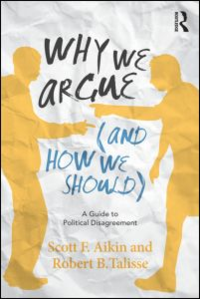
Scott F. Aikin and Robert B. Talisse

ArgueAccording to a prevailing conception among political theorists, part of what accounts for the legitimacy of democratic government and the bindingness of its laws is democracy’s commitment to public deliberation. Democracy is not merely a process of collective decision in which each adult citizen gets precisely one vote and the majority rules; after all, that an outcome was produced by a process of majoritarian equal voting provides only a weak reason to accept it. The crucial aspect of democracy is the process of public reasoning and deliberation that precedes the vote. The idea is that majoritarian equal voting procedures can produce a binding outcome only when they are engaged after citizens have had ample opportunity to reason and deliberate together about matters of public concern. We claimed in last month’s post that democracy is all about argument; this means that at democracy’s core is public deliberation.

In a democracy, public deliberation is the activity in which citizens exchange reasons concerning which governmental policies should be instituted. This activity is necessary because democratic decision-making regularly takes place against a backdrop of disagreement, where different conceptions of public interest conflict. It is important to note that although reasoning always has consensus among its goals, democratic deliberation is aimed primarily at reconciling citizens to the central reality of politics, namely that in a society of free and equal individuals, no one can get everything he or she wants from politics. As democratic citizens, we disagree about which policies will best serve the public interest, and so, when democracy makes collective decisions, some of us will lose – our preferred policy will fail to win the requisite support. Yet democratic laws and decisions are prima facie binding on us all, even when they conflict with our individual judgments about what is best.

Read more »

Monday, September 10, 2012

On Cursing

By Tom Jacobs and Troy Hatlevig

Profanity is the crutch of the inarticulate.

~ anonymous

Fuck you, you fucking fuck.

~ Joe Pesci, in Goodfellas

I curse a lot. I seem to drop the f-bomb more frequently than most, and I’m not sure why this is. I like the word and the way that it adverbializes or adjectivizes things in ways that most adverbs or adjectives don’t.[i] And it accentuates a thought like few other words can. I recall that one of my best friends growing up had an older brother, a true black sheep of the family—drugs, alcohol, county lock up, and so forth—and whenever his father referred to him, he never called him by his name (which I’ll say is Larry). He never said, when things went South for his son, “ah, that Larry.” He always said, “ah, that fucking Larry.” This seems right and true and appropriate. There’s just no other locution that will convey the sentiment.

There are many excellent curse words. Used to be that “douchebag” was the word of choice when describing an irritating or pretentious person (or, if modified to “douchebaggy”) an adjective to describe something overwrought or transparently depthless. Then it became “douchenozzle.” I’m not sure what’s replaced it, but I think the internet has had a role. When confronted with the incomprehensible, sometimes profanity is the only response.

***

No matter what, though, you still can’t really swear in front of your mom. Or, to be more precise, you can swear in front of your mom, but you can’t swear well. For example, one method of swearing well is by using purposeful offhandedness, as in, “so I asked the fuckin guy where his fuckin car was.” You might say that to your mom when telling her your funny story about the douchenozzle from the mall parking lot, but you won’t tell it in an offhanded way.

***

Swearing in front of your parents is a bit like smoking in front of them: embarrassing and humiliating and somehow dehumanizing to both parties. But still, there is an assertion of self there somewhere. Cursing in a most general kind of way is an assertion of self.

There is a peculiar thrill in cursing in front of people we shouldn’t (our parents, our students, our loved ones). But still, cursing rises like a dark light to imprism our behavior (both perceived and meant) on life’s stage. There is something about cursing well…about knowing how to deploy curse words to maximum effectiveness…that speaks volumes about your position in the larger scheme of things. Either you’ve plumbed or not; either you’ve worked construction or not. Either you have worked a blue collar job or not. And it is in the blue collar arena that the best swearing occurs.

Either to shock, or to generate some kind of fraternal resonance, or to simply act as a shibboleth…both you and I know this word, and I’m deploying it for a particular effect (to make you like me, to make you think I’m cool, or to settle the dust that’s been kicked up merely by meeting), cursing has a key role in our theatrical lives.

Read more »

Poetry in Translation: Unveil Your Face!

After Mohammed Iqbal


Unveil your face
A star is witness

Stop flickering
Blaze

Illuminate
Be

How long will you beg like Moses on the mountain?
Fan the flame within you

Create a new Mecca with every speck of your embers
Rid yourself of idolatry

Observe the limits in this temple
Even if you want to boast

First create the confidence of Alexander
Then lust after the splendor of Darius

Translated from the Urdu by Rafiq Kathwari, guest poet at 3 Quarks Daily

Girl in White: An Interview with Sue Hubbard

by Elatia Harris

Girl-in-white

Sue_hubbard

L., Cover, Girl in White, by Sue Hubbard, Cinnamon, 2012. The painting is Portrait of Myself on my Fifth Wedding Annivesary, by Paula Modersohn Becker, 1906, the Boettcherstrasse Museum, Bremen.

R., Sue Hubbard, photo by Derek Adams, suehubbard.com

Sue Hubbard is an award-winning poet, novelist and critic, based in London, who has written about contemporary art for 3 Quarks Daily since 2008. She is the author of Girl in White, a newly published work of fiction based on the life of Paula Modersohn Becker, a pioneering German painter who died in 1907 at age 31, a few days after giving birth. In her short time, Becker worked with enormous dedication to paint authentically, and to focus on subjects outside the usual range of German painting of her era. She did not live to see the great transition of which she was a part. Rather, questioning everything, demanding love and fulfillment as a woman as well as freedom as a painter, she was among those who got to the very edge of the Modern. At her death, over 400 paintings and hundreds of drawings were found in her studio.

ELATIA HARRIS: I am struck by how, as a critic and writer about art, you are very much in the trenches, illuminating the sometimes quite difficult art that is happening right now. Yet Girl in White is set in the early years of the 20th century. Did not only Paula Modersohn Becker but her era attract you?

SUE HUBBARD: It’s true I do write about contemporary art but I’m not a conventional art critic or an academic art historian. My first practice is as a poet. I started writing about art about 20 years ago, when a small magazine that published both art and poetry asked me to write about some artists. I have always seen art and poetry primarily as a form of exploration, a voyage of discovery to uncover the essential self. I am interested in artists and writers who push the boundaries, not for their own sake but to discover new things about the human condition. I’m attracted to the Romantics as well as to the early Moderns and existentialists, so I am quite at home with Paula, who was hungry to discover new things about herself and the possibilities of art.

Read more »

Monday Poem

Further

nothing is further
than a horizon
on a day at sea

storm surge nil, line beyond
the rock of swells
and slap of sea on hull

the horizon,
that crisp ring
that noose

a scalpel cut
between gray and gray
between realms
it cleaves high and low

it's a rift we never breach
but ever keep our eyes on

the edge we never reach
the prey we never snatch
a shore we never beach
a gate that’s never latched

the horizon is tight-lipped and taut
as a lute string strung from zip to zip

distant as a hoax
a hold we never grip
.
.
by Jim Culleny 9/7/12

Ardor and Blight: A Women’s Dictionary

by Mara Jebsen

These are the first two entries of a book of poem-essays inspired by the Oxford English Dictionary.

A is for Ardor

Tumblr_l89dcnJY4Q1qd89zio1_500

Ardor is life. The zeal in a line

down the centre of the body. The wick.

I ascend, with burning

eye. Ascend: to rise

over mountain and lesser; to take on, in some sky

the space of dominion. Now Animated.

Now moved

from within. Fully half of all ancestors

are women. Their brave, painted faces are hard

to know. The frame around mine,

and the frame around yours could melt – there was a song:

my grandma and your

grandma,

sitting by the fire-

then one set the other’s flag ablaze.

It happens that our ancestors are moving

in small circles, in skirts, in their different

houses. Let us will them: Leave their houses.

Burn flags together. Ancestor worship— is veneration

of those dead, whose blood we believe

is threads through our own; that even now they hold sway

over the affairs of the living. Ahankara, in Buddhism

is the false identification

of the true inner spirit with the body,

or mind, or outside

world.

It all burns off, except the wick, the promise

of fire. Are we ardent spirits,

like brandy and gin? I cannot picture

myself without a body. Dear

grandmama, most inflammable of

flammables; how is it I know

you are dancing like blazes in the waltz

of the beyond: when I spin, I burn; hands open, receiving

the gust of a gift called ardor.

Read more »

The Supremacy for Koran Burning

By Maniza NaqviKoranburning

Burning the Koran was not a problem for some of the earliest and most revered Muslims considered to have been exemplary in their actions. In a manner of speaking, they were the forefathers of this tradition and had supremacy for burning the Koran in order, in their opinion, as a matter of necessity, to secure it.

Koran burning, it seems has proved handy for mining and oiling it for whatever its worth, whenever, whichever absolute power ruling over Muslim populations has faced any danger to its longevity. Fourteen hundred years later, Koran burning fueled divisions again; and was once again linked to reasons of security two years ago in September 2010 when there was much agony and fury about the odd call to burn copies of the Koran by an odd preacher in Florida. The President of the United States stepped in to plead with the preacher to not do this (here). And among the reasons the President gave in making his case was that it would endanger American troops fighting in Afghanistan and Iraq. To have stopped the preacher outright from burning copies of the Koran would have been against the preacher’s rights of freedom of speech enshrined in the first amendment. The preacher was, quite correctly, free to do what he pleased it should not have mattered if he hurt sentiments. Sentiments are important but not as important as principles enshrined in the first amendment. This is what makes America: the rule of law that guarantees the freedom of speech, and together, the rule of law and freedom of speech, guarantee the strengthening of tolerance, a flourishing of opinions and civil liberties. The plea to not burn the Koran, however, wasn’t this, but rather couched in the justification that it would hurt the military troops and become a security risk because it would hurt sentiments! Anyway, a year and half later, earlier this year in February 2012, copies of the Koran were burned by Americans at a military base in Afghanistan. Protests and riots ensued and people were killed (here and here). These were people who probably had never had the opportunity to even learn how to read, let alone read or understand the Koran. It is not clear and no one seems to have investigated why there was a need to burn these copies or: why there were so many Korans at an American base or whether these were even copies of the Koran; or whether these were copies of the Bible in the Pashto language, which were being distributed by the US military to illiterate villagers who would not have known the difference as had been reported earlier (here, here , here , here and here) or why was there such religiosity at the base.

Destroying copies of the Koran has been a regular occurrence. In Pakistan alone, each year, for example in Lahore, hundreds of copies of the Koran are found lying in the bed of the main canal that runs through the city when it dries out—thrown in the water by the pious who want to rid themselves of torn copies of it—to do so in water is “allowed” by tradition and of course then there are the copies used by the pious for the purposes of securing their gains by using it as a prop and tool for black magic. In other parts of the country there are rivers where the same practice would occur and of course there is the sea in Karachi. The percentage for each form of piety’s purpose would be hard to determine though judging by the talk of black magic and superstition and the number of Mullahs involved, for a fee, in this booming business, I would imagine that the number of copies destroyed accordingly for this purpose outweigh any other reason.

Read more »

9/11 Eleven Years Out

by Kevin S. Baldwin

It was one of the most perfect autumn days I had ever experienced. Sunny, clear, with just a bit of crispness in the air, and a slight breeze. The colors of foliage and sky were super-saturated. It was one of those times where there was no doubt that it is great to be alive.

Mississippi-River-IllinoisI was out on the Mississippi River about 10 miles North of Burlington, Iowa with some colleagues on what was essentially a fundraising expedition. We were accompanying a generous alum who had grown up on the river and was thinking of buying some riverfront property for his retirement that would be donated to the college for use as a biological field station upon his death. We had just shut off the small outboard motor and were slowly drifting south, with the water gently lapping against the side of the boat. We grabbed a few lotus plants that were floating on the water's surface that reflected the bright blue of the sky. Huck Finn and Tom Sawyer had nothing on us. It was beautiful. Peaceful.

A cell phone rang and the moment evaporated. I was annoyed. Had technology made it so we could no longer sever ourselves from the world we have created, if only to enjoy the natural world for a few moments? I tried to calm my inner Luddite.

One of our party answered. There was a pause, and I slowly began to realize something big was up. I could make out a few words from the clearly agitated caller, like “twin towers”, “Pentagon” and “we're under attack.” It was still early in the morning and the full horror of the day had yet to unfold. Given that we didn't know much, we decided to cut short our journey and head back to shore.

Read more »

Monday, August 27, 2012

Conventional Wisdom

by Akim Reinhardt

As the Republican Party begins its national convention today in Florida, I offer this brief history of political conventions and examine their relevance to modern American politics.

George Washington's cherry treeThe generation of political leaders who initiated and executed the American Revolution and founded a new nation, believed in the concept of republican virtue. That is, they felt it the obligation of every citizen to give of themselves to the welfare of their new, shared political endeavor. That their definition of citizenship was quite narrow is very imoprtant, but another matter altogether.

The founders believed that in order for the republic to survive and be healthy, citizens must sublimate their selfish interests for the sake of the general welfare. In line with this, they imagined that the nation’s politicians would be citizen servants: men, who for a temporary period of time, sacrificed the profits and joys of their personal pursuits so that they might shoulder the responsibility of governing the nation, the states, and localities, offering their wisdom and insight for everyone’s benefit.

There was nothing of political parties in this vision. Neither the Articles of Confederation nor the U.S. Constitution made any mention of them. They are, in the strict sense of the term, extra-constitutional political organizations, and they are most decidedly not what the new nation’s architects had in mind when they fashioned this republic. Indeed, they did not even use the term “party” for the most part, instead referring to the political alliances that soon formed as “factions.” George Washington especially despised the new factionalism, even in its nascent form, and he refused to ally with any group. To this day, he is the only president listed on the roll of chief executives as Independent.

Perhaps it was näive of Washington and other purists to scoff at the emerging political gangs. Perhaps the constitution’s framers should have better anticipated this development and done something to temper it, to keep it from warping their beloved system of checks and balances. Regardless, the move towards modern parties was underway as the nation’s politicians began to lineup behind the philosophies and reputations of top leaders such as Thomas Jefferson, Alexander Hamilton, and John Adams.

Read more »