Thoughts on Art

Hank Willis Thomas at Artforum:
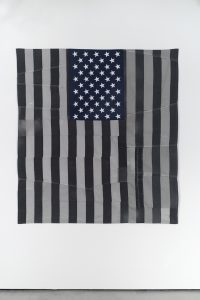
All of my work is about framing and context. Where you stand affects what you see. Your notion of reality is completely shaped by your perspective and what you bring to what you’re looking at. You can have multiple people looking at or talking about the same thing, but having different experiences when it comes to what they’re seeing and what they’re actually talking about.

I’ve always loved modern art, especially Minimalism and Conceptual art. However, I’ve often struggled with interpreting its meaning and even interpreting its value, and at some point I thought that I could engage with it more closely by working with optical ideas that artists such as Frank StellaDaniel Buren, and Ellsworth Kelly were wrestling with. I was really interested in Buren’s stripes because they are seen as so mundane and apolitical, and I realized that in the United States stripes play a critical role in our iconography as a country (the stars and stripes) but, of course, that we also imprison more people in the land of the free than anywhere else in the world and that prison stripes also have a meaning, a potency. There’s the idea of bars that are meant to represent liberty but are also meant to represent people being confined.

more here.
Handel’s Saint Cecilia Ode

Sudip Bose at the American Scholar:

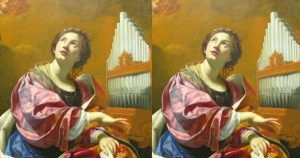
If music is the agent of creation, it remains, for those on earth, a reminder of the divine. It is at once a celestial gift and a personification of human emotions. For both Dryden and Handel, music can be blissful and serene, as in the “What passion cannot music raise and quell!”—a movement that also features two extended, heartfelt solos, the soprano dovetailing beautifully with the cello. It can inspire us to war—“The trumpet’s loud clangor / Excites us to arms / With shrill notes of anger. / And mortal alarms”—the trumpet and tenor sounding the battle cry, and the martial roll of the timpani (corresponding to “The double double double beat / Of the thund’ring drum …”) truly bringing our blood to the boil. Music can reflect our jealousy, our pain, our anger, our desperation. And in quieter moments, it can mirror feelings of deep melancholy. In the movement commencing with “The soft complaining flute,” Handel contrasts the sad desolation of the solo flute and lute continuo (the timbres becoming magical with the addition of the soprano’s voice) with some spectacular coloratura on the word warbling in “Whose dirge is whisper’d by the warbling lute.” More passages of impressive coloratura come later, though in Handel’s hands, this writing never amounts to mere showing off, to virtuosity for its own sake. Rather, the florid embellishments always seem to enhance meaning, aligning text and music to the greatest effect.

more here.

NASA lander survives harrowing descent to surface of Mars

Paul Voosen in Science:

Update: NASA’s InSight spacecraft survived its descent through the thin atmosphere of Mars and successfully landed on the planet’s surface today. Although hurdles remain to achieve operating status, the lander is well positioned to begin to take Mars’s heartbeat in the next few months. “It was intense, and you could feel the emotion,” says NASA Administrator Jim Bridenstine in Washington, D.C. NASA was able to quickly confirm the landing thanks to a flawless performance by two tiny satellites that accompanied the lander. These CubeSats caught and relayed InSight’s signal to Earth, along with a bonus: a first picture of the terrain where the lander will place its two instruments. Although the picture is obscured by motes of dust on the camera, the terrain looks promising, says Rob Manning, chief engineer at the Jet Propulsion Laboratory (JPL) here. “It looks like there’s not a lot of rocks in the field of view.” A confirming “beep” of health, sent directly from InSight followed, soon after the CubeSat relay. Now, the agency must wait 5 hours for confirmation that the lander’s solar panels have been deployed. Here is our story from earlier today:

PASADENA, CALIFORNIA—A boring spot on Mars is about to get real interesting. Later today, at 11:54 a.m. PST, NASA’s $814 million InSight spacecraft will attempt to land on a flat lava plain near the martian equator. The mission will be NASA’s first landing on the Red Planet since the Curiosity rover in 2012. “I’m really confident, personally, that we’re going to land safely,” says Bruce Banerdt, the mission’s principal investigator here at JPL. “Doesn’t mean I’m not nervous.” The size of an SUV, InSight is designed to explore the martian interior by sensing “marsquakes.” It has spent the past 6 months uneventfully cruising through space, making occasional tweaks to its trajectory. That calm will break at 11:41 a.m., when the spacecraft pivots and presents its heat shield to the atmosphere. At 11:47 a.m., the spacecraft will begin its screaming plunge toward the surface; friction will send temperatures on the heat shield soaring to 1500°C.

More here.

Genome-edited baby claim provokes international outcry

David Cyranosky and Heidi Ledford in Nature:

A Chinese scientist claims to have helped make the world’s first genome-edited babies — twin girls, who were born this month. The announcement has provoked shock and outrage among scientists around the world. He Jiankui, a genome-editing researcher at the Southern University of Science and Technology of China in Shenzhen, says that he impregnated a woman with embryos that had been edited to disable the genetic pathway HIV uses to infect cells. In a video posted to YouTube, He says the girls are healthy and now at home with their parents. Sequencing of the babies’ DNA has shown that the editing worked, and altered only the target gene, he says. The scientist’s claims have not been verified through independent genome testing, nor published in a peer-reviewed journal. But, if true, the twins’ birth would represent a significant — and controversial — leap in the use of genome editing. Until now, the use of these tools in embryos has been limited to research, often to investigate the benefit of using the technology to eliminate disease-causing mutations from the human germ line. But some studies have reported off-target effects, raising significant safety concerns.
HIV’s entry point

Documents posted on China’s clinical-trial registry show that He used the popular CRISPR–Cas9 genome-editing tool to disable a gene called CCR5, which encodes a protein that allows HIV to enter a cell. Genome-editing scientist Fyodor Urnov was asked to review documents that described DNA sequence analysis of human embryos and fetuses edited at the CCR5 locus for an article in MIT Technology Review. “The data I reviewed are consistent with the fact that the editing has, in fact, taken place,” says Urnov, who is based at the Altius Institute for Biomedical Sciences in Seattle, Washington. But he adds that the only way to tell whether the children’s genomes have been edited is to independently test their DNA.

More here.

Tuesday Poem

Self Portrait with NeoNazi Demonstration

— Leipzig, Germany 4/20/15

Just like that the day is black
and blue, bruised with hate.
Just like that my skin, black
as fine leather stretches so tight
I might tear into bright black
ribbons. See the flag– spent
and flaccid– the windless black,
red and gold clutched in a fist
that I fear will name my black
face dirt, and land. And so, just
like that plans fade to black—
a sunlit walk home folds flat
into a taxi’s steel skin, the black
seat holding my body upright.
See the street draped in black
uniforms, the shrill blue shout
of sirens, the march of black-
draped demonstrators, faces set
toward the sun in rows of black
sunglasses. I want to shoot
something, to become a black
grizzly and claw someone’s throat:
what I mean is I want to be black
and brave, but today, I am not.
Just like that.

By Lauren K. Alleyne
from Split This Rock

Monday, November 26, 2018

Russia’s Dead Souls: A Tale of Two Movies

by Pranab Bardhan

Ever since my childhood I have been excited, even electrified, by movies. In my college days in Calcutta, in search of alternate experience beyond Indian and Hollywood movies, I used to frequent the local Film Society events, showing some commercially unavailable European fare. Short of funds these Film Society outfits mainly went for movies they could procure at low cost. The East European consulates in the city were particularly generous in making available films from their countries.

Most of them involved grim, but occasionally gripping, stories of life struggles under Nazi occupation and oppression, laced with heart-warming episodes of small triumphs or tragic acts of heroism. It was only much later that I realized that some of these stories were also muffled and indirect protests of the directors against the then Soviet domination in their countries. This was the case, for example, in some of the films of the great Polish director, Andrzej Wajda (whose early films like Kanal and Ashes and Diamonds I had seen several times in Calcutta). His father was among the thousands of Polish officers killed in Katyn forest by Stalin’s secret police in 1940. (Wajda finally made a film about the Katyn massacre much later in his life, when he was in his 80s).

After Calcutta, when I went to Cambridge, England, as a student, for the first time I was exposed to what can be called an ‘abundanza’ of European art films. To borrow the words of the Irish writer John Banville, for me it was an “opulent pleasure garden where I sipped and sucked, dazed as a bumblebee in full-blown summer” (Banville had used these words to describe his ecstatic exploration of his lover’s female body). A couple of movie halls in Cambridge used to specialize in arranging retrospectives of these art films. Read more »

Shades of Life

by Adele A Wilby

Many decades ago, I packed my bags and left the shores of Australia and headed to the United Kingdom (UK). My secondary years of education had taught me to believe that my journey to the UK would amount to a ‘return’ to the ‘motherland’. A ‘return to the motherland’? Really? That says more about the education system I was exposed to, than just how naïve I was. However, having learned after my arrival that the UK was not, in fact, my ‘motherland’, I did discern that it had more to offer in terms of being ‘in’ the world than the distant shores of Australia, and I decided to stay. Thus, after many years resident in the UK, I considered myself as someone familiar with the country, until, that is, a change in my life circumstances provided me the opportunity to know the UK, or more specifically, England, in a totally different way.

Acting on the advice of a friend concerned with what he considered to be my solitary life following the death of my husband, I joined the Ramblers’ Association in the UK. Involvement with activities of the Ramblers didn’t last too long; group walking was not my thing. I did learn however, that walking was something I relished; it literally, put a spring in my step. The more regularly I walked the more the country opened up to me, an England loaded with complexity, diversity, mystery, and an alluring, limitless beauty: the English countryside.

In many ways, the countryside is how England can be: cold and aloof, requiring time to get to know; a place where one can feel a sojourner in its midst; a place where its nuances and secrets take time to understand. But it is too a place that tolerates your presence, and, as long as you remain respectful, it will allow you to saunter and relish the attributes that it has to offer, undisturbed and secure. That, to me, is fair enough; I don’t ask for more. I have no wish to disturb its existence, or indeed, undermine any aspect of its life.

The UK is exceptional for its network of public footways and bridleways; walking routes where ramblers are permitted to cross farmers’ property, to pass through private driveways and gardens and around farm buildings, if that is where the public right of way takes its direction. Read more »

Verb Tenses

by Gabrielle C. Durham

We can agree that a verb in the present tense means that action is occurring now. What about the present progressive, which I used in the previous statement? That apparently confounds non-native English speakers because it means that an action is in the middle of happening. Friends have asked me, “What is the difference between I am playing tennis and I play tennis?” That example is actually a softball because the present progressive indicates that the first person is in the middle of playing a game and the simple present indicates the playing of the sport in general.
This feeling of verbal instability perhaps approaches the bewilderment I still feel with some verbs in Russian when deciding whether to use perfect versus imperfect (honestly, not that common an occurrence, put play along with me, please). I understand when Misha went by train to Novgorod yesterday, no sweat. It’s when he ate a 3-day feast beforehand that I start getting itchy palms. Yes, the verb is in the perfect, or completed, past tense, but that piggish boy just kept engaging in the activity for 72 hours. Would you use the perfect or imperfect past? You could make a persuasive argument for either. According to the Oxford Dictionary, we can break this use of tense down to aspect, which would be either continuous or perfect.

So what does tense tell us? Verb tense refers to when a subject performed an activity (the verb). Easy, peasy, right? Not really if you start talking about other things that happened in relation to that time. That’s where pluperfects and subjunctives, among other infernal entities, come into play. Read more »

Earth Is (Still) A Clock

by Mary Hrovat

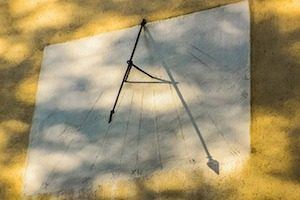
Image of sundial on an external wallBefore the second was defined in terms of the characteristics of the cesium atom, before leap seconds or leap days or Julian dates or the Gregorian calendar, before clocks, even before the sundial and the hourglass, there were sunrise, sunset, and shadows.

I’ve been thinking about timekeeping using shadows because a tulip tree in my backyard casts a shadow that traces a semicircle over the lawn on sunny days and moonlit nights, like the hand of a clock. The shadow is longest and most noticeable at this time of year, when the sun crosses the sky low in the south, and on summer nights around full moon. (The full moon crosses the sky low in the south in the summer, when the sun is riding high in the north.) However, I can see it year-round, given adequate sunlight or moonlight, although its appearance varies depending on the position of the sun or moon. I enjoy seeing this subtle demonstration of daily and seasonal cycles.

The gnomon on a sundial (the part that casts a shadow) was probably inspired by natural objects like this tree that cast useful shadows and roughly indicate the time of day. The first human-made gnomons were vertical poles or towers. For example, Egyptian obelisks, in addition to being tributes to gods or markers celebrating a ruler’s achievements, acted as gnomons, and their shadows marked the time of day for a city.

Sundials of various types were developed as these early timekeepers were refined by aligning the gnomon with Earth’s rotational axis and adding a dial that marks divisions in time. In addition, the natural or solar hours, which vary in length throughout the year if you’re not near the equator, were eventually replaced by hours of equal length. Thus was timekeeping made more useful but also distanced somewhat from its roots in solar time, particularly when clock time had to be coordinated across different regions and eventually across the globe. Read more »

Oh! What an Ugly War

by Thomas O’Dwyer

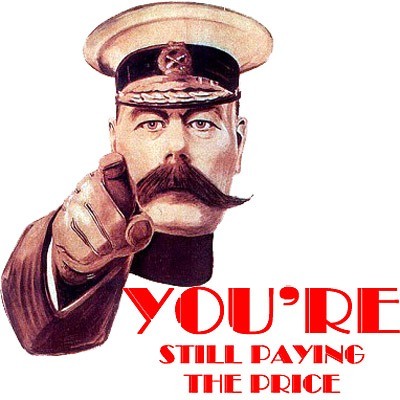
Kitchener poster

Now that the hundred years have passed, can we wrap up World War I, stick a label on it and dispatch it to the archives of dead history? Otherwise, it’s going to be with us forever. If you are old enough to remember the 1968 events for the 50th anniversary, then you’ve lived to see them happen all over again. The only difference this November has been the absence of interviews with living survivors – there are none left. Harry Patch, the last surviving man to have fought in the trenches at Passchendaele, died in Britain in 2009, aged 111. The last German veteran, Franz Künstler, died in 2008, aged 107. The last veteran from any country, Florence Green from England, who had been in the Women’s Royal Air Force, died in 2012, aged 110.

A notable British film came out around the 50th anniversary – Oh! What a Lovely War, directed by Richard Attenborough. It was a parade of stars – Maggie Smith, Dirk Bogarde, John Gielgud, John Mills, Kenneth More, Laurence Olivier, Jack Hawkins, and three Redgraves (Corin, Michael and Vanessa). They romped through two hours of popular songs parodying the war. It progressed from jingoistic optimism, through the stupidity of the generals and incomprehension of the soldiers, to a vast panorama of white crosses at the end. Attenborough nailed the pointless evil essence of the war (on the Western Front) with touching grandeur and sadness. In background shots, cricket scoreboards tallied the rising death toll in the “great game.”

Is it possible that in 100 years time the world will continue to stand in silence for the war dead on the 11th hour of the 11th day of the 11th month? Read more »

In Search of Big Dumb Objects

by Joshua Wilbur 

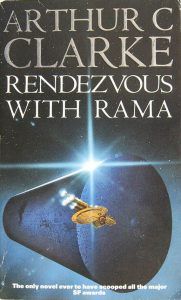
I first encountered a Big Dumb Object (“BDO”) in an underfunded school library in rural East Texas. Sitting cross-legged on the carpeted floor, I held a battered paperback just a few inches from my face, periodically turning it over to inspect the image on the book’s cover.

Rama.

I was twelve years old—“the real golden age of science-fiction”—and Arthur C. Clarke’s Rendezvous with Rama captivated my imagination. The novel’s premise is simple: an alien starship, a massive cylinder of unknown origin and construction, has entered the solar system, and a crew of scientists must investigate. Thin on plot (and even thinner on characterization), Rama lingers in my memory not for what’s hidden within the vessel but for what’s kindled from without, from the mere suggestion of a colossus come from the stars. It stirred in me what sci-fi critics have called the “sense of wonder,” a feeling of awe that courses through the heart of the genre.

Nothing better epitomizes this sense of wonder than “Big Dumb Objects,” a term coined by Roz Kaveney and lovingly adopted by fans of the science fiction genre. BDOs, as you’ll have guessed, are really big, dumb in the old sense of “mute, silent, refraining from speaking,” and usually serve as a focal point for narrative action. Mysterious thing is discovered; mysterious thing is explored. In a Weird Things column for The Guardian, Damien Walter defines the BDO:

“ … the Big Dumb Object (BDO) is a unique selling point of the sci-fi genre. It can be a broad term – usually, they’re alien architectures, ranging from the man-sized to the planetary. BDOs either look extreme or unusual, and can often do extreme or unusual things: everything from lurking on a horizon to creating worlds. Usually, BDOs are plonked into plots to awe us with their majesty and mystery – really, they’re science fiction’s equivalent of a MacGuffin.” Read more »

In-Gendered Empathy

by Max Sirak

Recently I embarked on an unexpected and enlightening adventure.

I went to Las Vegas with four of my oldest friends to see some music. The band, Phish, was playing for a four night run at the MGM Grand’s Garden Arena and we decided to meet up and attend. It also happened to be over Halloween.

For those unfamiliar, Phish is a four-piece band that owes its legacy to the Grateful Dead. Their fans are fiercely loyal and regularly tour with the band, traveling from location to location and seeing as many concerts as they can. This is because Phish shows are fun

They’re equal parts concert and carnival. Beach balls and balloons bounce around the room when the band plays. The fans are engaged. They dress up in costumes. They make signs in hopes of encouraging the group to play certain songs. At a peak musical moment, the crowd spontaneously begins throwing hundreds, if not thousands, of Glow Sticks around the venue. This is called a “Glow Stick War.”

The concerts are between three and four hours. There’s no opening act and always a set-break (intermission). The music is largely instrumental and is accompanied by one of the best light shows in the business.

In preparation for the trip, a group text emerged. There were all sorts of details to hash out. Flight times, hotel reservations, and Halloween costumes were all discussed. It was quickly decided we’d dress up differently for each evening. Read more »

Callous Doughboys Band

by Christopher Bacas

I stayed out late the night before I left for college, saying goodbye to friends whose future included institutions even more punitive than mine. My parents packed my belongings in two long, green army duffel bags purchased at “Sunny’s Surplus”, where you could buy Afro picks with folding handles, decommissioned grenades and a “knuckle knife”.

At Baltimore-Washington airport, I watched a young man carrying a black-leather trumpet case unload his luggage from a Rolls Royce. My parents thought he might be going to school with me. I doubted them. My throat burnt by cheap Mexican weed, trumpet kid looked as sullen as I felt. He boarded with me and we flew southwest. At Dallas-Fort Worth, we both headed to the baggage carousels, still avoiding eye contact. The area gradually cleared, leaving a cluster of freshman music students. A saxophonist unpacked a gleaming Yamaha alto and played scales with a windup, wooden metronome. He began them slowly and evenly, a proper music lesson, and ended each with a monsoon of notes whose velocity propelled his body backwards, a cephalopod in flight.

A few of us took out the letters promising shuttle bus service to our dorm in Denton. At the curb, unmarked vans pulled in, waited and left, sometimes without picking up passengers. They drove through a lattice of Texas sun and graphite shadow. It was one-hundred and fourteen degrees. Read more »

Sunday, November 25, 2018

Do You Have a Moral Duty to Leave Facebook?

S. Matthew Liao in the New York Times:

I joined Facebook in 2008, and for the most part, I have benefited from being on it. Lately, however, I have wondered whether I should delete my Facebook account. As a philosopher with a special interest in ethics, I am using “should” in the moral sense. That is, in light of recent events implicating Facebook in objectionable behavior, is there a duty to leave it?

In moral philosophy, it is common to draw a distinction between duties to oneself and duties to others. From a self-regarding perspective, there are numerous reasons one might have a duty to leave Facebook. For one thing, Facebook can be time-consuming and addictive, to no fruitful end. In addition, as researchers have demonstrated, Facebook use can worsen depression and anxiety. Someone who finds himself mindlessly and compulsively scrolling through Facebook, or who is constantly comparing himself unfavorably with his Facebook friends, might therefore have a duty of self-care to get off Facebook.

From the perspective of one’s duties to others, the possibility of a duty to leave Facebook arises once one recognizes that Facebook has played a significant role in undermining democratic values around the world.

More here.  [Thanks to Sean Carroll who left Facebook today and cited this article in his farewell note.]

Despite vast increases in the time and money spent on research, progress is barely keeping pace with the past. What went wrong?

Patrick Collison and Michael Nielsen in The Atlantic:

It’s surprisingly difficult to measure scientific progress in meaningful ways. Part of the trouble is that it’s hard to accurately evaluate how important any given scientific discovery is.

Consider the early experiments on what we now call electricity. Many of these experiments seemed strange at the time. In one such experiment, scientists noticed that after rubbing amber on a cat’s fur, the amber would mysteriously attract objects such as feathers, for no apparent reason. In another experiment, a scientist noticed that a frog’s leg would unexpectedly twitch when touched by a metal scalpel.

Even to the scientists doing these experiments, it wasn’t obvious whether they were unimportant curiosities or a path to something deeper. Today, with the benefit of more than a century of hindsight, they look like epochal experiments, early hints of a new fundamental force of nature.

More here.

Matt Taibbi: Why You Should Care About the Julian Assange Case

Matt Taibbi in Rolling Stone:

If you hate Assange because of his role in the 2016 race, please take a deep breath and consider what a criminal charge that does not involve the 2016 election might mean. An Assange prosecution could give the Trump presidency broad new powers to put Trump’s media “enemies” in jail, instead of just yanking a credential or two. The Jim Acosta business is a minor flap in comparison.
Although Assange may not be a traditional journalist in terms of motive, what he does is essentially indistinguishable from what news agencies do, and what happens to him will profoundly impact journalism.

Reporters regularly publish stolen, hacked and illegally-obtained material. A case that defined such behavior as criminal conspiracy would be devastating. It would have every reporter in the country ripping national security sources out of their rolodexes and tossing them in the trash.

More here.

The Autocracy App

Jacob Weisberg in the New York Review of Books:

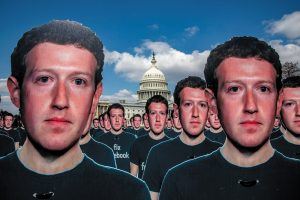
Cardboard cutouts of Mark Zuckerberg placed outside the Capitol to protest the spread of disinformation on Facebook, Washington, D.C., April 2018

Facebook is a company that has lost control—not of its business, which has suffered remarkably little from its series of unfortunate events since the 2016 election, but of its consequences. Its old slogan, “Move fast and break things,” was changed a few years ago to the less memorable “Move fast with stable infra.” Around the world, however, Facebook continues to break many things indeed.

In Myanmar, hatred whipped up on Facebook Messenger has driven ethnic cleansing of the Rohingya. In India, false child abduction rumors on Facebook’s WhatsApp service have incited mobs to lynch innocent victims. In the Philippines, Turkey, and other receding democracies, gangs of “patriotic trolls” use Facebook to spread disinformation and terrorize opponents. And in the United States, the platform’s advertising tools remain conduits for subterranean propaganda.

Mark Zuckerberg now spends much of his time apologizing for data breaches, privacy violations, and the manipulation of Facebook users by Russian spies. This is not how it was supposed to be. A decade ago, Zuckerberg and the company’s chief operating officer, Sheryl Sandberg, championed Facebook as an agent of free expression, protest, and positive political change. To drive progress, Zuckerberg always argued, societies would have to get over their hang-ups about privacy, which he described as a dated concept and no longer the social norm.

More here.

Rob Reich on “Is philanthropy bad for democracy?”

From Julia Galef’s Rationally Speaking:

This episode features political scientist Rob Reich, author of “Just Giving: Why Philanthropy is Failing Democracy, and How it Can Do Better”. Rob and Julia debate his criticisms of philanthropy: Does it deserve to be tax-deductible? Is it a violation of the autonomy of recipients to attach strings to their charitable gifts? And do philanthropists have too much power in society?
More here.

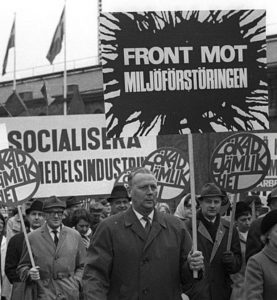
In the 1970s, the Swedish labor movement developed a plan to gradually socialize ownership. What can we learn from it today?

Peter Gowan and Mio Tastas Viktorsson in Jacobin:

Confronting the power of capital in the United States will require a plan.

We may be confident that the concentration of capital in the hands of a tiny minority represents both the primary obstacle to economic equality and one of the most fundamental threats to democracy in America, but without a concrete agenda capable of securing control over capital for the people, we will never succeed in overcoming these problems.

The potential benefits of public control over the 30 percent of the national income which flows to capital are immense: a society which can provide a level of comfort, security, and freedom currently unknown by most, a massive reduction in racial and gender wealth gaps, and a healthier democracy.

As such, the question of how to secure control of capital for the people must be engaged seriously, honestly, and by drawing upon the lessons of others who have tried to do so before.

More here.