Vienna-Hating Viennese

Matt Levin at The Paris Review:
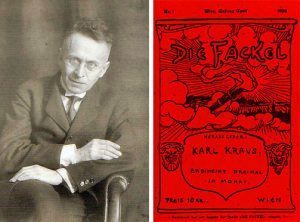
Vienna as a bourgeois, democratic city was never a stable entity. The liberal bourgeoisie came to municipal power in Vienna in the 1860s, yet the authority of the monarchy and aristocracy persisted, though in a weakened form, and, unlike the partial integration of the bourgeoisie into the social world of the British and French aristocracy, it kept its doors barred to the newcomers. And almost as soon as the liberals gained a foothold, a third element asserted itself, a gathering din of nationalist agitations from the patchwork of ethnicities that constituted the Habsburg Empire, each growing restless in the dilapidating imperium. The Liberals, never fully in control, saw their influence hedged and threatened almost immediately.

By 1895, the populist, nationalist, and viciously anti-Semitic politician Karl Lueger had been elected mayor of Vienna, and liberals cheered as Emperor Franz Joseph undemocratically canceled the election. Nevertheless, Lueger was elected again and finally seated in 1897, canceling any hope of liberalizing even their own home, let alone the empire.

more here.

The Rise of Early London

Philip Parker at Literary Review:

Anglo-Saxon London suffers from an image problem, or more precisely from the problem that we have no image of it at all. In contrast to the showy glamour of Roman Britain, with its amphitheatres, temples and abundance of literature, or the vibrant cultural melting pot of the Tudor era, the Anglo-Saxon metropolis has almost no remaining visible architecture, a dearth of written sources and a patchy archaeological presence.

It is an arena from which historians have, perhaps wisely, shied away, but Rory Naismith’s Citadel of the Saxons manages to turn the slim pickings of the surviving evidence into something like a consistent narrative of the early days of London. It is a fascinating account of a period when it was more an overgrown village than a global city (or even a national capital).

more here.

Thursday Poem

Heaven on Earth

No one knows anything of it, except its name,
as if things exist only in utterance.
Skin devours pulp
and dust is another name for naught.

And this is not the worse of man’s wretchedness:
He descends into the vessel of You and is You.
and rises as the mist “I am
at your beck and call, O Lord.
Your beck and call!”

And here you are, Jerusalem, Al-Quds,
skating on the ice of meaning.
The sky houses her djinn and ifrits in you
to guard the oceans of language.

(Silence)

Adonis
from Kunshirtu ‘l-Quds
publisher: Dâr al-Adâb, Beirut, 2012

Translation: 2013, Khaled Mattawa
First published on Poetry International, 2013

Wednesday, December 26, 2018

One Giant Step for a Chess-Playing Machine

Steven Strogatz in the NYT:

The question now is whether machine learning can help humans discover similar truths about the things we really care about: the great unsolved problems of science and medicine, such as cancer and consciousness; the riddles of the immune system, the mysteries of the genome.

The early signs are encouraging. Last August, two articles in Nature Medicine explored how machine learning could be applied to medical diagnosis. In one, researchers at DeepMind teamed up with clinicians at Moorfields Eye Hospital in London to develop a deep-learning algorithm that could classify a wide range of retinal pathologies as accurately as human experts can. (Ophthalmology suffers from a severe shortage of experts who can interpret the millions of diagnostic eye scans performed each year; artificially intelligent assistants could help enormously.)

The other article concerned a machine-learning algorithm that decides whether a CT scan of an emergency-room patient shows signs of a stroke, an intracranial hemorrhage or other critical neurological event. For stroke victims, every minute matters; the longer treatment is delayed, the worse the outcome tends to be. (Neurologists have a grim saying: “Time is brain.”) The new algorithm flagged these and other critical events with an accuracy comparable to human experts — but it did so 150 times faster. A faster diagnostician could allow the most urgent cases to be triaged sooner, with review by a human radiologist.

What is frustrating about machine learning, however, is that the algorithms can’t articulate what they’re thinking.

More here.

Two Roads for the New French Right

National Front leader Jean-Marie Le Pen with his granddaughter Marion in a campaign poster, 1992

Mark Lilla in the NY Review of Books:

Whatever one thinks of these conservative ideas about society and the economy, they form a coherent worldview. The same cannot really be said about the establishment left and right in Europe today. The left opposes the uncontrolled fluidity of the global economy and wants to rein it in on behalf of workers, while it celebrates immigration, multiculturalism, and fluid gender roles that large numbers of workers reject. The establishment right reverses those positions, denouncing the free circulation of people for destabilizing society, while promoting the free circulation of capital, which does exactly that. These French conservatives criticize uncontrolled fluidity in both its neoliberal and cosmopolitan forms.

But what exactly do they propose instead? Like Marxists in the past who were vague about what communism would actually entail, they seem less concerned with defining the order they have in mind than with working to establish it. Though they are only a small group with no popular following, they are already asking themselves grand strategic questions. (The point of little magazines is to think big in them.) Could one restore organic connections between individuals and families, families and nations, nations and civilization? If so, how? Through direct political action? By seeking political power directly? Or by finding a way to slowly transform Western culture from within, as a prelude to establishing a new politics? Most of these writers think they need to change minds first. That is why they can’t seem to get through an article, or even a meal, without mentioning Antonio Gramsci.

More here.

Actually Existing Cosmopolitanism

Jeffrey J. Williams interviews Bruce Robbins over at the LA Review of Books:

JEFFREY J. WILLIAMS: Your new book, The Beneficiary, looks at an uncomfortable side of cosmopolitanism, underscoring that though we might criticize capitalism, we’re beneficiaries of it too. It’s a bookend to your last book,Perpetual War, which looks at globalization from the standpoint of the victims, instead of looking from the standpoint of those who benefit. Can you talk about that more?

BRUCE ROBBINS: As cosmopolitanism has caught on, a lot of people have decided that it is a banner they can march behind. I’ve of course been pleased, but also a little uneasy because the version of cosmopolitanism is sometimes not strenuous enough. It’s something that people can claim on the cheap. I have always been haunted by the ancient Greek normative sense that your cosmopolitan commitment has to prove itself in difficult moments, when the power of your community is being usurped and you’re being asked to go along with it, so it’s not always so easy or convenient.

Perpetual War was a moment when I said, if you’re not willing to detach yourself from your nation when it is making a war that you consider unjust, then you really can’t use the word cosmopolitanism appropriately. It’s not going to be comfortable to say I am detaching myself from my community when that community is sending men and women into harm’s way in a foreign place. People may spit on you, or worse. We don’t want to forget the more strenuous version of cosmopolitanism that involves detachment from military adventurism or war.

But at some point I realized it’s not just military entanglement that would define that more strenuous version of cosmopolitanism; it’s also the question of the economic well-being of people who are far away from you and belong to other countries.

More here.

‘Gilets jaunes’: a rather unusual coalition

Honfleur, le 17 novembre 2018, mouvement des gilets jaunes bloquants le Pont de Normandie et ses accès. © Nicolas Cleuet / Hans Lucas

Lionel Venturini interviews Stefano Palombari over at the Verso Blog:

Lionel Venturini: The ‘gilets jaunes’ are a heterogeneous movement. How do you explain why this hasn’t broken up?

Stefano Palombari: The IFOP survey on the backing for the ‘gilets jaunes’ shows three categories that are most supportive of the movement: employees (63%), manual workers (59%) and self-employed (62%, including small businesspeople, shopkeepers and tradespeople). This social coalition is quite new in France. What is striking about the list of demands given to the media is that all are addressed to the government, not to employers. The only wage demand is for the minimum wage, which is set by the government, to be increased to 1,300 euros – 150 euros more than today, which is very reasonable. When it comes to purchasing power, the key demand is for taxes to be cut. It is precisely the absence of traditional wage demands that has permitted a unified movement, combining categories that would otherwise not agree among themselves.

LV: This recalls the beginnings of the Five Star Movement in Italy, which is now in power in coalition with the far right.

SP: The Five Star Movement had a base that included self-employed and employees: the price paid to build this social alliance was that the wage relationship was no longer questioned. In their demands, the ‘gilets jaunes’ also do not call for Macron’s labour laws and decrees to be repealed: is this a sign? It is too early to be certain, but there is a risk that the neoliberal nature of the wage relationship will no longer be challenged. In Italy, the League/Five Star Government has not challenged Matteo Renzi’s Jobs Act, which is very similar to the El Khomri law in France.

More here.

Quine’s Naturalism

Richard Marshall interviews Sander Verhaegh in 3:AM Magazine:

Quine has always identified himself as a member of an international movement of empiricist  philosophers. In 1932, just after he obtained his Ph.D., Quine spent a year in Europe to learn from what he regarded to be the leading ‘scientific philosophers’: Schlick’s circle in Vienna, Carnap in Prague, and the Polish logicians in Warsaw. Later, he helped many of these philosophers to get a position in the US, and played a role in the Unity of Science Movement. Many of these ‘scientific philosophers’ dismissed the traditional philosophers’ foundationalist projects and sought to reconceive philosophy as a scientific enterprise. Carnap, for instance, argued that philosophy should become a “properly scientific field, where all work is done according to strict scientific methods and not by means of ‘higher’ or ‘deeper’ insights”. Philosophers, Carnap believed, should study the logic ofscience.

Some of the documents I found in the archives show that Quine’s first meetings with Carnap had a tremendous impact on his metaphilosophical development. In a report to the people who funded his fellowship, for example, Quine writes that Carnap helped him to find “the most satisfactory answer” to the “perplexing question of the nature of philosophy”. Because much of the historiography of twentieth-century analytic philosophy is focused on the Carnap-Quine debate, people tend to forget that the two basically shared the same perspective on philosophy. I believe it is historically more accurate to claim that Carnap and Quine, in their discussions about analyticity, ontology, and the nature of logic and mathematics, were only disagreeing about the details. As Gary Ebbs has recently argued, Quine was just trying to be “more Carnapian than Carnap”; he was trying to improve the empiricist tradition from within.

More here.

What is Trump

Dylan Riler in the New Left Review:

Debates around the politics of Trump and other new-right leaders have led to an explosion of historical analogizing, with the experience of the 1930s looming large. According to much of this commentary, Trump—not to mention Orbán, Kaczynski, Modi, Duterte, Erdoğan—is an authoritarian figure justifiably compared to those of the fascist era. The proponents of this view span the political spectrum, from neoconservative right and liberal mainstream to anarchist insurrectionary. The typical rhetorical device they deploy is to advance and protect the identification of Trump with fascism by way of nominal disclaimers of it. Thus for Timothy Snyder, a Cold War liberal, ‘There are differences’—yet: ‘Trump has made his debt to fascism clear from the beginning. From his initial linkage of immigrants to sexual violence to his continued identification of journalists as “enemies” . . . he has given us every clue we need.’ For Snyder’s Yale colleague, Jason Stanley, ‘I’m not arguing that Trump is a fascist leader, in the sense that he’s ruling as a fascist’—but: ‘as far as his rhetorical strategy goes, it’s very fascist.’ For their fellow liberal Richard Evans, at Cambridge: ‘It’s not the same’—however: ‘Trump is a 21st-century would-be dictator who uses the unprecedented power of social media and the Internet to spread conspiracy theories’—‘worryingly reminiscent of the fascists of the 1920s and 1930s.’

From the right, former Republican adviser Max Boot insists: ‘To be clear, I am in no way suggesting there’s any analogy between Trump and Hitler’—however: ‘Trump is a fascist. And that’s not a term I use loosely or often.’ For the liberal neo-con Robert Kagan, ‘This is how fascism comes to America, not with jackboots and salutes’—but ‘with a television huckster, a phony billionaire, a textbook egomaniac “tapping into” popular resentments and insecurities.’ On the left, eco-Marxist John Bellamy Foster agrees that there are ‘historically distinct features’—yet Trump is nevertheless a systematic ‘neofascist’ who, like his interwar forebears, aims at ‘the repression of the workforce’. Queer theorist Judith Butler acknowledges, ‘With Trump, we have a different situation’—but ‘one which I would still call fascist.’ For social democrat Geoffrey Eley, ‘It makes no sense to draw direct equivalences’—nevertheless: ‘we have the kind of crisis that can enable a politics that looks like fascism to coalesce. And this is where Trump has prospered.’ For anarcho-syndicalist Mark Bray, ‘No, I wouldn’t say that Trump is a fascist’—although, ‘he has displayed quite a few fascistic qualities . . . Trump was enabled by fascism (among other things) and in turn enabled fascism.’

More here.

Why Exaggeration Jokes Work

James Geary in The Atlantic:

Everything is formed by habit. The crow’s feet that come from squinting or laughter, the crease in a treasured and oft-opened letter, the ruts worn in a path frequently traveled—all are created by repeatedly performing the same action. Even neurons are formed by habit. When continuously exposed to a fixed stimulus, neurons become steadily less sensitive to that stimulus—until they eventually stop responding to it altogether. Anything that’s habitually encountered—the landscape of a daily commute, storefronts passed on a walk to the bus stop, photographs arranged on a mantelpiece—tends toward invisibility. The more we see a thing, the less we see it. Familiarity breeds neglect. Once perception settles into a comfortable pattern, we fall asleep to it. Only when the pattern is broken do we notice there is a pattern at all. The chains of mental habit are too weak to be felt until they are too strong to be broken, to paraphrase Samuel Johnson. Wit, whether visual or verbal, can make the commonplace uncommon again by breaking the habits that render perception routine. We tend to define the quality of wit as merely being deft with a clever comeback. But true wit is richer, cannier, more riddling. And the best of it is often based on a biological phenomenon called supernormal stimuli.
…Supernormal stimuli are key to certain kinds of wit, too, deliberately skewing or exaggerating our usual patterns of perception. The great silent comic Buster Keaton is a case in point. In The High Sign (1921), as Keaton settles down on a bench to read his local daily, he unfolds the paper to standard broadsheet format. He soon notices, though, that the newspaper is bigger than he expected, so he continues unfolding it—first to roughly the surface area of an ample picnic blanket, then easily to the proportions of a king-size bedsheet, until he’s finally engulfed by a single gigantic swath of newsprint.

More here.


Egypt and Pakistan had highest rise in research output in 2018

Anita Makri in Nature:

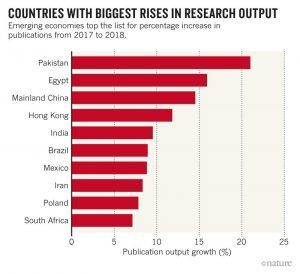
Emerging economies showed some of the largest increases in research output in 2018, according to estimates from the publishing-services company Clarivate Analytics. Egypt and Pakistan topped the list in percentage terms, with rises of 21% and 15.9%, respectively. China’s publications rose by about 15%, and India, Brazil, Mexico and Iran all saw their output grow by more than 8% compared with 2017 (See ‘Countries with biggest rises in research output’). Globally, research output rose by around 5% in 2018, to an estimated 1,620,731 papers listed in a vast science-citation database Web of Science, the highest ever (see ‘Research output rose again in 2018’). This diversification of players in science is a phenomenal success, says Caroline Wagner, a science and technology policy analyst at Ohio State University, and a former adviser to the US government. “In 1980, only 5 countries did 90% of all science — the United States, the United Kingdom, France, Germany and Japan,” she says. “Now there are 20 countries within the top producing group.”

…It’s not yet clear what has driven the strong gains by Egypt and Pakistan. One reason could be that both countries started from a low base — near the bottom of the list of top 40 countries in overall numbers of papers, says Robert Tijssen, head of science and innovation studies at Leiden University in the Netherlands. The figures might also reflect changes in how the database is curated, which has added more local or national journals to the mix. But some geographical regions, notably in Africa, are still under-represented, says Tijssen. Increases in funding and international collaborations might also have boosted the rise in publications in Egypt and Pakistan, say Tijssen and Wagner.

More here.

Tuesday, December 25, 2018

ALFONSO CUARÓN’S “ROMA” IS THE UNAWARE “GET OUT” OF LATIN AMERICA’S INDIGENOUS PEOPLE AND ITS WORKING POOR

Pablo Calvi in The Believer:

In the warmer sections of the Tibetan Plateau and some tropical Asian forests, the Cordycepsa type of fungus—grows and survives in a very unusual way. In the winter, its spores lodge into the bodies of an insect host, spreading into its digestive tract and later its head. As the spores mature, they take control of the infected body and begin re-modulating its brain activity. By the spring, when the fungus has reached maturity, the hosting body is all but a shell, obedient, docile, inert, available as a food supply, fully colonized.

The slowness of the process belies its violence. By snatching the body first, then altering its vital functions, its perception of the world, the fungus turns the host into a mere receptacle for the younger spores which will then spread and disseminate in their turn. Violent as it may be, however, the cycle is somewhat painless. It realizes itself by keeping the host alive, plunging it into disorientation and confusion and, ultimately, a slow erasure.

Early on in his life, Mexican film director Alfonso Cuarón wanted to become a pilot or an astronaut. In more ways than one, he has succeeded with his latest project, Roma. In the film, produced by Netflix with limited theatrical release, Cuarón becomes the pilot of his former nanny’s gaze. The quasi-autobiography of the director’s childhood during the year his father left the family is rendered through the eyes of Cleo, a teenage Mixtec woman charged with the children’s care. Cleo’s character is based on Liboria “Libo” Rodríguez, an indigenous woman who in 1962, at 17 or 18 years of age, joined the Cuarón family as a full-time nanny. The “Roma” of the title is a reference to “Colonia Roma,” the upper-class Mexico City neighborhood where Cuarón’s family lived during the sixties and seventies.

More here.

Bernard Williams: Ethics from a human point of view

Portrait of Professor Bernard Williams, Chairman of the Obscenity and Film Censorship Committee, September 6th 1977. (Photo by Roger Jackson/Central Press/Getty Images)

Paul Russell in the TLS:

When Bernard Williams died in June 2003, the obituary in The Timessaid that “he will be remembered as the most brilliant and most important British moral philosopher of his time”. It goes on to make clear that Williams was far from the dry, awkward, detached academic philosopher of caricature.

Born in Essex in 1929, Williams had an extraordinary and, in some respects, glamorous life. He not only enjoyed a stellar academic career – holding a series of distinguished posts at Oxford, UCL, Cambridge and Berkeley – but was also a public figure in British political and cultural life. He played, for example, a leading role in several high profile government committees and reports, and served for almost two decades on the board of the English National Opera. He had, moreover, an easy confidence and charm, a lucidity of expression, and a sharp and, at times, acerbic wit (which could alarm both friends and foes alike).

Although these achievements and qualities are impressive, what he will be remembered for chiefly is his significant contribution to philosophy, which spanned a wide spectrum of topics. It is in the field of ethics, in particular, that his contributions are of the most lasting importance. And yet there is a real sense in which he remains a rather enigmatic figure – and the interpretation of his work continues to be a matter of considerable debate.

More here.

Democracy and Truth: A Short History by Sophia Rosenfeld review – the roots of our current predicament

Fara Dabhoiwala in The Guardian:

In her short, sharp book, the historian Sophia Rosenfeld takes a longer and deeper view. Her argument is that, ever since its origins in the late 18th century, modern democracy has had a peculiar relationship to truth: the current crisis merely epitomises that. We shouldn’t focus only on external causes, for our system of government carries within it the seeds of its own destruction. As in her previous work on the twisted history of democratic political rhetoric, it’s a simultaneously reassuring and unsettling message.

The essential problem, as Rosenfeld sees it, is that democratic government is predicated on an aspiration to collective truth. Unlike older systems of aristocratic and monarchical rule, which excluded the people from power and stressed the need for administrative secrecy, the new republics of the late 18th century, and the more egalitarian mass democracies that succeeded them, depended on openness and trust between citizens and rulers. Through the free discussion and united wisdom of the educated and the masses, errors would be dispelled, “public knowledge” established and societies advanced. And yet, she points out, the reality has never lived up to this powerful ideal. From the outset, democratic societies contained vast inequalities of power and education, and their media have always been driven by commercial and partisan imperatives. In practice, instead of a free civil marketplace of ideas, politics has always been a vicious fight over the truth and the power of determining it.

More here.

All That Was Solid

An interview with Adam Tooze in Jacobin:

[I]f you think of the European Coal and Steel Community as the original kernel of the European integration project [in 1951], the whole project was to say, “We’ve got this tightly interconnected economic sector that has powerful geopolitical and broader historical implications, so we have to neutralize it. And the way we’re going to neutralize it is this mechanism.”

They did that with agriculture as well, in the early 1960s. They said, “Peasants are a big chunk of our population, a key part of this historical transformation, and politically potentially really lethal, and so as we stabilize, let’s have this Common Agricultural Policy.”

It’s really telling to me that before the 2008 crisis the Europeans were unable politically to draw on that and say, “Right, we’re building this tightly interconnected economic sector — finance. It has potentially explosive implications for the eurozone project. Clearly, we need to have a banking union, and we need to have it straight away and right from the beginning.”

More here.

How Liberalism Failed

Sheri Berman in Dissent:

A massive amount of ink has already been spilled trying to figure out what has gone wrong, but two narratives can be plucked from the confusion. The first focuses on economic change. Over the past few decades growth has slowed, inequality has risen, and social mobility has declined, particularly in the United States. This has made life more insecure for the working and middle classes by privileging highly educated and urban dwellers over less-educated and rural ones, and spreading economic risk, fear of the future, and social divisions throughout Western societies. The second narrative focuses on social change. During this same period, traditional norms and attitudes about religion, sexuality, family life, and more have been challenged by the emergence of feminist, LGBTI, and other social movements. Meanwhile, massive immigration and (especially in the United States) the mobilization of hitherto oppressed minority groups like African Americans has disrupted existing status and political hierarchies, making many white citizens in particular uncomfortable, resentful, and angry.

Most analysis stops here, at viewing economic or social change or some combination of the two as leading inevitably to dissatisfaction with liberal democracy and a readiness to embrace populist, illiberal, or even undemocratic alternatives. The issue, of course, is that social, economic, and technological change alone are not the problem—they only become so if politicians and governments don’t help citizens adjust to them. If we want, therefore, to understand liberal democracy’s current problems, we need to examine not only such changes, but also how elites and governments have responded to them.

More here.

To understand Trump’s America, read John Steinbeck

Daniel Rey in New Statesman:

His book is a lie, a black, infernal creation of a twisted, distorted mind.” It was a Democratic representative from Oklahoma who gave this verdict of The Grapes of Wrath, John Steinbeck’s chronicle of migrants leaving the Dust Bowl for California. Disdained by the political elite and much of the literary set, it was nonetheless the best-selling book of 1939. Today’s parallels with the 1930s give Steinbeck’s work renewed urgency. He writes about farm labourers, shopkeepers and the denizens of village taverns – the kinds of people who, before the enormous political upheaval of 2016, the chattering classes barely remembered. In the age of Trump, mass-migration and the phenomenon of the ‘left behind’, Steinbeck’s work is just as relevant as when he wrote it. But more than that: reading Steinbeck fifty years after his death is the perfect antidote to the culture war that has gripped America.

As in the 1930s, machinery – today it’s automation – threaten traditional livelihoods and ways of life in the United States. The Rust Belt is today’s version of the Dust Bowl of the Depression. “One man on a tractor can take the place of twelve or fourteen families,” representatives of city-based corporations explain to the tenant families working the Oklahoma land in The Grapes of Wrath. Unconcerned by the fabric of local communities, the agents suggest the families abandon their homes. “Why don’t you go west to California? … You can reach out anywhere and pick an orange,” they advise, incentivising migration, like the local authorities today who pack homeless people on buses and send them to other American cities.

More here.